






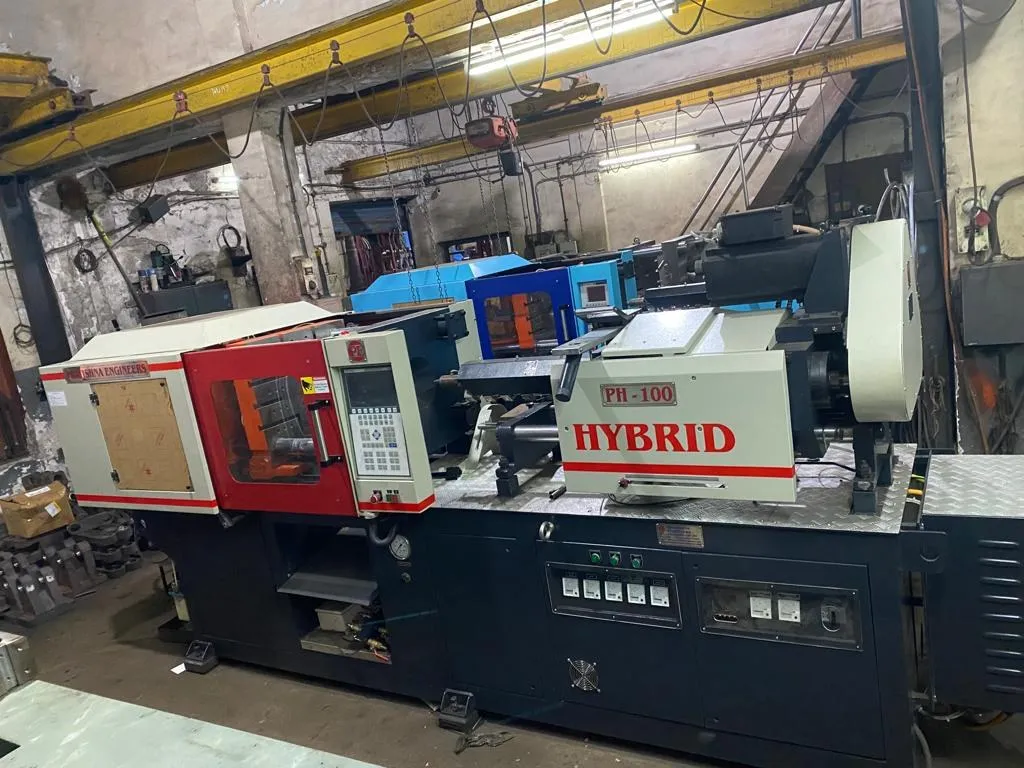

Before buying, check these hybrid injection machine specifications against your part, in this order. Each line compares a machine figure with a number you can work out from the part and mould.
Pre-purchase checklist for a hybrid machine
| Specification | Compare it with |
|---|---|
| Clamp force | Projected area times cavities times tonnage factor, plus a reserve |
| Shot capacity (g PS) and screw diameter | Your shot volume, kept between 20% and 65% of barrel capacity |
| Injection pressure at each screw | The pressure your mould and material need |
| Injection speed and rate | Fill time for thin walls and multi-cavity moulds |
| Tie-bar space and platen size | Mould width and height |
| Mould height range, stroke and daylight | Mould thickness, and 2.5 times part height to eject |
| Ejector stroke and pattern | The ejector layout of your mould |
| Connected load and heater power | Your sanctioned demand and tariff |
Hybrid-specific items, such as how injection pressure is measured and how the ball screw is lubricated, come after these basics. A machine that fails the clamp, shot or mould-fit check is the wrong machine, however good its drive.
Key Takeaways
- Size the clamp from projected area and a tonnage factor; 3 US tons/in² is a common starting point.
- Keep the shot between 20% and 65% of barrel capacity, and work in volume, not grams.
- On one injection unit, a smaller screw gives more pressure and less shot volume, by the square of the diameter ratio.
- Check mould fit and opening stroke on paper before the machine arrives.
Which hybrid injection machine specifications decide clamp and mould fit?
Clamp force, tie-bar space, mould height range and opening stroke. Clamp force must cover the projected area of all cavities and any cold runner at the material's tonnage factor. The mould must fit between the tie bars, and the opening must be long enough to release the part.
The method set out in Plastics Technology by J. Williams of RJG is a good start: take the projected area of one part minus through holes, multiply by cavities, add the full cold-runner area, then multiply by a tonnage factor. Typical factors run from 2 to 10 US tons/in², with 3 recommended as a starting point, about 0.422 t/cm². Then add a reserve, such as 10%, which is a starting margin, not a rule.
For mould fit, B. Catoen in MoldMaking Technology advises that the mould should ideally fit within the tie bars, and at minimum the projected area of the parts must sit inside them. Opening stroke should be at least 2.5 times the part height. On a toggle clamp the full stroke is available at every mould height. On a piston clamp, maximum daylight equals minimum mould height plus maximum stroke, so a taller mould leaves less opening.
How do you read shot size, screw options and pressure?
Shot capacity is listed in grams of polystyrene, so convert your shot to volume first. Then choose a screw whose capacity your shot uses at 20% to 65%. Where two screw sizes are offered on one unit, the smaller one gives higher pressure and the larger one more volume.
J. Bozzelli's method in Plastics Technology uses melt densities of 0.945 g/cm³ for PS and about 0.74 g/cm³ for PP, adds 10% for check valve leakage and melt uniformity, and sizes the barrel so the shot is at most 65% of it. Below about 20%, residence time grows and the melt can degrade.
On one injection unit, pressure scales with one over the screw diameter squared and swept volume with the diameter squared. Moving from a 40 mm to a 45 mm screw raises volume by 27% and cuts available pressure to 79%. Ask for the pressure at the screw you will run. The ball screw article in this series covers how that pressure is produced and read.
Which injection speed and control figures matter for precision work?
Injection speed in mm/s, injection rate in cm³/s, and how finely the controller can set and monitor speed, transfer position, holding pressure and cushion. Speed alone means little until you multiply it by the screw area, because that product is the melt volume entering the mould each second.
For example, 150 mm/s on a 40 mm screw is 15 cm/s × 12.57 cm², or about 188 cm³/s, so a 60 cm³ shot fills in about a third of a second if the speed can be held. On the control side, ask whether the screen logs actual values every shot and whether you can set alarm limits on cushion, fill time and peak pressure. Those limits catch drift before rejects reach the packing table.
What should you check on power, controls and service?
Check the total connected load and heater power against your sanctioned demand, how the controller shows actual speed, position and pressure every shot, how the ball screw is lubricated, and who can service both the servo and hydraulic sides close to your plant.
Power factor shows up on the bill as well. Under MSEDCL's kVAh billing, demand is charged on kVA and energy on kVAh, and its FAQ notes that at a power factor of 0.85, 15% of the power does no useful work. At 0.85, 100 kWh of work is billed as about 117.6 kVAh; at 0.95, about 105.3 kVAh. Ask for the machine's power factor and plan capacitors or an APFC panel where needed.
Our flat opinion: do not buy on the shot weight figure alone. Buy on the injection pressure at the screw you will run, because a large barrel with too little pressure leaves you short on thin walls and long flow paths.
What should you send before asking for a quotation?
Send the part drawing or 3D model, material grade, cavities, runner type, mould dimensions, part weight, wall thickness and target output. With those, the clamp, shot and mould-fit checks above can be done before any model is discussed. Compare options on the hybrid injection moulding machine page.
Frequently Asked Questions About Hybrid Machine Specifications
Why are shot capacities quoted in grams of polystyrene?
It is a convention that lets buyers compare machines, but your material has a different melt density. PP melt is lighter than PS melt, so the same barrel holds fewer grams of PP. Convert your shot to cubic centimetres of melt and compare volumes, not grams, before you choose a screw.
What is daylight on an injection moulding machine?
Daylight is the largest distance between the platens with the clamp fully open. Subtract the mould height to get the usable opening for ejecting the part. On a piston clamp the usable opening falls as the mould gets taller, so check it with the tallest mould you plan to run.
How much clamp reserve should I keep?
A 10% reserve over the calculated tonnage is a common starting margin, not a rule. Too little risks flash; far too much can crush vents, cause burns and damage the mould. Plastics Technology describes a cavity block that split when a mould needing about 100 tons was clamped at 400 tons.
Should I order a second screw and barrel?
Consider it if you run very different shot sizes or materials. Bozzelli notes that a second barrel ordered with a new machine can be low cost, and that a skilled operator can swap one in under 30 minutes. It lets one machine cover both high-pressure thin-wall work and larger shots.
What does total connected load tell me?
It is the sum of the motor and heater ratings, the most the machine could draw at once. Average draw while moulding is lower. Use connected load to size cables, breakers and sanctioned demand, and a measured average draw for energy cost. Ask the supplier for both figures before you compare machines.
Related Articles
- What Is a Hybrid Injection Moulding Machine?
- How Does Servo-Electric Injection With a Ball Screw Work?
- Hybrid vs Hydraulic vs All-Electric Injection Moulding Machines
- Applications of Hybrid Injection Moulding Machines
Sources & References
- Plastics Technology, J. Williams (RJG): Clamp Tonnage: More Is Better...Right? (May 2017)
- Plastics Technology, J. Bozzelli: A Simpler Way to Calculate Shot Size vs. Barrel Capacity (2017, updated 2022)
- MoldMaking Technology, B. Catoen: Machine Sizing and Specification for Optimal Mold Performance, Part 1 (Aug 2025)
- MSEDCL: kVAh Billing: Frequently Asked Questions
Technical Disclaimer
Disclaimer: The information provided in this document is for general informational and educational purposes only. It is based on technical references and industry information available at the time of preparation and may be subject to change. It does not constitute engineering, technical, commercial or professional advice, nor does it constitute a quotation, specification, warranty or contractual commitment by Pratishna Engineers.
Actual injection moulding machine and process requirements vary according to the component design, material, mould, production volume, machine configuration and operating conditions. The information, examples, calculations and recommendations provided should be independently evaluated and verified for the specific application before making any equipment, process or production decision. Information obtained from third-party sources remains subject to the accuracy and limitations of those sources.
Limitation of Liability: Pratishna Engineers makes no representation or warranty, express or implied, regarding the completeness, accuracy or suitability of the information for any particular application. To the extent permitted by applicable law, Pratishna Engineers shall not be liable for any loss, damage, cost or consequence arising from reliance on or use of the information contained in this document. Final machine selection, configuration and application suitability should be confirmed with Pratishna Engineers based on complete and accurate project requirements.

