






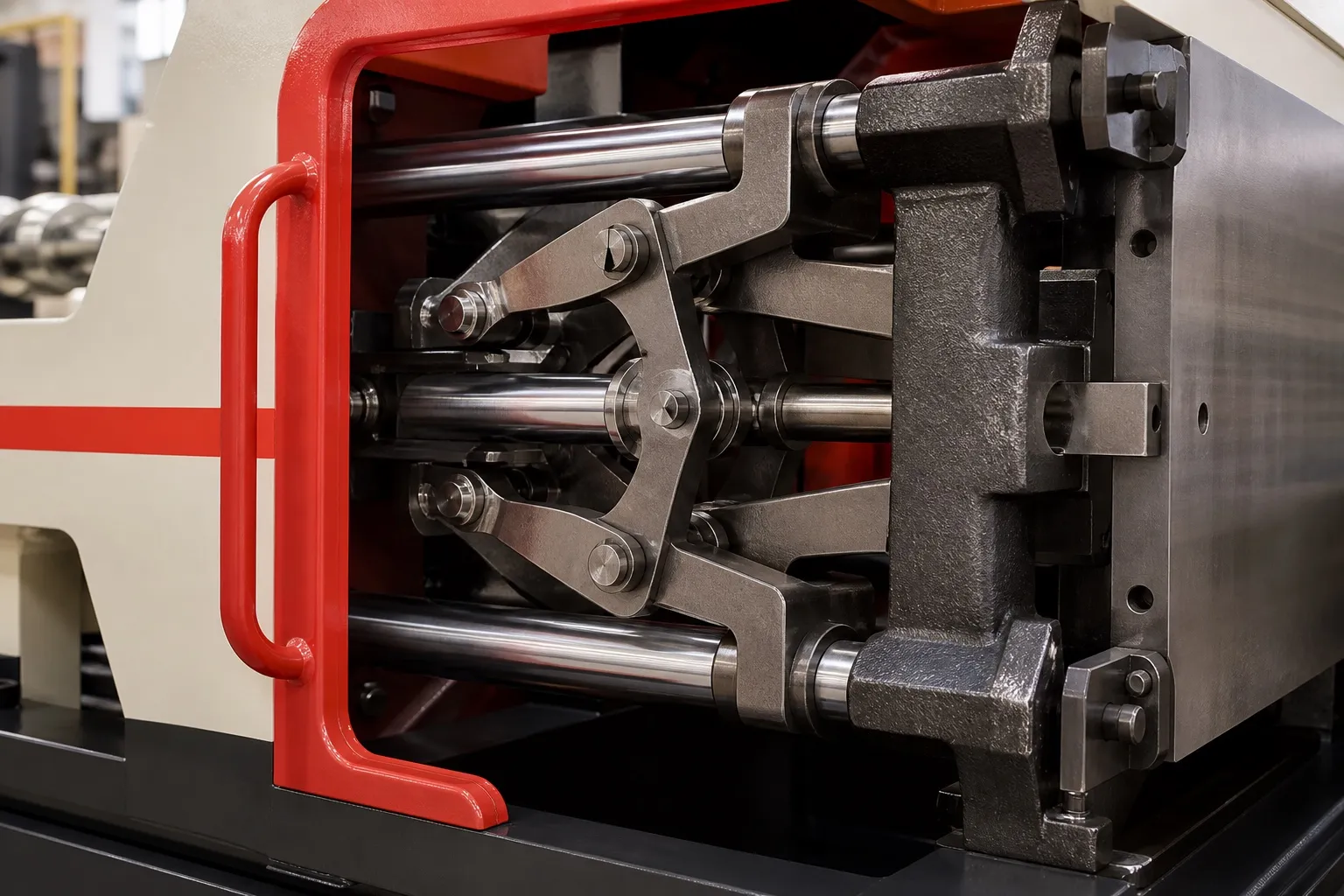

Two platen vs toggle at a glance
| Point | Two platen (hydro-mechanical) | Toggle |
|---|---|---|
| Platens | Two, joined by four tie bars | Three: fixed, moving and rear |
| How force is made | Short-stroke hydraulic cylinders after nuts lock the tie bars | Linkage straightens and stretches the tie bars |
| Opening stroke | Daylight minus mould height; falls as the mould gets taller | Same stroke at every mould height |
| Mould height setting | Locking position on grooved tie bars | Mechanical die-height adjustment |
| Setting tonnage | Set by oil pressure for each mould | Reported to be hard to run below maximum |
| Lock-up speed | About 0.5 s (supplier claim) | About 0.2 s (supplier claim) |
| Opening force | Set by cylinder area and pressure | Reported to be greater; suits deep-draw parts |
| Machine length | Reduced in most hydro-mechanical designs (reported) | Longer: rear platen and linkage |
| Main wear points | Locking nuts, tie-bar grooves, cylinder seals | Pins and bushes in the linkage |
In short, two platen vs toggle comes down to mould size and cycle. A two platen machine gives a shorter machine, tonnage you set per mould and long opening on short moulds; a toggle gives a fixed stroke at every mould height and a slightly faster lock.
Key Takeaways
- Toggle stroke is fixed at every mould height; two platen opening is daylight minus mould height.
- Toggles are reported to lock slightly faster and open with more force, which helps short-cycle and deep-draw work.
- Two platen clamps set tonnage by pressure, avoid toggle die-height over-clamping and can shorten the machine.
- Decide on your tallest part, widest mould and target cycle, not on clamp type alone.
Which gives more mould opening for tall parts?
It depends on mould height. A toggle gives its full stroke at every mould height. A two platen machine gives daylight minus mould height, so it opens further with short moulds and less with tall ones. Compare usable opening on your tallest mould, not catalogue stroke figures.
MoldMaking Technology gives the target: opening stroke at least 2.5 times part height, so the part can drop clear or be picked out. Its sizing guide sets the two relationships side by side. On a toggle, maximum daylight equals maximum shut height plus stroke, and the full stroke is there at every shut height. On a piston-type clamp, such as a two platen machine, maximum stroke is available only at minimum shut height.
So the two platen machine wins on opening whenever mould height is less than its daylight minus the toggle stroke. The worked example below puts numbers on a tall bucket.
Opening is only half of the fit. Wide moulds also need enough tie-bar spacing, and the what-is article in this series shows how to check that before you compare strokes.
Which clamp is faster and better for short cycles?
A toggle is reported to lock up slightly faster, about 0.2 s against 0.5 s for hydraulic locking in one supplier claim, and to have greater opening force. On short-cycle, shallow parts that gap counts. On long-cycle large parts, it is a small share of the cycle.
Put numbers on it: a 0.3 s difference is under 1% of a 40 s cycle but 5% of a 6 s cycle. Large crates and pails tend to sit at the long end, thin-wall cups at the short end.
On a long cycle, the lock-up difference will not show on the output report; cooling time will. Cooling time rises steeply with wall thickness, so a thinner, even wall usually buys more output than a faster clamp.
Thin-wall packaging raises the bar further. A review by a SABIC engineer noted that thin-wall machines tend to have accumulator-assisted clamps for fast clamp movement and extra-thick platens. That is a separate machine class, and clamp layout alone will not make a large machine fast.
How do two platen vs toggle compare on maintenance and mould care?
A toggle has pins and bushes that wear; if they wear unevenly, platen parallelism can suffer, and grease can contaminate the mould area. A two platen clamp moves those wear points to locking nuts, tie-bar grooves and cylinder seals, and avoids over-clamping from die-height adjustment on a warm mould.
Toggle defenders point to reliability, simplicity and rigidity, and those are fair points on a well-maintained machine. The same 2010 review noted another toggle concern: most toggles apply force at the platen corners, which can mean higher platen deflection.
Whichever you choose, check platen parallelism at installation and after major repairs. MoldMaking Technology gives 0.025 to 0.05 mm as generally acceptable for machines under 500 t.
Ask for the service plan for each design: lubrication points and intervals on a toggle, nut and groove inspection and seal replacement on a two platen clamp. Spares cost and lead time count as much as the design itself.
Which should you pick for crates, bins and furniture?
Pick two platen when moulds are large, tall or heavy and you want tonnage set per mould: crates, bins, pails, chairs and table tops. Pick a toggle for small to mid-size moulds with shallow parts and short cycles, where fixed stroke and fast lock-up help most.
In India, Reliance lists PP grades such as Repol B030MG and MI3530 for crates and furniture, and C120MN for paint pails. These parts combine large projected area with deep walls, which is where the two platen layout earns its keep.
There is a middle ground. A mid-size job, such as a bucket that fits a toggle stroke with margin, can go either way. There, compare cycle time, energy use and service support rather than clamp type.
My view: if your tallest part needs more opening than the toggle stroke can give at 2.5 times part height, the decision is already made.
How do you decide for your own mould?
List your tallest part, mould height, mould width and weight, projected area and target cycle. Work out the opening each machine gives on that mould and the tonnage the part needs, then compare. See the two platen injection moulding machine page for sizes.
Frequently Asked Questions About Two Platen vs Toggle Machines
Is a two platen machine more accurate than a toggle?
Not by default. Accuracy depends on platen stiffness, parallelism, mould condition and process control. Direct hydraulic clamping is reported to give finer pressure control and more uniform pressure, while toggle defenders cite rigidity. Check parallelism and tonnage repeatability on the machine you are buying rather than relying on the clamp type.
Can a toggle machine run a small mould at low tonnage?
It can be set lower, but a Plastics Technology review reported that toggles can be harder to run below maximum tonnage or to ramp tonnage within a cycle. On a two platen clamp, tonnage follows oil pressure, so a lower setting is a number on the screen. Either way, avoid over-clamping.
Which uses less floor space, a toggle or a two platen machine?
A Plastics Technology review noted that most two platen hydro-mechanical machines reduce overall length compared with toggles. Width depends on platen and tie-bar size. Check the full layout, including mould-change access, guarding, robot and conveyor, because those decide the bay length you need, not the clamp alone.
Does a toggle or two platen machine suit stack moulds?
Stack moulds need clamp force for one face plus about 10% for each extra level, and they are tall, so opening matters. A two platen machine loses usable opening as mould height rises, while a toggle stroke stays fixed. Work out mould height, opening and tonnage on both before choosing.
Can a toggle machine be converted to two platen clamping?
Not in any practical sense. The clamp layout, platens, tie bars, hydraulics and controls all differ, so it would mean a new clamp end. If your current toggle lacks opening for a new part, compare a mould with a lower stack height, a different part orientation, or a machine sized for the opening.
Related Articles
- What Is a Two Platen Injection Moulding Machine?
- How Does Hydro-Mechanical Clamping Work?
- Important Specifications to Consider Before Buying a Two Platen Machine
- Applications of Two Platen Injection Moulding Machines
Sources & References
- Plastics Technology, M. Knights: Hybrid Injection Clamps: The Best of Both Worlds? (June 2010)
- MoldMaking Technology, B. Catoen: Machine Sizing and Specification for Optimal Mold Performance, Part 1 (Aug 2025)
- PlasticsToday, G. Tremblay (Sabic Innovative Plastics): Never too thin (Oct 2007)
- UL Prospector: Polypropylene (PP): REPOL grade listing
Technical Disclaimer
Disclaimer: The information provided in this document is for general informational and educational purposes only. It is based on technical references and industry information available at the time of preparation and may be subject to change. It does not constitute engineering, technical, commercial or professional advice, nor does it constitute a quotation, specification, warranty or contractual commitment by Pratishna Engineers.
Actual injection moulding machine and process requirements vary according to the component design, material, mould, production volume, machine configuration and operating conditions. The information, examples, calculations and recommendations provided should be independently evaluated and verified for the specific application before making any equipment, process or production decision. Information obtained from third-party sources remains subject to the accuracy and limitations of those sources.
Limitation of Liability: Pratishna Engineers makes no representation or warranty, express or implied, regarding the completeness, accuracy or suitability of the information for any particular application. To the extent permitted by applicable law, Pratishna Engineers shall not be liable for any loss, damage, cost or consequence arising from reliance on or use of the information contained in this document. Final machine selection, configuration and application suitability should be confirmed with Pratishna Engineers based on complete and accurate project requirements.

