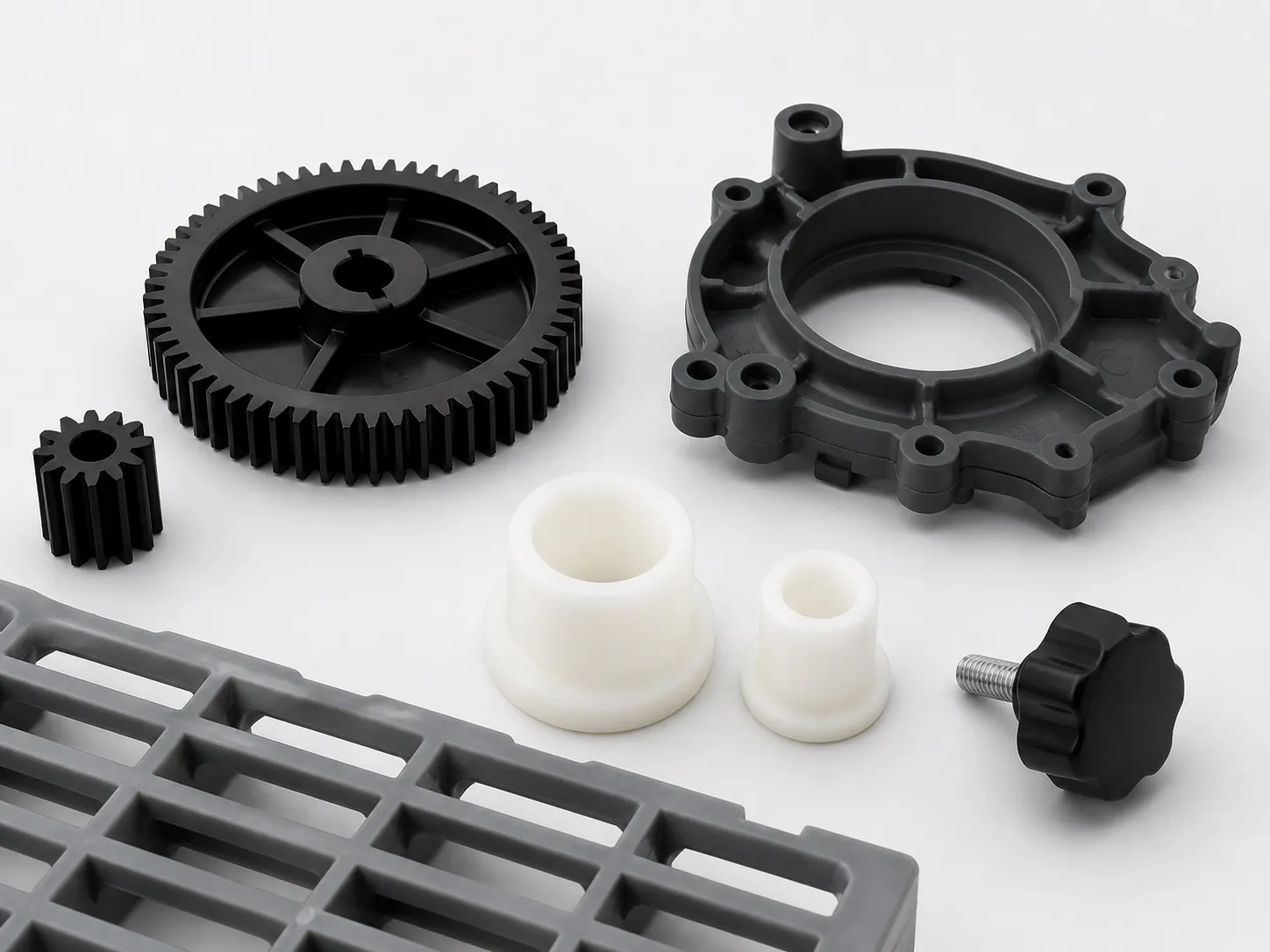
Insert-moulded parts for a 60 ton vertical insert moulding machine (insert counts and resins are examples)
| Part group | Inserts per shot | Example resins | Why the step up from 40 t |
|---|---|---|---|
| Plug top bases | Three pins per cavity, four or more cavities | FR PC, PA66 | More cavities fit when the tonnage factor is high |
| Connectors and terminal housings | A row of terminals in each cavity | PA66, PBT | Wider housings and two-cavity moulds |
| Parts with threaded brass bushes | One to four bushes per part | PA66, POM, ABS | Larger parts with bosses spread across them |
| Sensor housings | Pins, bushes or metal sleeves | PBT, PA66, PC | Bigger outlines and thicker walls |
| Multi-insert engineering parts | Mixed inserts in one part | Engineering grades | Larger lower moulds and more room to load |
A 60 t vertical clamp with an upward-facing lower mould covers the same kind of work as 40 t, but on larger parts and in more cavities. With a 10% reserve (a starting margin, not a rule), it carries about 78 to 194 cm² of projected area, 50% more than 40 t at any tonnage factor.
That extra area is what you buy. Loading time per insert does not change with tonnage, so check that the operator can still load the larger shot within the cycle.
Key Takeaways
- Typical 60 t work is plug top bases, connectors, threaded-bush parts, sensor housings and parts carrying several kinds of insert.
- With a 10% reserve, 60 t carries about 194 cm² at 2 US t/in², 129 cm² at 3 and 78 cm² at 5.
- More cavities mean more inserts to load; time a full shot by hand before you fix the cavity count.
- Switches, MCBs and RCCBs are under compulsory ISI certification, so the moulded parts inside them must suit the certified product.
What Can a 60 Ton Vertical Insert Moulding Machine Make?
Parts where several metal inserts sit in a larger plastic body, or small insert parts run in more cavities. Plug top bases, connector housings, parts with threaded brass bushes, sensor housings and multi-insert engineering parts are typical. The clamp, the lower mould size and loading time set the limit together.
Plug top bases are the classic case. Each carries three brass pins, and a four or eight-cavity mould can fit 60 t where it would not fit 40 t at a high tonnage factor. The plug tops article in this series works through cavity count against pin loading.
Connectors and terminal housings bring rows of terminals and fine shut-offs, so flash control matters as much as clamp. Parts with threaded bushes need boss design that holds the bush against pull and twist. Both have their own articles in this series.
Shot grows with cavities too. John Bozzelli's guidance in Plastics Technology keeps the shot between 20% and 65% of barrel capacity, worked in volume. Adding cavities on the same barrel moves the shot up that window, while a single small part on a large barrel sits near the bottom, where melt stays hot long enough to degrade.
Sensor housings and multi-insert parts can be larger in outline. Here the lower mould size and the open height for loading can decide the machine before the clamp force does.
How Much Projected Area Does 60 t Carry?
About 194 cm² at 2 US t/in², 129 cm² at 3 and 78 cm² at 5, after a 10% reserve. That covers parts plus any cold runner. The table compares 60 t with 40 t, so you can see where a part crosses from one size to the other.
Largest total projected area with a 10% reserve (1 US t/in² = 0.1406 t/cm²)
| Tonnage factor (US t/in²) | At 40 t | At 60 t | Gain |
|---|---|---|---|
| 2 | 129.3 cm² | 194.0 cm² | +50% |
| 3 | 86.2 cm² | 129.3 cm² | +50% |
| 4 | 64.7 cm² | 97.0 cm² | +50% |
| 5 | 51.7 cm² | 77.6 cm² | +50% |
Read the table from your own part. Add the projected area of every cavity and the runner, pick the factor for your resin and wall, and see which column it falls under. A part that sits between the two columns needs trial data or the larger machine.
The factor depends on the resin, wall and flow length. RJG's Jeremy Williams, writing in Plastics Technology, gives a typical range of 2 to 10 US t/in² and suggests 3 as a starting point. A PC datasheet quotes 3.0 to 5.0, so flame-retardant PC switch and plug bodies can sit near the top of the table.
Williams also warns against clamping at the machine maximum when the mould needs much less, and describes a cavity block that split under far more tonnage than its mould required. On insert moulds, over-clamping can crush vents and break inserts, so set clamp to the job.
Mould size cuts the other way. A Plastics Technology article on mounting moulds gives a rule of thumb that a mould should cover at least 70% of the distance between the tie bars, because a small mould lets the platens bow and flash the centre. On a tie-bar machine, a small single-cavity insert mould can fall below that line.
Which Indian Certifications Touch These Parts?
Several finished products made from these parts are under compulsory ISI certification. BIS lists switches to IS 3854, RCCBs to IS 12640, MCBs to IS/IEC 60898 and PVC cables to IS 694 under its Scheme I list, through the 2003 Quality Control Order for electrical accessories.
The licence sits with the maker of the finished product, but the moulded parts must keep that product passing. A switch base, MCB housing part or connector moulded in an unapproved grade, or with unrecorded regrind, can put the customer's certification at risk.
Our view: buy a 60 t vertical machine for the insert layout and the lower mould size you need, not for tonnage headroom. If the clamp check at the upper factor passes on 40 t and the mould fits, the smaller machine loads just as fast.
What Should You Send to Check a 60 t Fit?
Send the part and insert drawings, inserts per part, resin grade, part weight, lower mould size if known, target cavities and output per shift. With those, clamp at the upper factor, shot size, mould size and loading time can be checked together. See the 60 ton vertical injection moulding machine page.
Frequently Asked Questions About 60 Ton Vertical Insert Moulding
When should I choose 60 t over 40 t for an insert part?
When the clamp check at the upper tonnage factor passes 36 t, when the lower mould is too large for the smaller machine, or when you need more cavities than 40 t can carry. If none of these applies, the smaller machine loads just as fast and costs less to run.
Does a 60 t machine load inserts faster than a 40 t machine?
No. Loading speed depends on the operator or robot, the pocket design and the number of inserts per shot, not on clamp force. A larger shot with more cavities can make each cycle longer. Time the full loading routine before assuming more cavities means more output.
Can a 60 t vertical machine run a two-colour or two-material part?
Only if it is built or fitted for a second injection unit or a separate overmoulding step. A standard single-unit machine can run the second shot as a separate operation, with the first-shot part loaded as an insert. Plan the mould and the loading for both steps.
How large a lower mould can a 60 t machine take?
It depends on the table or platen size and the clamp stroke of the machine you choose. Ask for the minimum and maximum mould size and the loading height, and check that your lower mould leaves room for the operator's hands and any table movement.
Which resins run on a 60 t insert machine?
Engineering grades such as PA66, PBT, POM and flame-retardant PC can all be used for insert parts, along with ABS and PP for simpler items. Match the screw and barrel to the resin, dry the hygroscopic grades, and keep the shot within 20% to 65% of barrel capacity.
Related Articles
- Plug Tops With Brass Pins on a 60 Ton Vertical Machine
- Threaded Bush Inserts: Getting Pull-Out Strength Right
- Connector Insert Moulding: Terminal Location and Flash Control
Sources & References
- Plastics Technology, J. Williams (RJG): Clamp Tonnage: More Is Better...Right?
- Bayer MaterialScience (now Covestro) via IDES: Makrolon 2558 datasheet
- Bureau of Indian Standards: Scheme I (ISI Mark Scheme): products under compulsory certification
- Plastics Technology, J. Bozzelli: A Simpler Way to Calculate Shot Size vs. Barrel Capacity
Technical Disclaimer
Disclaimer: The information provided in this document is for general informational and educational purposes only. It is based on technical references and industry information available at the time of preparation and may be subject to change. It does not constitute engineering, technical, commercial or professional advice, nor does it constitute a quotation, specification, warranty or contractual commitment by Pratishna Engineers.
Actual injection moulding machine and process requirements vary according to the component design, material, mould, production volume, machine configuration and operating conditions. The information, examples, calculations and recommendations provided should be independently evaluated and verified for the specific application before making any equipment, process or production decision. Information obtained from third-party sources remains subject to the accuracy and limitations of those sources.
Limitation of Liability: Pratishna Engineers makes no representation or warranty, express or implied, regarding the completeness, accuracy or suitability of the information for any particular application. To the extent permitted by applicable law, Pratishna Engineers shall not be liable for any loss, damage, cost or consequence arising from reliance on or use of the information contained in this document. Final machine selection, configuration and application suitability should be confirmed with Pratishna Engineers based on complete and accurate project requirements.