






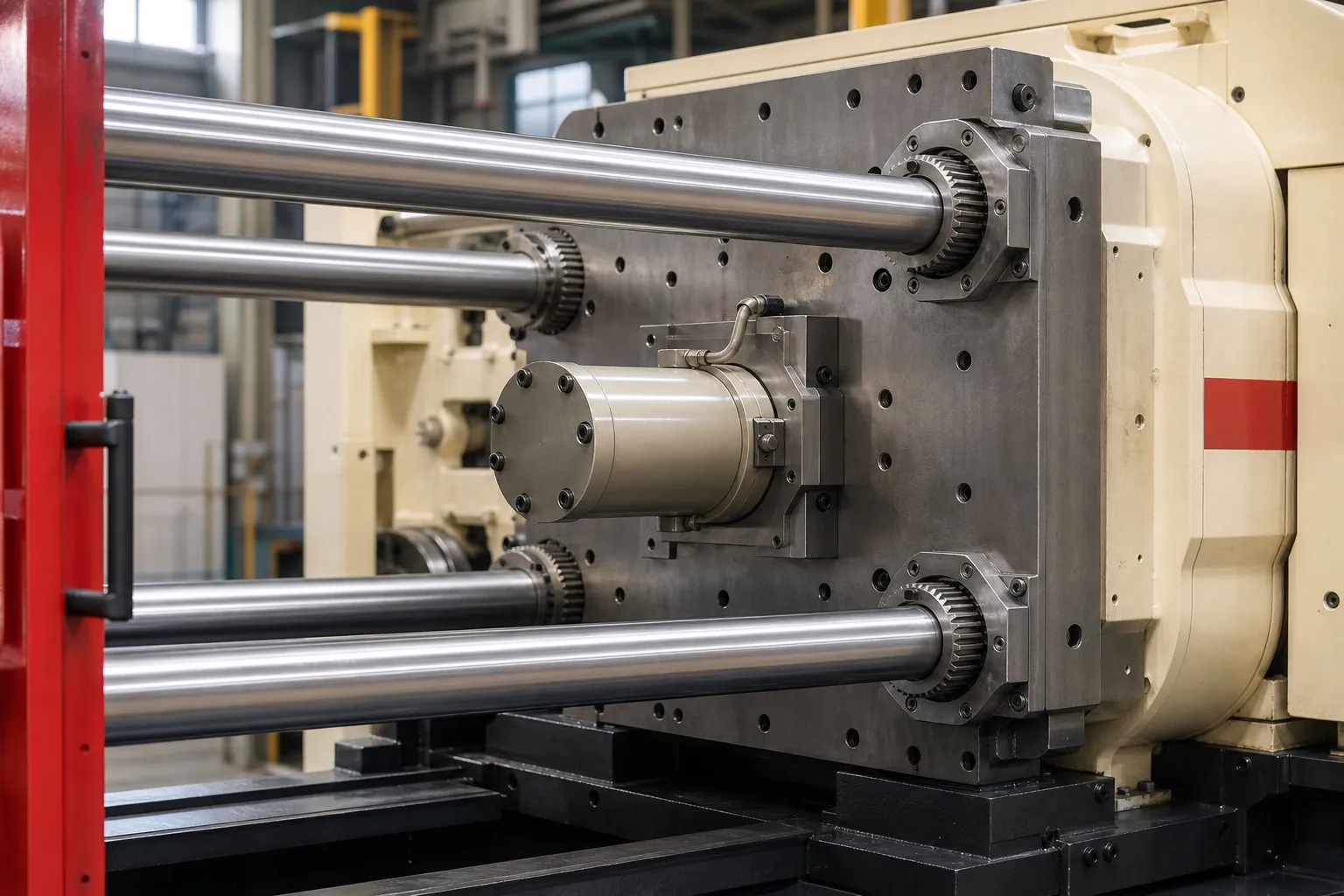

Two platen vs toggle machine: how the clamp designs compare, as reported in Plastics Technology and MoldMaking Technology
| Point | Toggle clamp | Two-platen clamp |
|---|---|---|
| How it locks | A cylinder drives a linkage that straightens and locks the moving platen | Cylinders move the platen; split nuts or similar lock it on the tie bars, then short-stroke cylinders build tonnage |
| Machine length | Longer, with a rear platen and linkage | Shorter overall than a toggle or fully hydraulic machine |
| Opening and daylight | Maximum daylight = maximum mould height + stroke, so full stroke at every mould height | Platen travel set by the cylinders and frame rather than a linkage |
| Tonnage control | Reportedly harder to run below full tonnage or ramp it during a cycle | Direct hydraulic clamping is reported to give finer pressure control and a greater mould-height range |
| Lock-up and opening force | Suppliers quoted say it locks up slightly faster and opens with more force, suiting deep-draw parts | Tonnage builds after the locks engage |
Move from a toggle to a two-platen machine when a real mould needs more opening stroke, more mould height or a shorter machine than the toggle offers. In a two platen vs toggle machine choice around 320 t, clamp alone is not the reason, because both designs are built at and around this tonnage.
The table summarises the differences reported by neutral trade sources. The sections below explain how each clamp works, the signs that a toggle has run out, and what changes on the shop floor.
Key Takeaways
- A toggle gives full stroke at every mould height; its maximum daylight equals maximum mould height plus stroke.
- Two-platen machines are shorter overall than toggles of similar tonnage, which can decide a crowded bay.
- Toggles are reported to lock up a little faster and open with more force; direct hydraulic clamps to give finer tonnage control.
- Switch when stroke, mould height, tie-bar gap or floor length fails on a real mould.
Two Platen vs Toggle Machine: How Do the Clamps Work?
A toggle uses a linkage that straightens and locks, multiplying a cylinder's force. A two-platen machine has no rear platen: cylinders move the moving platen, a mechanical lock engages on the tie bars, and short-stroke hydraulic cylinders then build the clamp force.
Mikell Knights' Plastics Technology article on hybrid clamps describes this hydromechanical style: split nuts or similar devices lock the moving platen, then one or more short-stroke cylinders apply tonnage. It notes that such machines reduce overall length compared with toggles or fully hydraulic machines.
The same article sets out a long-running debate. Critics cite the toggle's more limited range of stroke adjustment, the risk of over-clamping if mould height is set with the mould closed and the mould then warms and expands, difficulty running below full tonnage, and possible platen deflection because force acts at the corners. Defenders cite reliability, simplicity, rigidity and fast lock-up.
When Does a 320 t Toggle Machine Run Out?
When a mould needs more opening than the stroke, more thickness than the maximum mould height, a wider tie-bar gap, or more floor length than you have. Deep pails, tall tubs and large IML containers hit stroke and mould height first; wide lids hit the tie bars.
Bruce Catoen's MoldMaking Technology guide gives the toggle relationship: maximum daylight equals maximum mould height plus stroke. For a direct hydraulic (piston) clamp, maximum daylight equals minimum mould height plus maximum stroke. The large IML containers article in this series works through a daylight budget in detail.
The guide also sets opening stroke at a minimum of 2.5 times the part height. A 350 mm tall pail therefore wants about 875 mm of stroke, which can exceed what a mid-size toggle offers.
Heavy moulds are another signal. Catoen's guide advises checking the maximum mould weight for both platens and notes that platen level and parallelism of 0.025 to 0.05 mm are generally acceptable on machines under 500 t. A tall pail mould can reach the weight limit before the clamp limit.
Machines of similar tonnage can differ widely in stroke, tie-bar gap and mould height, so compare data sheets on those lines first. The paint pail article in this series gives stroke figures for common pail sizes.
What Does a Two-Platen Machine Change on the Shop Floor?
Mostly length, opening and tonnage control. A shorter machine can fit a bay that a toggle will not, and direct hydraulic clamping is reported to give finer tonnage control. Lock-up can be a little slower, which matters less when cooling time is long, as it is on thick, heavy containers.
Set-up time can change too. The Plastics Technology article reports some builders' view that toggles take longer to set up because of mould-height adjustment. Weigh that against how often you change moulds; a machine that runs one pail mould for months gains little from faster changeovers.
Running cost depends on the drive more than the clamp type. The ExxonMobil, AMI and Tangram energy guide says a standard hydraulic machine's base load can be 75% or more of its energy, against about 10 to 20% for all-electric and hybrid machines, and that ten-year energy cost exceeds purchase cost in almost every case.
In Maharashtra, MSEDCL bills demand on kVA and energy on kVAh, which MERC intended for HT consumers and LT consumers above 20 kW from 1 April 2020. At a power factor of 0.85, 15% of the power drawn does no useful work. Ask for measured power on a cycle like yours for each option.
Our view: at around 320 t, do not change clamp type for clamp. Change when a specific mould fails on stroke, mould height or length, and size the two-platen machine for that mould list rather than for a future you cannot yet see.
How Should You Decide Between the Two Designs?
List your largest and deepest moulds with closed thickness, part height and rim size, plus the bay length available. Check each against stroke, mould height, daylight and tie-bar gap on both designs, then compare running cost. See the 320 ton horizontal injection moulding machine page.
Frequently Asked Questions About Two Platen and Toggle Machines
Is a two-platen machine more expensive than a toggle of the same tonnage?
Prices vary by supplier and specification, so compare quotations on the same stroke, mould height and tie-bar gap. Include floor space, energy and maintenance in the comparison, because a shorter machine can save bay length and a different drive changes the monthly running cost.
Can a toggle machine be given a longer stroke later?
Only within narrow limits. Stroke on a toggle is set by the linkage geometry, so it cannot be extended much after purchase. Some machines can be ordered with an extended stroke. If deep moulds are planned, specify stroke and mould height when ordering rather than hoping to adapt the machine later.
Does a two-platen machine mould better parts?
Not by itself. Part quality comes from the mould, the process and the machine's control of speed, pressure and temperature. A two-platen clamp can help where tonnage control or mould support matters, but a well-maintained toggle running a good mould also produces good containers.
What is platen deflection and why does it matter?
Under clamp, the platens bend slightly around the mould. Too much bending can let the parting line open in places and cause flash, especially in the centre of a small mould on a large platen. Plastics Technology notes that most toggles apply force at the platen corners rather than the centre.
Should I move up in tonnage instead of changing clamp type?
If clamp is the limit, yes, and a larger toggle may also bring more stroke and a wider tie-bar gap. If stroke, mould height or machine length is the limit, compare a larger toggle with a two-platen machine on those figures and choose the one that fits your moulds and your bay.
Related Articles
- What Can You Make on a 320 Ton Container Moulding Machine?
- Paint Pail Moulding on a 320 Ton Machine
- Large IML Containers: Daylight and Ejector Stroke on a 320 Ton Machine
Sources & References
- Plastics Technology, M. Knights: Hybrid Injection Clamps: The Best of Both Worlds?
- MoldMaking Technology, B. Catoen: Machine Sizing and Specification for Optimal Mold Performance, Part 1
- ExxonMobil, AMI and Tangram Technology: An Energy Saving Guide for Injection Moulders
- Maharashtra State Electricity Distribution Co. Ltd (MSEDCL): kVAh Billing: Frequently Asked Questions
Technical Disclaimer
Disclaimer: The information provided in this document is for general informational and educational purposes only. It is based on technical references and industry information available at the time of preparation and may be subject to change. It does not constitute engineering, technical, commercial or professional advice, nor does it constitute a quotation, specification, warranty or contractual commitment by Pratishna Engineers.
Actual injection moulding machine and process requirements vary according to the component design, material, mould, production volume, machine configuration and operating conditions. The information, examples, calculations and recommendations provided should be independently evaluated and verified for the specific application before making any equipment, process or production decision. Information obtained from third-party sources remains subject to the accuracy and limitations of those sources.
Limitation of Liability: Pratishna Engineers makes no representation or warranty, express or implied, regarding the completeness, accuracy or suitability of the information for any particular application. To the extent permitted by applicable law, Pratishna Engineers shall not be liable for any loss, damage, cost or consequence arising from reliance on or use of the information contained in this document. Final machine selection, configuration and application suitability should be confirmed with Pratishna Engineers based on complete and accurate project requirements.


