






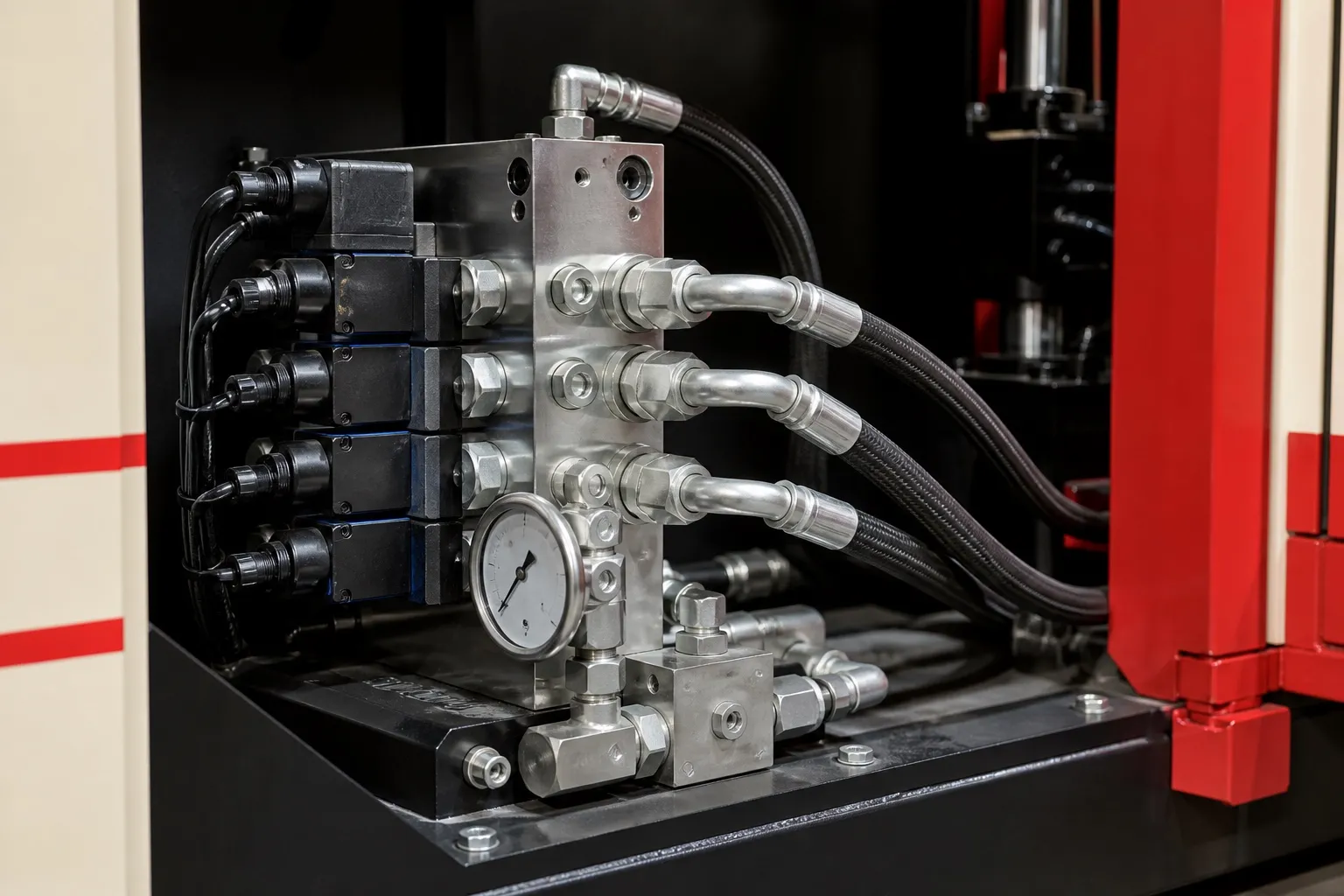

The power part of injection moulding machine running cost comes down to three numbers: the power the machine and its auxiliaries draw, the cycle time, and the share of shots that become good parts. You pay for power by the hour and sell parts by the piece. On a 100 t machine, a shorter cycle can cut the power cost per part more than a change of motor.
This article shows where the power goes, what idle time costs, how cycle time sets output, and how Indian tariffs change the sums.
Key Takeaways
- Tangram's benchmarks, published in an ExxonMobil energy guide, put the variable energy of injection moulding at typically 0.9 to 1.6 kWh per kg processed.
- A standard hydraulic machine's base load can be 75% or more of its energy, so idle time and slow cycles cost power without making parts.
- When the machine's draw stays roughly constant, power cost per part falls in step with cycle time; in the worked example, 30 s to 26 s saves about 13%.
- In Maharashtra, kVAh billing means a poor power factor raises billed units, so check your billing basis and power factor along with the rate.
What Makes Up Injection Moulding Machine Running Cost?
Power for the main drive and barrel heaters, power for chillers, dryers and compressed air, and the cycle time that spreads all of it over parts. Labour, resin and scrap sit on top. For energy, the useful measures are kWh per kg processed and power cost per good part.
An energy guide produced for ExxonMobil with Tangram Technology splits a typical moulding plant's energy as about 66% polymer processing, 11% chillers, 10% compressed air, 5% water pumps and 5% lighting. It puts the site base load, energy used at zero output, at 20 to 40% of the total.
Where the power goes and the levers the ExxonMobil and Tangram guide names
| Area | Share or figure | Lever |
|---|---|---|
| Barrel heating | 10 to 25% of a machine's energy input | Barrel insulation can cut heating energy by up to 50% |
| Chilled and cooling water | 11 to 16% of a typical plant's energy | Raising chilled water set point by 1 °C cuts chiller cost by about 3% |
| Compressed air | Up to 10% of total energy cost | Leaks can be 20 to 40% of air generated; fix them first |
| Resin drying | Up to 15% of process energy | Dry only the resins that need it, and no longer than needed |
| Machine base load | 75% or more on standard hydraulic machines; 10 to 20% on all-electric and hybrid | Switch motors off during stops; match machine size to the job |
The guide also notes that the energy to run a moulding machine over ten years is, in almost every case, greater than its purchase price. That makes running cost a buying decision, not only a production one.
How Much Does Idle Time Cost on a Hydraulic Machine?
More than it looks. On a standard hydraulic machine, base load can be 75% or more of total energy, the ExxonMobil guide says. Moulding consultant Robin Kent has measured idling machines drawing 52 to 97.5% of their full moulding energy while making nothing.
Kent's own example idled at 64% of production energy while it waited for a technician. He suggests that stops longer than about 1.5 hours may be cheaper to shut down and restart, and that shorter stops should use an idle mode with motors off and heaters set back. Cooling water and compressed air to idle machines should stop too.
Drive type changes the picture. The guide puts all-electric and hybrid base loads at around 10 to 20%, mostly barrel heating, and Kent recorded one hydraulic machine using 22% less energy with its variable-frequency drive switched on than off.
A high base load can also mean the machine is too large for the job, the guide notes. That is one more reason to size the clamp and screw from the part rather than buying spare tonnage.
How Do Cycle Time and Output Drive Cost per Part?
Output per hour is 3,600 divided by cycle time in seconds, times cavities, times the share of good shots. With the machine's draw roughly constant, power cost per part falls in step with cycle time. That makes cooling, about 85% of the cycle in one RJG trial, the main lever.
Output at different cycle times (2 cavities, 85% good shots, assumed for illustration)
| Cycle time | Good shots per hour | Parts per hour | Parts per 8 h shift |
|---|---|---|---|
| 20 s | 153 | 306 | 2,448 |
| 25 s | 122 | 245 | 1,958 |
| 30 s | 102 | 204 | 1,632 |
| 40 s | 77 | 153 | 1,224 |
Cooling time grows with the square of wall thickness, RJG explains, so the part designer sets much of the cycle before the mould is built. On the square law, a wall 20% thinner needs about 36% less cooling time. RJG also suggests adding about 20% to the calculated cooling time as a safety factor, worth knowing before you promise a cycle.
The good-shot share works the same way. Every rejected shot uses the same power as a good one, so raising good shots from 85% to 95% on a 30 s cycle lifts output from 204 to 228 parts an hour and cuts power cost per part by about 10%.
Our view: cycle time, not the motor rating on the brochure, decides your power cost per part. A machine that runs a stable 26 s cycle on the same draw makes each part cheaper than one that needs 30 s, whatever the drive.
Kent adds one more use for the meter: rising energy on the same job can be an early sign of screw or barrel wear.
How Do Indian Electricity Tariffs Change the Calculation?
Tariff structure matters as much as the rate. In Maharashtra, MSEDCL explains that under kVAh billing, demand charges are levied on kVA and energy charges on kVAh, so a poor power factor raises billed units. Rates have also changed through several regulatory orders since 2025.
MSEDCL's FAQ notes that at a power factor of 0.85, 15% of the power does no useful work, and it recommends capacitors or automatic power factor correction panels. A machine drawing 12 kWh at a power factor of 0.85 is billed for about 14.1 kVAh, about 18% more units. The FAQ says MERC intended kVAh billing for HT consumers and LT consumers above 20 kW from 1 April 2020, so check the basis printed on your own bill.
Rates themselves have moved. A circular from the Deccan Chamber of Commerce, Industries and Agriculture in Pune records that MERC issued a fresh order on 25 March 2026, after the Bombay High Court set aside a June 2025 review order and the Supreme Court sent the matter back. For costing, use the rates on your latest bill rather than a figure from a brochure or an old quote.
What Should You Measure Before Comparing Machines?
Log one machine for a full shift with a clamp-meter data logger, and record cycle time, good shots and kg processed. Note the power factor and billing basis from your bill. With those, kWh per kg and power cost per part can be compared on the same job. See the 100 ton horizontal injection moulding machine page.
Frequently Asked Questions About Injection Moulding Machine Running Cost
What is a good kWh per kg for injection moulding?
The ExxonMobil and Tangram guide gives a typical variable load of 0.9 to 1.6 kWh per kg for a moulding site. Treat that as a sanity check, not a target, because part weight, cycle and machine type all move it. The most useful comparison is your own machines on the same job over time.
Is an all-electric or servo machine always cheaper to run?
Not always. Servo and all-electric drives cut base load, which helps most where cycles are long or machines wait between jobs. The saving depends on your cycle and idle time, so ask for measured kWh per kg on a comparable mould before paying a premium, and compare it with your own logged figures.
How do I measure my machine's power draw?
Robin Kent uses a clamp-meter data logger on the supply cables, and a single machine can be measured in about 30 minutes. Log several full cycles, record what each cable feeds, and average the heater load over 10 to 15 minutes. Live electrical work needs a qualified person and proper safety precautions.
Should I switch the machine off during breaks?
For long stops, yes. Kent suggests idle periods longer than about 1.5 hours may be cheaper to switch off and restart, and recommends an idle mode with motors off and heaters set back for shorter stops. Stop chilled water, compressed air and conveyors to idle machines as well.
Do chillers and dryers belong in cost per part?
Yes. The ExxonMobil and Tangram guide puts chilled and cooling water at 11 to 16% of a typical plant's energy and drying at up to 15% of process energy. Allocate them by machine where you can, or your cost per part will look lower than it really is.
Related Articles
- What Can You Make on a 100 Ton Injection Moulding Machine?
- 100 Ton Machine for Switch Plates and Electrical Accessories
- Choosing Between the 32 mm and 35 mm Screw on a 100 Ton Machine
Sources & References
- Maharashtra State Electricity Distribution Co. Ltd (MSEDCL): kVAh Billing: Frequently Asked Questions
- Deccan Chamber of Commerce, Industries and Agriculture, Pune: Circular No. 085: MERC Order dated 25 March 2026 on MSEDCL tariff revision
- ExxonMobil, Applied Market Information and Tangram Technology: An Energy Saving Guide for Injection Moulders
- PlasticsToday, R. Kent: Getting to know your real energy use and cost
- RJG Inc.: How to Determine Injection Molding Cooling Time
Technical Disclaimer
Disclaimer: The information provided in this document is for general informational and educational purposes only. It is based on technical references and industry information available at the time of preparation and may be subject to change. It does not constitute engineering, technical, commercial or professional advice, nor does it constitute a quotation, specification, warranty or contractual commitment by Pratishna Engineers.
Actual injection moulding machine and process requirements vary according to the component design, material, mould, production volume, machine configuration and operating conditions. The information, examples, calculations and recommendations provided should be independently evaluated and verified for the specific application before making any equipment, process or production decision. Information obtained from third-party sources remains subject to the accuracy and limitations of those sources.
Limitation of Liability: Pratishna Engineers makes no representation or warranty, express or implied, regarding the completeness, accuracy or suitability of the information for any particular application. To the extent permitted by applicable law, Pratishna Engineers shall not be liable for any loss, damage, cost or consequence arising from reliance on or use of the information contained in this document. Final machine selection, configuration and application suitability should be confirmed with Pratishna Engineers based on complete and accurate project requirements.


