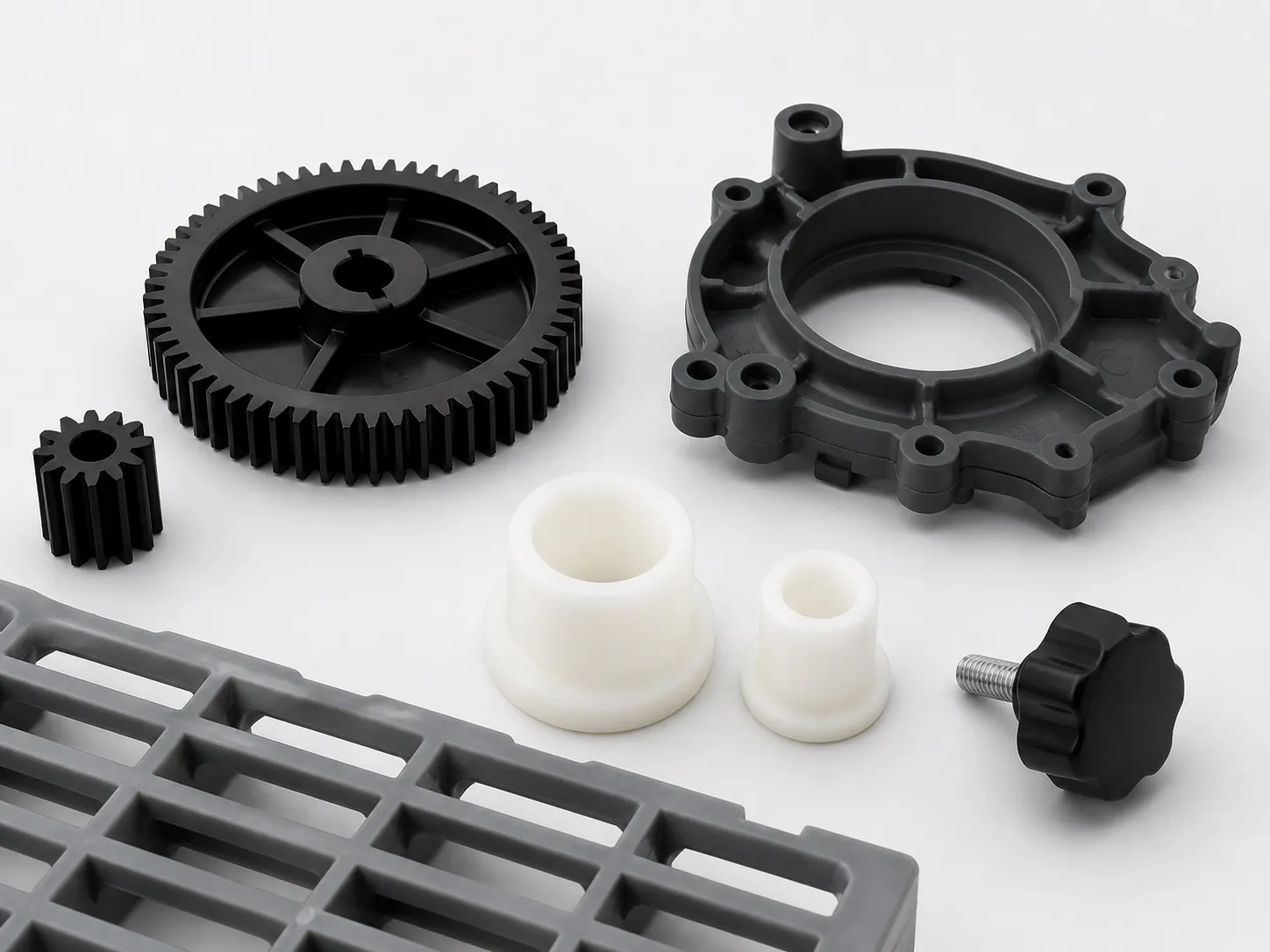

Yes, a 165 ton machine suits appliance parts moulding for medium components: housings for mixers and fans, heater and cooler grilles, iron handles, covers, bases and small drawers. The part fits when its projected area times the resin's tonnage factor stays under about 150 t with a 10% reserve. The resin, such as ABS or a PP copolymer, sets that factor and much of the cycle.
What decides profit on these jobs is less the clamp and more the wall thickness, because cooling takes most of the cycle.
Key Takeaways
- Grilles and louvred covers fit larger than their outline suggests, because through-holes are subtracted from projected area.
- ABS needs drying before moulding; INEOS lists 71 to 88 °C for 2 to 4 hours, to below 0.10% moisture, for its Lustran ABS 248.
- Cooling time rises with the square of wall thickness, so a wall 20% thinner needs about 36% less cooling.
- Irons, immersion heaters, stoves and room heaters are under compulsory BIS certification, so material choices for their plastic parts must support the finished product's tests.
Which Appliance Parts Fit a 165 Ton Clamp?
Parts with a projected area of up to about 530 cm² in an easy-flowing resin, or about 270 cm² at a factor of 4, fit a 165 ton clamp with a 10% reserve. That covers many small-appliance housings, covers and grilles, but not large panels, tubs or full-width front covers.
The full calculation is explained in the applications article in this series. For appliance parts, two details matter most. Louvres and vent slots are through-holes, so a grille of 300 × 200 mm can need far less clamp than a solid cover of the same outline. Large flat faces, by contrast, use up the limit quickly.
Small appliance parts such as knobs, buttons, clips and switch caps sit at the other end. One cavity of these needs only a few tonnes, so on a 165 ton machine they make sense only as a multi-cavity family mould with a matching shot. Otherwise a smaller machine runs them for less, for the energy reasons set out in the applications article in this series.
Deep housings bring a different check. The clamp may cope, yet the mould needs enough opening stroke to drop the part. That check is covered in the tie-bar and platen article in this series.
Which Materials Suit Appliance Parts Moulding?
ABS and PP copolymer both suit many appliance parts. ABS gives a stiff, glossy housing and needs drying. PP copolymer is lighter and cheaper per part, takes impact well and needs no drying. Parts near heat, or with flame requirements, may call for specialised grades.
Two cited appliance-grade resins and what they mean on the machine
| Grade (supplier) | Data from the supplier's sheet | What it means on the machine |
|---|---|---|
| Lustran ABS 248 (INEOS) | Clamp 2.0 to 4.0 US t/in²; drying 71 to 88 °C, 2 to 4 h, below 0.10%; melt 246 to 266 °C; mould 43 to 66 °C; max regrind 20%; listed for small appliance housings | Needs a dryer and mould heating; clamp need can double between the low and high factor |
| Repol B300MN (Reliance) | PP impact copolymer; MFR 30 g/10 min; HDT 105 °C; melt 190 to 240 °C; mould 20 to 50 °C; listed for appliance and automotive parts | High flow and fast crystallisation suit large articles with shorter cycles |
INEOS rates Lustran ABS 248 at UL 94 HB and suggests a shot of 50% to 75% of barrel capacity. Reliance describes Repol B300MN as a high-crystalline copolymer whose flow and fast crystallisation suit large articles with lower cycle times. It is an Indian grade, which helps local supply.
Our view: choose the grade with the appliance maker before the mould is cut. Changing from PP to ABS after trials changes shrinkage, so the mould may need rework, and the clamp need can change with it.
How Does Wall Thickness Set the Cycle Time?
Wall thickness drives cooling, and cooling can be the longest step by far. In the cooling equation thickness is squared, so small changes in wall have large effects. Thinning a wall by 20% cuts cooling time by about 36%, because 0.8 squared is 0.64.
RJG's breakdown of cooling time gives a sense of scale. In its trial on an eight-cavity ABS tensile bar 3.3 mm thick, about 85% of the cycle was spent cooling. The part only needs about 40% of its heat removed before ejection, so it can leave the mould while still warm.
RJG adds about 20% to the calculated cooling timer as a safety margin. Use that as a starting value on a new mould, then trim it in trials while you watch warpage and ejector marks.
For appliance housings, uneven walls cost more than thick ones. A boss or rib much thicker than the wall around it sets the cooling time for the whole part. Coring out thick areas can save more cycle than a change of machine.
What Do Indian Certification Rules Mean for Appliance Parts?
Several heating appliances are under compulsory BIS certification. The list covering electrical appliances includes irons, immersion heaters, stoves and room heaters under the IS 302 series, and they must carry the ISI mark. Plastic parts in these products must help the finished appliance pass its tests.
The certification is for the appliance, not the moulded part, but it reaches the moulder through the drawing. Parts near heating elements may need a higher heat rating or a flame-retardant grade, and the appliance maker may fix the exact grade in the purchase order.
In practice, keep material certificates, batch records and a regrind policy for every certified customer. A change of grade without approval can put the customer's certification at risk.
What Should You Send to Plan an Appliance Part?
Send the part drawing or a sample, the material grade the appliance maker has approved, wall thicknesses, cavities, the mould's size and shut height, the target cycle, and annual volume. With those, clamp, shot and a realistic cycle can be estimated. See the 165 ton horizontal injection moulding machine page.
Frequently Asked Questions About Appliance Parts Moulding
Which appliance parts are too large for a 165 ton machine?
Large one-piece parts such as washing machine tubs, refrigerator liners, large panels and full-width covers are. Their projected area passes the roughly 530 cm² that 165 t allows even in easy-flowing PP with a 10% reserve. Check the outline first, then the resin's tonnage factor, before you discuss cycle or cost.
Why does ABS need drying when it is not a nylon?
ABS absorbs some moisture from the air, and wet pellets cause splay and surface marks on glossy housings. For Lustran ABS 248, INEOS lists drying at 71 to 88 °C for 2 to 4 hours, to below 0.10% moisture. Check your own grade's data sheet, since limits vary by supplier.
Is ABS or PP better for an appliance housing?
It depends on the brief. ABS gives stiffness, gloss and easy decoration, at higher cost and with drying. PP copolymer is lighter, tougher on impact and needs no drying, but it is less stiff and harder to print. For a visible, glossy housing ABS is the stronger candidate; for hidden or flexing parts, PP copolymer can suit.
How much regrind can go into ABS appliance parts?
INEOS gives a maximum of 20% regrind for Lustran ABS 248. Keep regrind clean, dry it with the virgin material and track it by batch. Certified appliance customers may set a lower limit or none at all, so check the purchase order before adding any regrind.
Does a hotter mould give better appliance parts?
Often it gives better gloss, weld lines and lower stress, at the cost of longer cooling. INEOS lists a mould temperature of 43 to 66 °C for Lustran ABS 248. Start in the middle, then raise it only if the surface needs it and the cycle can carry the extra cooling.
Related Articles
- What Can You Make on a 165 Ton Injection Moulding Machine?
- 165 Ton Machine for Pipe Fittings and Plumbing Parts
- 165 Ton vs 180 Ton: Tie-Bar Space and Platen Size Compared
Sources & References
- INEOS ABS via UL IDES: Lustran ABS 248 technical data sheet
- Reliance Industries: Repol B300MN technical data sheet (July 2024)
- RJG Inc.: How to Determine Injection Molding Cooling Time
- Bureau of Indian Standards: Scheme I (ISI Mark Scheme): products under compulsory certification
Technical Disclaimer
Disclaimer: The information provided in this document is for general informational and educational purposes only. It is based on technical references and industry information available at the time of preparation and may be subject to change. It does not constitute engineering, technical, commercial or professional advice, nor does it constitute a quotation, specification, warranty or contractual commitment by Pratishna Engineers.
Actual injection moulding machine and process requirements vary according to the component design, material, mould, production volume, machine configuration and operating conditions. The information, examples, calculations and recommendations provided should be independently evaluated and verified for the specific application before making any equipment, process or production decision. Information obtained from third-party sources remains subject to the accuracy and limitations of those sources.
Limitation of Liability: Pratishna Engineers makes no representation or warranty, express or implied, regarding the completeness, accuracy or suitability of the information for any particular application. To the extent permitted by applicable law, Pratishna Engineers shall not be liable for any loss, damage, cost or consequence arising from reliance on or use of the information contained in this document. Final machine selection, configuration and application suitability should be confirmed with Pratishna Engineers based on complete and accurate project requirements.