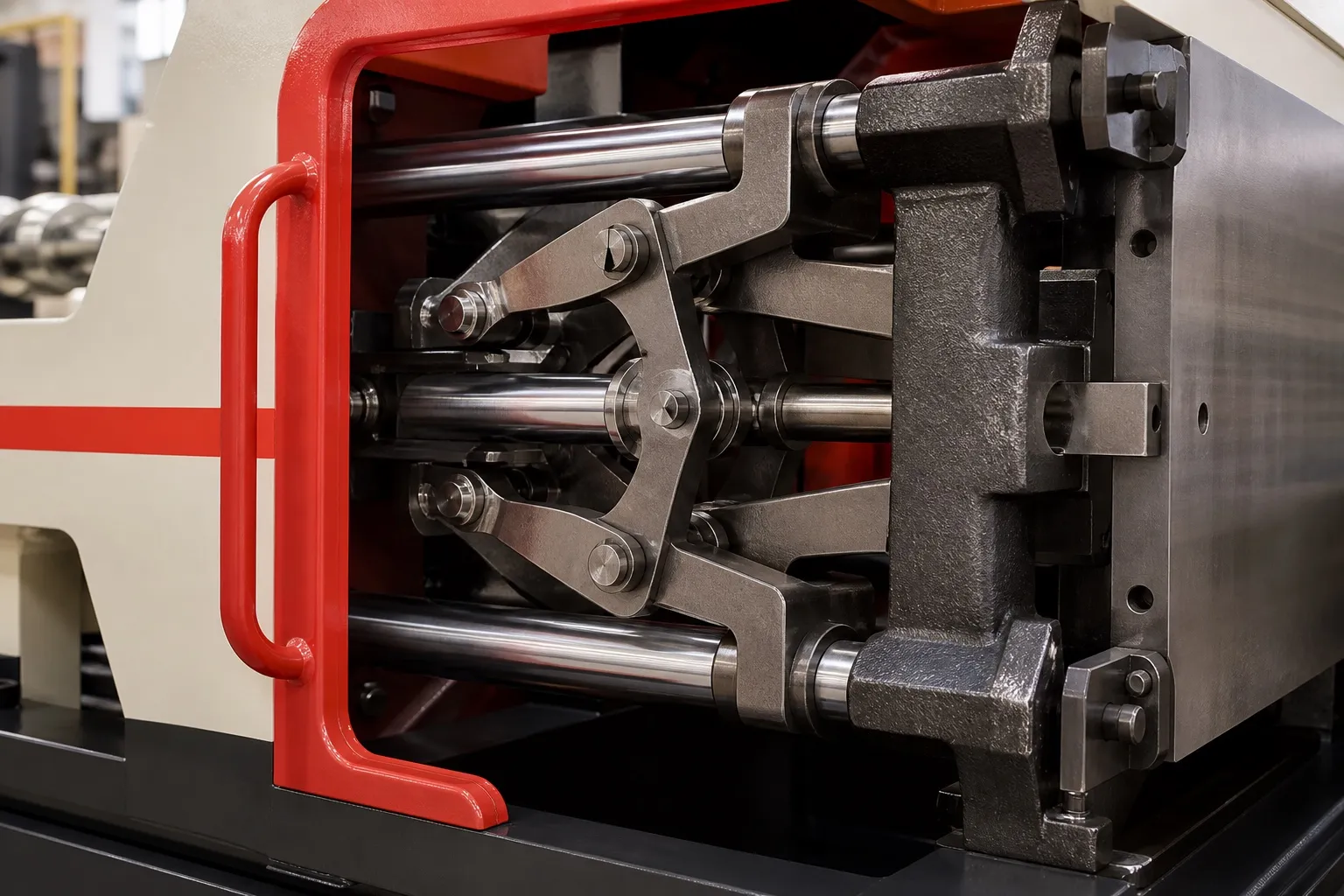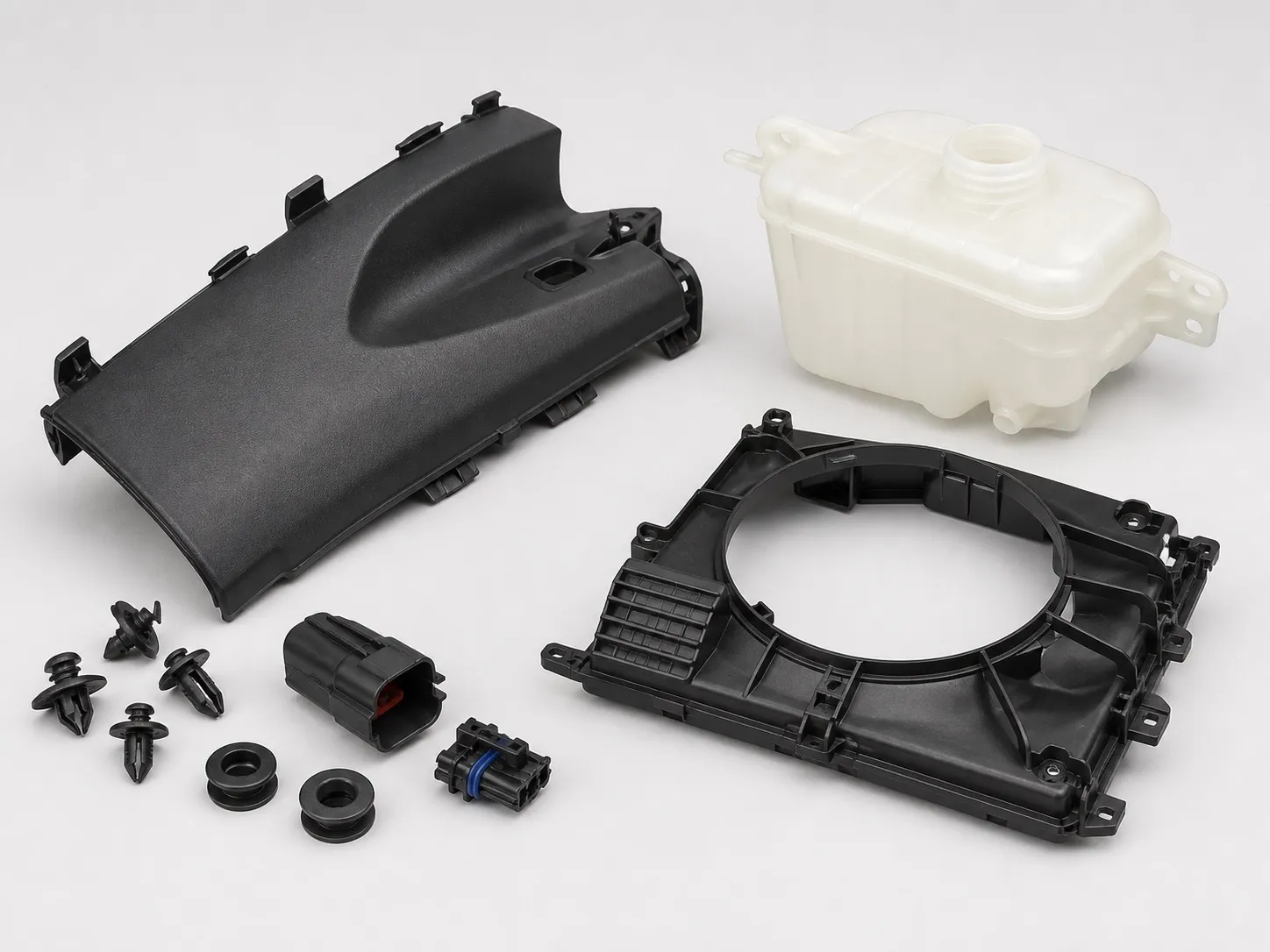

Thirty-two cavities of a 20 × 15 mm nylon trim clip, plus a 30 cm² cold runner, give 126 cm² of projected area. At 3 to 5 US t/in² with a 10% reserve, that needs about 58 to 97 t of clamp. For automotive clip moulding, a 125 t machine has clamp to spare.
What decides whether the clips pass are drying, packing, gate design and cavity balance. This article covers those, for the two resins most clip drawings call for: PA66 and POM.
Key Takeaways
- Clips need little clamp per cavity, so mould size, shot and part quality limit the cavity count on 125 t.
- PA66 must be dry. BASF gives 60 °C for 1 to 2 hours for unopened bags of a fastener grade, and a moisture level of 0.04 to 0.20% for exposed material.
- POM shrinks hard as it crystallises. DuPont puts the melt to solid density change for Delrin at about 18%, so packing time and gate size decide strength.
- Never let acetal meet PVC or flame-retardant resins in the barrel. DuPont warns the acids they release rapidly degrade Delrin.
What Clamp Does Automotive Clip Moulding Need?
Very little per cavity. A small clip's projected area is a few square centimetres, so even 32 or 48 cavities stay within a 125 t clamp at moderate factors. The limits come from the mould's size, its side actions, the shot volume and how evenly every cavity fills.
The calculation is the same as for any part: area per cavity, times cavities, plus the cold runner, times a tonnage factor. Plastics Technology suggests 3 US t/in² as a starting point when no better figure is known. The full method is in the projected area article in this series.
At 48 cavities of the same clip, with a 40 cm² runner, the area rises to 184 cm² and the clamp to about 85 to 142 t. That layout outgrows 125 t at the cautious factor, so 32 cavities is the safer plan on this size.
Our firm view: do not chase cavity count on clips. Every extra cavity adds another place for a short shot or a weak leg, and a clip that fails on the assembly line costs far more than the extra machine hours a smaller mould needs.
Should Your Clips Be Moulded in PA66 or POM?
Follow the customer's drawing, which normally names the resin. PA66 suits clips that need toughness and heat resistance, provided it is dried and handled well. POM suits clips that need stiffness, low friction and steady dimensions, provided packing and residence time are controlled. Each needs different equipment care.
Processing points from resin supplier guidance for two clip resins
| Point | PA66 (BASF Ultramid A3L HP, listed for fasteners and clamps) | POM (DuPont Delrin acetal homopolymer) |
|---|---|---|
| Melt temperature | 288 to 305 °C | 215 ± 5 °C recommended |
| Moisture and drying | 60 °C for 1 to 2 h for unopened bags; 0.04 to 0.20% moisture | Not covered in the moulding tips sheet; follow the grade data sheet |
| Mould temperature | 60 to 100 °C | Not covered in the moulding tips sheet; follow the grade data sheet |
| Main degradation risk | Excess moisture during moulding | Long residence time, high melt temperature, PVC or FR contamination |
| Packing | Hold until the gate area is frozen | Gate at least half the wall; gate land under 0.8 mm |
BASF describes nylon 66 as hygroscopic and says excess moisture during moulding degrades it. The data for its Ultramid A3L HP also lists injection pressure of 35 to 125 MPa and screw compression ratios of 3:1 to 4:1.
DuPont gives a different warning for Delrin. Too high a melt temperature or too long a residence time causes degradation, and it recommends setting nozzles and hot runners to 190 °C.
Why Do Packing and Gate Design Decide Clip Strength?
A clip's legs and barbs carry the load, and they are the last sections to fill and pack. If the gate freezes before packing ends, the part shrinks unevenly and loses strength. DuPont says poor packing in Delrin can cut mechanical performance by up to 30%.
Acetal is highly crystalline, close to 60% according to DuPont. Its tips sheet shows an 11% volume drop from crystallisation and a further 7% from thermal shrinkage, about 2% in linear terms. The part must be fed with melt during packing, or the clip ends up with voids.
For semi-crystalline resins, DuPont recommends a tunnel gate in the thickest section, with a diameter of at least half the wall and a land shorter than 0.8 mm. A narrow conical gate can freeze at its tip before the part is packed.
DuPont also advises ejecting acetal parts hot and letting them cool freely. In its trial, 15 s of packing and 2 s of cooling gave a diameter of 49.61 ± 0.02 mm, while 15 s of cooling in the mould widened the spread to ± 0.07 mm.
What Else Does a Clip Moulding Cell Need?
Beyond the machine, plan a dehumidifying dryer sized to your hourly resin use, a mould temperature controller, a conveyor for parts ejected hot, and clean purging routines. For multi-cavity moulds, add a way to keep parts from each cavity traceable, so a weak cavity can be found quickly.
Size the dryer from throughput, not from the bag count. The worked example below shows the method. If the dryer is too small, the resin leaves it before reaching the target moisture, and the clips can look fine while being brittle.
DuPont recommends ejecting onto a conveyor before bulk packing, because parts dropped straight into a box cool unevenly. Larger trim parts beside the clips can be PP; Reliance lists automotive and appliance parts for its Repol B300MN impact copolymer, a high-flow grade at 30 g/10 min MFR.
What Should You Check Before Quoting a Clip Job?
Check the customer's resin and grade, the clip drawing with its critical dimensions, the cavity count you can keep balanced, the runner type, the mould's outside size and side actions, and the dryer capacity for your hourly throughput. See the 125 ton horizontal injection moulding machine page.
Frequently Asked Questions About Automotive Clip Moulding
Why do nylon clips break during assembly?
One cause is moisture during moulding, which degrades nylon 66 and leaves brittle parts. Weak packing, a poorly placed gate or high regrind levels can also cause it. Check the resin's moisture before moulding, review the gate size and packing time, and test clips from every cavity, not only a few.
Can I use regrind in automotive clips?
Only if your customer's specification allows it, and automotive drawings can set a limit or ban it for safety-related parts. Where regrind is allowed, keep the share consistent, dry it like virgin resin, and track which lots it went into. Test clip strength whenever the regrind ratio changes.
Why should acetal never follow PVC in the barrel?
PVC and flame-retardant resins release acids such as HCl or HBr when heated, and DuPont warns these cause rapid degradation of Delrin. Purge the barrel thoroughly with a compatible resin before switching to acetal, and keep PVC regrind and FR materials well away from the acetal hopper.
Do clip moulds need side actions?
They do whenever barbs, hooks or undercuts on the legs cannot release in the opening direction. Slides, lifters or collapsible cores then free the part. Side actions make the mould wider and more complex, so they can limit cavity count through tie-bar space long before clamp becomes an issue.
How many cavities should a first clip mould have?
Start with the count you can balance and inspect reliably, then scale. Proving a new clip in a smaller mould first can save an expensive rebuild, but the right number depends on your volume, budget and quality plan. On 125 t, mould size and cavity balance tend to limit clips before clamp does.
Related Articles
- What Can You Make on a 125 Ton Injection Moulding Machine?
- Multi-Cavity Closure Moulds on a 125 Ton Machine
- 125 Ton vs 150 Ton: Sizing a Machine by Projected Area
Sources & References
- BASF via Material Data Center (M-Base): Ultramid A3L HP (PA66) datasheet
- DuPont (via Formerra): Delrin Acetal Homopolymer Resin Molding Tips
- Reliance Industries: Repol B300MN technical data sheet (July 2024)
- Plastics Technology, J. Williams (RJG): Clamp Tonnage: More Is Better...Right?
Technical Disclaimer
Disclaimer: The information provided in this document is for general informational and educational purposes only. It is based on technical references and industry information available at the time of preparation and may be subject to change. It does not constitute engineering, technical, commercial or professional advice, nor does it constitute a quotation, specification, warranty or contractual commitment by Pratishna Engineers.
Actual injection moulding machine and process requirements vary according to the component design, material, mould, production volume, machine configuration and operating conditions. The information, examples, calculations and recommendations provided should be independently evaluated and verified for the specific application before making any equipment, process or production decision. Information obtained from third-party sources remains subject to the accuracy and limitations of those sources.
Limitation of Liability: Pratishna Engineers makes no representation or warranty, express or implied, regarding the completeness, accuracy or suitability of the information for any particular application. To the extent permitted by applicable law, Pratishna Engineers shall not be liable for any loss, damage, cost or consequence arising from reliance on or use of the information contained in this document. Final machine selection, configuration and application suitability should be confirmed with Pratishna Engineers based on complete and accurate project requirements.