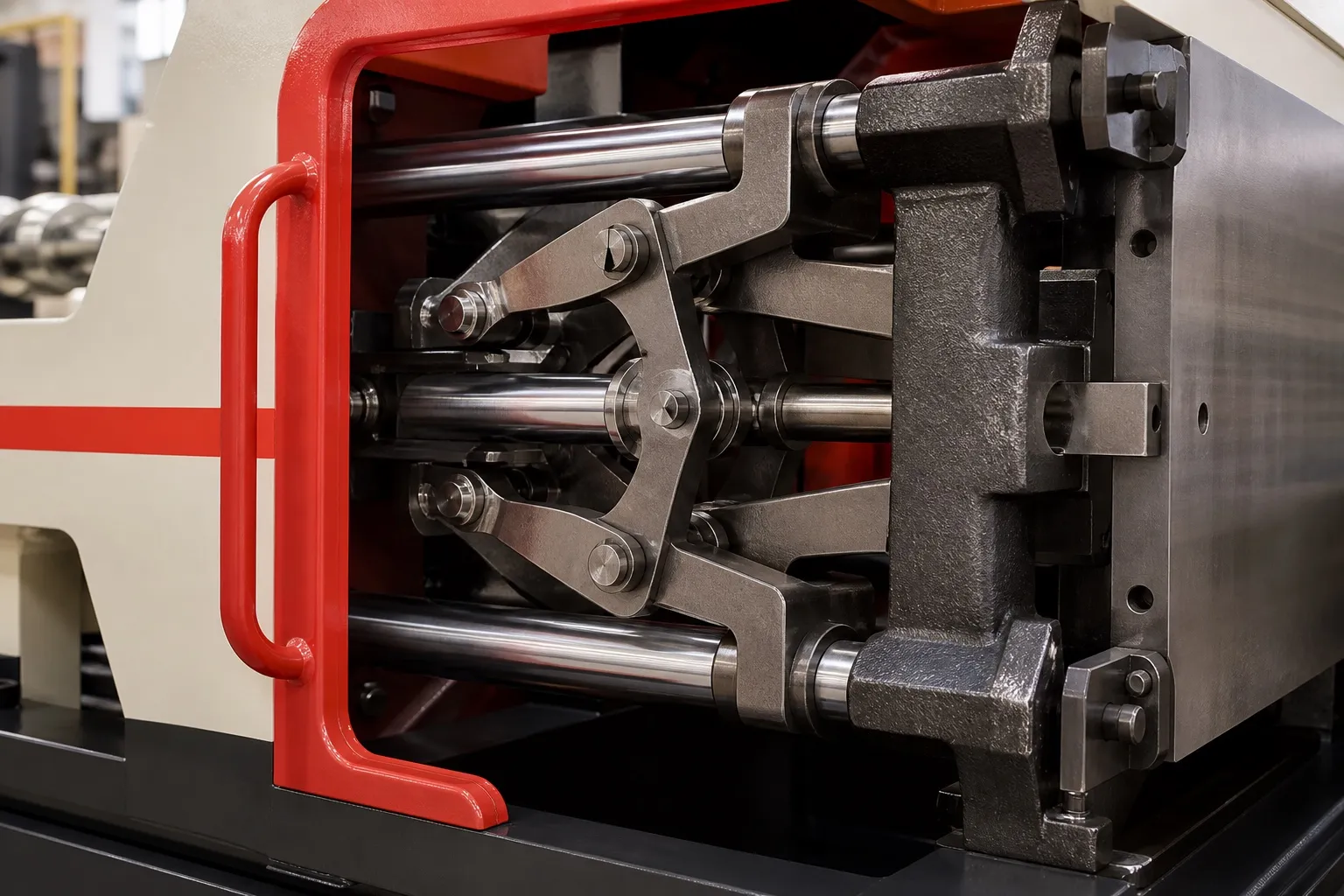
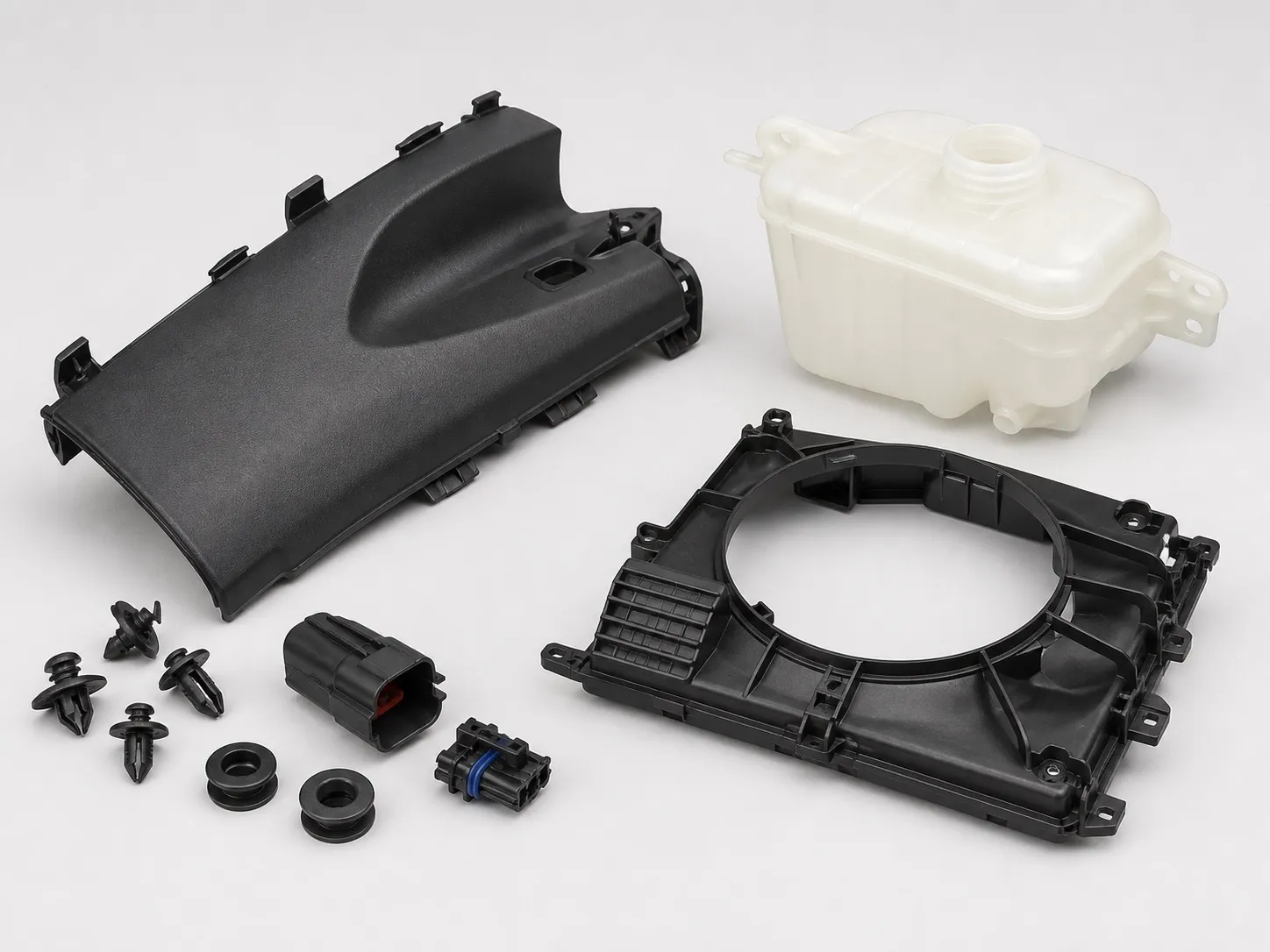
Short answer: a 125 t clamp suits medium parts and multi-cavity small parts whose projected area times the resin's tonnage factor stays under about 114 t. Typical 125 ton injection moulding machine applications include houseware lids and tubs, appliance covers and housings, multi-cavity caps and closures, automotive clips, electrical boxes and irrigation fittings.
In PP, that can mean a part of up to about 400 cm² in one cavity. In a stiffer resin such as PC, taken at a factor of 5, the limit drops to around 160 cm². The resin, the cavity count and the runner decide the answer more than the product name does.
Key Takeaways
- With a 10% reserve, a 125 t clamp covers a projected area of about 404 cm² at a tonnage factor of 2 and about 162 cm² at a factor of 5.
- PP sits at 2 to 3 US t/in², an ABS grade can call for 2 to 4, and PC sits toward the top of the 2 to 8 range, so one mould can fit in one resin and not in another.
- Small parts in many cavities, such as closures and clips, are often limited by mould size, shot and cooling rather than by clamp.
- Food-contact and packaging rules in India can fix the resin grade and recycled content before you size the machine.
Which 125 Ton Injection Moulding Machine Applications Fit Best?
The best fits are jobs that need roughly 60 to 114 t of clamp. Below that, a smaller machine may run the mould at lower cost. Above it, flash and parting-line damage become real risks. Houseware, appliance covers, closures, clips and electrical boxes can land inside this window.
Common 125 t jobs and what usually limits them
| Product family | Common resins | What to check first on a 125 t clamp |
|---|---|---|
| Houseware lids, tubs, storage boxes | PP | Projected area of the widest part, usually the lid |
| Appliance covers and small housings | ABS, PP | Clamp at the higher tonnage factor, mould temperature |
| Multi-cavity caps and closures | HDPE, PP | Cavity count, hot runner, cooling time |
| Automotive clips and fasteners | PA66, POM | Drying, packing time, gate design |
| Electrical boxes and plates | PC, FR grades | Higher tonnage factor, flame rating at the wall used |
| Irrigation fittings and valves | PP, HDPE | BIS standard for the product, core pulls |
Cavity count moves the answer more than the product type does. A cover that needs 55 t in one cavity needs about 110 t in two, before any cold runner is added. The same product can be a comfortable job in one layout and an overloaded one in the next.
Our view is firm: if your calculation lands above about 114 t, do not run the mould on 125 t and hope. Resin lots, melt temperature and vent condition all move the real need, and a machine with no reserve turns small changes into flash.
How Do Resin and Cavity Count Change What Fits?
Stiffer resins need more clamp per square centimetre, so the same mould can fit in PP and fail in PC. More cavities multiply the area, and a cold runner adds its own area on top. Check resin, cavities and runner together before you choose the clamp size.
SPE's Plastics Engineering magazine puts tonnage factors between 2 and 8 US t/in², with polyethylene at the low end, PC toward the top and PP at 2 to 3. INEOS lists 2 to 4 US t/in² for its Lustran ABS 248, a grade it names for small appliance housings and toys.
Those ranges are wide, and the position inside them depends on flow length, wall thickness and gating. The method, the unit conversion and the full table of area limits at 125 t and 150 t are in the projected area article in this series.
Melt flow index helps only inside one resin family. A 12 MFR PP flows more easily than a 4 MFR PP, but you cannot compare a PP figure with a PC figure and draw a conclusion about clamp.
Which Parts Outgrow a 125 Ton Clamp?
Wide, flat parts outgrow it first, because projected area grows with length times width. Large trays, crate sides and big lids can pass 400 cm² even in PP. Thin walls with long flow paths also need a higher tonnage factor, which shrinks the area a 125 t clamp can hold.
Deep parts are a different case. A tall container can have a small projected area and fit the clamp easily, yet need more opening stroke and mould height than the machine offers. Check stroke, daylight and tie-bar space on the drawing before you look at clamp at all.
Heavy parts can also outgrow the injection unit before the clamp. The shot has to use a sensible share of barrel capacity, neither a tiny fraction nor nearly all of it, so a thick, heavy part in a small barrel can run short on melt quality even when the clamp is fine.
Closures and clips sit at the other extreme: small areas, many cavities. They are covered in the closure and clip articles in this series.
Which Indian Rules Shape the Parts You Plan to Mould?
Rules on food contact and packaging can decide your resin grade, and with it your tonnage factor and processing window. In India, food-contact PP grades are made to standards such as IS 10910, and rigid plastic packaging now carries recycled-content targets under the amended Plastic Waste Management Rules.
Reliance's Repol H110MAS is an example of a local grade built for this work. Reliance describes it as a nucleated PP homopolymer for rigid packaging, furniture and houseware, with an MFR of 11 g/10 min and compliance with IS 10910 for food contact.
For rigid packaging, the March 2026 amendment sets at least 30% recycled content for 2025-26, rising to 60% by 2028-29, with exemptions where food rules restrict recycled material. If recycled PP enters your blend, run trials early, because flow and colour can shift between lots and change the process window.
What Should You Do Before Choosing a 125 Ton Machine?
Collect the part drawing or a sample, the exact resin grade, the cavity count, the runner type, the mould's outside size and shut height, and your monthly quantity. With those, clamp, shot and mould fit can be checked on paper first. See the 125 ton horizontal injection moulding machine page.
Frequently Asked Questions About 125 Ton Injection Moulding Machine Applications
Is a 125 ton machine a good first machine for a new unit?
It can be, if your planned parts land between about 60 and 114 t of clamp. That range covers many houseware, appliance and packaging jobs. List the three or four parts you expect to run most, check each one's clamp and shot, and size for the one you will run most hours.
Can a 125 ton machine mould a bucket?
It depends on the bucket's size and the resin. The clamp sees the opening's projected area, which can be modest, but a tall bucket needs a long opening stroke and enough daylight to eject it. Check stroke, mould height and shot weight against the bucket before you look at clamp.
Does the colour or masterbatch change the clamp needed?
Rarely by much, but it can change the process. Some pigments shift flow, shrinkage or thermal stability, and high masterbatch loadings can alter how the melt fills thin sections. Run trials with the actual colour before you lock cycle time or cavity count for a new product.
Can I run PC and PP on the same 125 ton machine?
Yes, with planning. PC needs drying, higher melt and mould temperatures, and a higher tonnage factor, so a mould that fits in PP may need fewer cavities in PC. Purge thoroughly between resins, and check that your dryer and mould temperature controller cover both.
What does a 10% clamp reserve protect against?
It covers normal variation that raises the force pushing the mould open, such as a hotter melt, a new resin lot or a partly blocked vent. It is a starting margin, not a rule. Very consistent processes may use less, while thin walls or uncertain factors may justify more.
Related Articles
- Multi-Cavity Closure Moulds on a 125 Ton Machine
- 125 Ton vs 150 Ton: Sizing a Machine by Projected Area
- Moulding Automotive Clips and Fasteners on a 125 Ton Machine
Sources & References
- Plastics Engineering (SPE), A. Urbina: Mastering Clamping Force Calculation
- INEOS ABS via UL IDES: Lustran ABS 248 technical data sheet
- Reliance Industries: Repol H110MAS technical data sheet (July 2024)
- Polymerupdate, D. K. Jha: India eases plastic recycling regulations (8 April 2026)
Technical Disclaimer
Disclaimer: The information provided in this document is for general informational and educational purposes only. It is based on technical references and industry information available at the time of preparation and may be subject to change. It does not constitute engineering, technical, commercial or professional advice, nor does it constitute a quotation, specification, warranty or contractual commitment by Pratishna Engineers.
Actual injection moulding machine and process requirements vary according to the component design, material, mould, production volume, machine configuration and operating conditions. The information, examples, calculations and recommendations provided should be independently evaluated and verified for the specific application before making any equipment, process or production decision. Information obtained from third-party sources remains subject to the accuracy and limitations of those sources.
Limitation of Liability: Pratishna Engineers makes no representation or warranty, express or implied, regarding the completeness, accuracy or suitability of the information for any particular application. To the extent permitted by applicable law, Pratishna Engineers shall not be liable for any loss, damage, cost or consequence arising from reliance on or use of the information contained in this document. Final machine selection, configuration and application suitability should be confirmed with Pratishna Engineers based on complete and accurate project requirements.