






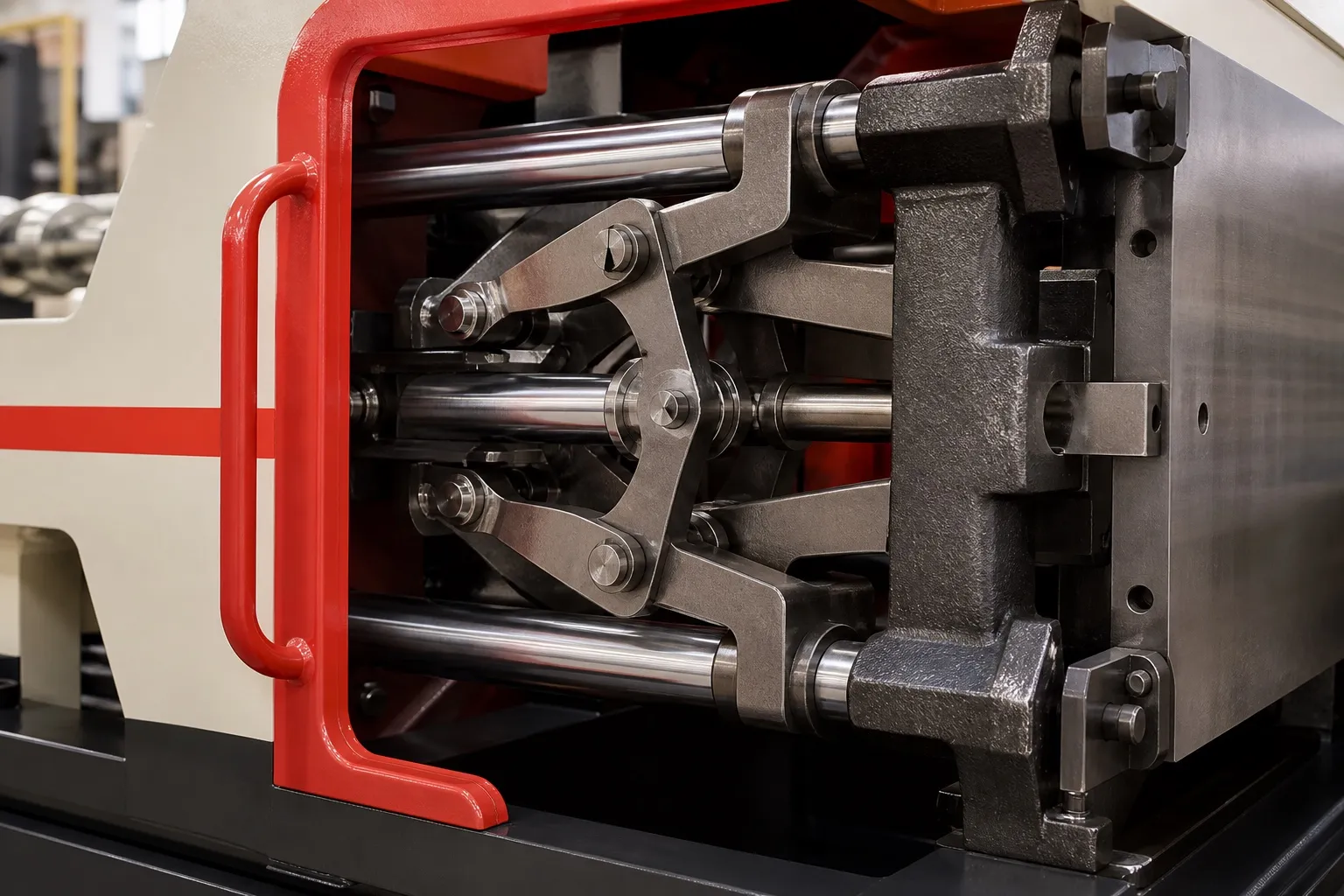

A 16-cavity mould for 20 g water bottle preforms needs roughly 61 to 106 t of clamp, a barrel rated at least about 445 g of PS, and 160 to 192 g/s of injection rate. On a 14 s cycle it gives around 4,000 preforms an hour. That is how you size a PET preform making machine: start from the preform and the cavity count, then work out clamp, shot, output and utilities in that order. The figures above rest on stated assumptions, and the worked example near the end shows every step.
Tonnage on its own tells you little. Two presses with the same clamp can suit very different preforms, because the barrel, the injection rate and the dryer decide whether that clamp is ever put to use.
Key Takeaways
- Clamp follows the projected area of the neck support ledge times the cavity count, not the preform weight.
- The shot should use about 20% to 65% of barrel capacity; for PET, the barrel needs a PS rating of at least about 1.39 times the shot weight.
- Output is 3,600 divided by the cycle in seconds, times cavities, times the share of good shots, and the cycle follows wall thickness.
- Size the dryer, chilled water and injection rate with the machine, because any one of them can cap output before the clamp does.
How much clamp force does a PET preform making machine need?
Start with projected area: for a preform, the circle of its neck support ledge, multiplied by the number of cavities. Multiply the area by a pressure factor and add a reserve. A 33 mm ledge projects about 8.55 cm², so 16 cavities project about 137 cm².
Two factors bracket the answer. The guide value of 400 bar cavity pressure, used where no material data exist, works out to 0.408 t/cm². A cautious 5 US t/in², taken from the 2 to 8 US t/in² range quoted for different materials, is 0.703 t/cm². Add a 10% reserve on top of either; treat that as a starting margin, not a rule.
Preform moulds have deep cores and long, narrow cavities, so their projected area is small for the shot weight they carry. A preform press can therefore run short of shot or injection rate well before it runs short of clamp.
Too much clamp has a cost as well. Excess clamp force can crack cylinder mounting plates, deform platens and, at the mould, crush the vents.
Clamp needed by cavity count, 33 mm neck support ledge (assumed), with a 10% reserve
| Cavities | Projected area (cm²) | At 400 bar guide (t) | At 5 US t/in² (t) |
|---|---|---|---|
| 8 | 68.4 | 30.7 | 52.9 |
| 16 | 136.8 | 61.4 | 105.8 |
| 24 | 205.3 | 92.1 | 158.7 |
| 32 | 273.7 | 122.8 | 211.6 |
What shot size and barrel suit your preform weight?
Multiply preform weight by cavities to get the shot, then check that it uses about 20% to 65% of the barrel. Below it the melt degrades; above it, melting turns uneven. For PET, the barrel PS rating should be roughly 1.39 to 4.5 times the shot weight.
Shot ratings are usually given in grams of PS, so convert before you compare. PS melt is about 0.945 g/cm³ and PET melt about 1.15 g/cm³, so a barrel holds about 1.22 times its PS rating in PET. Add 10% for check ring leakage and melt uniformity, then keep the result inside the window.
With PET, the low end of the window matters more than the high end. A small shot in a big barrel means long residence time, and residence time drives acetaldehyde, as the lightweighting article in this series explains. If you plan to run light pharma preforms and heavy 2 litre preforms on one press, a second barrel ordered with the machine can cost less than a compromise screw.
How do cavities and cycle time set hourly output?
Hourly output is 3,600 divided by the cycle time in seconds, times cavities, times the share of good shots. A 16-cavity mould on a 14 s cycle at 98% good shots gives 4,032 preforms an hour. On a 14 s cycle, every extra second costs about 6.7% of output.
Wall thickness, not weight, sets most of the cycle, because cooling time rises with the square of the wall. In-mould cooling for preforms is typically about 1 to 3 s, depending on wall, with mould water at 7 to 10 °C. The rest of the cycle is mould movement, take-out and screw recovery.
More cavities raise output only if the machine keeps pace. Each cavity needs its share of injection rate, so a 32-cavity mould needs twice the rate of a 16-cavity mould running the same preform. It also doubles the load on the dryer and the take-out tubes.
Preforms per hour at 98% good shots (calculated)
| Cavities | 12 s cycle | 14 s cycle | 16 s cycle |
|---|---|---|---|
| 8 | 2,352 | 2,016 | 1,764 |
| 16 | 4,704 | 4,032 | 3,528 |
| 24 | 7,056 | 6,048 | 5,292 |
| 32 | 9,408 | 8,064 | 7,056 |
What else must be sized with the machine?
The dryer, the chilled water supply and the injection rate. Each can cap output before the clamp does. A preform line needs dry resin at every shot, cold mould water at a steady flow, and enough injection speed to fill every cavity within the time the cycle allows.
PET is hygroscopic, and the moisture limit at the extruder throat is 50 ppm. Indian bottle grades such as Relpet G5761 are packed with moisture below 0.2%, which is about 2,000 ppm, so a desiccant dryer is part of the machine, not an extra. The hopper must hold the hourly throughput times the residence time; the rPET article in this series covers drying hours, dew point and IV checks.
For injection rate, a working figure for preforms is about 10 to 12 g/s per cavity. Faster than that and preforms can flash; slower, and the rate starts to limit how many cavities the press can fill well. Water flow to the mould and to the robot cooling tubes should match the mould maker's rating.
Our view is plain: choose the mould first and the machine second. Pick tonnage first and you may end up changing the mould to fit the press.
What should you send before asking for a machine quote?
Send the preform drawing with weight and neck finish, the cavity count you have in mind, the target cycle or hourly output, the resin grade, and the dryer and chiller capacity you already have. With these, clamp, barrel and injection rate can be checked before anyone talks about models. See the PET injection moulding machine range.
Frequently Asked Questions About Sizing a PET Preform Machine
Is a general-purpose injection moulding machine suitable for PET preforms?
It can melt PET, but preforms also need a screw suited to PET, barrel and nozzle heating for a melt of about 280 °C, hot runner temperature zones, a desiccant dryer and a take-out system with cooling. Without these, acetaldehyde, IV loss and haze become hard to control, so check each item before converting a general machine.
How many cavities should a first preform mould have?
There is no fixed number. Start from the hourly output you need, the cycle your wall allows and the shot window of the barrel. A lower cavity count is easier to balance and maintain, and a second mould can follow later. One practical approach is to choose a count that your existing dryer and chiller can support.
Does preform weight decide the machine tonnage?
Not directly. Clamp depends on projected area, which for a preform is the neck support ledge, multiplied by cavities. Weight decides the shot and the barrel. A heavy 2 litre preform and a light 500 ml preform on the same neck can need similar clamp per cavity but very different barrels and injection rates.
Can one machine run both preforms and closures?
It is possible, but the two jobs pull in different directions. Closures in HDPE or PP run short cycles and need no drying, while preforms need dry PET, a PET screw and close control of residence time. A barrel change helps, yet mould heights, ejection and take-out also differ, so check both moulds against the machine.
What utilities does a preform machine need besides electric power?
Chilled water at about 7 to 10 °C for the mould and take-out tubes, at the flow the mould maker specifies; compressed air for the valve gates, typically 8 to 10 bar; and a desiccant dryer with its own power and air supply. Plan floor space and cooling tower capacity for all of them along with the press.
Related Articles
- Moulding With rPET: Meeting India's Recycled Content Rules for PET Bottles
- Lightweighting PET Preforms: Wall Thickness, Cycle Time and Machine Settings
- PET Preform Neck Finishes Explained: PCO 1881, 26/22 and Wide Mouth
Sources & References
- SPE Plastics Engineering, A. Urbina: Mastering Clamping Force Calculation (Mar 2024)
- Plastics Technology, J. Bozzelli: A Simpler Way to Calculate Shot Size vs. Barrel Capacity
- PETplanet Insider, R. Unterlander and O. Brandau: The Rapid Guide to Perfect Preforms, part 34: Wavy Body (Nov 2012)
- Reliance Industries: Relpet G5761 Technical Data Sheet (Aug 2022)
Technical Disclaimer
Disclaimer: The information provided in this document is for general informational and educational purposes only. It is based on technical references and industry information available at the time of preparation and may be subject to change. It does not constitute engineering, technical, commercial or professional advice, nor does it constitute a quotation, specification, warranty or contractual commitment by Pratishna Engineers.
Actual injection moulding machine and process requirements vary according to the component design, material, mould, production volume, machine configuration and operating conditions. The information, examples, calculations and recommendations provided should be independently evaluated and verified for the specific application before making any equipment, process or production decision. Information obtained from third-party sources remains subject to the accuracy and limitations of those sources.
Limitation of Liability: Pratishna Engineers makes no representation or warranty, express or implied, regarding the completeness, accuracy or suitability of the information for any particular application. To the extent permitted by applicable law, Pratishna Engineers shall not be liable for any loss, damage, cost or consequence arising from reliance on or use of the information contained in this document. Final machine selection, configuration and application suitability should be confirmed with Pratishna Engineers based on complete and accurate project requirements.

