






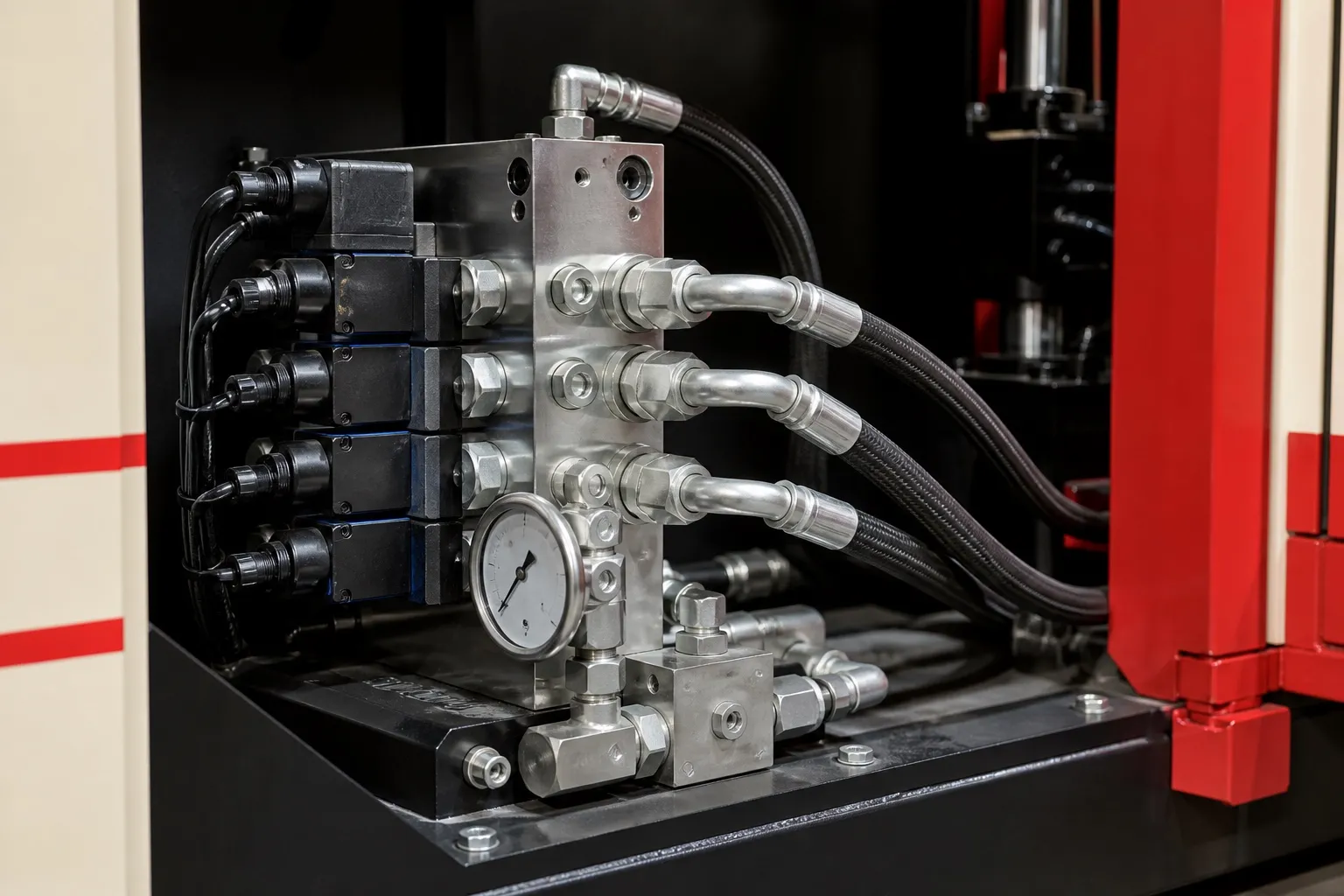

Take a 700 g PP dustbin shot (an assumed figure). At PP's melt density of about 0.74 g/cm³, that is about 946 cm³ of melt. Filling it in 2.0 s needs about 473 cm³/s at the screw. With an assumed 10:1 intensification ratio, the injection cylinder needs ten times that in oil, about 284 L/min, and at 140 bar that is about 66 kW of hydraulic power while filling.
That is the core of pump flow injection moulding on a large household machine. Pump flow sets how fast the machine can fill, open, close and eject. Cooling, which pump flow cannot shorten, often sets the rest of the cycle on thick household parts.
Key Takeaways
- Oil flow equals injection rate times the intensification ratio, so a 10:1 unit needs 10 cm³ of oil for each cm³ of melt.
- Hydraulic power in kW equals pressure in bar times flow in L/min, divided by 600.
- On thick household parts, a thinner wall can raise output more than a larger pump.
- Older fixed-speed, fixed-volume pump drives have very high energy demand; variable-speed and servo pump drives can cut it.
How Does Pump Flow Set Injection Speed?
The pump pushes oil into the injection cylinder, and the screw moves the melt. Injection rate in cm³/s equals oil flow divided by the intensification ratio, the ram area over the screw area. A machine fills faster only if the pump, or an accumulator, can deliver more oil.
John Bozzelli explains the intensification ratio in Plastics Technology. Machines range from 6:1 to 43:1, and the ratio changes with screw size on the same injection unit. He describes a mould that needed about 1,585 bar of plastic pressure: it would not fill on a machine with 1,380 bar available but filled on one with 2,014 bar.
Power follows from flow and pressure. One bar acting on one litre per minute is 100,000 Pa × 1/60,000 m³/s, or about 1.67 W, so kW equals bar times L/min divided by 600. The table applies that to the 700 g shot.
Oil flow and hydraulic power to fill a 700 g PP shot (946 cm³ of melt) at different fill times, assuming a 10:1 intensification ratio and 140 bar hydraulic pressure
| Fill time | Injection rate | Oil flow | Hydraulic power |
|---|---|---|---|
| 1.5 s | 631 cm³/s | 378 L/min | 88 kW |
| 2.0 s | 473 cm³/s | 284 L/min | 66 kW |
| 3.0 s | 315 cm³/s | 189 L/min | 44 kW |
| 4.0 s | 236 cm³/s | 142 L/min | 33 kW |
How Much of the Cycle Does Pump Flow Injection Moulding Control?
Fill, mould opening and closing, ejection, and screw recovery when recovery outlasts cooling. It does not shorten packing or cooling, which depend on the part and the mould. On a thick dustbin or tub, those fixed phases can take most of the cycle, so pump gains are limited.
Cooling time rises with the square of wall thickness. A wall 10% thinner needs about 19% less cooling, because 0.9² is 0.81. On a 50 s cycle with 32 s of cooling, that saves about 6 s, more than a faster pump can save on fill and movements together, as the worked example shows.
Screw recovery is the case to watch. Recovery normally runs during cooling, but a heavy shot on a large barrel can take longer to plasticise than the part takes to cool. The cycle then waits for the screw, and the pump or screw drive becomes the limit.
Our view: on large household machines, buy pump flow for the fill speeds and movement times your moulds need, then spend the rest on cooling: mould water, chillers and wall design. A larger pump cannot shorten 30 s of cooling.
What Do Pump Type and Base Load Do to Energy Cost?
A fixed pump delivers full flow whether the cycle needs it or not, so it wastes energy during cooling and holding. Variable-volume pumps, variable-speed motors and servo-driven pumps cut flow when oil is not needed, which lowers the machine's base load and the plant's bill.
Robin Kent of Tangram Technology, in an SPE Plastics Engineering energy tip, calls the motors of hydraulic machines the largest energy users in the system. He notes that older machines with fixed-speed, fixed-volume pumps have very high demand, and that retrofits with variable-speed motors, variable-volume pumps or servo-driven pumps can cut energy use sharply.
The ExxonMobil, AMI and Tangram energy guide for moulders adds that a standard hydraulic machine's base load can be 75% or more of its total energy, against about 10% to 20% for all-electric and hybrid machines. It also notes that a high base load can mean the machine is too large for the job.
How Does Power Factor Billing Affect a Large Machine?
Where the supply is billed on kVAh, poor power factor raises the energy bill directly. MSEDCL's guidance notes that at a power factor of 0.85, 15% of the power drawn does no useful work. Large hydraulic motors make power factor correction worth checking.
MSEDCL charges demand on kVA and energy on kVAh, and recommends capacitors or APFC panels. MERC intended kVAh billing for all HT consumers and LT consumers above 20 kW from 1 April 2020. Check your latest bill for the basis and rates that apply to your connection.
What Should You Check Before Choosing Pump Flow?
List the shot weight, wall thickness, target fill time and current cycle breakdown for your heaviest moulds, then work out oil flow and power from the formulas above. Compare that with cooling time before paying for flow you cannot use. See the 260 ton horizontal injection moulding machine page.
Frequently Asked Questions About Pump Flow and Cycle Time
What is an accumulator, and do household machines need one?
An accumulator stores pressurised oil and releases it during injection, giving more flow for a short time than the pump can supply alone. It suits thin-wall parts with fill times under a second. Thick household parts that fill in two to four seconds can often be served by the pump alone.
Does a bigger screw need more pump flow?
For the same injection rate, a bigger screw on the same injection cylinder lowers the intensification ratio, so each cm³ of melt needs less oil, but the maximum plastic pressure falls. Bozzelli notes that the ratio changes with screw size, so check both flow and pressure when choosing a screw.
How can I measure what my machine actually draws?
Use a clamp-on power meter or data logger on the machine supply and record several full cycles, so peaks and averages both show. Log the same job before and after any change, such as a pump retrofit or a new mould water setting, so you compare like with like.
Is a servo-driven pump worth it for household parts?
It depends on hours run and the jobs, but energy adds up: the ExxonMobil, AMI and Tangram guide notes that ten-year energy cost exceeds purchase cost in almost every case. Compare measured kWh per kg on similar jobs, and include any retrofit option for existing machines.
Does faster injection always shorten the cycle?
Only by the seconds saved in fill, which are few on a thick part. Faster fill can also raise shear heating and cause flash or burns. Set injection speed for part quality first, then look for cycle time in cooling, mould movements and screw recovery.
Related Articles
- What Can You Make on a 260 Ton Household Moulding Machine?
- Dustbins and Large Storage Boxes on a 260 Ton Machine
- Large Flat Trays Without Warp on a 260 Ton Machine
Sources & References
- Plastics Technology, J. Bozzelli: Understanding Intensification Ratio
- SPE Plastics Engineering, R. Kent (Tangram Technology): Energy-Saving Tip 67: Injection Molding: get the right motor (Sept 2016)
- ExxonMobil, AMI and Tangram Technology: An Energy Saving Guide for Injection Moulders
- MSEDCL: kVAh Billing: Frequently Asked Questions
Technical Disclaimer
Disclaimer: The information provided in this document is for general informational and educational purposes only. It is based on technical references and industry information available at the time of preparation and may be subject to change. It does not constitute engineering, technical, commercial or professional advice, nor does it constitute a quotation, specification, warranty or contractual commitment by Pratishna Engineers.
Actual injection moulding machine and process requirements vary according to the component design, material, mould, production volume, machine configuration and operating conditions. The information, examples, calculations and recommendations provided should be independently evaluated and verified for the specific application before making any equipment, process or production decision. Information obtained from third-party sources remains subject to the accuracy and limitations of those sources.
Limitation of Liability: Pratishna Engineers makes no representation or warranty, express or implied, regarding the completeness, accuracy or suitability of the information for any particular application. To the extent permitted by applicable law, Pratishna Engineers shall not be liable for any loss, damage, cost or consequence arising from reliance on or use of the information contained in this document. Final machine selection, configuration and application suitability should be confirmed with Pratishna Engineers based on complete and accurate project requirements.


