






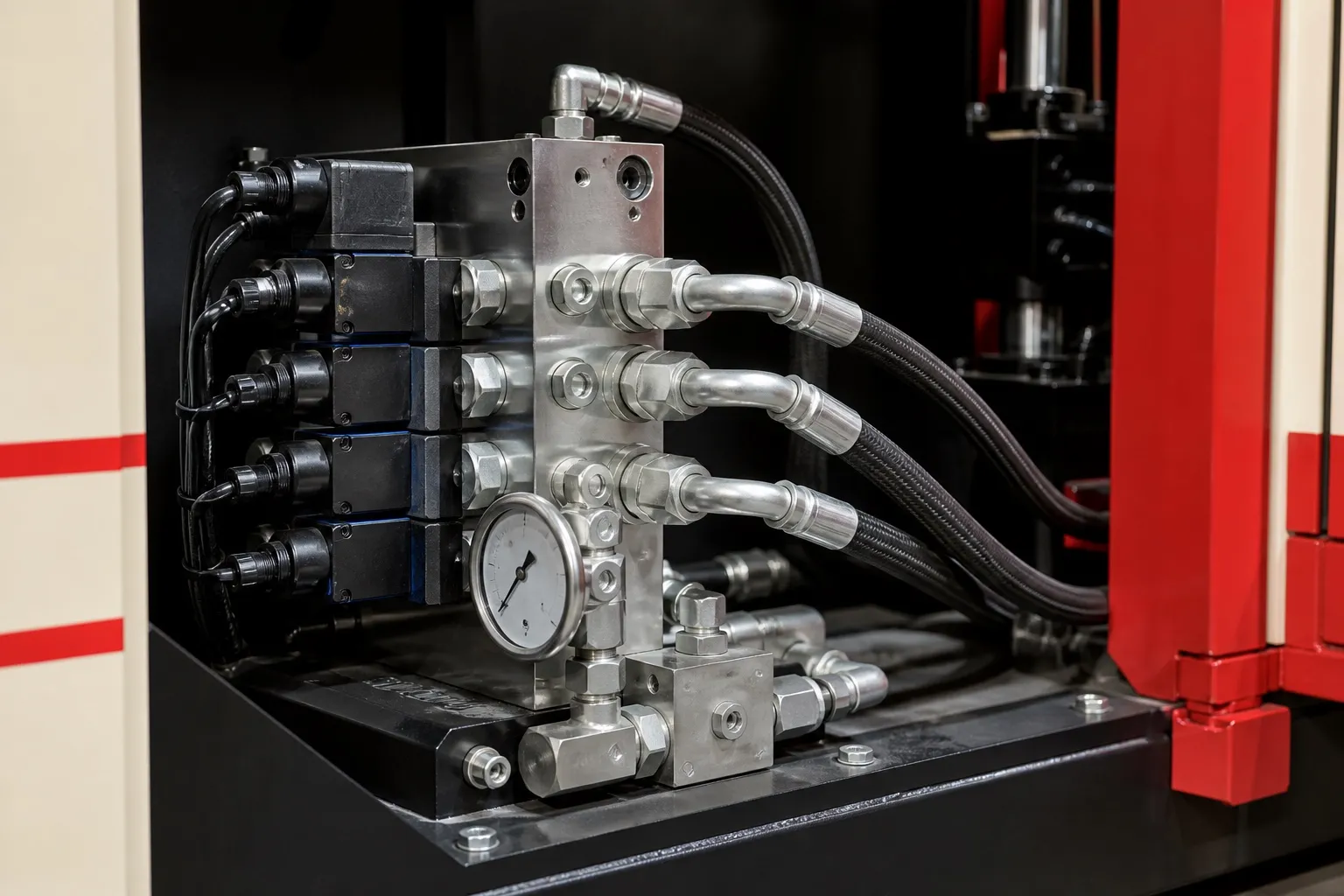

Clip a power logger on an older hydraulic machine running a thick bucket on a long cycle, and the reading barely drops between injection and cooling. That flat line is the waste. A servo pump injection moulding machine runs its hydraulic pump at the speed each phase needs, so the draw falls during cooling and hold instead of staying near peak. The savings come from three places: less oil dumped over relief valves, less heat for the oil cooler to remove, and lower draw while the machine idles. How much you save depends on how much of your cycle is low-demand time.
Key Takeaways
- A fixed pump on a fixed-speed motor draws close to peak power for the whole cycle, and surplus oil crosses a relief valve as heat.
- A servo pump matches pump speed to demand, so the savings come mostly from cooling, hold and idle time rather than injection.
- In one measured case, slowing a fixed pump only during screw rotation cut average power per cycle by about a third.
- Under kVAh billing in Maharashtra, compare power factor as well as kW when you judge a machine's running cost.
Where does a fixed pump waste power?
A fixed-displacement pump on a fixed-speed motor delivers full flow all cycle, even when the machine needs almost none. Electric power stays roughly constant, at no less than the peak hydraulic demand plus losses. Surplus oil goes over a relief valve and turns into heat.
Look at what a cycle needs. Mould close, injection and hold need flow and pressure for a few seconds. During cooling, the clamp only has to hold while the screw recovers, and demand drops further once recovery ends. In a university study of a 54.5 s cycle, about 4 kW of hydraulic power was being dumped across a relief valve during screw rotation, with about 4.5 kW more split between clamp hold and a second relief valve.
That heat goes into the oil, then into the oil cooler and the cooling water. You pay for it twice: once at the motor and again at the cooling tower or chiller.
Hydraulic demand by cycle phase, fixed pump against servo pump
| Cycle phase | Hydraulic demand | Fixed pump | Servo pump |
|---|---|---|---|
| Mould close and open | High flow, moderate pressure | Full speed | Fast |
| Injection | High flow, high pressure | Full speed | Full speed |
| Hold | Low flow, high pressure | Full speed, surplus over relief valve | Slow, holding pressure |
| Screw recovery | Moderate flow (hydraulic screw drive) | Full speed | Reduced speed |
| Cooling only | Clamp hold only | Full speed, surplus becomes heat | Near standstill |
| Idle | None | Full speed if left running | Near standstill |
How does a servo pump injection moulding machine cut that waste?
It changes pump speed instead of throwing oil away. A servo motor drives the pump at whatever speed the cycle needs: fast during injection, slow while holding pressure, almost stopped during pure cooling. Flow follows demand, so less oil crosses the relief valve and less power becomes heat.
The same idea works with a variable frequency drive on an ordinary motor, with slower response. In the study above, the team cut motor frequency from 60 Hz to 36 Hz only during screw rotation. Average power per cycle fell from 13.9 kW to 9.1 kW on one meter and from 14.4 kW to 9.7 kW on the other. That is a saving of 4.7 to 4.8 kW, or about 33 to 35%.
A servo drive goes further because the motor can run slowly and still respond fast when the next injection starts. Energy guides put the base load of standard hydraulic machines at 75% or more of total energy, against about 10 to 20% for all-electric and hybrid machines. A pump that slows down attacks that idle share on a hydraulic machine.
How much will a servo pump save on your jobs?
It depends on how much of your cycle runs at low hydraulic demand. Long cooling phases on thick parts give the biggest savings; short, fast cycles that inject and move almost continuously give the smallest. Measure your own cycle before trusting any percentage, including the ones here.
Cooling time grows quickly with wall thickness, so thick-walled buckets, crates and furniture parts spend long periods where a fixed pump runs for nothing. The study's authors make the same point: savings scale with the share of the cycle at minimal demand and with how many hours the machine runs each year.
Our flat opinion: a 30-minute power log on your own job is worth more than any brochure percentage. Clamp-meter data loggers can capture a machine's draw in that time, and heater load can be averaged over 10 to 15 minutes. Idle time counts too. Idling machines have been measured drawing 52% to 97.5% of their full moulding energy, and one hydraulic machine used 22% less energy with its variable frequency drive switched on.
What else changes besides the energy bill?
Oil temperature, cooling load and the way the utility bills you. Less oil over the relief valve means less heat in the tank and a lighter load on the oil cooler. In Maharashtra, kVAh billing also makes power factor part of the bill, so check how the drive affects it.
MSEDCL bills HT consumers and larger LT consumers on kVAh, with demand charges on kVA. At a power factor of 0.85, 15% of the power drawn does no useful work. For every 100 kWh you are billed about 117.6 kVAh at 0.85 and about 105.3 kVAh at 0.95, so ask what power factor the drive presents and whether an APFC panel is needed.
One caution from the study: pumps have a minimum safe speed. A drive setting that ran the pump below about 240 rpm was linked to pump and motor failures, and the team settled on about 720 rpm for that system. A servo package must be matched to its pump, not bolted on.
What should you check before choosing a servo-pump machine?
Log the power of your current machine on your main job, note the cycle phases and running hours, and ask for the expected power profile on the same cycle. Then compare kVAh, not just kW. See the horizontal injection moulding machine range.
Frequently Asked Questions About Servo Pumps
Can an older hydraulic machine be converted to a servo pump?
A retrofit is possible on some machines, but it has to be engineered for that pump and control. Pumps have a minimum safe speed; in one study a setting below about 240 rpm was linked to pump and motor failures. Ask for the pump's speed limits, the control changes needed and a measured before-and-after power log.
Does a servo pump make the machine faster?
Not by itself. Cycle time is set mostly by cooling, injection and mould movement. A servo pump can respond quickly when demand rises, which helps repeatability, but energy saving is the main reason to choose one. Judge any speed claim on a measured cycle with your own mould and resin.
Why does the hydraulic oil run cooler with a servo pump?
Because less oil is forced over the relief valve. On a fixed pump, surplus flow is throttled across the valve and its energy becomes heat in the oil, which the oil cooler then removes with cooling water. When the pump slows down instead, that heat is never made, so the cooling load falls.
How do I measure my machine's actual energy use?
Put a clamp-meter data logger on the machine's supply while it runs your main job. A log can capture the machine's draw in as little as 30 minutes, and heater load is best averaged over 10 to 15 minutes. Repeat the log after any change so you compare the same job and cycle.
Should a machine be switched off during long breaks?
For long stoppages, it can pay. Idling machines have been measured drawing 52% to 97.5% of their full moulding energy, and idle periods longer than about 1.5 hours may cost less to shut down and restart. Check barrel heat-up time and purging needs for your resin before making it a rule.
Related Articles
- Choosing a Horizontal Injection Moulding Machine: Match the Machine Family to the Part
- How to Size a Horizontal Machine From Your Mould: Tie Bars, Daylight and Shot Weight
- Toggle Clamping on Horizontal Machines: Speed, Stroke and Tonnage
Sources & References
- S. Williams, G. Wrate, T. Wanke, M. Scheuerell (Milwaukee School of Engineering), ASEE Annual Conference: Energy Savings in Injection-Molded Plastic Manufacturing (2004)
- ExxonMobil, AMI and Tangram Technology: An Energy Saving Guide for Injection Moulders
- PlasticsToday, R. Kent: Getting to know your real energy use and cost (Jan 2010)
- MSEDCL: kVAh Billing: Frequently Asked Questions
Technical Disclaimer
Disclaimer: The information provided in this document is for general informational and educational purposes only. It is based on technical references and industry information available at the time of preparation and may be subject to change. It does not constitute engineering, technical, commercial or professional advice, nor does it constitute a quotation, specification, warranty or contractual commitment by Pratishna Engineers.
Actual injection moulding machine and process requirements vary according to the component design, material, mould, production volume, machine configuration and operating conditions. The information, examples, calculations and recommendations provided should be independently evaluated and verified for the specific application before making any equipment, process or production decision. Information obtained from third-party sources remains subject to the accuracy and limitations of those sources.
Limitation of Liability: Pratishna Engineers makes no representation or warranty, express or implied, regarding the completeness, accuracy or suitability of the information for any particular application. To the extent permitted by applicable law, Pratishna Engineers shall not be liable for any loss, damage, cost or consequence arising from reliance on or use of the information contained in this document. Final machine selection, configuration and application suitability should be confirmed with Pratishna Engineers based on complete and accurate project requirements.


