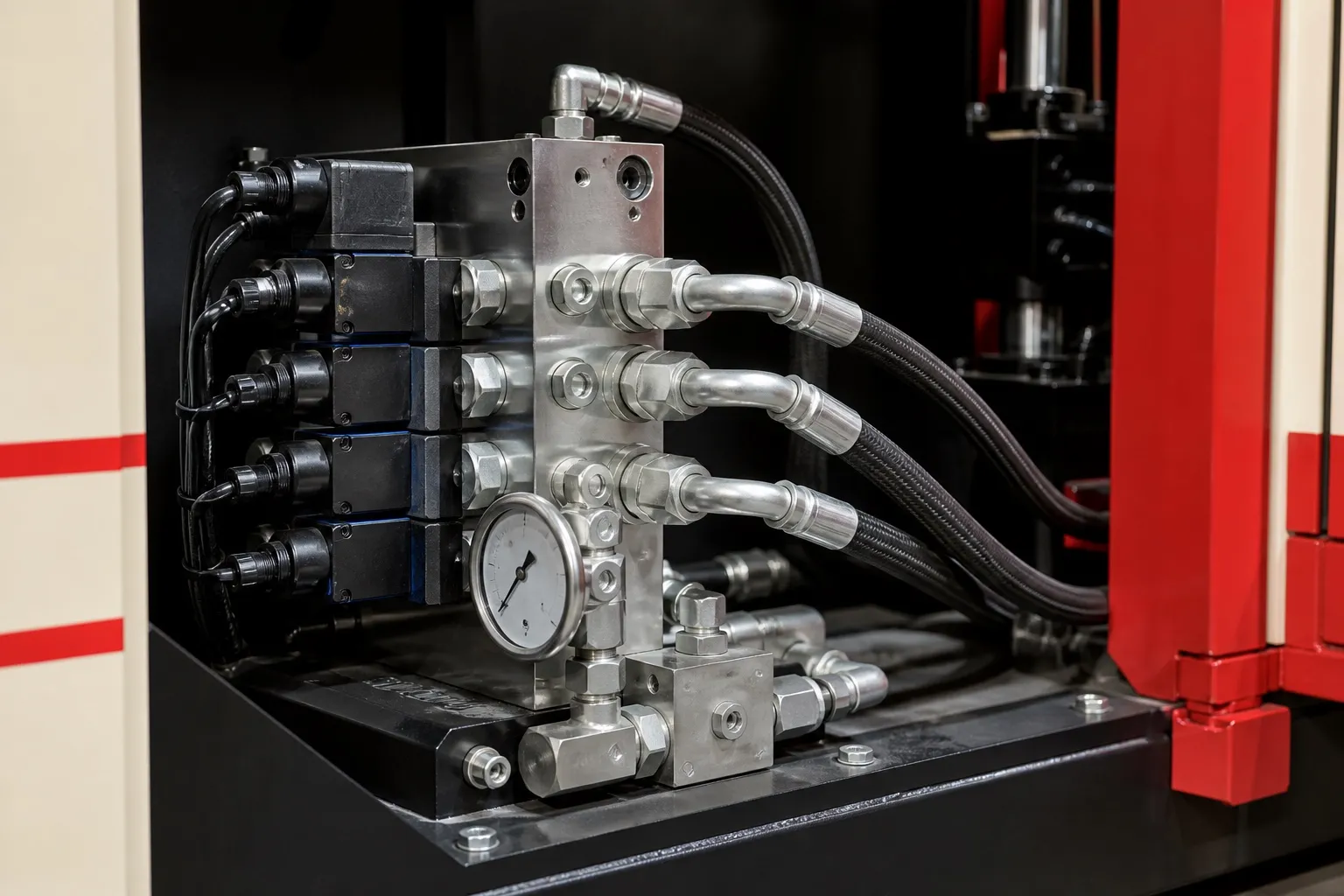
Toggle clamping injection moulding machines compared with direct hydraulic and two-platen clamps
| Factor | Toggle clamp | Direct hydraulic or two-platen clamp |
|---|---|---|
| Lock-up and opening | Reported slightly faster lock-up (about 0.2 s claimed) and greater opening force | Reported about 0.5 s lock-up; finer pressure control reported |
| Opening stroke | Full stroke at every shut height | Piston type: maximum stroke only at minimum shut height |
| Tonnage setting | Set by die-height adjustment; reportedly harder to run below maximum | Set by hydraulic pressure; more uniform pressure reported |
| Force on the platen | Mostly applied near the corners; more deflection possible | Applied through cylinders |
| Machine length | Longer | Two-platen designs mostly shorter |
A toggle clamp closes the mould through a linkage that straightens as the platen reaches the mould. Near lock-up, a modest cylinder force becomes full clamp tonnage and the links lock. You get fast movement and full opening stroke at any mould height. The weak points are tonnage setting and linkage wear.
Key Takeaways
- A toggle multiplies a modest cylinder force into full clamp tonnage as the links straighten, so the platen is fast mid-stroke and slow near lock-up.
- Tonnage on a toggle comes from tie-bar stretch set by die height, so set and check it with the mould at working temperature.
- Toggles keep full opening stroke at every mould height and reportedly open with more force, which helps on deep parts.
- Linkage wear shows up as lost parallelism and one-sided flash; check pins, bushes and lubrication before blaming the process.
How does a toggle clamp build its tonnage?
Through geometry and tie-bar stretch. As the links straighten, the platen moves less for each millimetre of cylinder travel, so force rises sharply near lock-up. When the links lock, the mould is squeezed and the tie bars stretch slightly. That stretch, set by die height, is your clamp force.
This is why tonnage on a toggle machine is not dialled in like a pressure. The die-height adjustment moves the whole toggle assembly closer to or further from the mould, which decides how far the tie bars stretch at lock-up. A thicker mould, or one that grows as it heats, stretches them further.
Over-clamping is a real risk, not a theory. In one documented case, a mould that needed about 100 tons was clamped at the full 400 tons of the machine, and the cavity block split in two places at a cost of upwards of $100,000. Milder over-clamping shows as burns, gloss changes, crushed vents, a rolled parting line and broken inserts.
Our flat view: set and check toggle tonnage with the mould at running temperature, never cold. Adjusting die height with a cold mould closed can over-clamp once the steel warms and expands.
Why are toggle clamps fast, and where does the speed run out?
The linkage gives the platen a natural speed profile: quick through the middle of the stroke and slow at both ends. Fast travel cuts dry cycle time, while the slow approach protects the mould. The limits are lock-up, the mould protection settings and how quickly the part ejects.
Supplier figures quoted in trade press put toggle lock-up at about 0.2 s against about 0.5 s for a direct hydraulic clamp. Treat those as reported claims, though the direction fits how the linkage moves. As a guide, dry cycles run about 1 to 2.5 s on thin-wall machines and 3 to 5 s on others.
Mould protection takes some of that speed back. The last few millimetres before the halves touch should run at low force, so a trapped part or a stuck slide stops the platen instead of being crushed. The worked example below shows that clamp speed pays mainly on short cycles.
How does stroke work on toggle clamping injection moulding machines?
On a toggle, opening stroke is fixed by the linkage, and the die-height adjustment moves the whole assembly. You get full stroke at every mould height, and maximum daylight equals maximum shut height plus stroke. On a piston clamp, available stroke shrinks as the mould gets thicker.
Opening stroke should be at least 2.5 times the part height, so a 200 mm deep pail needs at least 500 mm of stroke before ejection and robot access. Toggles are also reported to open with more force, which helps pull deep-draw parts off their cores. Paint pails fit this pattern: Reliance lists impact-copolymer PP grades such as Repol C120MN for pails, and their deep walls shrink onto the core.
Where the toggle gives ground is very tall moulds, since daylight is capped by maximum shut height plus a fixed stroke. The mould sizing article in this series shows how to check daylight from the mould drawing.
What wears on a toggle clamp, and how do you spot it?
The pins, bushes and links that carry the clamp force. Uneven wear tilts the moving platen, so the mould no longer closes parallel and flash appears on one side. Grease can also contaminate the mould area. Check parallelism and lubrication on a schedule, not after defects appear.
Toggles mostly apply force near the platen corners, so platen deflection can be higher than on designs that push nearer the centre. For machines under 500 t, parallelism of 0.025 to 0.05 mm is generally acceptable. Record it at tonnage when the machine is new, then compare at each service.
Defenders of the toggle point to reliability, simplicity and rigidity, and those are real strengths. They hold only while the linkage is lubricated, the die height is set correctly and the tonnage is checked with the mould hot.
What should you check before buying a toggle machine?
Check opening stroke against your deepest part, shut-height range against your thinnest and thickest moulds, and how tonnage is set and displayed. Ask how linkage wear and parallelism are monitored. See the horizontal injection moulding machine range.
Frequently Asked Questions About Toggle Clamps
Can a toggle machine run well below its rated tonnage?
It can be set lower through the die-height adjustment, but toggles are reported to be harder to run below maximum tonnage, or to ramp tonnage within a cycle, than direct hydraulic clamps. If many of your moulds need a small fraction of the rated force, check how the machine sets and displays tonnage.
Why should clamp tonnage be set with the mould hot?
Steel grows as the mould heats. If die height is set with a cold mould closed, the warm mould becomes effectively thicker and the toggle stretches the tie bars further at lock-up, raising clamp force above what you set. Set and recheck tonnage once the mould has reached running temperature.
Is a toggle or a hydraulic clamp better for deep parts?
For parts that grip the core, the toggle has two points in its favour: full opening stroke at every mould height and reportedly higher opening force. For very tall moulds, a clamp with more daylight may suit better. Either way, check opening stroke against at least 2.5 times the part depth.
What dry cycle time should I expect from a toggle machine?
As a published guide, dry cycles run about 1 to 2.5 s on machines built for thin-wall work and about 3 to 5 s on others. Measure it on the machine at your mould's opening stroke, because a dry cycle at full stroke differs from one at the stroke your part needs.
What are the signs of a worn toggle linkage?
Flash on one side of the parting line, tonnage readings that drift, knocking near lock-up and grease around the pins all point to wear. Check platen parallelism under clamp; for machines under 500 t, 0.025 to 0.05 mm is generally acceptable. Readings beyond that point to linkage or bush wear.
Related Articles
- Choosing a Horizontal Injection Moulding Machine: Match the Machine Family to the Part
- How to Size a Horizontal Machine From Your Mould: Tie Bars, Daylight and Shot Weight
- Servo Pumps on Horizontal Injection Moulding Machines: Where the Power Savings Come From
Sources & References
- Plastics Technology, M. Knights: Hybrid Injection Clamps: The Best of Both Worlds? (June 2010)
- MoldMaking Technology, B. Catoen: Machine Sizing and Specification for Optimal Mold Performance, Part 1 (Aug 2025)
- Plastics Technology, J. Williams (RJG): Clamp Tonnage: More Is Better...Right? (May 2017)
- UL Prospector: Polypropylene (PP): REPOL grade listing
Technical Disclaimer
Disclaimer: The information provided in this document is for general informational and educational purposes only. It is based on technical references and industry information available at the time of preparation and may be subject to change. It does not constitute engineering, technical, commercial or professional advice, nor does it constitute a quotation, specification, warranty or contractual commitment by Pratishna Engineers.
Actual injection moulding machine and process requirements vary according to the component design, material, mould, production volume, machine configuration and operating conditions. The information, examples, calculations and recommendations provided should be independently evaluated and verified for the specific application before making any equipment, process or production decision. Information obtained from third-party sources remains subject to the accuracy and limitations of those sources.
Limitation of Liability: Pratishna Engineers makes no representation or warranty, express or implied, regarding the completeness, accuracy or suitability of the information for any particular application. To the extent permitted by applicable law, Pratishna Engineers shall not be liable for any loss, damage, cost or consequence arising from reliance on or use of the information contained in this document. Final machine selection, configuration and application suitability should be confirmed with Pratishna Engineers based on complete and accurate project requirements.