
Two platen vs toggle: how the clamp designs compare on large moulds
| Point | Two platen (hydro-mechanical) | Toggle |
|---|---|---|
| How force is built | Platen locked to the tie bars, then short-stroke cylinders apply tonnage | Linkage straightens, locks the mould and stretches the tie bars |
| Opening at a given mould height | Maximum daylight minus mould height | Full stroke at every mould height within range |
| Tallest mould accepted | Up to the daylight limit, at reduced opening | Only up to the maximum shut height |
| Setting tonnage | Oil pressure setting; easy to run below maximum | Die-height adjustment; reported hard to run below maximum |
| Machine length | Reported shorter for similar tonnage | Longer, with rear platen and linkage |
| Clamp lock-up | Reported slightly slower | Reported slightly faster, with more opening force |
The short answer to two platen vs toggle for large moulds: choose the two platen machine when your moulds are tall, heavy or wide and the part needs a long opening to drop out, as with buckets, crates and dustbins. Choose the toggle when the mould is shallow, the stroke you need sits well inside its range and every fraction of a second of lock-up counts. Neither design wins in general. The right machine is the one whose opening, tie-bar gap and clamp suit your mould with room to spare.
Key Takeaways
- A toggle gives its full stroke at every mould height within range; a two platen machine gives maximum daylight minus mould height.
- Tall moulds that exceed a toggle's maximum shut height can often still run on a two platen machine.
- Two platen tonnage is an oil pressure setting, so running well below maximum is routine, which helps large, flat parts.
- Check opening first, then tie-bar gap and mould weight, then tonnage. Enough clamp with too little opening still cannot run the mould.
How does a two platen machine differ from a toggle machine?
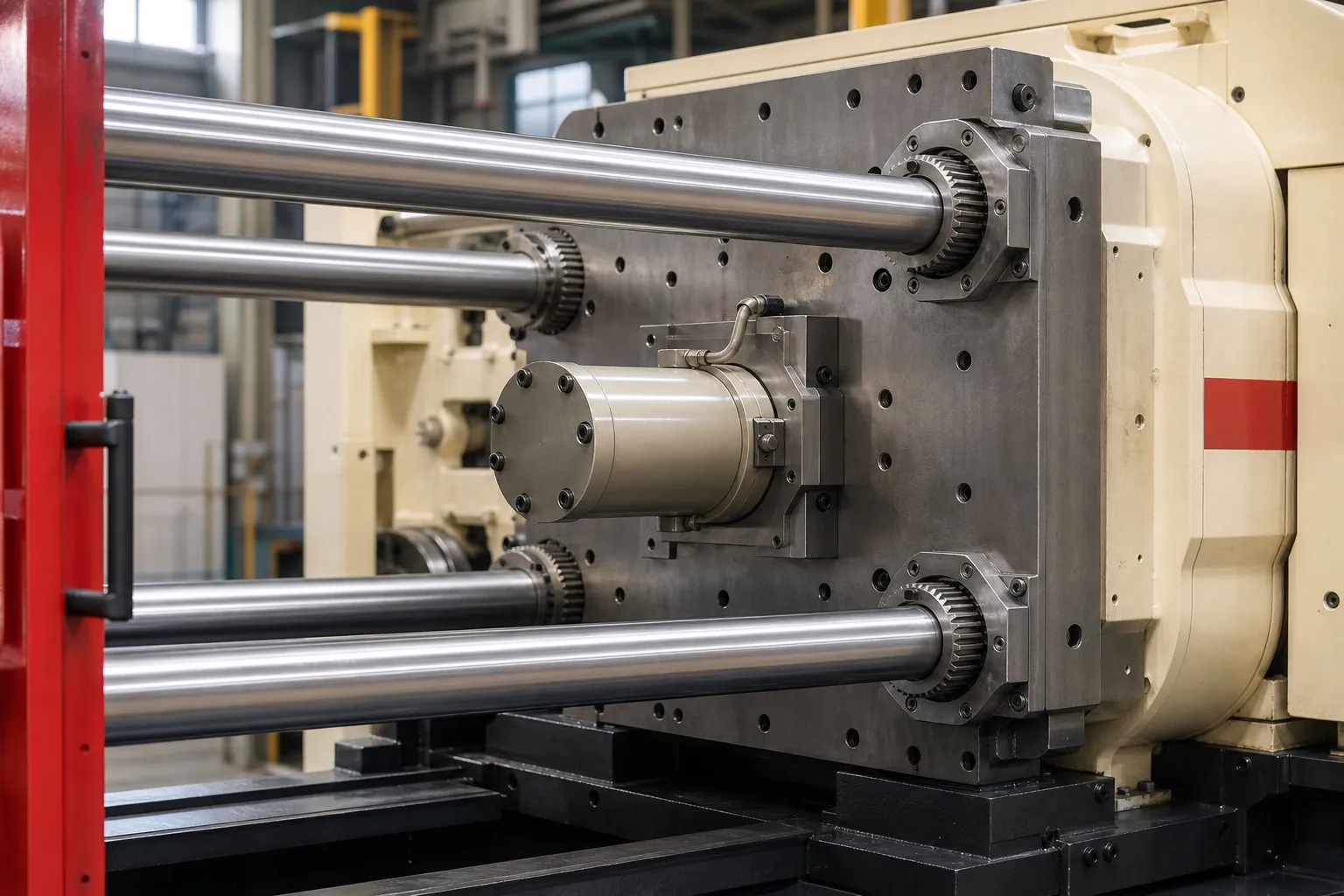
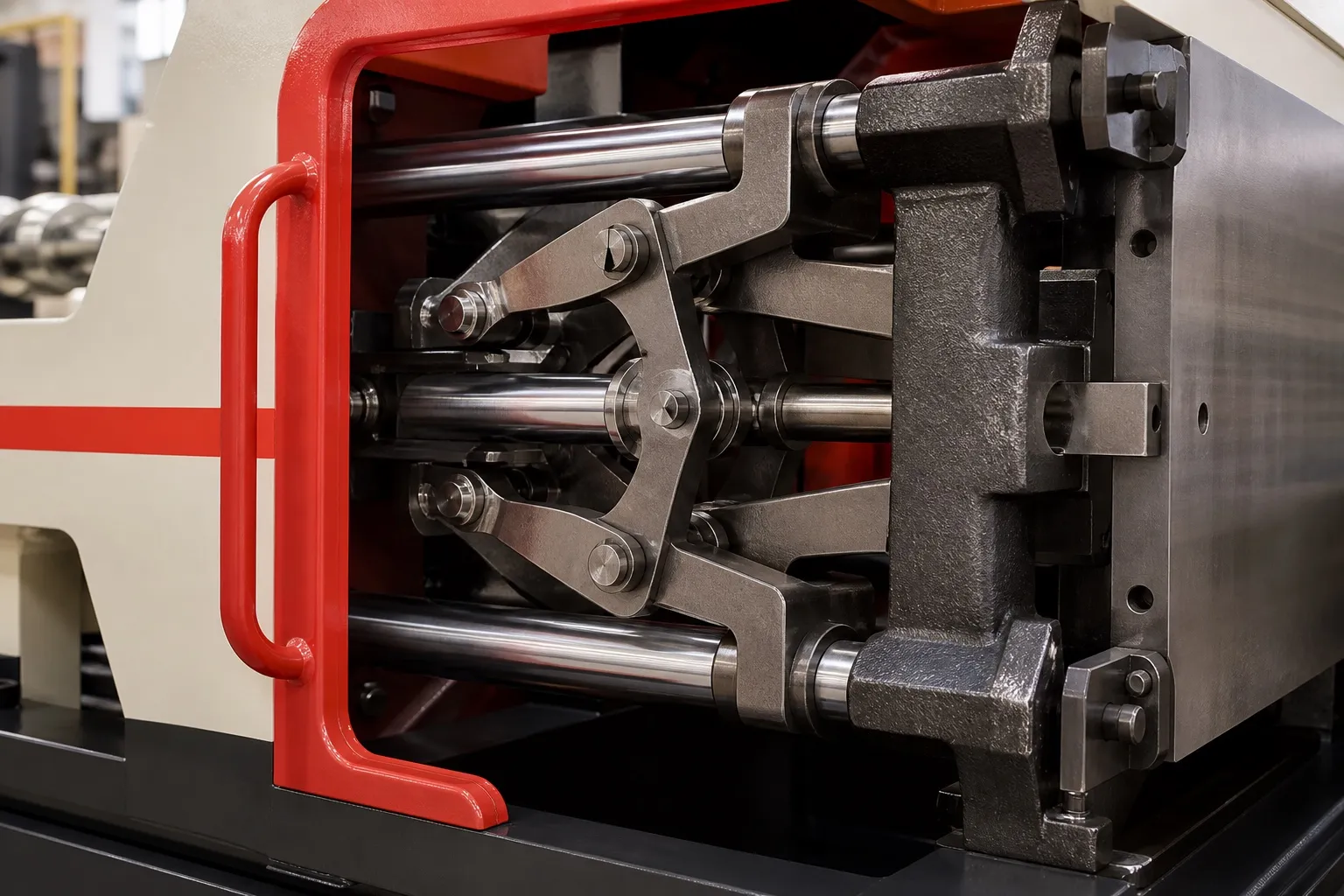
A toggle machine has three platens and a linkage that straightens to lock the mould and stretch the tie bars. A two platen machine drops the rear platen. Nuts lock the moving platen to the tie bars, then short-stroke cylinders apply the clamp force directly.
That one change explains most of the table above. Without a rear platen and linkage, Plastics Technology reports that most two platen hydro-mechanical machines are shorter overall than toggles or fully hydraulic machines of similar tonnage. That matters when a 250 t or 350 t machine has to fit into an existing shed with a fixed crane bay.
The trade-off is lock-up speed. Suppliers quoted in the same article claimed a toggle locks in about 0.2 s against about 0.5 s for a hydraulic clamp. On a 40 s bucket cycle, that 0.3 s difference is under 1% of the cycle. On a 6 s thin-wall lid, it is 5%, which is real output.
How the locks, nuts and clamp cylinders work in sequence, and why that spreads force evenly, is covered in the hydro-mechanical clamping article in this series.
Two platen vs toggle: which gives more opening for a tall mould?
A toggle opens by a fixed stroke, but only accepts moulds up to its maximum shut height. A two platen machine opens by its maximum daylight minus the mould height. Tall moulds that exceed a toggle's shut height, or need more than its stroke, often fit a two platen machine.
This difference sits in the geometry. A toggle's stroke is fixed by its linkage, so the platen always travels the same distance whatever the mould. A two platen machine has no linkage limit; the moving platen can travel until it reaches maximum daylight, so a thinner mould leaves more room.
Comparing the two is a subtraction. A two platen machine gives more opening than a toggle whenever the mould height is less than the two platen daylight minus the toggle stroke. Above that height the toggle gives more opening, provided the mould still fits under its maximum shut height. Do this sum with real figures from both spec sheets, not with headline tonnage.
For deep parts, MoldMaking Technology suggests an opening of at least 2.5 times the part height. The full method, including allowances for robots and ejector stroke, is in the mould height and daylight article in this series.
Which clamp handles large, flat parts and heavy moulds better?
For large, flat parts, a two platen clamp is often easier to run. Its tonnage is set by oil pressure, so you can run below maximum, and direct hydraulic clamping is reported to give more uniform pressure. Toggles are reported to deflect more, as most apply force at the corners.
Plastics Technology lists other reported toggle drawbacks that matter on big moulds. Die height is often set with the mould closed; once the mould warms and expands, clamp force can climb above the setting. Uneven wear in the linkage can upset platen parallelism, and grease near the mould is a contamination risk. Toggle supporters reply with reliability, simplicity and rigidity, and those points are fair.
Heavy moulds add their own checks whichever clamp you choose. Confirm the maximum mould weight the machine allows on both platens, not only the moving one, and confirm the mould covers enough of the tie-bar gap so the platens do not bow under clamp.
When is a toggle still the better choice for large moulds?
A toggle still makes sense when the mould is shallow, the cycle is short and the stroke you need sits well inside the toggle's range. Thin-wall lids and packaging fall here, where a faster lock-up repeats on every shot and opening stroke is never the limit.
Resin choice can shift the sums. Reliance lists Repol B300MN, a high-crystalline PP impact copolymer with an MFR of 30 g/10 min, as suitable for large articles with lower cycle times because of its high flow and fast crystallisation. When a faster resin shortens the cycle on a big part, lock-up becomes a larger share of what is left, though on a long large-part cycle it remains small.
If even one mould on your list is taller than a toggle's maximum shut height, the decision is made. Buy the two platen machine and stop comparing lock-up times.
What should you check before choosing two platen or toggle?
Put the mould first. List each mould's height, its width across the tie bars, its weight and the height of the tallest part, then compare those against both spec sheets: maximum and minimum mould height, stroke or daylight, tie-bar gap and mould weight limit. Only then compare tonnage and shot size, because clamp force is the easiest figure to match and the least likely to rule a machine out for a tall mould. If you are sizing for buckets, crates or dustbins, review the two platen injection moulding machine range and send the mould drawing together with the part drawing.
Frequently Asked Questions About Two Platen and Toggle Machines
Is a two platen machine more expensive to run than a toggle?
Running cost depends more on the pump drive than on the clamp design. A hydraulic machine with a servo or variable-speed pump can draw far less power when idle or holding than one with a fixed-speed pump. Compare the pump drive and connected load on both machines, then measure energy on a real job before deciding.
Can I move a mould from a toggle to a two platen machine?
Usually yes, if mould height, tie-bar gap, mounting pattern, ejector pattern and locating ring all match. Check the mould against the new machine's minimum mould height as well as its maximum. An ejector pattern mismatch may need an ejector box, and most moulds use a 101.6 mm or 120 mm locating ring.
Which is faster, a two platen or a toggle machine?
On lock-up, toggles are reported to be slightly faster; suppliers quoted in Plastics Technology claimed 0.2 s against 0.5 s. On large parts the cycle is often set by cooling, which rises steeply with wall thickness, so the clamp difference rarely decides output on buckets or crates. It matters more on short thin-wall cycles.
Why do two platen machines take less floor space?
There is no rear platen or toggle linkage behind the moving platen, and the short clamp cylinders are built into the platen. Plastics Technology reports that most two platen hydro-mechanical machines are shorter overall than toggles or fully hydraulic machines of similar tonnage. Compare overall length on both spec sheets before planning the layout.
Are toggles less reliable than two platen machines?
Not necessarily. Toggle supporters point to reliability, simplicity and rigidity. The reported weak spots are uneven linkage wear, which can upset platen parallelism, and grease near the mould. Two platen machines swap the linkage for cylinders, nuts and seals, which need their own maintenance. Judge on service support as much as on design.
Related Articles
- Hydro-Mechanical Clamping Explained: Balanced Force and Flash-Free Parts
- Moulding Buckets, Crates and Dustbins on Two Platen Machines
- Deep Moulds and Long Opening Strokes: Planning Mould Height and Daylight
Sources & References
- Plastics Technology, M. Knights: Hybrid Injection Clamps: The Best of Both Worlds? (June 2010)
- MoldMaking Technology, B. Catoen: Machine Sizing and Specification for Optimal Mold Performance, Part 1 (Aug 2025)
- Reliance Industries: Repol B300MN Technical Data Sheet (July 2024)
Technical Disclaimer
Disclaimer: The information provided in this document is for general informational and educational purposes only. It is based on technical references and industry information available at the time of preparation and may be subject to change. It does not constitute engineering, technical, commercial or professional advice, nor does it constitute a quotation, specification, warranty or contractual commitment by Pratishna Engineers.
Actual injection moulding machine and process requirements vary according to the component design, material, mould, production volume, machine configuration and operating conditions. The information, examples, calculations and recommendations provided should be independently evaluated and verified for the specific application before making any equipment, process or production decision. Information obtained from third-party sources remains subject to the accuracy and limitations of those sources.
Limitation of Liability: Pratishna Engineers makes no representation or warranty, express or implied, regarding the completeness, accuracy or suitability of the information for any particular application. To the extent permitted by applicable law, Pratishna Engineers shall not be liable for any loss, damage, cost or consequence arising from reliance on or use of the information contained in this document. Final machine selection, configuration and application suitability should be confirmed with Pratishna Engineers based on complete and accurate project requirements.