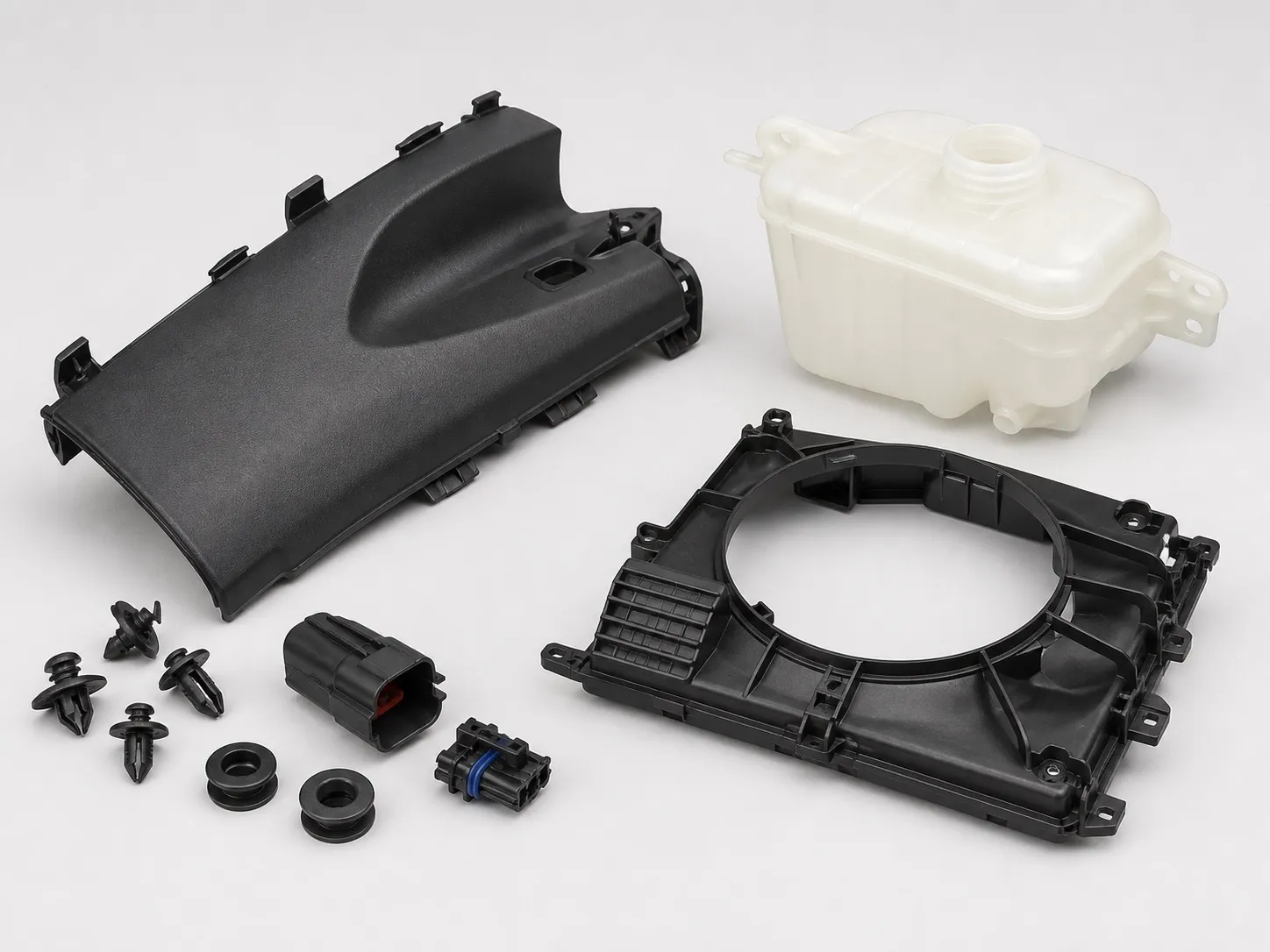
An 80 ton vertical insert moulding machine makes insert parts that are too large, or carry too many inserts, for a 40 or 60 t press: larger housings with brass bushes and earth terminals, connector bodies with several terminals, parts with four or more threaded inserts, automotive sensor and connector bodies, and multi-cavity moulds for small insert parts.
With a 10% reserve (a starting margin, not a rule), 80 t carries about 103 to 259 cm² of projected area, depending on the resin. That is twice the area of a 40 t machine and a third more than 60 t. On parts with many inserts, though, loading time can limit output before the clamp does.
Key Takeaways
- At 80 t with a 10% reserve, the largest total projected area is about 259 cm² at 2 US t/in² and about 103 cm² at 5 US t/in².
- Add the area of every cavity and any cold runner, then compare the result with the clamp, not the other way round.
- Shot size, insert count and the lower mould arrangement can decide an insert job as much as tonnage does.
- Boxes, enclosures and cable trunking sold in India need the BIS Standard Mark under the Electrical Accessories QCO, 2023.
What Can an 80 Ton Vertical Insert Moulding Machine Make?
Larger insert-moulded housings, connector bodies with several terminals, parts carrying several threaded inserts, automotive insert-moulded parts, and multi-cavity moulds for small insert parts. The table shows how much projected area each group can use at 80 t once a 10% reserve is held back.
Largest total projected area at 80 t with a 10% reserve (glass-filled factors are an assumption)
| Product group | Typical resin | Tonnage factor (US t/in²) | Largest total area at 80 t |
|---|---|---|---|
| Larger housings with bushes or earth terminals | ABS | 2 to 4 (resin datasheet) | 129 to 259 cm² |
| Connector bodies with several terminals | PBT or PA66, plain or glass-filled | 3 to 5 (assumed) | 103 to 172 cm² |
| Parts with several threaded inserts | PP | 2 to 3 | 172 to 259 cm² |
| Multi-cavity moulds for small insert parts | Any of the above | As for the resin | All cavities plus runner within the same limit |
SPE Plastics Engineering's guide by A. Urbina puts PP at 2 to 3 US t/in², with polyethylene at the low end and polycarbonate toward the high end. The ABS range comes from a Lustran ABS 248 datasheet, which lists small appliance housings among its uses. Glass-filled connector grades get 3 to 5 here as a cautious assumption; confirm the factor for your grade with the resin supplier.
PC housings need more clamp than ABS housings of the same outline, so plan a PC part toward the lower area figure.
How Do You Check the Clamp for an Insert Part?
Take the projected area of one part from the parting line, subtract through openings, multiply by the cavities and add the cold runner. Multiply by a tonnage factor, convert to metric tonnes, add a reserve and compare with 80 t. With a hot runner, only the cavities count.
This is the method John Williams of RJG sets out in Plastics Technology. He gives a typical range of 2 to 10 US t/in² and suggests 3 where no better data exists. Flow length, wall thickness, gate size, gate location and the number of gates all move the factor.
One US t/in² equals 0.1406 t/cm². At 80 t, 72.7 t is usable after the reserve, so factors of 2, 3 and 5 give about 259, 172 and 103 cm².
Spare clamp is not a reason to use it. Williams describes a mould that needed about 100 tons being clamped at a 400-ton machine's maximum; the cavity block split in two places. He lists broken inserts and crushed vents among the effects of over-clamping, which matters on any mould full of metal parts.
Which Other Limits Decide an Insert Job?
Shot size, insert count and the lower mould arrangement. The shot should use a healthy share of the barrel, every insert adds loading time, and tall inserts or deep parts need enough opening. On an insert job, any one of these can limit output before the clamp does.
A small connector shot on a large barrel uses only a small part of its capacity, so the melt stays in the barrel longer. Ratings are given in grams of PS, so convert your shot to volume before comparing.
The lower mould faces up, so inserts stay where they are placed while the mould closes. Each insert still has to be picked, placed and checked. The multi-insert housings article in this series works out that time, and the sliding mould article covers when a second lower half pays off.
Our view: size an 80 t vertical machine on inserts per shot and loading time first, and on clamp second. Extra tonnage does nothing for a cell that is waiting on the operator.
Which Indian Rule Covers Electrical Insert Parts?
The Electrical Accessories (Quality Control) Order, 2023, dated 1 January 2024. It makes the BIS Standard Mark compulsory for boxes and enclosures to IS 14772, cable trunking and ducting, bayonet lamp holders and non-interlock switch-socket-outlets, among other items. Insert-moulded housings for these products fall under it.
The order came into force six months after publication, with nine months for small enterprises and twelve for micro enterprises. Goods made for export are excluded. If your customer sells one of these products in India, ask which Indian Standard the part is tested to before the mould is designed.
What Should You Send Before Choosing an 80 Ton Vertical Machine?
Send the part drawing, the insert drawings and count per part, the resin grade, the planned cavities, the output target and how the inserts arrive: loose, on a reel or pre-cut. With those, the clamp, shot and loading time can be checked together. See the 80 ton vertical injection moulding machine page.
Frequently Asked Questions About 80 Ton Vertical Insert Moulding
Is 80 t too large for one small insert part?
It can be. A small part may need only a fraction of the clamp, and a large barrel holds a small shot for longer. Larger machines on small products also waste energy, according to a PlasticsToday energy study. Check the shot share of the barrel and consider a smaller press or more cavities.
Can an 80 t vertical machine run glass-filled grades?
Yes, provided the screw, barrel and nozzle suit abrasive glass-filled resins and the material is dried to its datasheet limit. Glass fibres wear standard screws and mould steel faster, so state the grade at the enquiry stage. The automotive article in this series covers drying for one PBT grade.
Do inserts reduce the projected area?
Usually not. Use the full outline of the part as seen in the mould opening direction. An insert whose end faces seal against both mould halves keeps melt off those faces, which can trim the figure slightly; treat that as a refinement and agree it with the mould maker.
How much opening do tall inserts need?
Enough for the part to clear the core and for a hand or gripper to place the tallest insert without touching the upper mould. Long pins standing in the lower mould add their height to that clearance. Check the mould height and opening on the drawing before choosing the machine.
How many cavities suit small insert parts at 80 t?
Count placements, not just area. Twelve cavities with two inserts each means 24 placements per shot. Time that routine on a trial fixture, then set the cavity count so the loading time stays within your cycle target. The clamp check comes after this.
Related Articles
- Multi-Insert Housings on an 80 Ton Vertical Machine
- Automotive Insert-Moulded Parts on Vertical Machines
- When to Use a Sliding Mould on an 80 Ton Vertical Machine
Sources & References
- Plastics Technology, J. Williams (RJG): Clamp Tonnage: More Is Better...Right? (May 2017)
- SPE Plastics Engineering, A. Urbina: Mastering Clamping Force Calculation (Mar 2024)
- INEOS ABS via UL IDES: Lustran ABS 248 datasheet
- Gazette of India (DPIIT): Electrical Accessories (Quality Control) Order, 2023
Technical Disclaimer
Disclaimer: The information provided in this document is for general informational and educational purposes only. It is based on technical references and industry information available at the time of preparation and may be subject to change. It does not constitute engineering, technical, commercial or professional advice, nor does it constitute a quotation, specification, warranty or contractual commitment by Pratishna Engineers.
Actual injection moulding machine and process requirements vary according to the component design, material, mould, production volume, machine configuration and operating conditions. The information, examples, calculations and recommendations provided should be independently evaluated and verified for the specific application before making any equipment, process or production decision. Information obtained from third-party sources remains subject to the accuracy and limitations of those sources.
Limitation of Liability: Pratishna Engineers makes no representation or warranty, express or implied, regarding the completeness, accuracy or suitability of the information for any particular application. To the extent permitted by applicable law, Pratishna Engineers shall not be liable for any loss, damage, cost or consequence arising from reliance on or use of the information contained in this document. Final machine selection, configuration and application suitability should be confirmed with Pratishna Engineers based on complete and accurate project requirements.