
A harness builder lays a taped bundle of twelve wires across the open mould, closes the guard, and a grommet forms around the bundle in one shot, in the exact position the drawing asks for. That is wire harness moulding at its simplest: a part formed directly on the bundle, so it cannot slide, split or be left off.
The bundle is a harder insert than a round cable. It is uneven, compressible and full of heat-sensitive insulation. Material choice and the seal at each end of the mould decide whether the part works and the wires survive.
Key Takeaways
- Harness grommets and ducts can be moulded in EPDM rubber, TPVs or styrenic TPEs, each with trade-offs in cycle, demoulding and recycling.
- Automotive buyers set material requirements such as VOC, fogging and odour, plus temperature range, flame resistance and weathering.
- A wire bundle varies in diameter far more than a single cable, so its shut-off needs to be compliant or pre-formed.
- Keep melt temperature within what the wire insulation can take; nylon clips can be better moulded separately and fitted.
Which Wire Harness Moulding Jobs Suit a Vertical Machine?
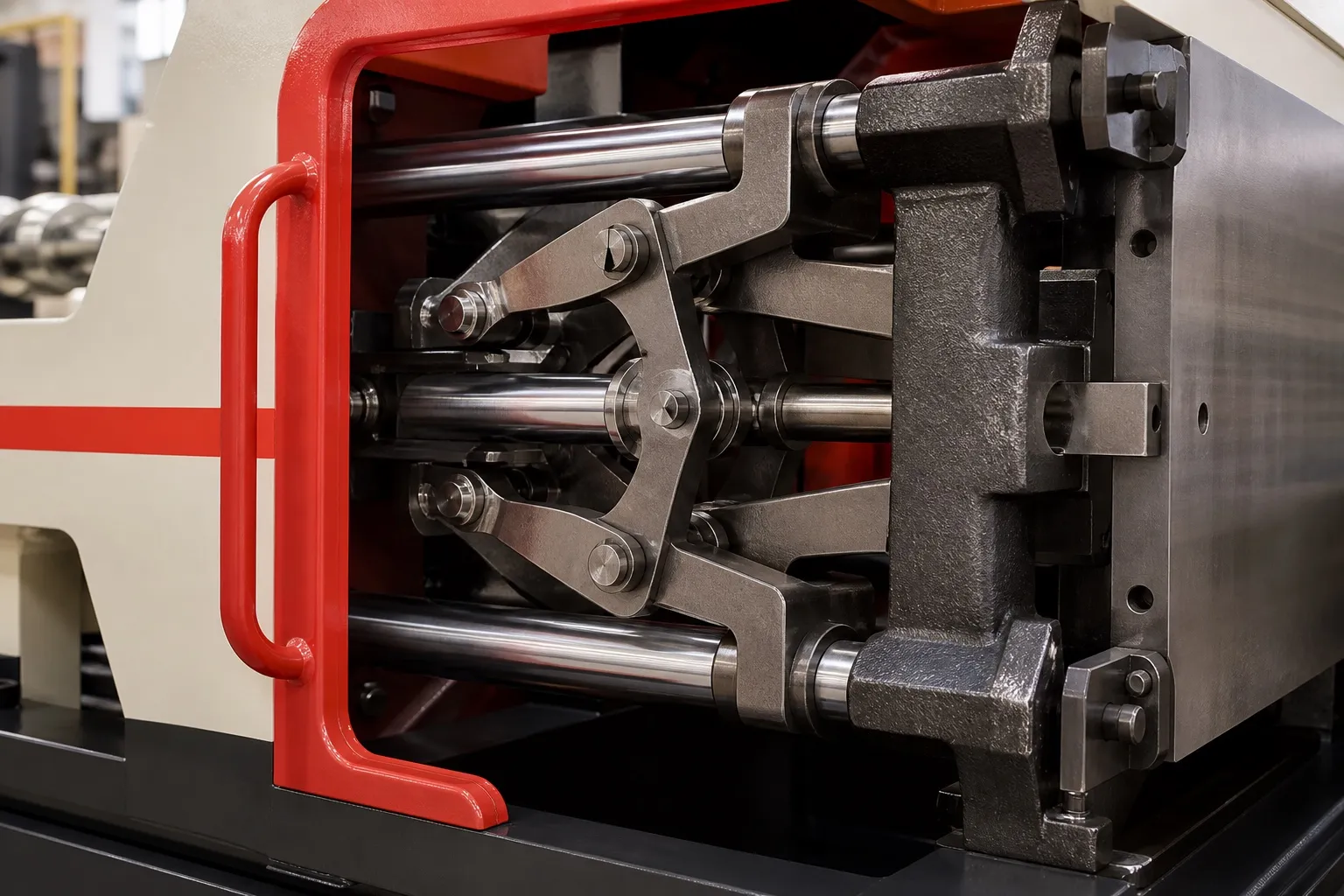
Jobs where a part is formed directly on a bundle that lies across the parting line: sealing grommets, through-panel boots, breakout sleeves where wires branch, and clips or holders fixed at a set point on the bundle. The horizontal clamp lets the bundle pass straight through the mould.
Moulding the part on removes an assembly step and fixes its position, which matters where a clip must sit at a set distance from a connector. It can also seal the bundle from inside, because the melt can flow into the gaps between wires rather than only around the outside.
Not every harness part should be moulded on. A clip that a fitter must move, or a grommet that has to pass through a small panel hole before the connector is fitted, can be better moulded separately and assembled later.
Harnesses are long and awkward, so the cell layout matters as much as the mould. A board or table beside the machine that holds the rest of the harness in its routed shape lets the operator load the same section the same way every cycle.
Which Materials Do Harness Grommets and Clips Use?
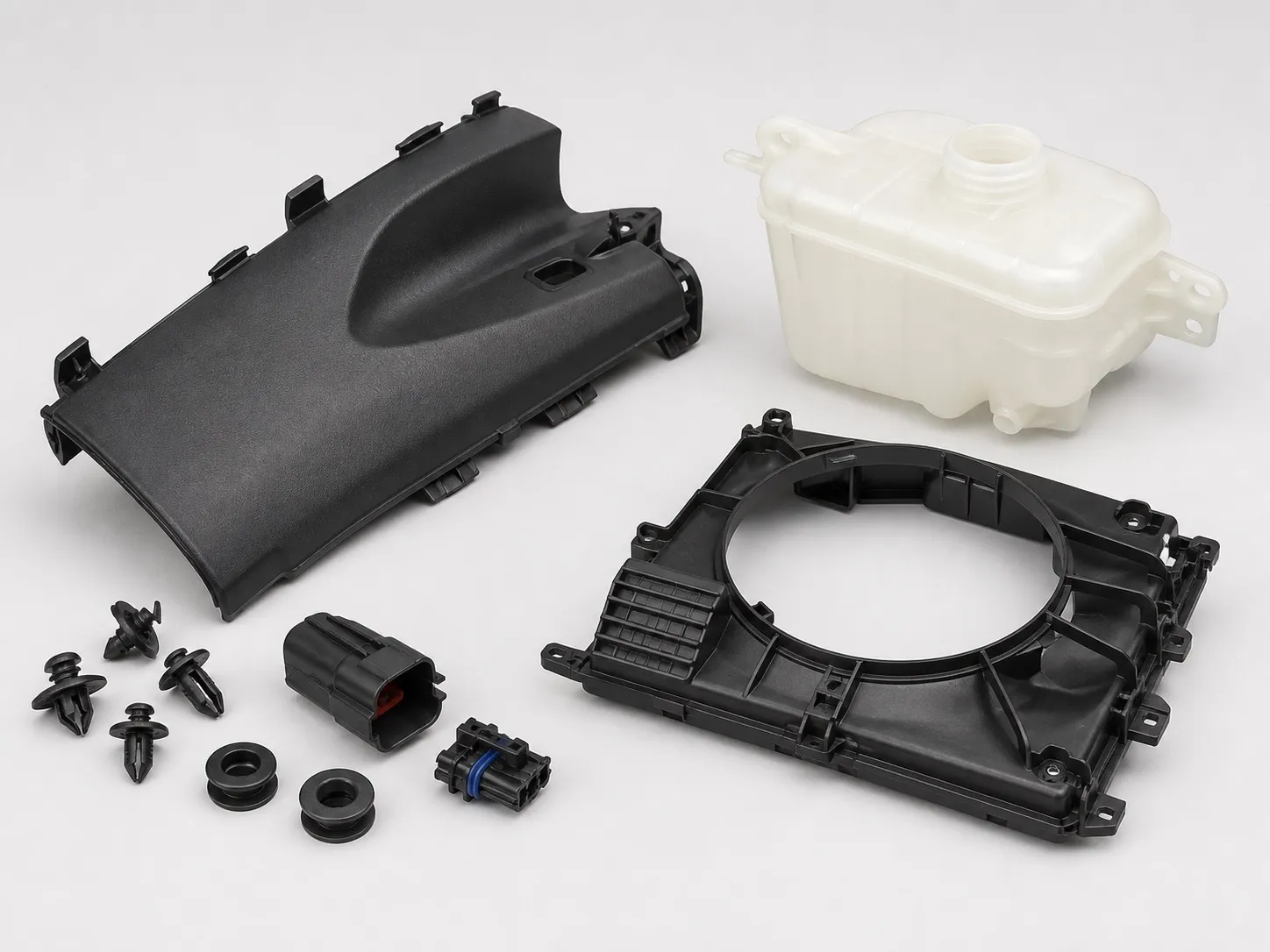
Soft parts such as grommets, boots and ducts use EPDM rubber, thermoplastic vulcanizates or styrenic TPEs, according to a Teknor Apex guide on automotive cable ducts. Stiff parts such as clips use engineering plastics; BASF lists an impact-modified nylon 66 grade for fasteners and clamps.
Harness part materials and points to note, from Teknor Apex and BASF data
| Material | Harness use | Points to note |
|---|---|---|
| EPDM rubber | Grommets, ducts | High density, long cycle times, cannot be two-shot moulded, cannot be recycled (Teknor Apex) |
| TPV | Grommets, ducts | Difficult to demould with complex designs and severe undercuts (Teknor Apex) |
| Standard styrenic TPE | Grommets, ducts, boots | Narrow processing window; can deform on release and show stress marks (Teknor Apex) |
| Impact-modified PA66 | Clips, holders, fasteners | Melt 288 to 305 °C, mould 60 to 100 °C, processing moisture 0.2% or less (BASF) |
The Teknor Apex guide also lists what automotive buyers ask of the material: low VOC, fogging and odour. Finished parts need a broad operating temperature range, flame resistance, good insulation and resistance to extreme weather. Get the customer's material specification before you choose a grade.
EPDM is a rubber that needs vulcanising, so it belongs on rubber moulding equipment. On a thermoplastic vertical machine, TPV and styrenic TPE are the practical soft materials, and some grades are made to bond to other plastics, such as the long-glass PP noted in the same guide.
Nylon 66 is hygroscopic, and moisture degrades it in the barrel. BASF's data for the impact-modified grade sets processing moisture at 0.2% or less, so a dryer belongs in any clip cell running it.
How Do You Mould Onto a Wire Bundle Without Damage?
Control the bundle's shape and the heat. Tape, tie or pre-sleeve the bundle so it enters the mould at a known diameter, use a compliant seal at each exit, and keep melt temperature within what the wire insulation can tolerate during the seconds of contact.
A bundle of round wires never packs solid. Its diameter depends on how tightly it is taped and how the wires lie, so two bundles of the same wires can differ by most of a millimetre. A fixed steel bore sized for one will flash on a thin bundle and crush a thick one.
Gate into the thickest part of the grommet, away from the bundle exits, so the melt reaches the seals last and with the least pressure. Vent the last points to fill, which on a grommet are the lips around the bundle when it is gated at the flange.
Heat is the second risk. The BASF nylon grade melts at 288 to 305 °C, far above the roughly 163 to 199 °C that a Teknor Apex flexible PVC guide gives for its compounds. Our view: overmould bundles with soft compounds, and mould nylon clips separately unless the wire insulation is rated for that contact.
Taped bundles bring an Indian rule worth knowing. The Electrical Accessories (Quality Control) Order, 2023 makes the Standard Mark compulsory for PVC insulating tapes to IS 7809 Part 3/Sec 1 and cable trunking to IS 14927 Part 2, with longer deadlines for small and micro enterprises and goods made for export excluded. Buy marked tape for domestic work.
What Should You Prepare Before a Harness Trial?
Prepare sample bundles built the way production will build them, the customer's material specification, the wire insulation type and temperature rating, and the position tolerance for each moulded part. Measure bundle diameters across a batch before the mould is designed. See the 55 ton vertical injection moulding machine page.
Frequently Asked Questions About Wire Harness Moulding
Can a grommet be moulded onto a bundle that already has connectors fitted?
Yes, as long as the connectors sit outside the mould and clear the platens, guard and ejector area. Only the moulded section of the bundle enters the mould. Plan where the connectors hang during the cycle so they cannot be trapped, and protect their contacts from flash and release agent.
How do I stop melt running along the wires to the far end?
Seal the bundle under each exit with tape or a pre-moulded sleeve, so the gaps between wires are closed where the mould shuts. Reduce injection speed near the end of fill and avoid hold pressure higher than the part needs. Check cut sections from trial parts for melt tracking along the wires.
Does a moulded grommet need to bond to the wires?
For a water seal, it needs either a bond to the insulation or a tight, lasting grip. Some TPE grades are made to bond to particular plastics, so ask the supplier about your insulation material. Prove the seal with the customer's ingress or pressure test on moulded samples, not with a pull test alone.
What cycle time should I expect for a TPE grommet?
It depends mostly on the thickest wall, because cooling time rises with the square of thickness. A grommet with a thick panel flange can need far longer than its thin boot section suggests. Keep walls even, core out heavy flanges, and set the cooling timer from trials on the real mould.
Can EPDM grommets be replaced with TPE?
They can be, and the switch can bring faster cycles, two-shot options and recyclable regrind. The customer must approve it, because sealing force, temperature range and ageing can differ from the EPDM part. Ask for the original specification and test TPE samples against it before tooling.
Related Articles
- What Can You Make on a 55 Ton Vertical Moulding Machine?
- Heavy Cord Strain Reliefs on a 55 Ton Vertical Machine
- Two-Cavity Cable Moulds on a Horizontal Clamp Vertical Machine
Sources & References
- Teknor Apex: Sarlink TPE for Cable Ducts: Product Selector Guide (Aug 2024)
- BASF via Material Data Center (M-Base): Ultramid A3L HP datasheet
- Teknor Apex: Processing Guide for Injection Molding of Apex Flexible PVC Compounds
- Gazette of India (DPIIT): Electrical Accessories (Quality Control) Order, 2023
Technical Disclaimer
Disclaimer: The information provided in this document is for general informational and educational purposes only. It is based on technical references and industry information available at the time of preparation and may be subject to change. It does not constitute engineering, technical, commercial or professional advice, nor does it constitute a quotation, specification, warranty or contractual commitment by Pratishna Engineers.
Actual injection moulding machine and process requirements vary according to the component design, material, mould, production volume, machine configuration and operating conditions. The information, examples, calculations and recommendations provided should be independently evaluated and verified for the specific application before making any equipment, process or production decision. Information obtained from third-party sources remains subject to the accuracy and limitations of those sources.
Limitation of Liability: Pratishna Engineers makes no representation or warranty, express or implied, regarding the completeness, accuracy or suitability of the information for any particular application. To the extent permitted by applicable law, Pratishna Engineers shall not be liable for any loss, damage, cost or consequence arising from reliance on or use of the information contained in this document. Final machine selection, configuration and application suitability should be confirmed with Pratishna Engineers based on complete and accurate project requirements.