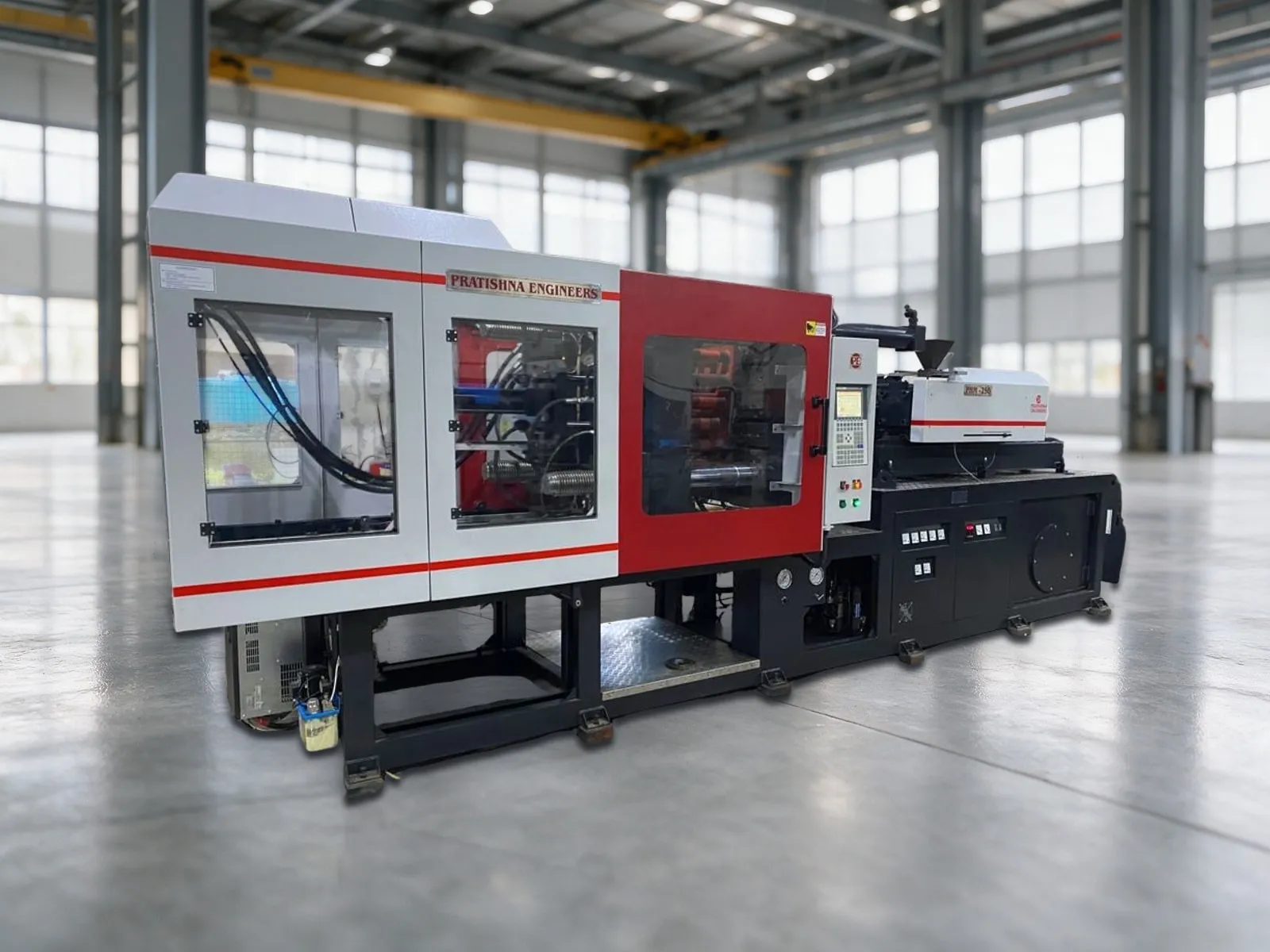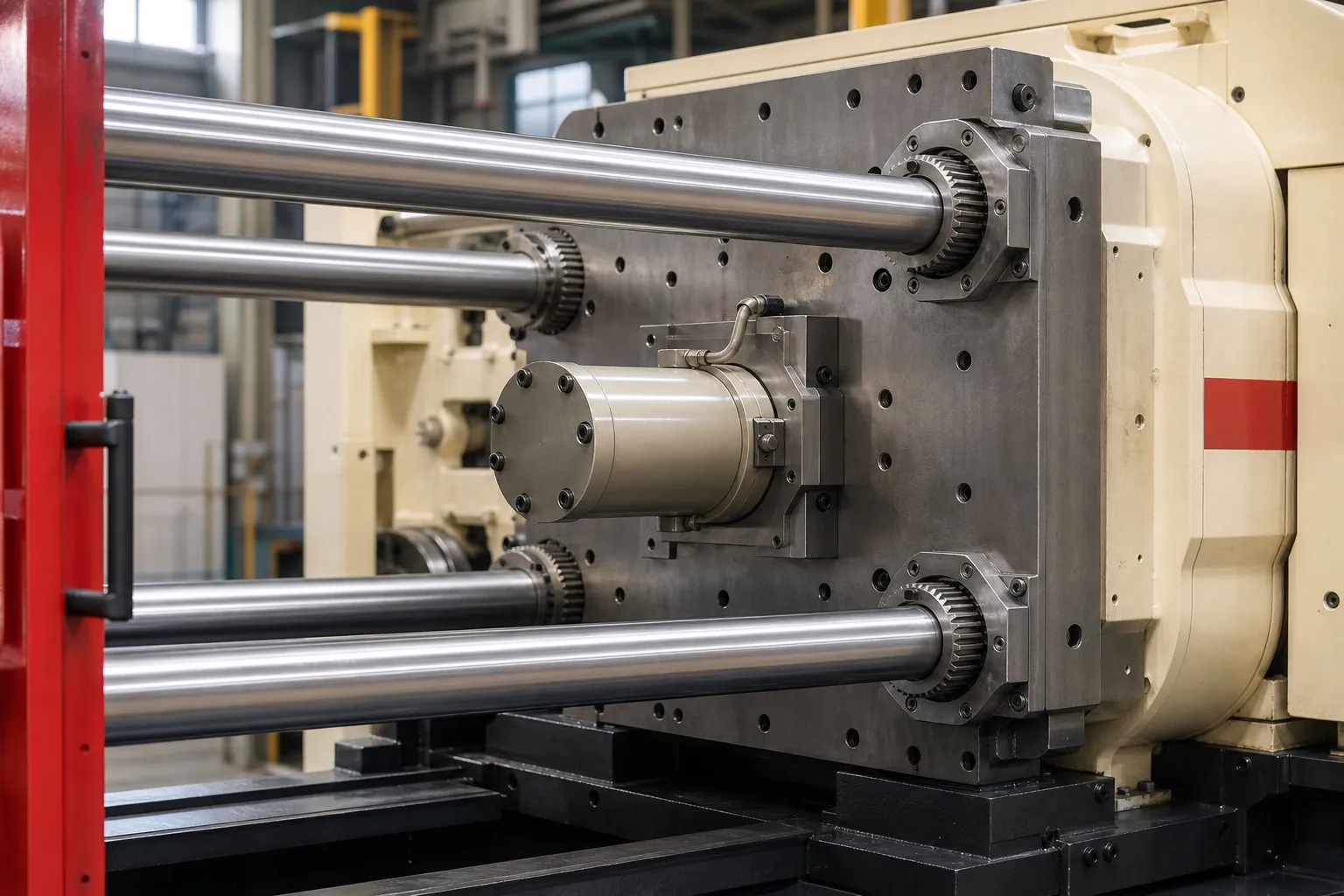

Two platen vs toggle: how opening stroke behaves on each clamp, from MoldMaking Technology and Plastics Technology
| Point | Toggle clamp | Two-platen (piston-type) clamp |
|---|---|---|
| Stroke and mould height | Full stroke at every mould height | Stroke falls as mould height rises; full stroke only at the minimum mould height |
| Maximum daylight | Maximum mould height + stroke | Minimum mould height + maximum stroke |
| Opening left with a mould in place | The rated stroke | Maximum daylight minus mould height |
| Range of adjustment | Stroke adjustment reported as more limited | Direct hydraulic clamping reported to give a greater mould-height range |
| Lock-up and opening force | Suppliers quoted claim slightly faster lock-up and greater opening force | Tonnage builds after the locks engage on the tie bars |
In a two platen vs toggle comparison at 160 t, the toggle keeps its full stroke whatever the mould height, while the two-platen machine gives its full stroke only at the minimum mould height. Every millimetre of extra mould height comes off the two-platen opening. Which leaves more room depends on your tallest mould.
So compare usable opening with your mould in place, not the stroke printed on the data sheet. The sections below explain why the two clamps behave differently and how to run the comparison on your own mould.
Key Takeaways
- Toggle: maximum daylight equals maximum mould height plus stroke, so the stroke is the same at every mould height.
- Two-platen: maximum daylight equals minimum mould height plus maximum stroke, so opening shrinks as the mould grows.
- Compare usable opening with your tallest mould in place, then check it against about 2.5 times part height.
- Set each mould's opening to what its part needs; a long stroke costs time only if the platen travels further than required.
Why Does Opening Stroke Behave Differently on Each Clamp?
A toggle's linkage fixes the stroke, and mould height is set by moving the whole linkage, so the stroke travels with it. A two-platen machine moves its platen along the tie bars inside a fixed maximum daylight, so a taller mould uses up part of that space.
Bruce Catoen's MoldMaking Technology guide puts it in two formulas. For a toggle, maximum daylight equals maximum mould shut height plus stroke, and the full stroke is available at each shut height. For a piston-type clamp, maximum daylight equals minimum shut height plus maximum stroke, and the stroke falls as shut height rises. The guide's figure shows the piston type as a two-platen machine.
The guide also says the mould must be thick enough for the machine's minimum shut height and thin enough for its maximum. That check applies to both designs, and on a toggle it is often the one that fails first for a deep mould.
Mould-height setting differs too. Mikell Knights' Plastics Technology article notes the criticism that setting toggle mould height with the mould closed can over-clamp once the mould warms and expands.
Two Platen vs Toggle: Which Leaves More Opening for a Deep Part?
The two-platen machine leaves more when its maximum daylight minus your mould height is larger than the toggle's stroke. A thin mould gets close to the full two-platen stroke; a very tall mould may leave less opening than a toggle, if the toggle accepts that mould height at all.
Put the two numbers side by side. On the toggle, usable opening is the stroke, provided the mould sits within the maximum mould height. On the two-platen machine, usable opening is maximum daylight minus mould height, provided the mould is at least the minimum mould height.
The crossover is easy to find. The two-platen machine gives more opening whenever mould height is below its maximum daylight minus the toggle's stroke. With the assumed figures in the example below, that is 1,250 minus 450, or 800 mm: any mould under 800 mm high gets more opening on the two-platen machine, provided it is within that machine's maximum mould height.
Then compare usable opening with what the part needs. Catoen's guide sets opening stroke at a minimum of 2.5 times part height. How to estimate mould height for a deep part before the mould is designed is covered in the mould height article in this series.
Robot take-out adds its own need. A side-entry or top-entry arm must pass between the open mould halves, so ask the robot supplier for the clearance it needs and add it to the part's figure if it is larger.
Does a Longer Stroke Cost Cycle Time?
Only when the platen travels further than the part needs. Where the controller lets you set the opening position per mould, a shallow part need not use the full stroke. Set opening to the part height rule plus robot clearance, and the extra stroke stays unused.
Catoen's guide gives a dry cycle of 3 to 5 seconds for conventional moulding and 1 to 2.5 seconds for thin-wall. The Plastics Technology article quotes suppliers claiming toggles lock up slightly faster, about 0.2 seconds against 0.5 seconds for hydraulic clamps; treat these as reported claims, not measurements.
Clamp movement matters more as cooling gets shorter. Reliance describes its Repol B300MN impact copolymer as high-flow and fast-crystallising, suited to large articles with lower cycle times. On a short-cooling job like that, every second of open and close is a larger share of the cycle.
Our view: buy the stroke for the deepest part you will run, then set each mould's opening to its own part. Paying for a long stroke and then running every mould at full opening wastes the time you bought it to save.
How Should You Compare Two Machines on Stroke?
List the tallest part and the closed height of its mould, plus any robot clearance. From each data sheet take stroke, minimum and maximum mould height and maximum daylight, then work out usable opening with that mould in place. See the 160 ton two platen injection moulding machine page.
Frequently Asked Questions About Two-Platen and Toggle Opening Stroke
Is the stroke on a data sheet the opening I will get?
On a toggle, yes, at any mould height within its range. On a two-platen machine, only with the thinnest mould it accepts. For a taller mould, subtract the mould height from the maximum daylight to find the opening you will actually have. Always do this sum for your tallest mould.
Why do toggle machines limit mould height?
The linkage and rear platen have a fixed adjustment range, so the gap between platens when the toggle is locked can only be set within that range. A deep-part mould can exceed the maximum mould height even when clamp and stroke are adequate, and that can be the reason to look at a two-platen machine.
Can a two-platen machine run a very thin mould?
Only if the mould is at least the machine's minimum mould height. A thinner mould needs a spacer or backing plate to make up the difference. Check that the spacer is flat, parallel and strong enough to carry the clamp force without bending, and that ejector rods still reach the ejector plate.
Does opening speed differ between the two designs?
Both can move fast in the middle of the stroke and slow down near the ends to protect the mould. Speed depends on the hydraulic or servo drive and its settings more than on the clamp type. Measure dry cycle on the machines you are comparing rather than relying on general claims.
Which design takes up less floor space?
Two-platen machines are reported to be shorter overall than toggle or fully hydraulic machines of similar tonnage, because there is no rear platen and linkage. Compare overall length, mould-change access and robot space on the actual layouts, since bay length can decide between two otherwise suitable machines.
Related Articles
- What Can You Make on a 160 Ton Two Platen Machine?
- Buckets and Storage Boxes on a 160 Ton Two Platen Machine
- Deep Moulds on a 1000 mm Stroke: Planning Mould Height
Sources & References
- MoldMaking Technology, B. Catoen: Machine Sizing and Specification for Optimal Mold Performance, Part 1
- Plastics Technology, M. Knights: Hybrid Injection Clamps: The Best of Both Worlds?
- Reliance Industries: Repol B300MN technical data sheet (July 2024)
Technical Disclaimer
Disclaimer: The information provided in this document is for general informational and educational purposes only. It is based on technical references and industry information available at the time of preparation and may be subject to change. It does not constitute engineering, technical, commercial or professional advice, nor does it constitute a quotation, specification, warranty or contractual commitment by Pratishna Engineers.
Actual injection moulding machine and process requirements vary according to the component design, material, mould, production volume, machine configuration and operating conditions. The information, examples, calculations and recommendations provided should be independently evaluated and verified for the specific application before making any equipment, process or production decision. Information obtained from third-party sources remains subject to the accuracy and limitations of those sources.
Limitation of Liability: Pratishna Engineers makes no representation or warranty, express or implied, regarding the completeness, accuracy or suitability of the information for any particular application. To the extent permitted by applicable law, Pratishna Engineers shall not be liable for any loss, damage, cost or consequence arising from reliance on or use of the information contained in this document. Final machine selection, configuration and application suitability should be confirmed with Pratishna Engineers based on complete and accurate project requirements.