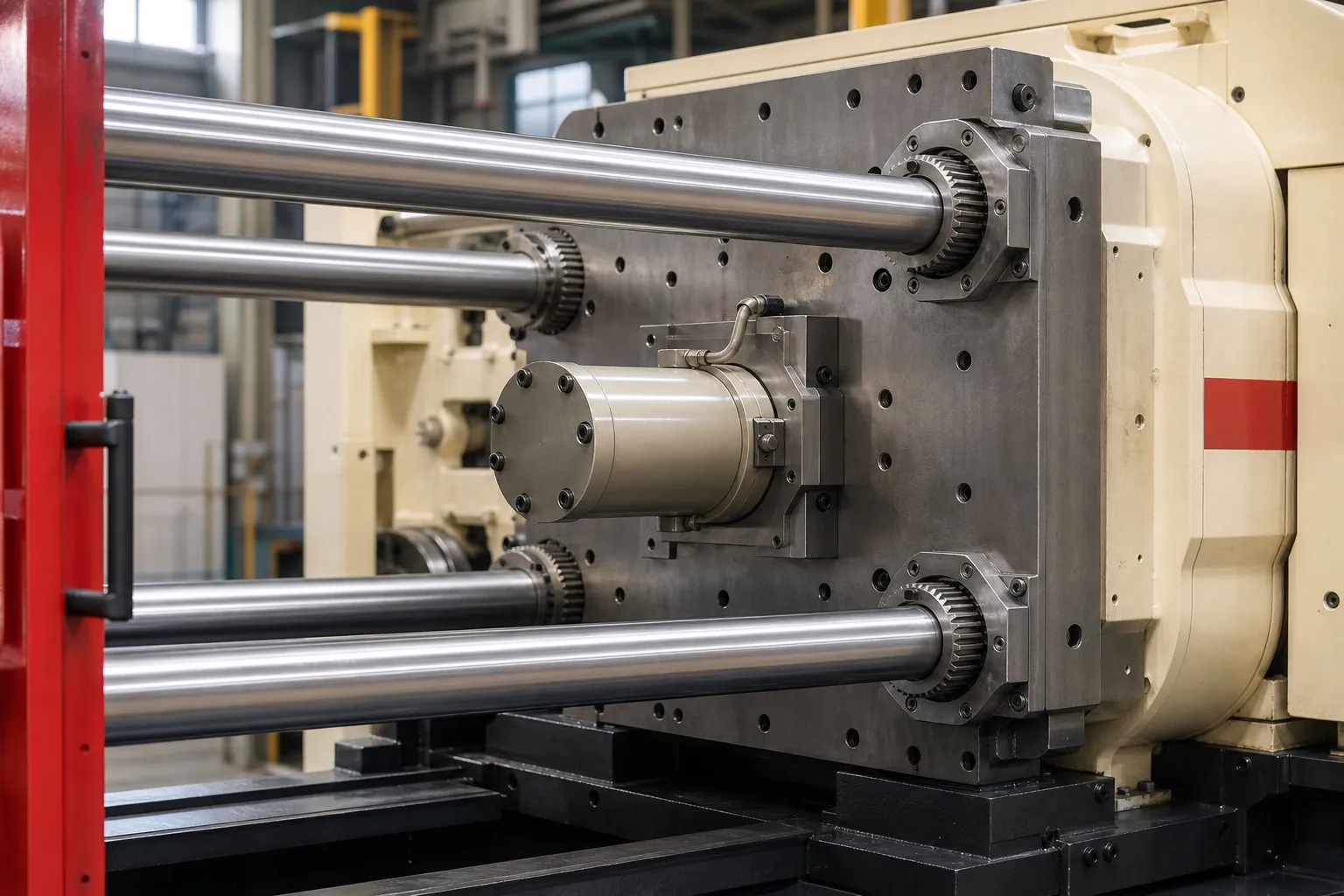
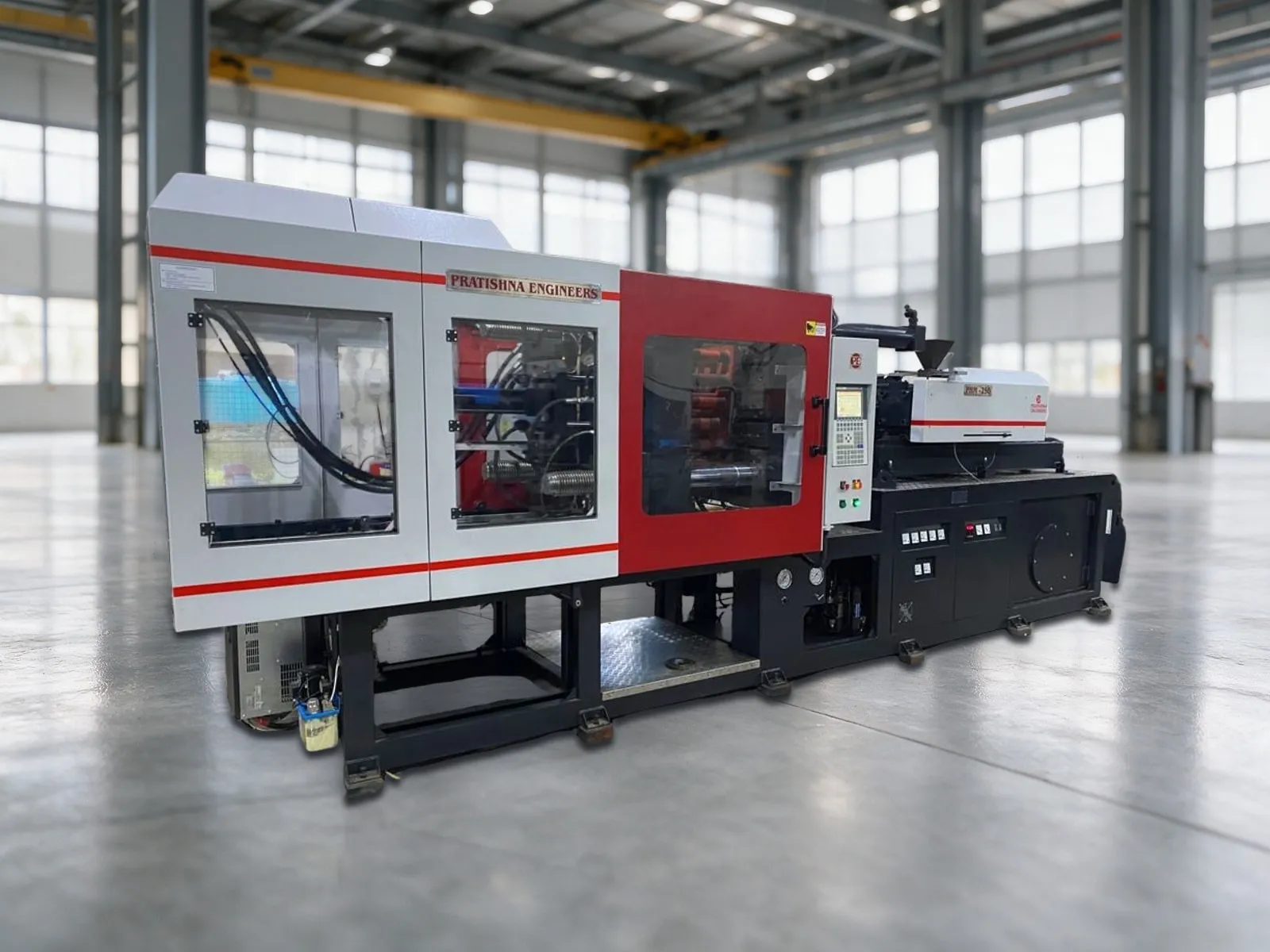
A plant adds a deeper bucket to its range. The clamp is fine, but the bucket barely clears the core when the mould opens, so an operator pulls each one by hand and the cycle stretches. A 160 t two-platen bucket making machine solves that kind of problem: its long opening suits deep parts, and its clamp carries a single round rim of about 210 to 257 mm in PP.
Storage boxes follow the same logic. Clamp sets the rim size, opening sets the depth, and the barrel sets how heavy the part can be. All three need to pass before a mould is cut.
Key Takeaways
- Round buckets up to about 230 mm rim fit 160 t at lower PP factors; a 250 mm rim needs about 152 t to 228 t.
- Aim for a shot of 20% to 65% of barrel capacity, worked out in volume because barrels are rated in PS.
- A 200 g PP bucket needs a barrel rated at least about 432 g PS to stay within 65%.
- Rigid plastic packaging in India must carry at least 30% recycled content in 2025-26, rising to 60% by 2028-29.
What Size of Bucket Can a 160 t Bucket Making Machine Carry?
With a 10% reserve, 160 t carries about 345 to 518 cm² of PP rim area at factors of 3 to 2 US t/in². A 210 mm round bucket fits at either factor, a 230 mm one toward the lower factor, and a 250 mm one usually needs more clamp.
Clamp and opening for buckets and storage boxes, one cavity (sizes assumed; PP factor 2 to 3 US t/in²; 10% reserve, a starting margin, not a rule; opening at 2.5 × part height)
| Part (rim, height) | Rim area | Clamp needed | Opening needed |
|---|---|---|---|
| Round bucket, 210 mm, 180 mm tall | 346 cm² | 107 t to 161 t | 450 mm |
| Round bucket, 230 mm, 200 mm tall | 416 cm² | 128 t to 193 t | 500 mm |
| Round bucket, 250 mm, 240 mm tall | 491 cm² | 152 t to 228 t | 600 mm |
| Storage box, 260 × 170 mm, 150 mm tall | 442 cm² | 137 t to 205 t | 375 mm |
| Storage box, 280 × 200 mm, 180 mm tall | 560 cm² | 173 t to 260 t | 450 mm |
The clamp method behind these figures is set out in the applications article in this series. The opening column uses a guide of 2.5 times part height; the mould height article explains how much opening a two-platen machine leaves once a tall mould is in place.
Boxes with lids are often moulded in separate tools. A lid needs the same clamp as its box, since the rim outline is the same, but much less opening and a far lighter shot. Stacking boxes also need consistent rim dimensions from shot to shot, so hold packing and cooling steady once a good setting is found.
How Big a Barrel Does a Bucket or Storage Box Need?
Big enough that the shot uses at most 65% of the barrel, small enough that it uses at least 20 to 25%. Work in volume: barrels are rated in grams of PS, and PP melt is lighter, so the same barrel holds fewer grams of PP than its rating suggests.
John Bozzelli's Plastics Technology articles give the window. Below about 20% of barrel capacity, residence time grows and the melt can degrade; above 65%, unmelt and long recovery appear. He gives melt densities of 0.945 g/cm³ for PS and about 0.74 g/cm³ for PP, and adds 10% for check-valve leakage and melt uniformity.
Put together, a barrel rated R grams of PS gives a good PP shot of about 0.142 × R to 0.463 × R. A 1,000 g PS barrel therefore suits PP shots of about 142 to 463 g. Bozzelli also warns against buying the biggest screw by default, because big screws usually mean lower plastic pressure.
Cooling sets most of the cycle on buckets and boxes. Cooling time grows with the square of wall thickness, so a wall 20% thinner needs about 36% less cooling. Output per hour is 3,600 divided by the cycle in seconds, times cavities, times the share of good shots.
Which PP Grades and Rules Apply to Buckets in India?
Buckets and pails usually use PP impact copolymer for drop strength. Paint pails count as rigid plastic packaging under the Plastic Waste Management Rules, which set minimum recycled content; household buckets sold empty are not packaging, though the same resin choices apply.
UL Prospector's listing of Reliance Repol grades shows C120MN and C080MA, both antistatic impact copolymers, for paint pails, luggage and industrial components. C120MN offers a balance of impact and stiffness; C080MA has higher impact strength. B030MG and MI3530 are listed for crates and furniture.
The PWM (Amendment) Rules notified on 31 March 2026, as reported by Polymerupdate, require rigid plastic packaging to contain at least 30% recycled material in 2025-26, rising to 60% by 2028-29. Exemptions apply where FSSAI and similar rules restrict recycled content, so food tubs differ from paint pails.
Recycled PP needs care in the press. Entec Polymers advises cold runners and larger gates rather than hot runners, because small metal pieces in recycled pellets can plug hot tips. It gives a typical melt of about 199 to 227 °C, a maximum of about 238 °C, and a residence time of 5 minutes at most.
Our view: if a bucket mould will run recycled blends, design it with a cold runner or direct sprue from the start. Converting a hot-runner tool after the first blocked tip costs more than the regrind it saves.
What Should You Check Before Ordering a Bucket Mould?
Confirm rim size, height, wall thickness, part weight and resin, including any recycled share. Then check clamp, opening at the planned mould height, barrel window and tie-bar fit on the machine's data sheet. See the 160 ton two platen injection moulding machine page.
Frequently Asked Questions About Bucket and Storage Box Moulding
Can one machine make buckets and their lids?
Yes, usually in separate moulds run one after the other. The lid needs the same clamp as the bucket because the rim outline matches, but far less shot and opening. Check that the lid mould is not too small for the platens, since a tiny mould on large platens can flash in the middle.
How many cavities of a small bucket fit at 160 t?
Add the rim areas, then compare with about 345 to 518 cm² at PP factors of 3 to 2 with a 10% reserve. Two 150 mm round buckets use about 353 cm², which fits toward the lower factor. Check the mould width against the tie-bar gap before settling on two cavities.
Why does my bucket stick on the core?
Deep PP parts shrink onto the core as they cool, and too little draft or too much packing makes this worse. A stripper ring that pushes on the rim spreads the load better than a few pins. Air poppets in the core can also help release the vacuum under a deep part.
Can I use 100% recycled PP for buckets?
For non-food buckets it is possible, but recycled PP varies more from lot to lot than virgin resin, so expect wider process settings and more checks on drop strength. Vent the mould well, run cold runners, and keep melt temperature and residence time lower than you would for virgin PP.
Is a separate machine needed for handles?
Not always. Plastic handles are small parts that can run in a family or separate mould on a smaller machine, which keeps the bucket machine on its main job. Metal wire handles are fitted after moulding into lugs or holes moulded on the bucket rim.
Related Articles
- What Can You Make on a 160 Ton Two Platen Machine?
- 160 Ton Two Platen vs Toggle Machine: Opening Stroke Compared
- Deep Moulds on a 1000 mm Stroke: Planning Mould Height
Sources & References
- Plastics Technology, J. Bozzelli: A Simpler Way to Calculate Shot Size vs. Barrel Capacity
- UL Prospector: Polypropylene (PP): REPOL grade listing
- Polymerupdate, D. K. Jha: India eases plastic recycling regulations
- Entec Polymers: Processing ECHO Post-Industrial Recycled Polypropylene Compounds
Technical Disclaimer
Disclaimer: The information provided in this document is for general informational and educational purposes only. It is based on technical references and industry information available at the time of preparation and may be subject to change. It does not constitute engineering, technical, commercial or professional advice, nor does it constitute a quotation, specification, warranty or contractual commitment by Pratishna Engineers.
Actual injection moulding machine and process requirements vary according to the component design, material, mould, production volume, machine configuration and operating conditions. The information, examples, calculations and recommendations provided should be independently evaluated and verified for the specific application before making any equipment, process or production decision. Information obtained from third-party sources remains subject to the accuracy and limitations of those sources.
Limitation of Liability: Pratishna Engineers makes no representation or warranty, express or implied, regarding the completeness, accuracy or suitability of the information for any particular application. To the extent permitted by applicable law, Pratishna Engineers shall not be liable for any loss, damage, cost or consequence arising from reliance on or use of the information contained in this document. Final machine selection, configuration and application suitability should be confirmed with Pratishna Engineers based on complete and accurate project requirements.