






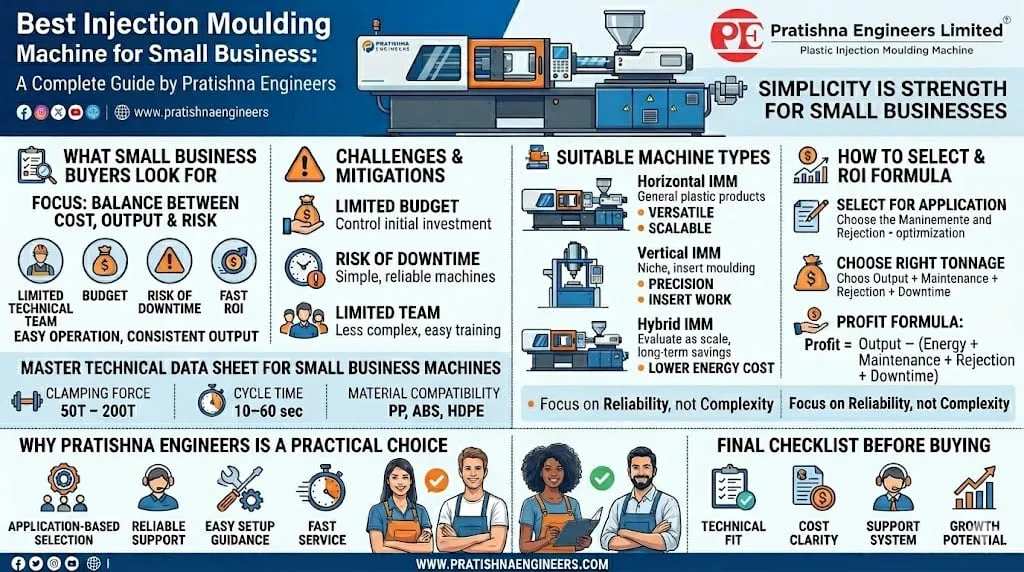

Picture a rented gala in an industrial estate: one shift, two operators, and three PP products to make, a storage container, its lid and a small cap. Choosing an injection moulding machine for small business work like this is less about the biggest part you might win one day and more about the parts you will run every week. The machine has to clamp the largest of them, give a good shot for the smallest, fit the floor with its auxiliaries and run on the power you have sanctioned.
Key Takeaways
- Size the clamp for the part with the largest projected area and the barrel for the spread of shot sizes in your mix.
- A shot below 20% of barrel capacity risks degradation, and above 65% risks unmelt, so one barrel may not cover every product.
- Single-shift running adds heat-up, start-up scrap and idle energy, so plan the start and end of each day.
- Plan floor space and sanctioned load for the dryer, chiller, grinder and material storage, not just the machine.
How do you size an injection moulding machine for small business product mixes?
Size the clamp for the part with the largest projected area, then size the barrel so the largest shot uses no more than 65% of capacity and the smallest at least 20%. If one barrel cannot cover both ends of your mix, plan a second barrel or a second machine.
The shot window comes from Plastics Technology's barrel guidance. Use 25% to 65% of barrel capacity: below 25%, melt uniformity is often poor because the screw turns too few times, and above 65% you risk unmelt and long recovery. Below 20%, long residence time leads to degradation. Machine shot ratings are usually in grams of PS, so work in volume: melt density is about 0.945 g/cm³ for PS and 0.74 g/cm³ for PP. Add 10% for check-valve leakage and melt uniformity before you size.
For clamp, PP sits at 2 to 3 US tons/in², about 0.281 to 0.422 t/cm², on projected area including any cold runner. Add a reserve of 10%, a starting margin, not a rule. A second barrel ordered with a new machine can be low cost, which is often the cheapest way to stretch one machine across a mix. Our flat view: buy for the part you will run most hours, not for the biggest enquiry you might receive.
What does single-shift running change?
It turns every day into a start-up and a shutdown. You lose time heating barrels and moulds, make scrap until the process settles, and dry material before the shift begins. Idle periods matter more too, because a machine left running through breaks draws energy without making parts.
An idling machine still draws a large share of its moulding energy, and PlasticsToday suggests that a stop of more than 1.5 hours may be cheaper to switch off and restart. On one shift, that makes lunch breaks and changeovers worth timing. Start the dryer early enough that material is ready when the barrel reaches temperature. If material sits in a hot barrel through a long break, residence time grows, so purge or drop to a standby temperature for long stops.
Write a short start-up and shutdown routine for each product: heater set points, purge steps, the first parts to check and when to switch to auto cycle. A small unit gains more from that sheet than from most machine options.
How much floor space and power should you plan for?
Plan for the machine plus everything around it: clearance to change moulds and open the guards, a dryer and hopper, a chiller or cooling tower, a grinder, raw material, finished goods and an aisle. Plan power for the drive, heaters and every auxiliary running at once, within your sanctioned load.
Floor and utility plan for a first machine
| Item | What to plan | Why it matters |
|---|---|---|
| Machine | Footprint plus space behind and beside for mould change and maintenance | Moulds and hydraulics need access |
| Mould handling | Chain block, crane or trolley rated for the heaviest mould | Safe and quick mould changes |
| Dryer and hopper | Floor or machine-mounted position, power supply | Hygroscopic resins need drying |
| Cooling | Chiller or cooling tower, water lines to the mould and oil cooler | Cooling sets cycle time |
| Grinder | Space near the machine for runners and rejects | Regrind returns to the hopper |
| Electrical | Sanctioned load, distribution board, power factor correction | Avoid tripping and billing penalties |
| Storage | Bagged resin, masterbatch, cartons, finished goods | Keeps the aisle clear |
On power, add the machine's connected load to the dryer, chiller, grinder and lighting before you apply for a connection. Above 20 kW, Maharashtra connections are billed on kVAh, so power factor correction belongs in the first budget.
Which material and product rules should a small unit check?
Check the resin grade against the product's end use before you mould it. Food containers need a food-contact grade, toys need the ISI mark under the Toys (Quality Control) Order, and some single-use items are banned. The material decision often settles the barrel, dryer and mould temperature needs as well.
Take an Indian example. Reliance's Repol H110MAS, a nucleated PP homopolymer for rigid packaging, furniture and houseware, states compliance with IS 10910 for food contact and that it is not for single-use plastic items banned under the Plastic Waste Management Rules. Its data sheet gives a melt range of 200 to 250 °C and a mould range of 20 to 50 °C; set your heater and cooling plan from figures like these rather than from habit.
What should you do before you order your first machine?
List your products with projected area, shot weight, material and expected volume, then work out the clamp and barrel window for the whole mix, as in the example below. Add the auxiliaries and the power they need. See the injection moulding machine range to match a machine type to that requirement.
Frequently Asked Questions About a First Injection Moulding Machine
What tonnage suits a first injection moulding machine?
Work it out from your largest part rather than picking a round number. Multiply projected area, including any cold runner, by a factor for your material, such as 0.281 to 0.422 t/cm² for PP, and add a reserve. Then check that the mould fits between the tie bars and the opening clears the part.
Can one machine run several different products?
Yes, if the clamp covers the largest part and every shot falls between about 20% and 65% of the barrel's capacity. When a small shot falls below that window, a second barrel or a smaller machine avoids degraded material. Check the mould sizes and opening strokes for each product too.
Should a small unit start with a semi-automatic cycle?
It can, when parts need trimming, inspection or packing by hand at the machine anyway. Semi-automatic running ties the cycle to the operator, though, so output depends on the person. If parts drop cleanly and need no handling, automatic running with a guard and a chute usually gives steadier cycles.
How much power does a small moulding unit need?
Add the connected loads of the machine drive, barrel heaters, dryer, chiller or tower pumps, grinder, compressor and lighting, then allow for those running together. Compare that with your sanctioned load before you order. In Maharashtra, connections above 20 kW are billed on kVAh, so plan power factor correction early.
Is one shift or two better for a first machine?
Two shifts spread start-up scrap, heat-up time and the machine's fixed costs over more parts, so cost per part usually falls. One shift is easier to staff and supervise while you learn the process. You can start with one and add a second once orders and trained operators are in place.
Related Articles
- Affordable Injection Moulding Machines in Mumbai
- Injection Moulding Machine Cost Breakdown India
- What is the Best Injection Moulding Machine Brand in Mumbai?
Sources & References
- Plastics Technology, J. Bozzelli: Revisiting Shot Size vs. Barrel Capacity
- Plastics Technology, J. Bozzelli: A Simpler Way to Calculate Shot Size vs. Barrel Capacity
- SPE Plastics Engineering, A. Urbina: Mastering Clamping Force Calculation
- Reliance Industries: Repol H110MAS Technical Data Sheet (July 2024)
Technical Disclaimer
Disclaimer: The information provided in this document is for general informational and educational purposes only. It is based on technical references and industry information available at the time of preparation and may be subject to change. It does not constitute engineering, technical, commercial or professional advice, nor does it constitute a quotation, specification, warranty or contractual commitment by Pratishna Engineers.
Actual injection moulding machine and process requirements vary according to the component design, material, mould, production volume, machine configuration and operating conditions. The information, examples, calculations and recommendations provided should be independently evaluated and verified for the specific application before making any equipment, process or production decision. Information obtained from third-party sources remains subject to the accuracy and limitations of those sources.
Limitation of Liability: Pratishna Engineers makes no representation or warranty, express or implied, regarding the completeness, accuracy or suitability of the information for any particular application. To the extent permitted by applicable law, Pratishna Engineers shall not be liable for any loss, damage, cost or consequence arising from reliance on or use of the information contained in this document. Final machine selection, configuration and application suitability should be confirmed with Pratishna Engineers based on complete and accurate project requirements.

