






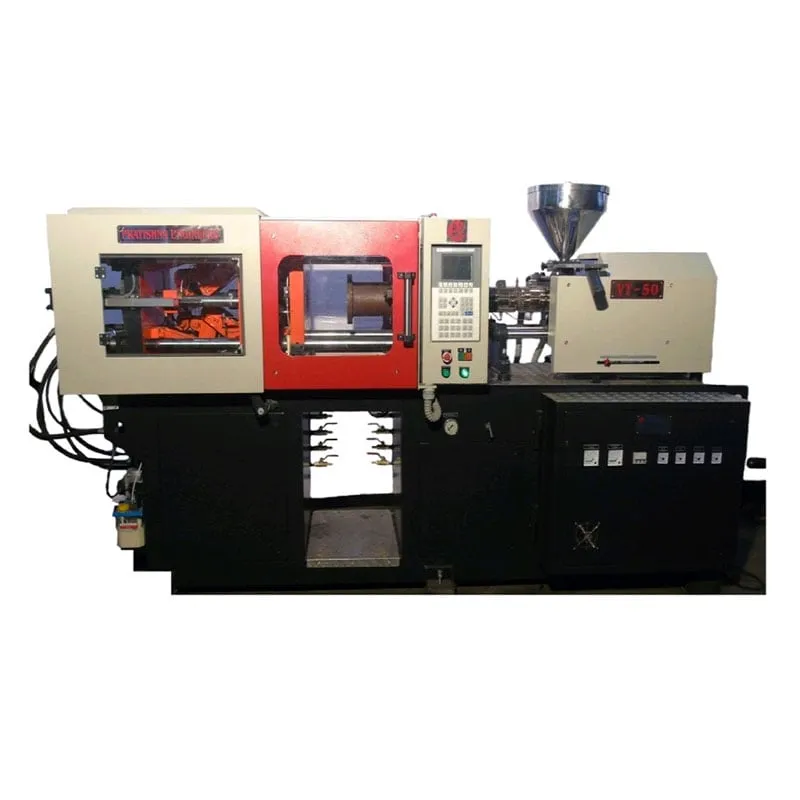

Start with one number. A PP part with 300 cm² of projected area, runner included, needs about 93 to 139 t of clamp once you add a 10% reserve, a starting margin, not a rule. That is the honest starting point for affordable injection moulding machines in Mumbai: buy the clamp, opening and shot your part needs, then spend what you save where it protects the machine and the mould. A 250 t machine bought for that part "to be safe" costs more on the invoice and keeps costing more in base-load energy every hour it runs.
Pratishna Engineers, a Mumbai manufacturer since 1991, works through the same order with buyers: component, material, mould, production requirement, then machine configuration.
Key Takeaways
- Right-size first: the clamp, opening stroke and shot your part needs decide the machine, not a round tonnage figure.
- An oversized machine costs twice, once at purchase and again in base-load energy, and a small mould on large platens risks flash.
- You can postpone convenience options such as a robot or hopper loader if the parts and shifts allow it.
- Never cut mould protection, oil cooling and filtration, the right screw for your material, guarding or power factor correction.
What makes affordable injection moulding machines in Mumbai worth buying?
An affordable machine is sized to your part, built to hold its settings and supported nearby, so the money saved at purchase is not spent again on energy, scrap or downtime. The machine with the lowest invoice and the one with the lowest cost per good part are often different.
Right-sizing starts with clamp. Plastics Technology gives the method: take the projected area of one part, subtract any cored-out through areas, multiply by the number of cavities, add the full cold-runner area, then multiply by a tonnage factor. Typical factors run from 2 to 10 US tons/in², with 3 recommended as a starting point. For PP, SPE gives 2 to 3 US tons/in², which converts to about 0.281 to 0.422 t/cm².
The factor moves with melt flow, flow length, wall thickness, gate size, gate location and number of gates. A long, thin flow path pushes it up. That is why two parts with the same projected area can need different machines.
Then check fit. MoldMaking Technology advises that the mould should ideally fit within the tie bars, that the opening stroke should be at least 2.5 times the part height, and that the mould must suit the machine's minimum and maximum shut height. A machine with the right clamp but too little opening is not right-sized.
On shot, keep the barrel in proportion. A shot that uses only a small share of a large barrel holds material hot for longer and gives poorer melt, so a bigger injection unit is not a free safety margin. The worked example below shows the window for a 400 g PP shot.
How does oversizing cost you twice?
First at purchase, because a larger clamp and injection unit cost more to build. Then every running hour, because a large hydraulic machine on a small job carries a high base load. A mould small for its platens adds a third risk: flash in the mould centre and platen damage.
The ExxonMobil, AMI and Tangram energy guide reports that a standard hydraulic machine's base load can be 75% or more of its total energy, and that a high base load can mean the machine is too large for the job. Base load is drawn whether the shot is large or small, so the oversized machine burns it on every cycle.
Mould fit matters as much. Plastics Technology's rule of thumb is that the mould should cover at least 70% of the distance between the tie bars. Smaller moulds let the platens bow under clamp, causing flash in the centre of the mould, and very small moulds can cause catastrophic platen damage. Running a big clamp at full tonnage on a small mould adds over-clamping risk: crushed vents, burns and cracked cavity blocks.
Plastics Technology describes one such case: a mould that needed about 100 tons was clamped at a 400-ton machine's maximum, and the cavity block split in two places, a repair costing upwards of $100,000. The lesson for a budget buyer is direct. Extra clamp you do not need is not insurance; it is a setting someone will one day turn all the way up.
Which options can you skip at the start?
You can postpone equipment that adds convenience or output but does not protect the machine, the mould or the part. A robot where a picker or gravity drop will do, a hopper loader on a single machine, or core-pull circuits for moulds you do not yet own can all wait.
Options you can usually defer, and when they start to pay
| Option | Defer it when | Add it when |
|---|---|---|
| Robot | A sprue picker or gravity drop handles the parts | Parts need placing, stacking or insert loading |
| Hopper loader | One machine is filled by hand within the shift | Material is handled for several machines or shifts |
| Core-pull circuits | Current moulds have no side cores | A mould with side cores is on order |
| Second screw and barrel | Every shot fits one barrel window | Small and large shots share the machine |
| Central conveying | The shop has a single machine | The shop grows to several machines |
Ask the maker which options can be added later without rework. Some, such as a hopper loader, can be added with little work. Others, such as extra hydraulic circuits or a robot interface, are simpler to provide at the build stage, so confirm that the machine is ready for them even if you do not buy them now.
Treat a second barrel differently from the other options. If your shots spread from small to large, a second barrel ordered with the machine can stretch one machine across the whole range, which is usually better value than a second machine bought early.
Which options should you never cut?
Never cut what protects the machine, the mould and the operator: low-pressure mould protection, adequate oil cooling and filtration, a screw and barrel suited to your material, full guarding with interlocks, and power factor correction. Each one prevents a cost far larger than the saving.
Mould protection stops the clamp from closing hard on a stuck part. Oil cooling and filtration keep the hydraulics stable through long shifts. The screw and barrel have to match the material: rigid PVC, glass-filled grades and PET each need specific metallurgy or geometry, and a general-purpose screw on the wrong material wears quickly.
Guarding is not optional. The Indian Omnibus Technical Regulation Order names IS/ISO 20430 as the safety standard for injection moulding machines, and its enforcement date is awaiting notification. Power factor correction earns its place in Maharashtra, where MSEDCL bills HT connections and LT connections above 20 kW on kVAh. Where you run long hours, a servo or variable-speed pump drive is also worth pricing against a fixed pump.
How Pratishna Engineers helps you right-size a machine
Pratishna Engineers selects machines with customers in a fixed order: component, material, mould, production requirement, then machine configuration. Following that order keeps the clamp, opening and shot tied to your part rather than to a round tonnage figure.
The range spans horizontal (E, C and H series), vertical (PV and PVDL series), PET, two-platen (PHM series), hybrid machines with hydraulic locking and electric injection, and special purpose machines, so the size can follow the part. Design, manufacturing, assembly, testing and service are done in-house at its Mumbai facilities in Andheri (E). The design team works in SolidWorks, Creo and AutoCAD, and an independent QA department works to written SOPs.
The manufacturing facilities in Mumbai cover about 25,000 sq ft, with CNC turning centres, vertical and horizontal machining centres, jig boring machines, and assembly and testing facilities.
The company started with machine rebuilding, indigenisation and technology adaptation before moving to complete machine design, manufacturing and automation, and import substitution remains a stated focus.
What should you send to get a right-sized offer?
Send the part drawing or sample, material grade, cavities, mould dimensions and weight, part height, shot weight, target output and shifts. With these, any maker can work out clamp, opening, tie-bar fit and barrel size before suggesting a machine. Browse the injection moulding machine range to see which machine types fit your parts.
Frequently Asked Questions About Affordable Injection Moulding Machines
What is the most economical way to start injection moulding in Mumbai?
Start with one right-sized machine for the products you will run most, with only the auxiliaries those products need. Defer convenience options, keep protective ones, and plan power factor correction from day one. Add a second barrel if your shot sizes spread widely, before you consider a second machine.
Is a smaller machine always cheaper to run?
Not always. A machine that is too small runs near its limits, which can mean slower cycles, unstable shots and more scrap. The aim is a machine sized to the part with a modest reserve. A right-sized machine usually runs at lower base load than an oversized one on the same job.
Can I add a robot later?
Usually, if the machine has a robot interface and the mounting points for it. Ask for these at the build stage even if you buy the robot later, because adding the interface afterwards can mean controller and wiring changes. Check that the guarding allows the robot to enter the mould area safely.
Why does an oversized machine waste energy?
A hydraulic machine draws base-load power to run its pump and heat its barrel whether the shot is large or small. On a small job, that base load is spread over fewer kilograms of good parts, so energy per kilogram rises. The energy guide links a high base load to machines that are too large for the job.
Does a servo or variable-speed pump drive pay for itself?
It depends on hours run and how much of the cycle the pump idles. The saving comes from slowing the motor when oil is not needed. Measure your current machine with a clamp-meter logger, which can take as little as 30 minutes, and compare the reading against the drive's expected consumption for your cycle.
Can Pratishna Engineers help me choose the right tonnage?
Yes. Send your component drawing or sample, material, mould details and production requirement. Pratishna Engineers works through component, material, mould, production requirement and then machine configuration, so the clamp, opening and barrel are sized from your part. You receive a configuration matched to that requirement rather than a round tonnage figure.
Should I buy a bigger machine for moulds I might get later?
Only if those moulds are likely and their sizes are known. A machine bought for a possible future part carries higher base load today, and today's small moulds may cover too little of its tie-bar gap. If growth is uncertain, right-size now and add a second machine when the larger mould arrives.
Related Articles
- Best Injection Moulding Machine for Small Business
- Injection Moulding Machine Cost Breakdown India
- Injection Moulding Machine Dealers in Mumbai
- Plastic Injection Moulding Machine Price in Mumbai
Sources & References
- Plastics Technology, J. Williams (RJG): Clamp Tonnage: More Is Better...Right?
- MoldMaking Technology, B. Catoen: Machine Sizing and Specification for Optimal Mold Performance, Part 1
- Plastics Technology, P. Witaszek, J. Klees, J. Fattori, E. Di Siro, J. Bozzelli: How to Mount an Injection Mold
- ExxonMobil, AMI and Tangram Technology: An Energy Saving Guide for Injection Moulders
Technical Disclaimer
Disclaimer: The information provided in this document is for general informational and educational purposes only. It is based on technical references and industry information available at the time of preparation and may be subject to change. It does not constitute engineering, technical, commercial or professional advice, nor does it constitute a quotation, specification, warranty or contractual commitment by Pratishna Engineers.
Actual injection moulding machine and process requirements vary according to the component design, material, mould, production volume, machine configuration and operating conditions. The information, examples, calculations and recommendations provided should be independently evaluated and verified for the specific application before making any equipment, process or production decision. Information obtained from third-party sources remains subject to the accuracy and limitations of those sources.
Limitation of Liability: Pratishna Engineers makes no representation or warranty, express or implied, regarding the completeness, accuracy or suitability of the information for any particular application. To the extent permitted by applicable law, Pratishna Engineers shall not be liable for any loss, damage, cost or consequence arising from reliance on or use of the information contained in this document. Final machine selection, configuration and application suitability should be confirmed with Pratishna Engineers based on complete and accurate project requirements.

