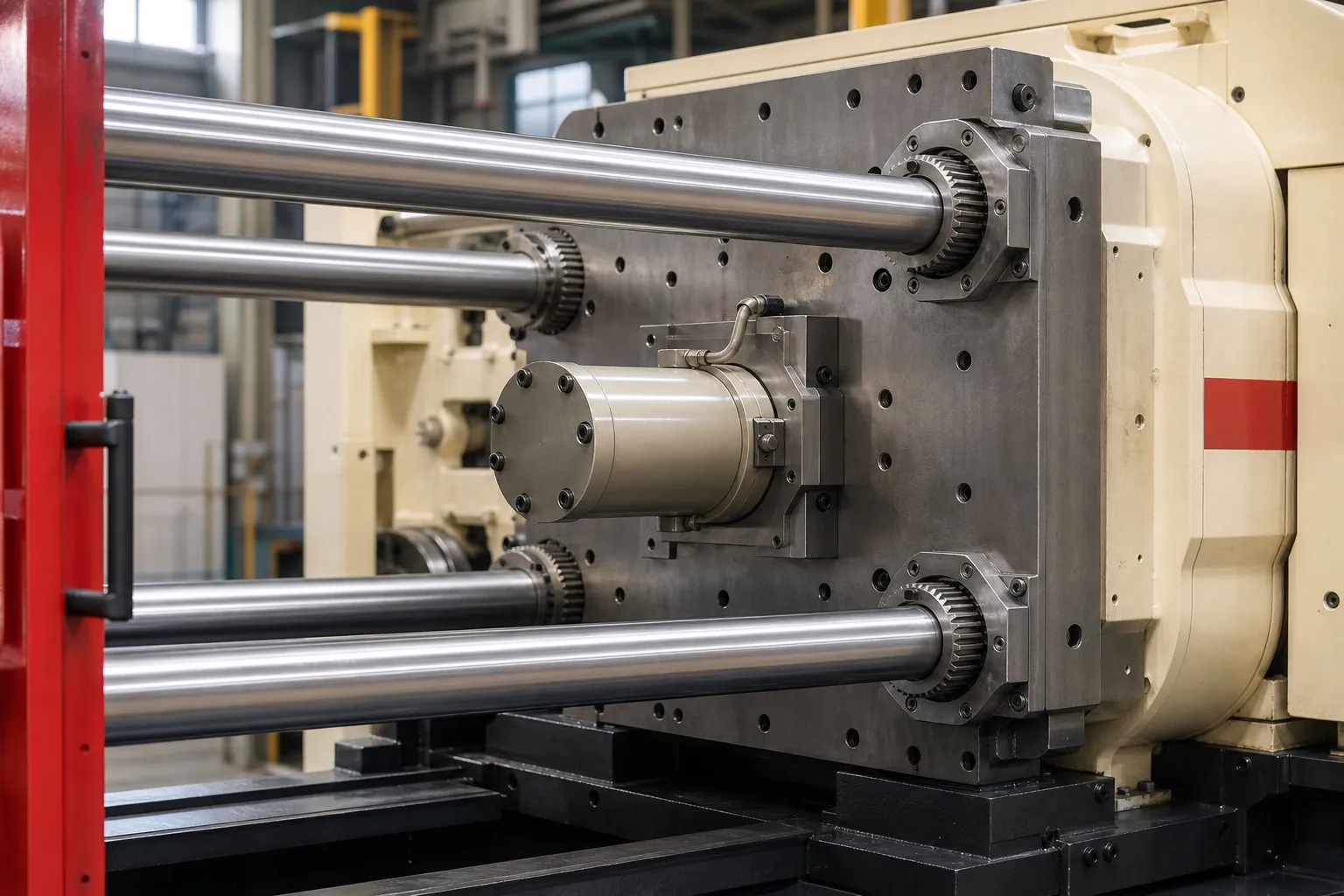
A dairy customer asks for a quote on a 48-cavity cap mould, and the first question on the shop floor is how much clamp it needs. The surprise is that the clamp sum comes out low. In caps and closures moulding on 140 to 320 t machines, the press can be chosen by mould size, cooling and closure design more than by clamp force.
Small caps have small projected areas, but a high-cavity mould with its hot runner, cooling and unscrewing or stripping action is wide and tall. That mould, not the clamp sum, can set the tonnage class.
Key Takeaways
- Caps have small projected areas, so even 48 cavities can need less clamp than the platen and tie-bar space for the mould imply.
- Cooling of the thickest section sets the cap cycle, and cooling time grows with the square of that thickness.
- Since 3 July 2024, plastic caps and lids on single-use beverage containers up to three litres sold in the EU must stay attached, which changes the mould for exporters.
- FSSAI's Packaging Regulations list PP and HDPE caps among suggested packaging for foods such as milk, with the resin conforming to the Indian Standards they name.
Why Is Caps and Closures Moulding Limited by Mould Size?
A cap's projected area is small, so the clamp sum for even a high-cavity mould can stay modest. But every cavity needs room for cooling, the stripping or unscrewing action and a hot runner drop, so the mould grows wider and taller faster than the clamp requirement does.
SPE's Plastics Engineering magazine places polyethylene at the low end of the 2 to 8 US t/in² range of tonnage factors and PP at 2 to 3. A 30 mm cap covers about 7 cm², so 48 of them add up to about 340 cm², a modest clamp sum for a mould that size.
So check the mould against tie-bar spacing and platen size first, then the clamp. If the platen you need comes with more clamp than the mould requires, set clamp force from the calculation rather than the machine maximum, to protect vents and parting faces.
Shot is the other check. Forty-eight caps at a few grams each still make a sizeable shot, and the hot runner holds melt in the manifold between shots, so heat-sensitive grades need care.
Ask the toolmaker for the hot runner layout early, since manifold and drop positions can fix the mould size as much as the cavity pitch does.
How Does Closure Design Change the Machine?
Threads, tamper bands and tethers decide how the cap leaves the core, and that sets the mould's action. Strip-off designs are pushed over shallow threads, unscrewing moulds rotate the cores and need a drive, and tethered bands add cuts or hinges. Each adds height, width or motion.
An unscrewing mould needs a hydraulic or electric drive, and the machine must supply the connections and control signals for it. Check the core-pull and auxiliary circuits when you first discuss the mould, not at installation.
Export rules are adding features. AIMPLAS, the Spanish plastics technology centre, explains that under Article 6 of EU Directive 2019/904, beverage containers up to three litres can be sold only if their plastic caps and lids stay attached during use, from 3 July 2024. The harmonised test standard, EN 17665, covers attachment strength and reliability over repeated use.
For a moulder, a tether means extra cuts or hinges in the band, which can change cooling, ejection and cap weight. Treat it as a new mould design, not a small edit to the old one.
Closure features and what they ask of the mould and machine
| Feature | Effect on the mould | What to check on the machine |
|---|---|---|
| Shallow threads, strip-off | Stripper plate or ring pushes the cap off | Ejector stroke and force |
| Deep threads, unscrewing | Rotating cores with a gear drive | Core-pull or auxiliary circuits, signals, mould height |
| Tamper-evident band | Thicker section, extra undercut | Cooling time, ejection reliability |
| Tethered band (EU export) | Cuts or hinges in the band | Cycle and ejection after redesign |
What Sets the Cycle for Caps and Closures?
Cooling of the thickest section sets it, which can be the top panel, the plug seal or the tamper band rather than the side wall. Cooling time rises with the square of thickness, so a section 20% thicker needs about 44% more cooling. Even cooling across cavities matters as much.
RJG notes that wall thickness has the largest effect on cooling time, and that only about 40% of the heat has to be removed before the part can be ejected. It suggests adding about 20% to the calculated cooling time as a safety factor.
Food rules shape the resin before the cycle. The FSSAI Packaging Regulations, 2018 list PP and HDPE caps in their suggested packaging for milk, edible oils and other foods, and name standards such as IS 10910 for PP and IS 7328 for HDPE moulding materials. The thin-wall container article in this series covers the migration and certificate requirements.
Our view: choose the cavity count you can cool evenly, not the largest that fits the platen. A 32-cavity mould at a steady cycle can outproduce a 48-cavity mould that runs with blocked cavities or a cycle stretched to suit the hottest one.
What Should You Send for a Cap Mould Check?
Send the closure drawing with the thickest section marked, the resin grade, the cavity count and pitch, the mould's outside size and shut height, the ejection method and your target output. Clamp, platen fit, shot and cycle can then be checked together. See the 140 to 320 ton container injection moulding machine page.
Frequently Asked Questions About Caps and Closures Moulding
What is the difference between strip-off and unscrewing cap moulds?
A strip-off mould pushes the cap over its threads, which works when the threads are shallow and the resin can flex. An unscrewing mould rotates each core to wind the cap off, which suits deeper or finer threads. Unscrewing moulds are larger, cost more and need a drive the machine can power.
How many cavities should a first cap mould have?
Work back from the monthly quantity, working hours and a realistic cycle, then add a margin for downtime. A cavity count that meets demand with a steady cycle is safer than the largest count that fits. Fewer, well-balanced cavities are also easier to start up and keep running.
Do tethered caps apply to caps sold only in India?
The EU rule applies to products placed on the EU market. Caps for the Indian market follow Indian rules. If your caps, or your customer's filled bottles, may be exported to the EU, design for the tether from the start, because changing a running mould later costs more than building it in.
Why do caps from different cavities vary in weight?
Usually because melt reaches the cavities at different times, pressures or temperatures, through runner imbalance, uneven hot runner drops or uneven cooling. Weigh caps by cavity number over several shots. A consistent pattern points to the mould, while random variation points to the process or the resin.
Which resins does FSSAI suggest for food caps?
The FSSAI Packaging Regulations' list of suggested packaging names PP and HDPE caps for products such as milk, edible oils and many other foods. The resin must conform to the relevant Indian Standard in the regulations, such as IS 10910 for PP. Confirm the grade's compliance with your resin supplier.
Related Articles
- Container Making Machines: Injection Rate, Stroke and Tonnage
- Thin-Wall Container Moulding on 140 to 320 Ton Machines
- Deep Container Moulds: Daylight, Ejector Stroke and Cycle Time
Sources & References
- AIMPLAS: The EU Mandates Attaching Caps to Plastic Bottles and Containers (June 2024)
- Food Safety and Standards Authority of India: Food Safety and Standards (Packaging) Regulations, 2018, compendium version III (1 June 2022)
- Plastics Engineering (SPE), A. Urbina: Mastering Clamping Force Calculation
- RJG Inc.: How to Determine Injection Molding Cooling Time
Technical Disclaimer
Disclaimer: The information provided in this document is for general informational and educational purposes only. It is based on technical references and industry information available at the time of preparation and may be subject to change. It does not constitute engineering, technical, commercial or professional advice, nor does it constitute a quotation, specification, warranty or contractual commitment by Pratishna Engineers.
Actual injection moulding machine and process requirements vary according to the component design, material, mould, production volume, machine configuration and operating conditions. The information, examples, calculations and recommendations provided should be independently evaluated and verified for the specific application before making any equipment, process or production decision. Information obtained from third-party sources remains subject to the accuracy and limitations of those sources.
Limitation of Liability: Pratishna Engineers makes no representation or warranty, express or implied, regarding the completeness, accuracy or suitability of the information for any particular application. To the extent permitted by applicable law, Pratishna Engineers shall not be liable for any loss, damage, cost or consequence arising from reliance on or use of the information contained in this document. Final machine selection, configuration and application suitability should be confirmed with Pratishna Engineers based on complete and accurate project requirements.