A 90 g PP tub shot is about 122 cm³ of melt. Fill it in half a second and the injection unit must move about 243 cm³/s. On a 45 mm screw that means a screw speed near 153 mm/s; on a 50 mm screw, about 124 mm/s. That sum sits at the centre of thin-wall container moulding: the thinner the wall, the faster the fill, and the more the injection unit decides the machine.
Clamp, platen stiffness, barrel size and the mould all have to keep pace with that speed. The sections below take each in turn.
Key Takeaways
- Thin-wall designs typically run flow length to wall ratios of 100:1 to 200:1 and need injection pressures and speeds far above conventional moulding.
- For thin-wall work, a Sabic engineer writing in PlasticsToday recommends a shot of at least 40% of barrel capacity, so a smaller barrel can be the better choice.
- Thin walls cool fast: cooling time depends on wall thickness squared, so a 0.6 mm wall needs about a quarter of the cooling of a 1.2 mm wall.
- Food containers in India must use plastics that conform to the Indian Standards listed in the FSSAI Packaging Regulations, such as IS 10910 for PP.
What Makes Thin-Wall Container Moulding Different?
The flow path is long for the wall, so melt must travel far through a narrow gap before it freezes. That needs far higher injection pressure and speed than a conventional part, a resin with high flow, and a mould and machine built to take the load.
Greg Tremblay, a Sabic engineer writing in PlasticsToday, describes thin-wall designs as having length to thickness ratios typically from 100:1 to 200:1. He puts injection pressures for this work typically above 30,000 psi, about 2,068 bar, and warns that such pressures and speeds can cause problems from burning to flash.
Resin choice follows from that. He calls for high-flow grades with low melt viscosity that can also take the heat of very high shear without degrading.
The mould has to keep up too. Tremblay suggests steels harder than P-20, thicker plates, as many support pillars as will fit, and vents at core pins and ejector pins as well as the parting line, because a fill this short leaves trapped air nowhere to go.
Gates need the same balance. Tremblay notes that large sprues, runners and gates cut pressure drop but add residence time, while gates that are too small can stop the mould filling. A filling analysis can find the middle ground before steel is cut.
What Does the Machine Need for Thin-Wall Work?
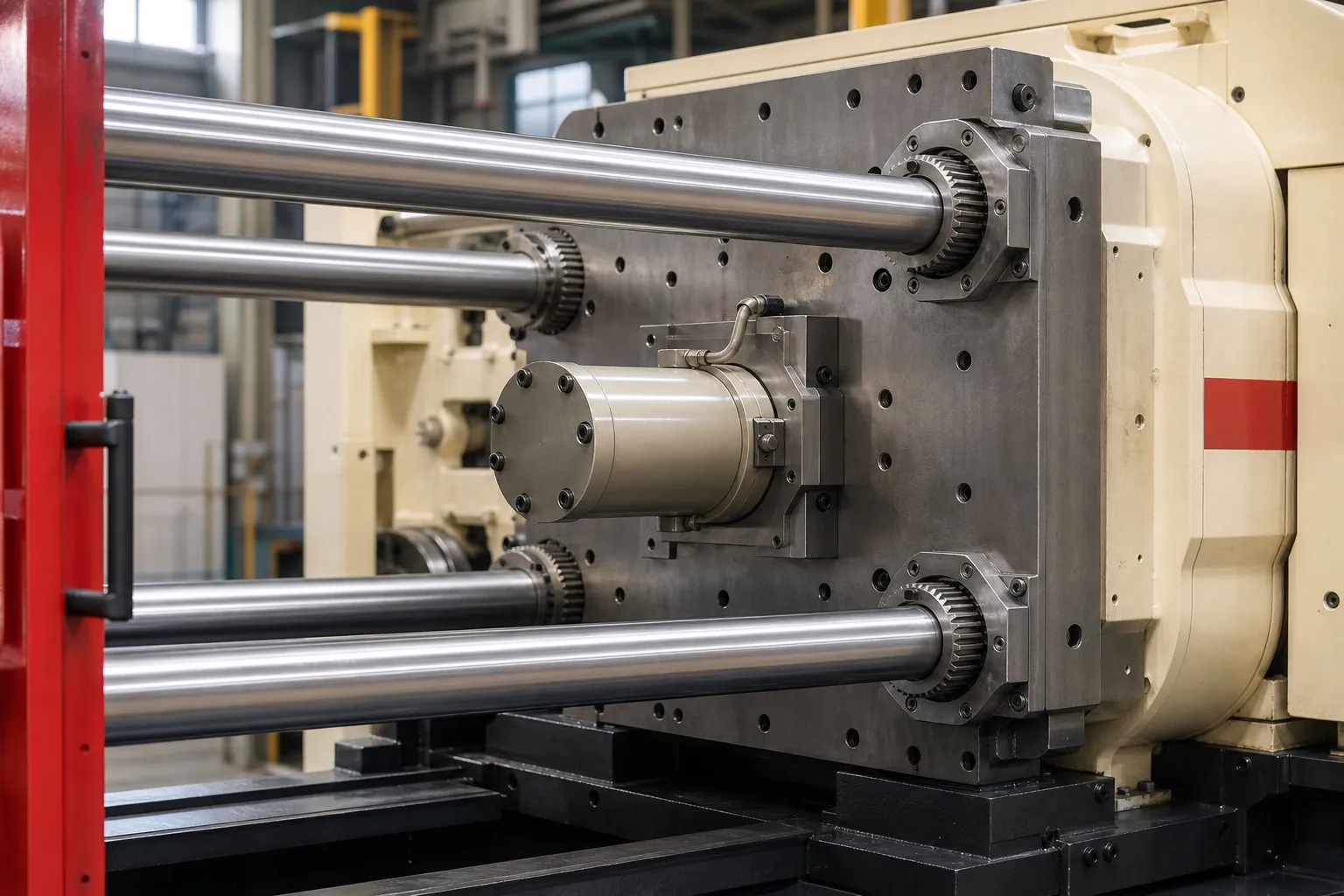
Speed, pressure and stiffness. The injection unit must deliver the shot in under a second at high pressure, the clamp must hold more force per cm², and the platens must not bend under that load. A machine strong on one and weak on another will struggle with thin-wall containers.
Tremblay gives thin-wall clamp factors of 5 to 8 US t/in², compared with 3 to 5 for conventional moulding, and injection velocities above 3 in/s, with many jobs at 6 in/s, about 152 mm/s. On the better thin-wall machines, he notes, tie-bar distance is no more than twice the platen thickness.
Barrel size works differently here. He recommends a shot of at least 40% of barrel capacity, because a barrel that is too large struggles to give the pressure boost and holds melt long enough to degrade. That is a tighter lower limit than general moulding uses.
Our view: do not plan thin-wall packaging around a converted general-purpose press. Tremblay counts adapting conventional machines as usually unwise, and each figure above shows where a standard press can fall short.
Thin-wall vs conventional moulding, as described by Tremblay in PlasticsToday
| Point | Thin-wall work | Conventional moulding |
|---|---|---|
| Flow length to wall | Typically 100:1 to 200:1 | Lower |
| Clamp factor | 5 to 8 US t/in² | 3 to 5 US t/in² |
| Injection velocity | Above 3 in/s; many jobs need 6 in/s | Lower |
| Fill time | Under 1 second | Longer |
| Shot as share of barrel | At least 40% | Wider working range |
| Venting | Parting line plus core and ejector pins on demanding parts | Parting line venting |
How Much Faster Do Thin Walls Cool?
Much faster, which is the payback for the harder fill. Cooling time depends most on wall thickness, and that term is squared, so halving the wall cuts cooling to about a quarter. The cycle then depends more on mould opening, ejection and part removal.
RJG makes the point in its guide to cooling time, where about 85% of the cycle in one thicker 8-cavity trial went on cooling. At thin-wall gauges that share falls, and clamp movement starts to count; Tremblay notes that thin-wall machines tend to use accumulator-assisted clamps for that reason.
For food containers, the rules come before the cycle. The FSSAI Packaging Regulations, 2018 require plastics used for food containers to conform to the Indian Standards in their Schedule III, such as IS 10910 for PP and IS 10146 for PE. Plastic packaging must also pass an overall migration limit of 60 mg/kg or 10 mg/dm² when tested to IS 9845.
The same regulations ask food businesses to hold a certificate of conformity from an NABL-accredited laboratory for packaging in direct contact with food. Settle the grade with your customer before trials begin.
What Should You Send for a Thin-Wall Machine Check?
Send the container drawing with the thinnest wall and longest flow path, the resin grade and its melt flow, the cavity count, the mould's shut height and your target cycle. Fill rate, screw speed, barrel use and clamp can then be checked together. See the 140 to 320 ton container injection moulding machine page.
Frequently Asked Questions About Thin-Wall Container Moulding
What wall thickness counts as thin-wall?
There is no single thickness. It is the wall relative to the flow length that matters. Tremblay describes thin-wall designs as typically 100:1 to 200:1. A 0.5 mm wall with a 75 mm flow is 150:1 and counts as thin-wall, while the same wall over 20 mm of flow is an ordinary part.
Why does a thin-wall mould need extra venting?
Because the cavity fills in under a second, air has very little time to escape. If it cannot leave fast enough, it compresses and heats, which can burn the plastic at the end of fill. Tremblay notes that demanding thin-wall tools vent core pins and ejector pins as well as the parting line.
Does a high-flow resin remove the need for a fast machine?
No. A high-flow grade lowers the pressure needed, but a thin wall still freezes quickly, so the shot must still arrive fast. Resin and machine work together: the right grade widens the process window, and the machine's speed and pressure decide whether the part fills inside it.
Can I use recycled PP for thin-wall food containers?
Only within FSSAI rules. Its Packaging Regulations, as amended, allow products made of recycled plastics for food use as and when the Food Authority frames standards and guidelines for them. Check FSSAI's current position for your product category before you plan a recycled grade for food contact.
Why does platen stiffness matter if the clamp force is enough?
Clamp force is the total load, but the platen must also spread it evenly. Under high cavity pressure a thin or flexible platen can bend, opening the parting line at the centre and causing flash even when the rated clamp is sufficient. That is why thin-wall machines use thick platens relative to tie-bar spacing.
Related Articles
- Container Making Machines: Injection Rate, Stroke and Tonnage
- Caps and Closures Moulding on 140 to 320 Ton Machines
- Deep Container Moulds: Daylight, Ejector Stroke and Cycle Time
Sources & References
- PlasticsToday, G. Tremblay (Sabic Innovative Plastics): Never too thin (October 2007)
- RJG Inc.: How to Determine Injection Molding Cooling Time
- Food Safety and Standards Authority of India: Food Safety and Standards (Packaging) Regulations, 2018, compendium version III (1 June 2022)
- Plastics Technology, J. Bozzelli: A Simpler Way to Calculate Shot Size vs. Barrel Capacity
Technical Disclaimer
Disclaimer: The information provided in this document is for general informational and educational purposes only. It is based on technical references and industry information available at the time of preparation and may be subject to change. It does not constitute engineering, technical, commercial or professional advice, nor does it constitute a quotation, specification, warranty or contractual commitment by Pratishna Engineers.
Actual injection moulding machine and process requirements vary according to the component design, material, mould, production volume, machine configuration and operating conditions. The information, examples, calculations and recommendations provided should be independently evaluated and verified for the specific application before making any equipment, process or production decision. Information obtained from third-party sources remains subject to the accuracy and limitations of those sources.
Limitation of Liability: Pratishna Engineers makes no representation or warranty, express or implied, regarding the completeness, accuracy or suitability of the information for any particular application. To the extent permitted by applicable law, Pratishna Engineers shall not be liable for any loss, damage, cost or consequence arising from reliance on or use of the information contained in this document. Final machine selection, configuration and application suitability should be confirmed with Pratishna Engineers based on complete and accurate project requirements.