(60 ÷ 55)² = 1.190. On the same injection unit, a 60 mm screw sweeps about 19% more melt per stroke than a 55 mm screw, and delivers about 84% of its plastic pressure, since 1 ÷ 1.190 = 0.840. Injection moulding screw selection at 200 t is a trade between those two numbers, judged against your heaviest shots and your hardest-to-fill parts.
At this tonnage the range often runs from heavy dustbins and crates down to lids and handles. The checks below show how to place each part on the right screw.
Key Takeaways
- A 60 mm screw gives about 19% more swept volume and about 16% less plastic pressure than a 55 mm screw on the same unit.
- Keep each shot between about 20% and 65% of the barrel's swept volume, worked out in PP melt volume, not PS grams.
- Thin, long-flow parts such as ribbed crates are the ones most likely to need the 55 mm screw's extra pressure.
- A second barrel can be cheaper than a compromise screw when a range mixes heavy and light shots.
Why Does the 60 mm Screw Give Less Pressure?
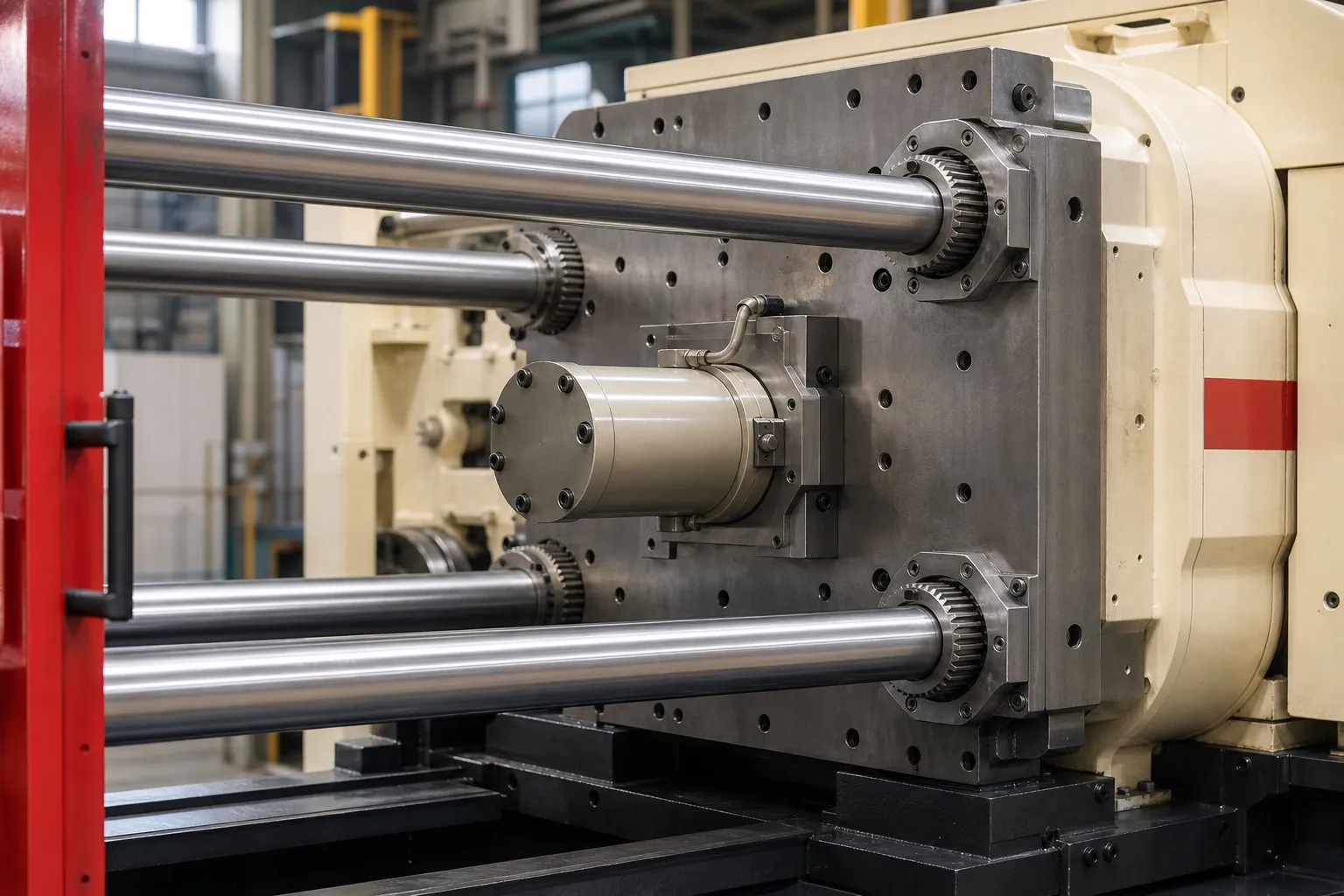
The hydraulic injection cylinder pushes with the same force whichever screw is fitted. A larger screw spreads that force over more area, so the melt sees less pressure. The ratio of ram area to screw area, the intensification ratio, fixes how much plastic pressure each screw can deliver.
John Bozzelli explains this in a Plastics Technology column on intensification ratio. Ratios across machines range from 6:1 to 43:1 and change whenever the screw size changes. Because area grows with the square of diameter, a 9% larger screw gives 19% more area and 16% less pressure.
Pressure can decide whether a mould fills at all. In Bozzelli's example, a mould that needed 1,585 bar of plastic pressure would not fill on a machine giving 1,380 bar, but filled on one giving 2,014 bar. Shot capacity cannot make up for pressure that is not there.
Injection Moulding Screw Selection: Which Shots Fit Each Barrel?
Convert each shot weight to PP melt volume, add 10% and compare it with each barrel's swept volume. Shots should sit between about 20% and 65%. Shots near the lower limit favour the 55 mm screw; shots above about 65% of the 55 mm barrel need the 60 mm one.
Bozzelli's second column gives the method. Barrels are rated in grams of PS, but PS melt is about 0.945 g/cm³ and PP melt about 0.74 g/cm³, so work in volume. He adds 10% for check-valve leakage and melt uniformity and places good shots between about 20% and 65% of capacity.
PP shots as a share of swept volume on two assumed barrels: 55 mm rated 600 g PS (634.9 cm³) and 60 mm at 1.19 times that (755.6 cm³); shot volume = weight ÷ 0.74 × 1.1
| PP shot (assumed part) | Melt volume + 10% | Share of 55 mm barrel | Share of 60 mm barrel |
|---|---|---|---|
| 100 g (bin lid) | 148.6 cm³ | 23.4% | 19.7%, below 20% |
| 200 g (bucket) | 297.3 cm³ | 46.8% | 39.3% |
| 300 g (dustbin) | 445.9 cm³ | 70.2%, above 65% | 59.0% |
| 400 g (crate) | 594.6 cm³ | 93.6%, above 65% | 78.7%, above 65% |
The table shows the usual pattern. Mid-weight shots fit both screws, light shots drift below 20% on the larger barrel, and heavy shots outgrow the smaller one. A shot that outgrows both, like the 400 g crate here, needs a larger injection unit, not a choice between these two.
Which Parts Need the Higher Pressure?
Parts with thin walls, long flow paths, fine ribs or many cavities fed from one sprue. Crates with ribbed walls and slotted bases, thin lids and long handles need more pressure than thick buckets and dustbins, which often fill comfortably on the larger screw.
Pressure demand rises as the flow path lengthens relative to the wall, so a crate with 2 mm ribs running the full height of a 250 mm wall asks much more of the screw than a 3 mm dustbin wall of similar height. A fill study on the mould gives the real figure.
Resin flow can ease the choice. Reliance describes its Repol B300MN impact copolymer as high-flow and fast-crystallising, suited to large articles with lower cycle times, with an MFR of 30 g/10 min. A higher-flow grade needs less pressure to fill, which can move a borderline crate onto the 60 mm screw.
Check the grade still meets the part's impact and stiffness needs before switching. The B300MN data sheet lists a notched Izod of 65 J/m and a flexural modulus of 1,600 MPa; compare those with the grade the crate was approved on.
Should You Order Both Barrels?
If your range mixes light and heavy shots, often yes. Bozzelli notes that a second barrel ordered with a new machine can be low cost, and that a skilled operator can swap a barrel in under 30 minutes, even hot. That can beat running half the moulds outside the window.
Screw geometry changes with diameter too. If the barrel length stays the same, a larger screw has a lower L/D, so fewer flights to melt and mix each shot. In his residence-time column, Bozzelli calls 20:1 his recommended minimum L/D for moulding.
The same column suggests measuring residence time rather than calculating it: drop a few granules of a different colour into the throat on cycle and count shots until the colour clears. Swirls during the test show poor mixing, a useful check on the larger screw with light shots.
Our view: choose the screw for the moulds that will run most hours, not for the heaviest part you might one day make. If one heavy job runs a few weeks a year, a second barrel for that job costs less than running every other mould on the wrong screw.
What Should You List Before Choosing a Screw?
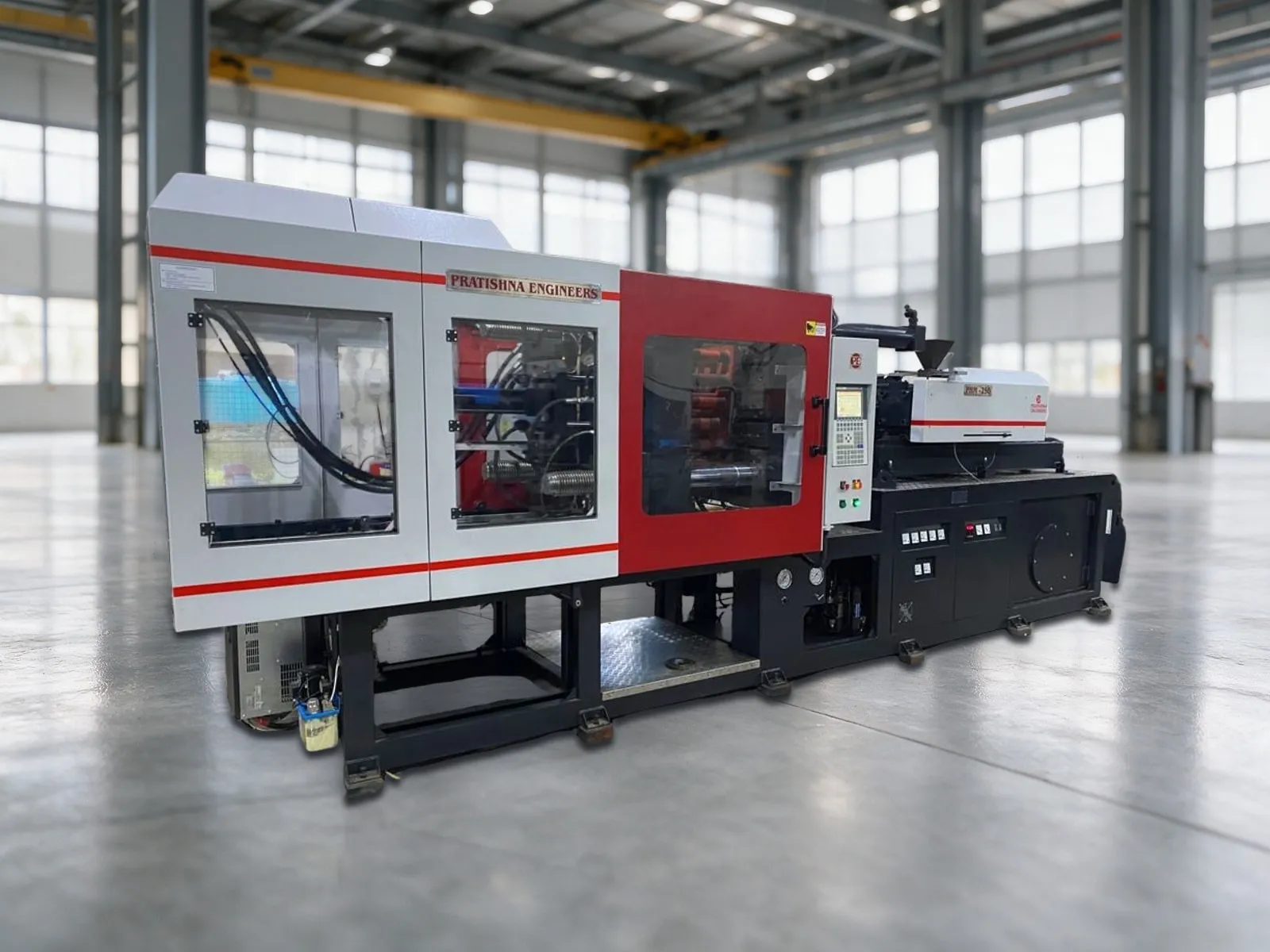
List every mould planned for the machine with shot weight including runner, resin grade, cavity count, thinnest wall and longest flow path, and the hours each will run. Check each shot against both barrels and each hard-to-fill part against both pressures. See the 200 ton two platen injection moulding machine page.
Frequently Asked Questions About 55 mm and 60 mm Screws
Can I change the screw on a machine I already own?
Usually the screw and barrel are changed together as a set, and the machine maker must confirm that the injection unit, heater bands and nozzle suit the new size. Plan it at the time of purchase if you can, since retrofitting later can take longer and cost more than ordering two barrels at the start.
Does a larger screw melt plastic faster?
It can plasticise more material per screw revolution, which helps heavy shots recover within the cooling time. But if barrel length stays the same, its L/D is lower, so each pellet gets fewer flights of shear and mixing. Check recovery time and melt quality on the real part, not just the rated output.
What happens if my shot is above 65% of the barrel?
Bozzelli links shots above about 65% of capacity to melt-quality problems. On the shop floor that can show up as unmelted pellets, streaks, colour variation and recovery that runs past the cooling time. Move the job to a larger barrel or reduce the shot, for example with a lighter design.
Is injection speed different between the two screws?
On the same hydraulic unit, the larger screw moves more melt per millimetre of travel, so its volume rate is higher at the same ram speed, while its pressure is lower. Fast fills on thin crates need both rate and pressure, so check the fill study against both figures.
Do recycled blends change the screw choice?
They can. Recycled PP can vary in flow from lot to lot, so a part that fills on the 60 mm screw with virgin resin may need more pressure on a stiffer blend. Recycled compounds also have tighter residence limits, which favours keeping light shots off the larger barrel.
Related Articles
- What Can You Make on a 200 Ton Two Platen Machine?
- Crates and Dustbins on a 200 Ton Two Platen Machine
- Energy Use of a 200 Ton Two Platen Machine With Servo Pump
Sources & References
- Plastics Technology, J. Bozzelli: Understanding Intensification Ratio
- Plastics Technology, J. Bozzelli: A Simpler Way to Calculate Shot Size vs. Barrel Capacity
- Plastics Technology, J. Bozzelli: Injection Molding: A Practical Approach to Calculating Residence Time
- Reliance Industries: Repol B300MN technical data sheet (July 2024)
Technical Disclaimer
Disclaimer: The information provided in this document is for general informational and educational purposes only. It is based on technical references and industry information available at the time of preparation and may be subject to change. It does not constitute engineering, technical, commercial or professional advice, nor does it constitute a quotation, specification, warranty or contractual commitment by Pratishna Engineers.
Actual injection moulding machine and process requirements vary according to the component design, material, mould, production volume, machine configuration and operating conditions. The information, examples, calculations and recommendations provided should be independently evaluated and verified for the specific application before making any equipment, process or production decision. Information obtained from third-party sources remains subject to the accuracy and limitations of those sources.
Limitation of Liability: Pratishna Engineers makes no representation or warranty, express or implied, regarding the completeness, accuracy or suitability of the information for any particular application. To the extent permitted by applicable law, Pratishna Engineers shall not be liable for any loss, damage, cost or consequence arising from reliance on or use of the information contained in this document. Final machine selection, configuration and application suitability should be confirmed with Pratishna Engineers based on complete and accurate project requirements.