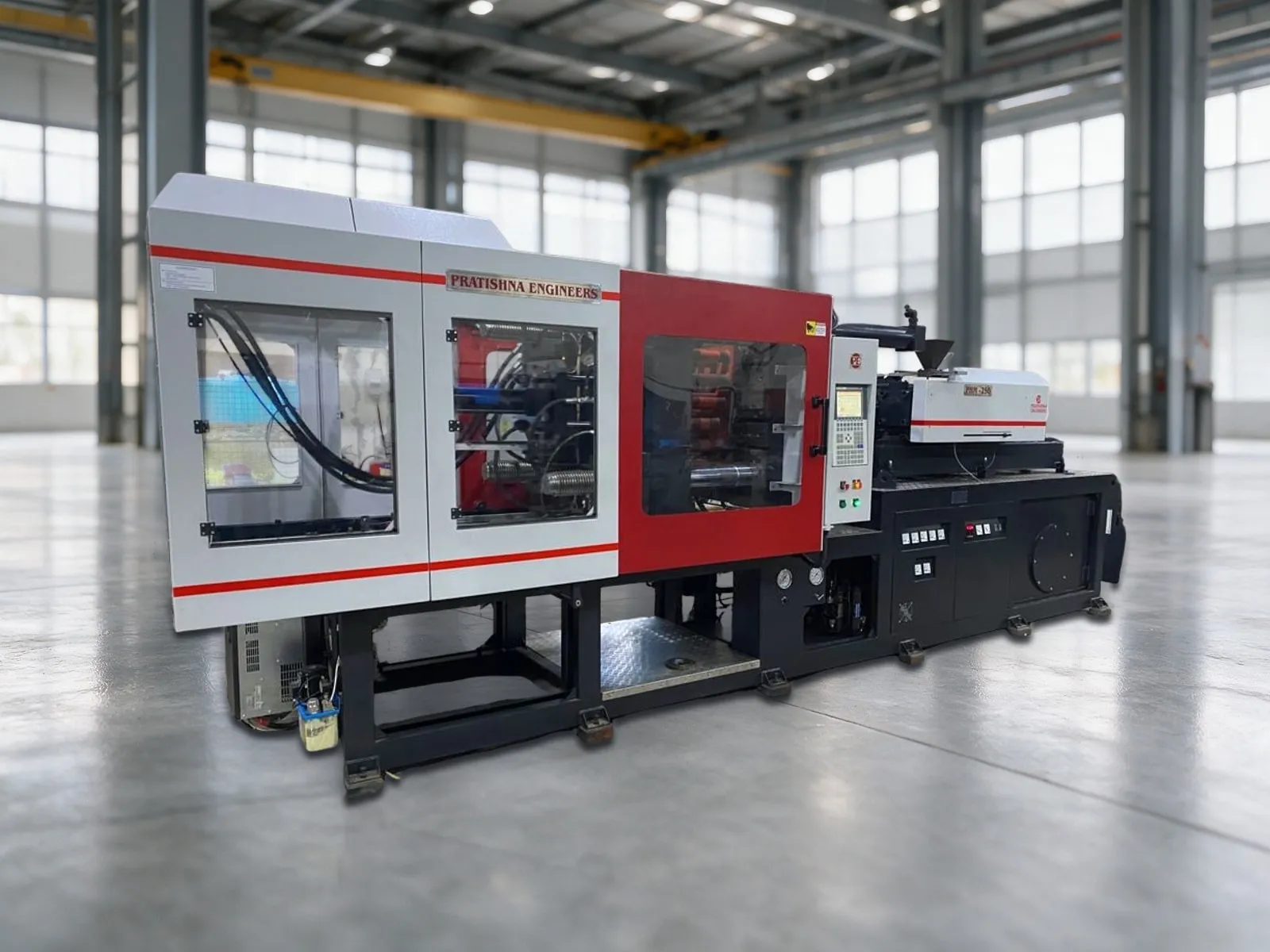
A moulder supplying vegetable crates and household dustbins wants one machine for both. The crate mould is wide and flat with a slotted base; the dustbin mould is narrow and tall. A 200 t two-platen crate making machine can run both if the crate's net base area stays within about 431 to 647 cm² of PP and the dustbin leaves enough opening once its mould is loaded.
The two parts fail in different ways. Crates run out of clamp and tie-bar width; dustbins run out of opening and daylight. Check each against its own limit, and size the machine for whichever of the two moulds is harder to fit.
Key Takeaways
- A crate's projected area is its footprint minus base openings; side-wall windows do not reduce clamp.
- A 400 × 300 mm crate fits 200 t at PP factors near 2 when about 55% of its base is open.
- A dustbin needs about 2.5 times its height in opening, measured after the mould height is subtracted from the daylight.
- Crate ribs work best at about 75% of the adjacent wall at the base, with a 25% to 50% wall radius at the root.
How Large a Crate Can a 200 t Crate Making Machine Mould?
One crate whose net base area, after deducting slots and holes, is about 431 to 647 cm² at PP factors of 3 to 2 with a 10% reserve. A 400 × 300 mm footprint needs roughly half its base open; a 300 × 200 mm crate needs far less.
Clamp and opening for crates and dustbins, one cavity (sizes and open shares assumed; PP factor 2 to 3 US t/in²; 10% reserve, a starting margin, not a rule; opening at 2.5 × height)
| Part | Net projected area | Clamp needed | Opening needed |
|---|---|---|---|
| Crate 300 × 200 mm, 150 mm tall, base 30% open | 420 cm² | 130 t to 195 t | 375 mm |
| Crate 400 × 300 mm, 250 mm tall, base 55% open | 540 cm² | 167 t to 251 t | 625 mm |
| Crate 400 × 300 mm, 250 mm tall, base 40% open | 720 cm² | 223 t to 334 t | 625 mm |
| Round dustbin, 260 mm rim, 280 mm tall | 531 cm² | 164 t to 247 t | 700 mm |
| Square dustbin, 240 × 240 mm, 330 mm tall | 576 cm² | 178 t to 267 t | 825 mm |
The clamp method behind the table is set out in the applications article in this series. Side-wall windows on a crate are formed by slides or shut-offs, so they add slide loads for the mould maker but do not reduce the clamp figure.
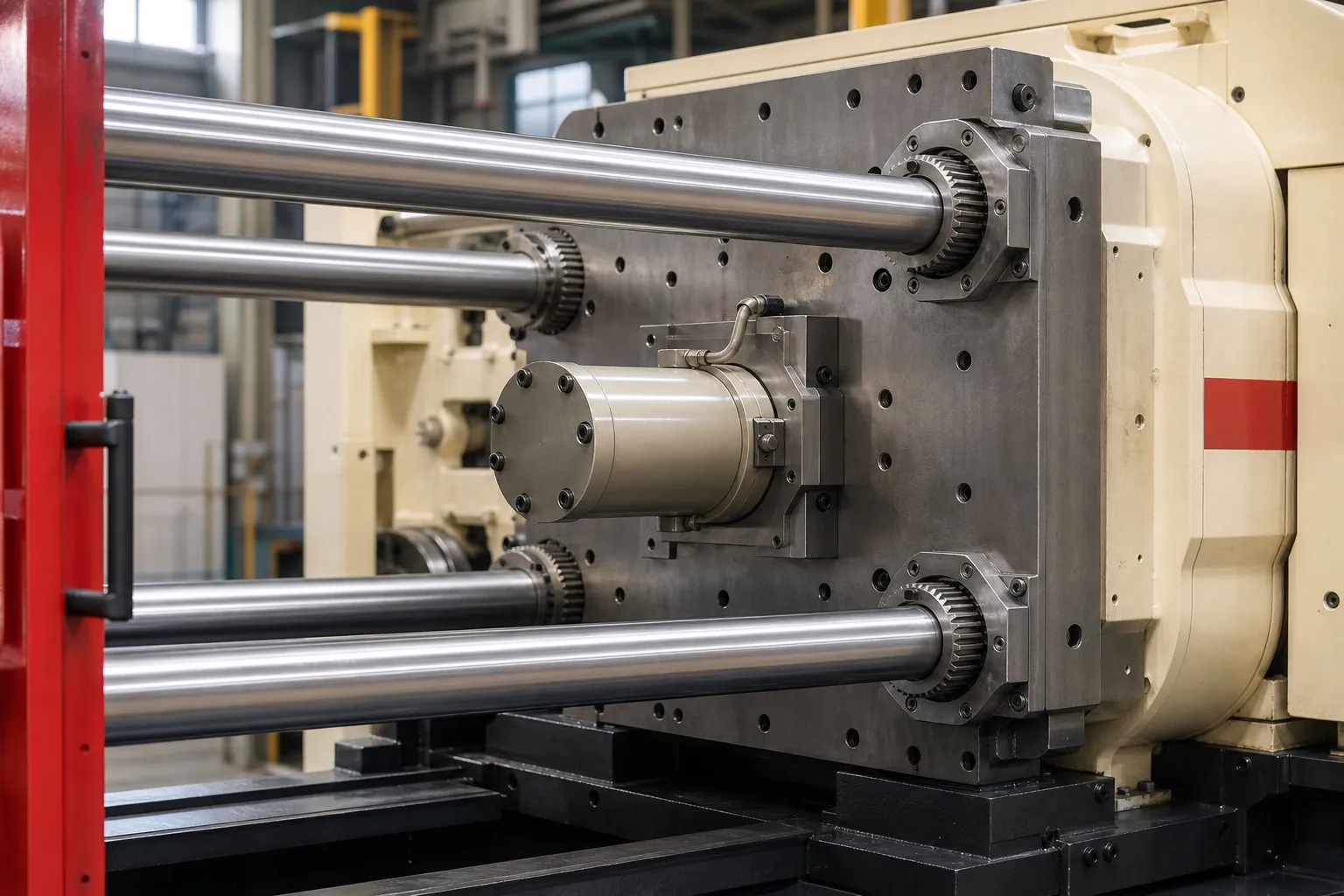
Width matters as much as area. A 400 × 300 mm crate mould with slides on all four sides is much wider than the crate, so confirm that it passes between the tie bars before settling the design.
What Does a Dustbin Need Besides Clamp?
Opening, mould height and ejection. A dustbin's rim area is modest, but its height sets the opening it needs and makes the mould tall. On a two-platen machine the opening left is the maximum daylight minus the mould height, so both numbers move together.
Bruce Catoen's MoldMaking Technology guide sets opening stroke at a minimum of 2.5 times part height. For a piston-type clamp, which its figure shows as a two-platen machine, maximum daylight equals minimum mould height plus maximum stroke, so the stroke falls as mould height rises.
The guide also asks you to check the maximum mould weight for both platens. A tall dustbin mould with a stripper plate is heavy, and its weight can become the limit before clamp does. Lids, pedals and hinges usually run in separate, smaller moulds.
How Should Crate Ribs and Walls Be Designed?
Keep walls even and ribs thinner than the wall they join. EnviroTech Molded Products' design notes suggest a rib base of about 75% of the adjacent wall, a root radius of 25% to 50% of the wall, and a taper of 0.5 to 1 degree per side.
The same notes say thick sections cool more slowly and shrink more, so uneven walls set up stresses that warp the part. For a crate that must stack square, that matters more than it does for a bucket. Deeper ribs can also cause ejection problems and sink marks.
PP does most of its shrinking in the first 48 hours after moulding, EnviroTech notes. Measure stacking height and corner squareness on crates aged at least that long, not straight off the machine, before approving a mould.
Which PP Grades Suit Crates and Dustbins in India?
Impact copolymers, chosen for drop strength at low temperatures and stiffness under stacking load. UL Prospector's listing of Reliance Repol grades shows B030MG and MI3530 for crates and furniture, and C080MA and C120MN, both antistatic, for paint pails, luggage and industrial components.
Utility crates and bins can carry recycled content. Entec Polymers' guidance on recycled PP advises cold runners and larger gates rather than hot runners, because small metal particles can plug hot tips. It also advises venting moulds and runners well, since mixed feedstocks can out-gas and leave deposits.
Entec gives a typical melt of about 199 to 227 °C for recycled PP compounds, with a maximum of about 238 °C and residence time of 5 minutes at most. Heavy crate and dustbin shots on long cycles can approach that limit, so check residence before raising temperatures.
Our view: test a crate mould with the recycled blend you will actually buy, and drop-test aged crates from that trial. A crate that passes on virgin PP tells you little about the blend that will run for the next five years.
What Should You Send for a Crate or Dustbin Check?
Send the crate footprint, height and base drawing showing openings, or the dustbin rim, height and wall, with part weight, resin and recycled share. Add the mould maker's estimate of closed height and width. See the 200 ton two platen injection moulding machine page.
Frequently Asked Questions About Crate and Dustbin Moulding
Do crate handles change the clamp needed?
Handle cut-outs in the end walls are side features, so they do not reduce projected area. Handles that stick out beyond the footprint add a little area. The bigger effect is on mould width, since slides that form handle openings sit outside the crate and must still fit between the tie bars.
Can one machine run both crates and dustbins without long changeovers?
Yes, but the moulds differ in height, width and weight, so clamp height, opening, ejector settings and robot positions all change. Store each mould's settings, standardise clamping and water connections, and keep a lifting plan for the heavier mould. Group runs to limit how often you switch.
Why do my crates warp after a day in the store?
PP keeps shrinking for up to about 48 hours, and uneven walls or ribs thicker than the wall shrink more in some areas than others. Check that ribs are thinner than the adjacent wall, balance cooling across the mould, and hold packing pressure steady once a good setting is found.
Is HDPE a better choice than PP for dustbins?
It can be, especially where low-temperature toughness matters, and polyethylene often needs a lower tonnage factor. PP is stiffer and usually holds shape better under load. The choice depends on the market, the wall thickness and the grade, so trial both if customers report cracked or deformed bins.
How heavy a crate shot can a 200 t machine handle?
That depends on the barrel, not the clamp. Convert the crate weight to melt volume, add 10% and keep the result between about 20% and 65% of the barrel's swept volume. The screw article in this series shows how this check plays out across two screw sizes.
Related Articles
- What Can You Make on a 200 Ton Two Platen Machine?
- Choosing Between 55 mm and 60 mm Screws on a 200 Ton Machine
- Energy Use of a 200 Ton Two Platen Machine With Servo Pump
Sources & References
- MoldMaking Technology, B. Catoen: Machine Sizing and Specification for Optimal Mold Performance, Part 1
- EnviroTech Molded Products: Molded Parts Design
- UL Prospector: Polypropylene (PP): REPOL grade listing
- Entec Polymers: Processing ECHO Post-Industrial Recycled Polypropylene Compounds
Technical Disclaimer
Disclaimer: The information provided in this document is for general informational and educational purposes only. It is based on technical references and industry information available at the time of preparation and may be subject to change. It does not constitute engineering, technical, commercial or professional advice, nor does it constitute a quotation, specification, warranty or contractual commitment by Pratishna Engineers.
Actual injection moulding machine and process requirements vary according to the component design, material, mould, production volume, machine configuration and operating conditions. The information, examples, calculations and recommendations provided should be independently evaluated and verified for the specific application before making any equipment, process or production decision. Information obtained from third-party sources remains subject to the accuracy and limitations of those sources.
Limitation of Liability: Pratishna Engineers makes no representation or warranty, express or implied, regarding the completeness, accuracy or suitability of the information for any particular application. To the extent permitted by applicable law, Pratishna Engineers shall not be liable for any loss, damage, cost or consequence arising from reliance on or use of the information contained in this document. Final machine selection, configuration and application suitability should be confirmed with Pratishna Engineers based on complete and accurate project requirements.