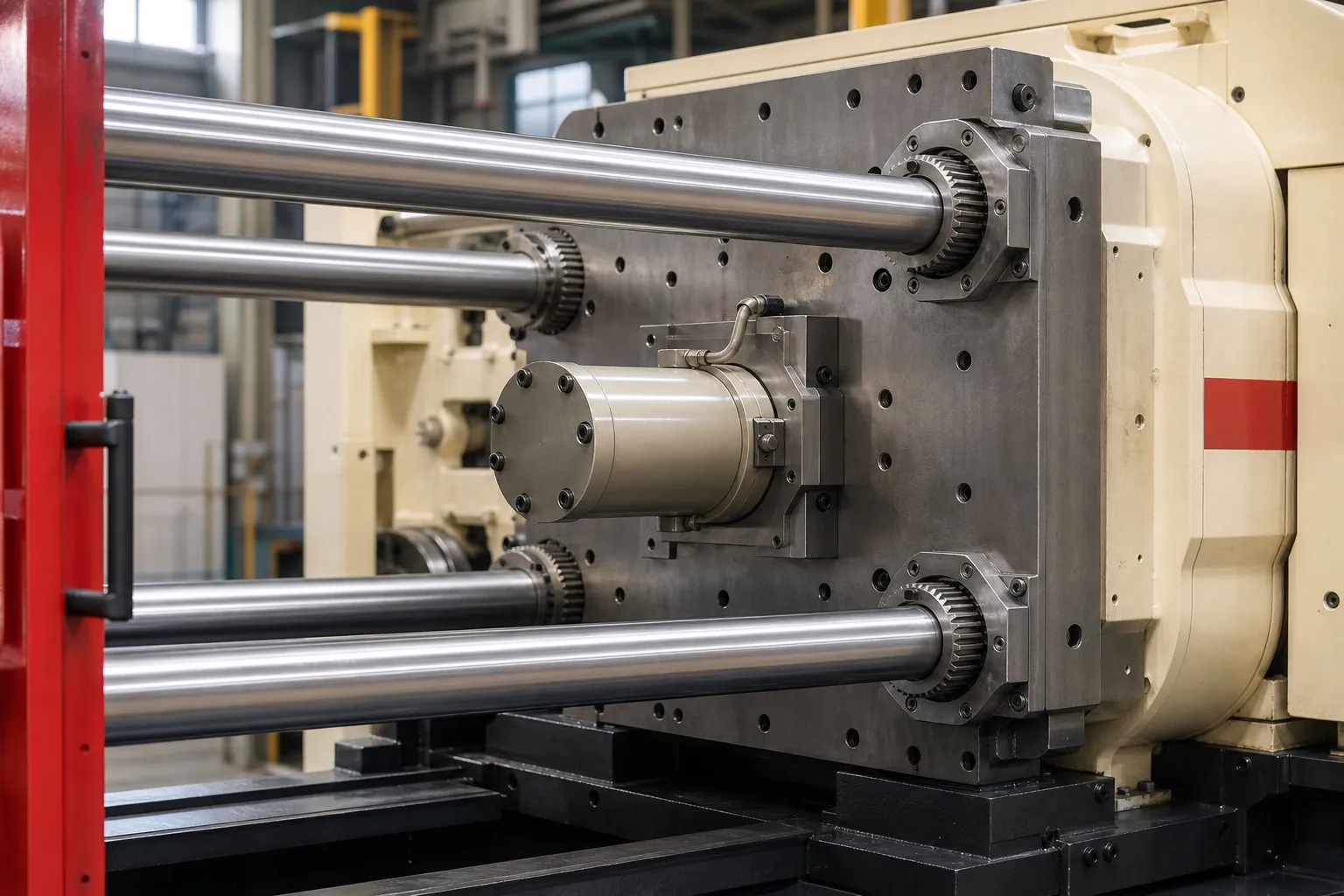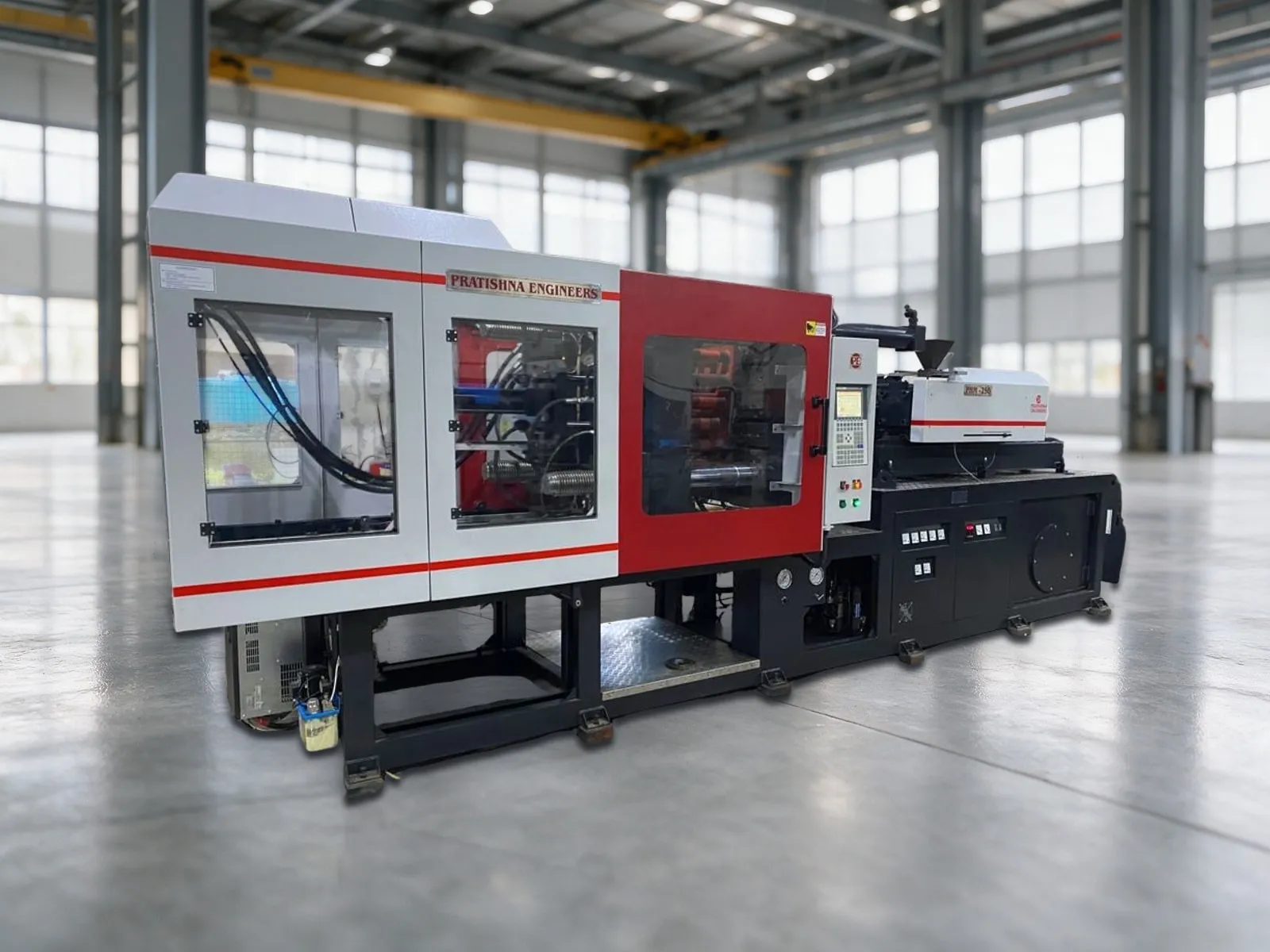

A 200 ton two platen machine suits larger PP and PE parts that are deep as well as wide: big buckets and tubs, small crates and bins, dustbins, storage boxes, laundry baskets and battery containers. Holding back 10% of the clamp (a starting margin, not a rule), it carries about 431 to 647 cm² of projected area at PP factors of 3 to 2 US t/in².
In round terms that is one rim of about 234 to 287 mm. The long opening of a two-platen clamp lets tall parts clear the core, so depth is rarely the first limit at this size; rim area, shot weight and mould width usually are.
Key Takeaways
- With a 10% reserve, 200 t carries about 431 to 647 cm² of PP area, one round rim of roughly 234 to 287 mm.
- Going from 160 t to 200 t adds 25% to the area you can clamp but only about 12% to the largest round rim.
- Crates and baskets fit only once their base openings are deducted; a solid 400 × 300 mm footprint needs far more clamp.
- Rigid plastic packaging in India must carry rising shares of recycled content under the 2026 PWM amendment.
What Can a 200 Ton Two Platen Machine Make?
Larger buckets and round tubs, rectangular storage boxes, small crates and bins with open bases, dustbins, laundry baskets and battery containers. The table shows how much projected area each group can use across all cavities at 200 t, after a 10% reserve, with example sizes for scale.
Largest total projected area on a 200 ton two platen machine, with a 10% reserve (example sizes are assumed)
| Product group | Tonnage factor (US t/in²) | Largest total area at 200 t | What that can mean |
|---|---|---|---|
| Larger buckets and round tubs (PP) | 2 to 3 | 431 to 647 cm² | One rim of about 234 mm at factor 3, up to about 287 mm at factor 2 |
| Storage boxes and tubs (PP) | 2 to 3 | 431 to 647 cm² | One 280 × 220 mm tub (616 cm²) only near factor 2 |
| Crates, bins and laundry baskets (PP) | 2 to 3 | 431 to 647 cm² net | A 400 × 300 mm crate needs about 46% to 64% of its base open |
| Dustbins (PP or PE) | 2 to 3 | 431 to 647 cm² | One 260 mm rim needs about 164 t to 247 t |
| Battery containers (PP) | 2 to 3 | 431 to 647 cm² | One 220 × 180 mm box needs about 122 t to 184 t; two do not fit |
The crate and dustbin rows are worked through in the crates and dustbins article in this series. Shot weight, not clamp, often limits the heavier parts in this table, which the screw article in this series covers.
How Much More Does 200 t Carry Than 160 t?
About 25% more projected area, because clamp scales directly with area. Rim diameter grows only with the square root of area, so the largest round rim rises by about 12%, from roughly 257 to 287 mm at a PP factor of 2. Small tonnage steps buy small size steps.
The sums follow the method John Williams of RJG sets out in Plastics Technology: projected area of one part, minus through openings, times cavities, plus any cold runner, times a tonnage factor. He suggests 3 US t/in² as a starting point within a typical range of 2 to 10.
SPE Plastics Engineering's guide by A. Urbina places PP at 2 to 3 US t/in², with polyethylene at the low end. At 0.1406 t/cm² per US t/in², 181.8 t usable at 200 t divided by 0.281 and 0.422 t/cm² gives about 647 and 431 cm².
So check a part against both machines before choosing, using the same factor and reserve for each. A tub that misses 160 t by a few percent may fit 200 t easily, while one that needs 200 t at factor 3 may still be better redesigned with a slightly smaller rim than moved to a larger machine.
Which Limits Besides Clamp Decide the Job?
Mould width, shot weight, mould weight and opening. A crate mould must pass between the tie bars and cover enough of the platen, a heavy dustbin shot must suit the barrel, and a deep part needs opening left after the mould height is subtracted from the daylight.
Mould size cuts both ways. A Plastics Technology mould-mounting guide by P. Witaszek and co-authors gives a rule of thumb that the mould should cover at least 70% of the distance between the tie bars. Smaller moulds let the platens bow under clamp, which can flash the centre of the mould.
That matters on a 200 t two-platen machine bought for crates and dustbins, because its platens are sized for wide moulds. If the same machine will also run small lids, check each lid mould against the minimum mould size in the machine manual, or keep lids on a smaller machine.
Which Recycled-Content Rules Apply in India?
Where buckets, pails, tubs or crates are sold as rigid plastic packaging, the Plastic Waste Management (Amendment) Rules notified on 31 March 2026 set minimum recycled content. Polymerupdate reports 30% for rigid packaging in 2025-26, rising to 60% by 2028-29, plus new reuse targets.
The same report says shortfalls for 2025-26 can be carried forward for up to three years, and exemptions apply where FSSAI and similar rules restrict recycled content, so food tubs are treated differently from paint pails and industrial bins. Penalties range from ₹10,000 to ₹15,00,000.
Our view: if your parts fall under these targets, trial the recycled blend on the mould before you commit to cavity count. Recycled PP can need a different tonnage factor and pressure than the virgin grade the mould was designed around.
What Should You Send Before Choosing a Machine?
Send rim size, height, wall thickness, part weight, resin and any recycled share for each part, with the closed mould thickness and width if the mould exists. Clamp, tie-bar fit, opening and shot can then be checked together. See the 200 ton two platen injection moulding machine page.
Frequently Asked Questions About Parts for a 200 t Two-Platen Machine
Can a 200 t two-platen machine make full-size vegetable crates?
Only if enough of the base is open. A 400 × 300 mm footprint covers 1,200 cm², while 200 t carries about 431 to 647 cm² of PP with a 10% reserve. That means roughly 46% to 64% of the base must be openings. Solid-base crates of that size need more clamp.
Is 200 t enough for a battery container?
For one cavity of a typical small container, often yes: a 220 × 180 mm outline needs about 122 t to 184 t at PP factors of 2 to 3. Two cavities need about 245 t to 368 t. Thick walls and heavy shots can make the barrel the tighter limit.
Why not buy a 250 t machine to be safe?
A larger machine costs more to buy, takes more floor space and draws more power at part load. If your largest regular part fits 200 t with a sensible reserve, extra tonnage adds cost without adding output. Buy for the parts you have, plus any part already firmly planned.
Does PE need less clamp than PP for the same tub?
Often, yes. SPE's guide places polyethylene at the low end of the tonnage factor range. The actual factor still depends on wall thickness, flow length and gating, so a thin PE tub with long flow can need as much as a PP one. Run the calculation for each resin.
Can laundry baskets with side holes run on a two-platen machine?
Yes. Holes in the base reduce projected area and clamp. Holes in the side walls are formed by slides or shut-offs and do not reduce the clamp figure, but they add slide loads that the mould maker must design for. Agree the slide layout before you fix the mould width.
Related Articles
- Crates and Dustbins on a 200 Ton Two Platen Machine
- Choosing Between 55 mm and 60 mm Screws on a 200 Ton Machine
- Energy Use of a 200 Ton Two Platen Machine With Servo Pump
Sources & References
- Plastics Technology, J. Williams (RJG): Clamp Tonnage: More Is Better...Right?
- SPE Plastics Engineering, A. Urbina: Mastering Clamping Force Calculation
- Plastics Technology, P. Witaszek, J. Klees, J. Fattori, E. Di Siro, J. Bozzelli: How to Mount an Injection Mold
- Polymerupdate, D. K. Jha: India eases plastic recycling regulations
Technical Disclaimer
Disclaimer: The information provided in this document is for general informational and educational purposes only. It is based on technical references and industry information available at the time of preparation and may be subject to change. It does not constitute engineering, technical, commercial or professional advice, nor does it constitute a quotation, specification, warranty or contractual commitment by Pratishna Engineers.
Actual injection moulding machine and process requirements vary according to the component design, material, mould, production volume, machine configuration and operating conditions. The information, examples, calculations and recommendations provided should be independently evaluated and verified for the specific application before making any equipment, process or production decision. Information obtained from third-party sources remains subject to the accuracy and limitations of those sources.
Limitation of Liability: Pratishna Engineers makes no representation or warranty, express or implied, regarding the completeness, accuracy or suitability of the information for any particular application. To the extent permitted by applicable law, Pratishna Engineers shall not be liable for any loss, damage, cost or consequence arising from reliance on or use of the information contained in this document. Final machine selection, configuration and application suitability should be confirmed with Pratishna Engineers based on complete and accurate project requirements.