






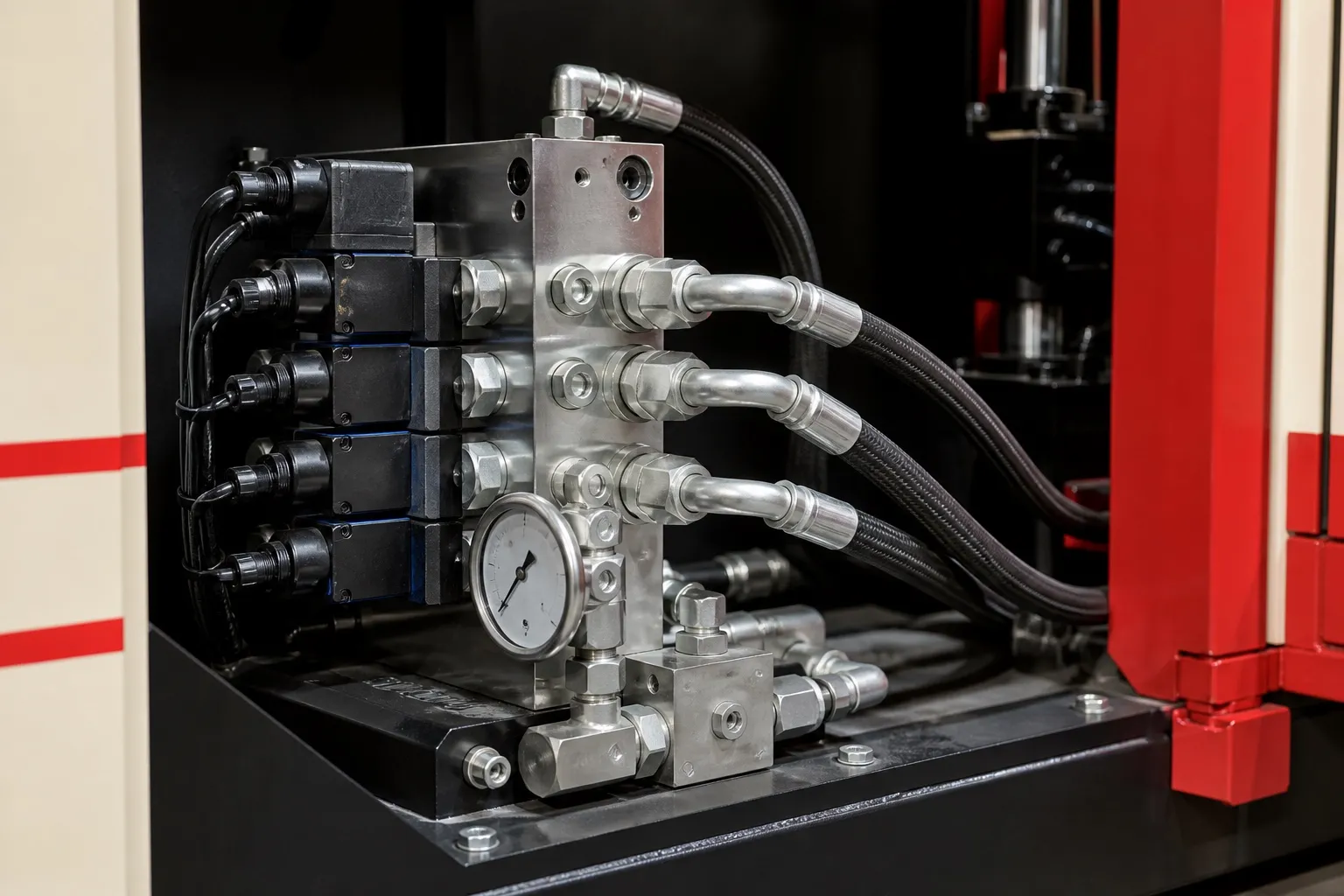

Take a hydraulic machine logged at 16 kW while moulding, of which 12 kW is drawn whether or not any axis moves. That is 75% base load. At 6,000 running hours and ₹10 per kWh (assumptions; use your own hours and bill), the fixed draw alone costs 12 × 6,000 × 10 = ₹7,20,000 a year.
Cutting power costs in injection moulding starts with that base load. Hybrid machines drive injection with servo motors that draw little when still, which brings base load down to about 10 to 20% of the machine's energy. Measurement, idle control, heater insulation and power factor do the rest.
Key Takeaways
- Moulding machines take about two thirds of a typical plant's energy, so they are the first place to measure.
- A high base load is the clearest sign of waste; servo drives on hybrid machines cut it sharply.
- Idle machines, bare barrels, cold chilled water and air leaks cost money on every machine type.
- Under kVAh billing, a poor power factor raises the bill directly, so correction pays even before any machine change.
Where Does the Power Go in a Moulding Plant?
Mostly into the moulding machines. In the ExxonMobil, AMI and Tangram energy guide, polymer processing takes 66% of a typical plant's energy, with chillers, compressed air and water pumps taking most of the rest. About 30% is described as discretionary in plants with no energy measures.
Typical energy split in an injection moulding plant, from the ExxonMobil, AMI and Tangram guide
| Use | Share of plant energy |
|---|---|
| Polymer processing (moulding machines) | 66% |
| Chillers | 11% |
| Compressed air | 10% |
| Water pumps | 5% |
| Lighting | 5% |
| Heating | 2% |
| Offices | 1% |
The same guide, drawing on Tangram surveys of more than 200 moulding sites, puts site base load at 20 to 40% of total energy and variable load typically at 0.9 to 1.6 kWh per kg. Your own figures will differ, which is why measuring comes before buying.
How Do Hybrid Machines Cut Power Costs in Injection Moulding?
By drawing power only when an axis moves. On a fixed-speed hydraulic machine, the motor and pump run through cooling and mould-open time. A servo-driven injection unit draws little when still, so base load falls to about 10 to 20% of the machine's energy, mostly barrel heating.
The guide notes that a standard hydraulic machine's base load can be 75% or more of its energy, and that a high base load can also mean the machine is too large for the job. It puts possible savings from all-electric machines at up to 60%, and adds that ten-year energy cost exceeds purchase cost in almost every case.
A hybrid saves most where the injection side and screw recovery used to keep a large pump turning, such as long cooling times or thin-wall jobs with short, fast fills. Where the clamp stays hydraulic, its pump drive still matters, so ask whether it is servo or variable-speed as well.
Retrofits are a middle path. Robin Kent of Tangram lists variable-speed motors, variable-volume pumps and servo motors on fixed pumps as options for older hydraulic machines, starting with a list of every motor and pump type in the plant.
What Can You Save Without Changing Machines?
Quite a lot. The guide lists barrel insulation, warmer chilled water, fewer air leaks, lower air pressure and staff training as savings that need no new press. Switching off idle machines adds more, since an idling machine can draw most of its full moulding energy.
Barrel heating is 10 to 25% of a machine's energy input, and insulation can cut that by up to 50%. Raising chilled water by 1 °C cuts chiller cost by about 3%. Compressed air leaks run at 20 to 40% in typical plants, and staff training can cut energy by up to 20%.
Idle time is easy to miss. In PlasticsToday, Kent reports idling machines drawing 52% to 97.5% of full moulding energy, and suggests that idle periods longer than about 1.5 hours may be cheaper to switch off and restart. He also notes that rising energy on the same job can point to screw or barrel wear.
Our view: fix the plant before you replace the press. Insulation, idle rules and leak repairs cost little, and a new machine installed in a wasteful plant will only show part of its saving.
How Does kVAh Billing Change the Sums?
It charges you for apparent energy, so a low power factor costs money directly. MSEDCL bills energy in kVAh and demand in kVA for HT consumers and LT consumers above 20 kW. At a power factor of 0.85, MSEDCL notes, 15% of the power drawn does no useful work.
Under the older kWh billing, consumers faced a penalty below a power factor of 0.90 and an incentive above 0.95. Under kVAh billing, every point below unity shows up in the energy charge, so capacitors or an automatic power factor correction panel pay back through the bill itself.
Tariffs themselves are moving. Check your latest bill for rates, since a 25 March 2026 MERC order affected MSEDCL tariffs from 1 July 2025, as the comparison article in this series notes.
How Should You Measure Before You Buy?
Log your worst machine with a clamp-meter data logger on a normal job; Kent notes that a machine can be measured in as little as 30 minutes, with heater load averaged over 10 to 15 minutes. Record kW moulding, kW idle and kg per hour, then compare offers against those numbers. See the hybrid injection moulding machine page.
Frequently Asked Questions About Power Costs in Injection Moulding
What is a good energy figure in kWh per kg?
There is no single target, because part weight, wall, resin and cycle all change it. The ExxonMobil, AMI and Tangram guide gives a typical variable load of 0.9 to 1.6 kWh per kg. Track your own figure per job over time; a rising value on the same mould deserves a check.
Should I switch machines off during lunch breaks?
Kent suggests idle periods longer than about 1.5 hours may be cheaper to switch off and restart. For shorter breaks, reduce heater set points or keep the machine cycling only if quality requires it. Weigh restart scrap and warm-up time against the energy saved.
Does a hybrid machine reduce chiller load?
It can. Less hydraulic work means less heat in the oil, so the oil cooler needs less chilled or cooling water. Mould cooling depends on the part and resin, not the drive, so that share stays. Measure water flow and temperature rise before resizing any chiller.
Is insulating barrel heaters safe and worth it?
Insulation jackets made for barrels can cut barrel heating energy by up to 50%, according to the ExxonMobil, AMI and Tangram guide. Use jackets rated for the barrel temperature, keep thermocouple and heater connections accessible, and check that zone control still behaves well after fitting.
How quickly can a servo pump retrofit pay back?
It depends on the base load you remove, your running hours and your tariff. Log the machine first, estimate the kW the retrofit removes, and multiply by hours and rate. A machine that idles or cools for long periods with a fixed pump running gains most.
Related Articles
- Hybrid vs Hydraulic vs All-Electric Injection Moulding Machines: A Practical Comparison
- Servo-Electric Ball Screw Injection: Why Shot Repeatability Improves
- Thin-Wall and Multi-Cavity Moulding on Hybrid Machines
Sources & References
- ExxonMobil, AMI and Tangram Technology: An Energy Saving Guide for Injection Moulders
- PlasticsToday, R. Kent: Getting to know your real energy use and cost (Jan 2010)
- SPE Plastics Engineering, R. Kent (Tangram Technology): Energy-Saving Tip 67: Injection Molding: get the right motor (Sept 2016)
- Maharashtra State Electricity Distribution Co. Ltd (MSEDCL): kVAh Billing: Frequently Asked Questions
Technical Disclaimer
Disclaimer: The information provided in this document is for general informational and educational purposes only. It is based on technical references and industry information available at the time of preparation and may be subject to change. It does not constitute engineering, technical, commercial or professional advice, nor does it constitute a quotation, specification, warranty or contractual commitment by Pratishna Engineers.
Actual injection moulding machine and process requirements vary according to the component design, material, mould, production volume, machine configuration and operating conditions. The information, examples, calculations and recommendations provided should be independently evaluated and verified for the specific application before making any equipment, process or production decision. Information obtained from third-party sources remains subject to the accuracy and limitations of those sources.
Limitation of Liability: Pratishna Engineers makes no representation or warranty, express or implied, regarding the completeness, accuracy or suitability of the information for any particular application. To the extent permitted by applicable law, Pratishna Engineers shall not be liable for any loss, damage, cost or consequence arising from reliance on or use of the information contained in this document. Final machine selection, configuration and application suitability should be confirmed with Pratishna Engineers based on complete and accurate project requirements.


