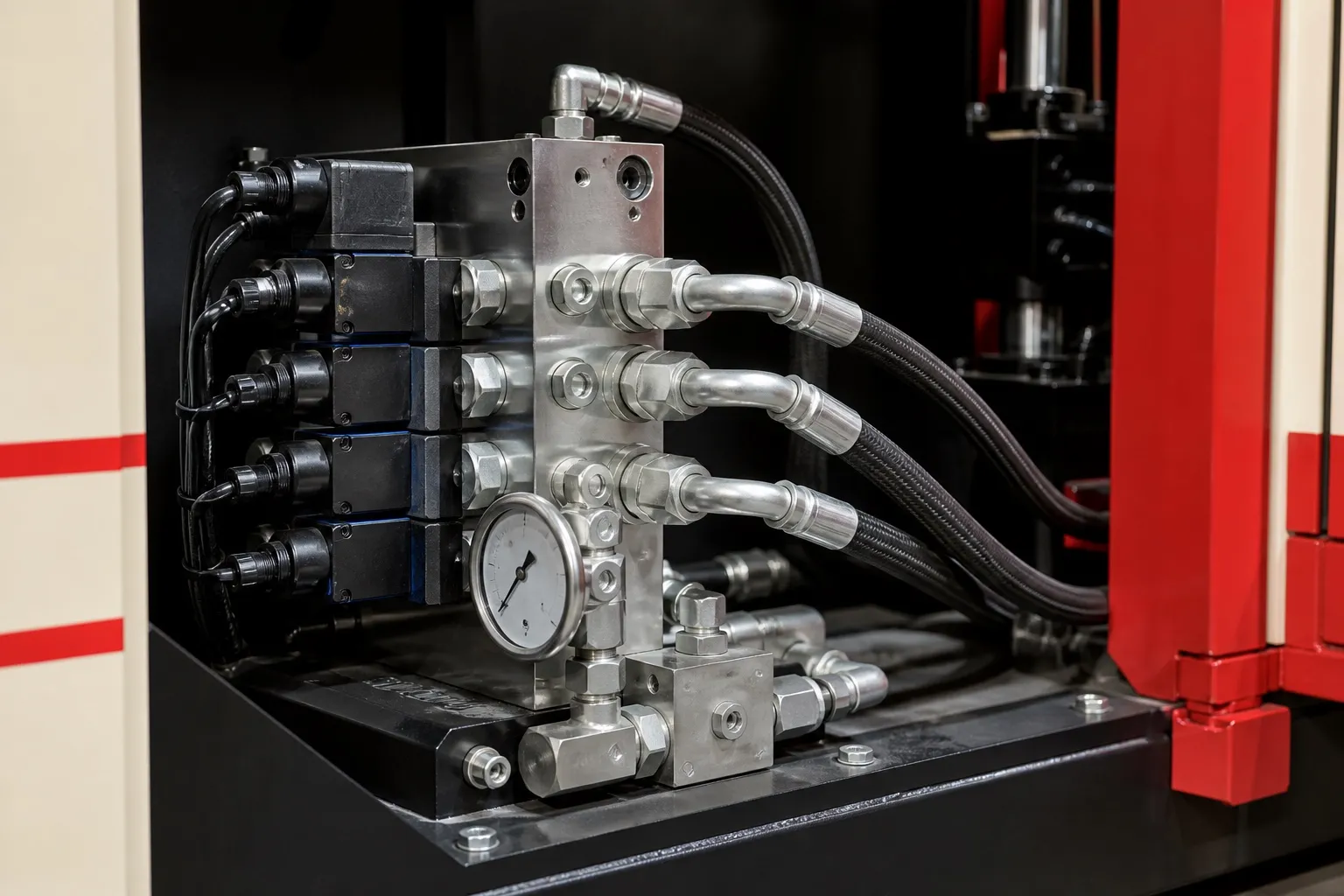
Yes, thin-wall and multi-cavity moulding can run well on hybrid machines, provided the injection unit delivers the speed, pressure and shot control the mould needs, and the clamp holds the mould evenly at the higher force thin walls demand. Electric injection suits the fast, repeatable fills these moulds need.
The machine is only half of it. Mould steel, venting, cooling, ejection and resin flow decide whether a thin wall fills every cavity in under a second. This article sets out those needs and works through a sizing example for a four-cavity lid mould.
Key Takeaways
- Thin-wall parts need far higher injection speed and pressure than conventional parts, with fill times under 1 second.
- Clamp needs rise to about 5 to 8 US tons per in² of projected area, against 3 to 5 in conventional moulding.
- Multi-cavity moulds need every cavity to fill and pack alike, so shot repeatability and identical venting matter.
- Size the barrel small enough that the shot uses at least 40% of it, and choose a high-flow resin grade.
What Makes Thin-Wall Moulding So Demanding?
Long flow through a thin section. Tremblay of Sabic Innovative Plastics, writing in PlasticsToday, gives thin-wall flow length to thickness ratios of typically 100:1 to 200:1, needing injection pressures and speeds far above conventional moulding. That can cause anything from burning to flash.
Conventional and thin-wall moulding compared, from PlasticsToday and MoldMaking Technology
| Point | Conventional moulding | Thin-wall moulding |
|---|---|---|
| Flow length to wall ratio | Lower; set by part design | Typically 100:1 to 200:1 |
| Clamp factor | 3 to 5 US t/in² (0.42 to 0.70 t/cm²) | 5 to 8 US t/in² (0.70 to 1.13 t/cm²) |
| Injection pressure | Set by part and resin | Typically above 30,000 psi (about 2,068 bar) |
| Injection velocity | Set by part and resin | Above 3 in/s (76 mm/s), many jobs 6 in/s (152 mm/s) |
| Fill time | Set by part and resin | Under 1 s |
| Dry cycle | 3 to 5 s | 1 to 2.5 s |
Tremblay adds that resins must withstand shear heating of 50,000 s⁻¹ or more, and he advises against adapting conventional machines for thin-wall work. Thin-wall machines tend to have accumulator-assisted clamps for fast movement and extra-thick platens, with a tie-bar distance to platen thickness ratio of 2:1 or less on better machines.
The reward is a short cycle. Cooling time follows the square of wall thickness, so a wall 20% thinner needs about 36% less cooling (0.8² = 0.64). Once cooling shrinks, fill, clamp movement and part removal become a large share of each cycle, and the machine has to keep up with the mould.
Why Do Hybrid Machines Suit Thin-Wall and Multi-Cavity Moulding?
Because the electric injection unit gives fast, closed-loop control of speed, position and pressure, while the hydraulic clamp supplies high, even force. Thin walls need short, fast fills that repeat; multi-cavity moulds need the same melt delivered to every cavity, shot after shot.
Control resolution matters at these speeds. Tremblay lists the resolution a thin-wall machine should offer: 0.04 in/s on speed, 1 bar on pressure, 0.004 in on position, 0.01 s on time, 1 rpm on screw speed and 0.10 ton on clamp. A servo drive with an encoder works naturally at that level, as the ball screw article in this series explains.
Short dry cycles count as much as fill speed. Catoen's MoldMaking Technology guide on machine sizing gives dry cycles of 1 to 2.5 s for thin-wall work, against 3 to 5 s otherwise. On a cycle of a few seconds, every half second of clamp movement is a large share of output.
On the clamp side, high cavity pressure across a large mould face asks for stiff platens and even force. Flash at the centre of a mould while its edges stay clean can point to platen bending, so ask how the clamp spreads its force and how thick the platens are for their tie-bar spacing.
Cavity count then multiplies everything. Output per hour is 3,600 ÷ cycle in seconds × cavities × good-shot share, so a fast cycle on many cavities only pays if every cavity stays good.
What Does a Multi-Cavity Thin-Wall Mould Need?
Strength, venting and cooling built for high pressure. Tremblay recommends steels harder than P-20, thicker plates, as many support pillars as fit, and interlocks. Demanding parts need vents on core and ejector pins as well as the parting line, and cooling lines sized for more flow.
Balance between cavities is the multi-cavity test. Vents, land widths and secondary vents should be identical cavity to cavity, as Shannon notes in MoldMaking Technology, and a hot runner keeps the shot to the parts themselves. Use mould-filling analysis before steel is cut, since large gates cut pressure drop but raise residence time.
Size the barrel to the shot. Tremblay advises that the shot be at least 40% of barrel size, because too large a barrel may not give the pressure boost and allows the melt to degrade. A small barrel on a fast unit suits thin-wall work better than a large one.
For food packaging, Reliance lists Repol H200MA, a PP homopolymer with an MFR of 25 g/10 min, for thin-walled containers, multi-cavity moulding and long flow paths. Its data sheet states compliance with IS 10910 for food contact, a melt range of 210 to 250 °C and a mould range of 20 to 50 °C.
Our view: specify injection rate and dry cycle together when you compare machines. A thin-wall job that fills fast but waits on the clamp, or clamps fast but fills slowly, loses output either way.
What Should You Send Before Choosing a Machine?
Send the part drawing with wall and flow length, the cavity count and runner type, the resin grade, the mould size and the target cycle. A trial or filling analysis on that data shows the speed and pressure needed. See the hybrid injection moulding machine page.
Frequently Asked Questions About Thin-Wall and Multi-Cavity Moulding
What wall thickness counts as thin-wall?
There is no fixed thickness. The useful measure is the ratio of flow length to wall, which Tremblay gives as typically 100:1 to 200:1 for thin-wall designs. A 0.6 mm wall with a short flow may mould conventionally, while a thicker wall with a very long flow may not.
Why do some cavities fill short in a multi-cavity mould?
Common causes are an unbalanced runner, uneven hot-runner tip temperatures, blocked or shallow vents, or uneven cooling. Weigh parts by cavity to find the pattern, check vent depths and tip temperatures on the short cavities, and confirm that the transfer position leaves enough melt for packing.
Can I add cavities to an existing thin-wall mould design?
Only after checking clamp, shot, injection rate and barrel size again, since each extra cavity adds projected area and shot volume. The fill must still finish in the same time, so the injection rate rises with the cavity count. Run a filling analysis on the new layout before cutting steel.
Why is ejection harder on thin-wall parts?
Thin walls give little area to push on, and low shrinkage through a thin section can make parts grip the core. Tremblay suggests doubling the ejector pins, each twice as large, and using blade or sleeve ejectors on ribs and bosses. Air assist on deep parts can also help release.
Does a higher-MFR resin always make thin-wall moulding easier?
It eases filling, but impact strength, stiffness and stress cracking can change with grade. Check the data sheet for the properties your part needs, and confirm food-contact compliance where needed. Trial the grade on the actual mould, since gate size and wall also decide whether it fills.
Related Articles
- Hybrid vs Hydraulic vs All-Electric Injection Moulding Machines: A Practical Comparison
- Servo-Electric Ball Screw Injection: Why Shot Repeatability Improves
- Cutting Power Costs in Injection Moulding With Hybrid Machines
Sources & References
- PlasticsToday, G. Tremblay (Sabic Innovative Plastics): Never too thin (Oct 2007)
- MoldMaking Technology, B. Catoen: Machine Sizing and Specification for Optimal Mold Performance, Part 1 (Aug 2025)
- MoldMaking Technology, S. Shannon (The Estee Lauder Companies): How to Determine the Proper Vent Depth (Mar 2019, updated Dec 2024)
- Reliance Industries: Repol H200MA Technical Data Sheet (July 2024)
Technical Disclaimer
Disclaimer: The information provided in this document is for general informational and educational purposes only. It is based on technical references and industry information available at the time of preparation and may be subject to change. It does not constitute engineering, technical, commercial or professional advice, nor does it constitute a quotation, specification, warranty or contractual commitment by Pratishna Engineers.
Actual injection moulding machine and process requirements vary according to the component design, material, mould, production volume, machine configuration and operating conditions. The information, examples, calculations and recommendations provided should be independently evaluated and verified for the specific application before making any equipment, process or production decision. Information obtained from third-party sources remains subject to the accuracy and limitations of those sources.
Limitation of Liability: Pratishna Engineers makes no representation or warranty, express or implied, regarding the completeness, accuracy or suitability of the information for any particular application. To the extent permitted by applicable law, Pratishna Engineers shall not be liable for any loss, damage, cost or consequence arising from reliance on or use of the information contained in this document. Final machine selection, configuration and application suitability should be confirmed with Pratishna Engineers based on complete and accurate project requirements.