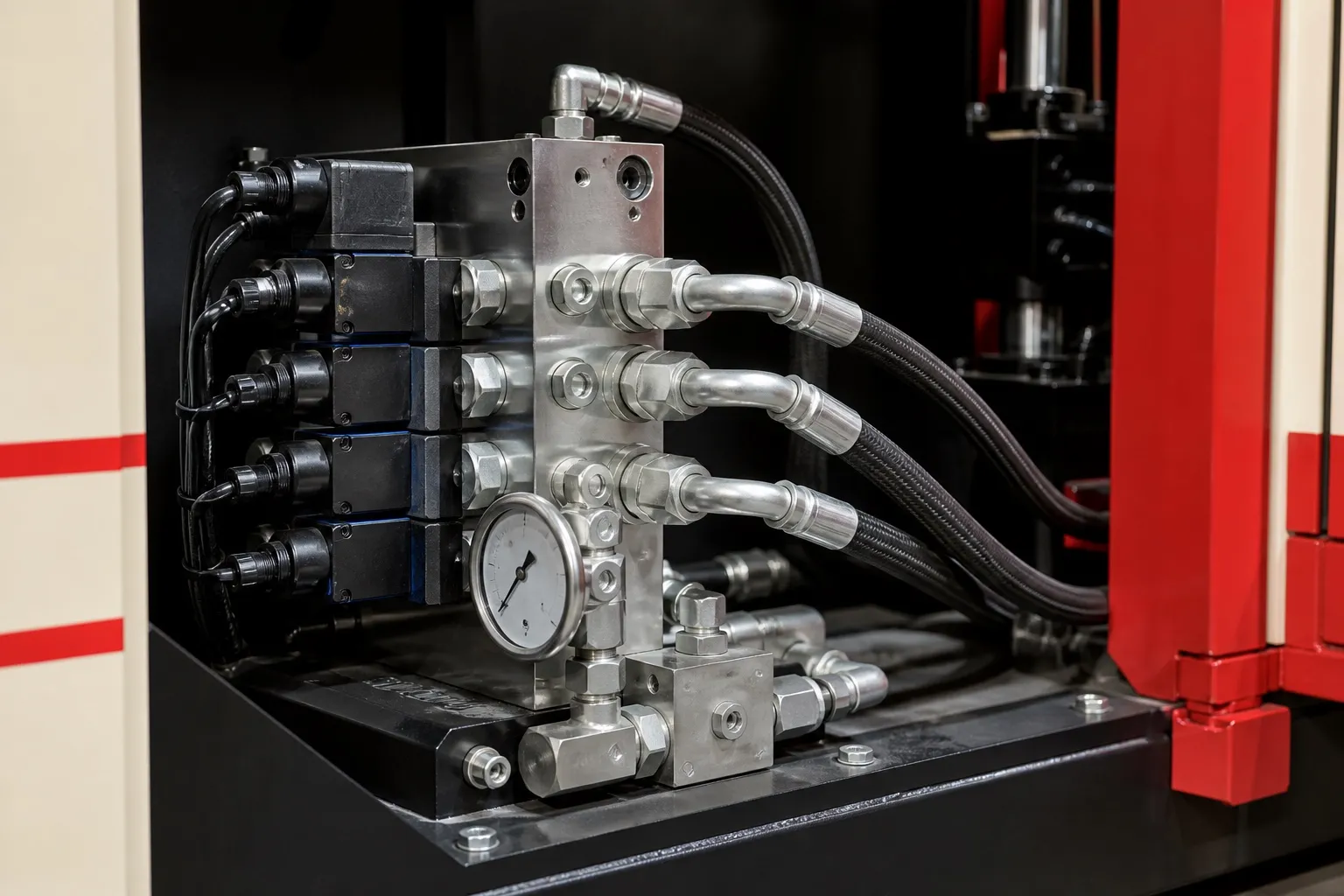
An 8-cavity closure mould runs well at 9 am. By early afternoon the shift supervisor is chasing light shots in two cavities, and nobody has touched a setting. The oil has warmed, the valves respond a little differently, and the screw no longer stops in quite the same place.
Servo-electric ball screw injection removes most of that drift from the drive. A servo motor turns a ball screw, its encoder counts every fraction of a turn, and the controller holds the screw to the same speed profile and the same end position shot after shot. The melt itself can still vary, and that limit matters as much as the gain.
Key Takeaways
- A ball screw turns servo motor rotation into screw travel that the controller measures and corrects throughout every shot.
- Removing oil from the injection drive removes drift from oil temperature, oil compressibility and valve response.
- Melt compressibility, check-ring closing and resin variation still change shot weight, so a repeatable screw is not a repeatable part on its own.
- Prove the gain by weighing consecutive shots on your mould, not by reading screw position on the screen.
How Does Servo-Electric Ball Screw Injection Move the Screw?
A servo motor, usually through a belt or gearbox, turns a threaded shaft. Recirculating balls in a nut ride along that thread and convert rotation into straight-line travel of the screw. The motor encoder reports position continuously, so speed and position are controlled in a closed loop throughout injection.
Pressure is controlled through the same drive. A load cell or the motor torque tells the controller how hard the screw is pushing, and the controller limits it. In a hybrid machine, this electric unit usually handles injection and screw rotation, while oil still drives the clamp and ejector.
One practical result is the pressure reading. In his Plastics Technology article on intensification ratio, John Bozzelli explains that a hydraulic machine multiplies oil pressure by the ratio of ram area to screw area, between 6:1 and 43:1 across machines, and that the ratio changes with screw size. Electric machines read plastic pressure directly, effectively at 1:1.
So the number on an electric unit's screen is the pressure the melt sees, and a setting can be compared between machines without first converting it.
Why Does Shot Repeatability Improve?
Because the drive stops being a source of variation. A hydraulic injection unit depends on pumps, valves and oil whose behaviour shifts with temperature and load. A ball screw drive follows a stored speed and position profile and corrects any error within the same shot, so screw travel repeats closely.
Sources of injection drive variation, hydraulic and servo-electric ball screw
| Source | Hydraulic injection | Servo-electric ball screw injection |
|---|---|---|
| Drive medium | Oil, which compresses slightly under pressure | Steel screw and balls, no oil in the drive path |
| Speed control | Pump and proportional valves, response varies with oil temperature | Motor speed set and corrected through the encoder |
| Transfer to hold | Valve switching; a moving oil column carries on briefly | Motor reverses or holds torque under direct control |
| Pressure reading | Oil pressure, multiplied by the intensification ratio | Plastic pressure, read directly |
| Warm-up drift | Oil and valve behaviour change as oil warms | Little drive change; barrel and mould still need to settle |
The biggest gain is at transfer from fill to hold, where small timing errors change how much melt reaches the cavities. A repeatable transfer position and a clean switch to holding pressure give each cavity the same start to packing, which is what multi-cavity and thin-wall moulds need.
Thin-wall work adds speed to the demand, as the thin-wall article in this series explains.
What Can a Ball Screw Not Fix?
It cannot make the melt behave the same every shot. Plastic compresses under injection pressure, the check ring takes a moment to close, and resin lots differ in viscosity and moisture. Each of these changes the weight of melt delivered, even when the screw travels the same distance every time.
David Hoffman of the American Injection Molding Institute showed the scale of compressibility in Plastics Technology. Fill-only parts moulded at the same shot volume came out 3.12% under their calculated weight in PP, 12.64% in POM and 15.54% in PC, in step with compressibility at injection pressure of 4.3%, 6.7% and 9.2%.
Hoffman also links screw bounce at transfer to that compression and release of the melt. A stiff, fast drive helps here, but the screw can only deliver what the material lets through.
Resin variation will grow for many Indian moulders. The Plastic Waste Management (Amendment) Rules notified on 31 March 2026 require rigid plastic packaging to contain at least 30% recycled material in 2025-26, rising to 60% by 2028-29. Recycled feed can vary more from lot to lot than virgin resin, so watch viscosity as well as screw position.
Our view: treat part weight, not screw position, as the proof of repeatability. Screen values that never change can hide a drifting part weight, and only a scale shows it.
How Can You Prove the Gain on Your Own Mould?
Let the barrel, mould and process settle, then weigh a run of consecutive shots on a laboratory balance and calculate the spread and standard deviation. Repeat on the same mould with the other machine or after a change. Compare the spread against your weight tolerance, not against a general claim.
Weigh away from drafts, at the same time after moulding for every part, and record cavity numbers so a single unbalanced cavity does not hide in the average. Note the cushion and peak pressure for each shot as well. If position and cushion hold steady while weight drifts, the cause lies in the material or the check ring, not the drive.
What Should You Send for a Repeatability Trial?
Send the part drawing, resin grade and any recycled share, cavity count, shot weight and the weight tolerance your customer checks. Include current weight data if you have it. See the hybrid injection moulding machine page.
Frequently Asked Questions About Ball Screw Injection
How long does a ball screw last in an injection unit?
Life depends on load, speed, stroke and lubrication, so ask the supplier for the rated life at your injection pressure and cycle, and for the lubrication interval. Follow that interval strictly. Rising noise, heat or backlash at the nut are signs to plan an inspection before accuracy suffers.
Does ball screw injection allow higher injection pressure?
Not by itself. Maximum pressure depends on the motor torque, the ball screw rating and the screw diameter. A smaller screw on the same unit gives higher pressure and a smaller shot. Check the pressure and shot rating for the screw diameter you will actually use.
Why do my part weights vary when the cushion looks steady?
A steady cushion shows that the screw stopped in the same place, not that the same melt reached the cavities. Melt compressibility, viscosity changes, a slow-closing check ring or an unbalanced runner can all shift weight. Weigh parts by cavity and check the check ring and resin moisture.
Is holding pressure controlled differently on an electric unit?
The principle is the same: after transfer, the screw holds a set pressure while the gates freeze. On an electric unit, the motor controls that pressure from a direct plastic pressure signal rather than a hydraulic valve, so the set value is the pressure in the melt.
Can an older hydraulic machine be upgraded for better repeatability?
Some improvement is possible. Servo or variable-speed pump drives and better valves can steady speed control, and process monitoring can flag drift early. An electric injection unit changes the drive itself, which is a larger step. Measure your current weight spread first, so you know what the upgrade must achieve.
Related Articles
- Hybrid vs Hydraulic vs All-Electric Injection Moulding Machines: A Practical Comparison
- Cutting Power Costs in Injection Moulding With Hybrid Machines
- Thin-Wall and Multi-Cavity Moulding on Hybrid Machines
Sources & References
- Plastics Technology, D. Hoffman (American Injection Molding Institute): Screw Bounce: What Causes It and Why You Should Care (April 2025, pp. 18 to 19)
- Plastics Technology, J. Bozzelli: Understanding Intensification Ratio (2016, updated 2022)
- Plastics Technology, J. Bozzelli: A Simpler Way to Calculate Shot Size vs. Barrel Capacity (2017, updated 2022)
- Polymerupdate, D. K. Jha: India eases plastic recycling regulations (8 Apr 2026)
Technical Disclaimer
Disclaimer: The information provided in this document is for general informational and educational purposes only. It is based on technical references and industry information available at the time of preparation and may be subject to change. It does not constitute engineering, technical, commercial or professional advice, nor does it constitute a quotation, specification, warranty or contractual commitment by Pratishna Engineers.
Actual injection moulding machine and process requirements vary according to the component design, material, mould, production volume, machine configuration and operating conditions. The information, examples, calculations and recommendations provided should be independently evaluated and verified for the specific application before making any equipment, process or production decision. Information obtained from third-party sources remains subject to the accuracy and limitations of those sources.
Limitation of Liability: Pratishna Engineers makes no representation or warranty, express or implied, regarding the completeness, accuracy or suitability of the information for any particular application. To the extent permitted by applicable law, Pratishna Engineers shall not be liable for any loss, damage, cost or consequence arising from reliance on or use of the information contained in this document. Final machine selection, configuration and application suitability should be confirmed with Pratishna Engineers based on complete and accurate project requirements.