






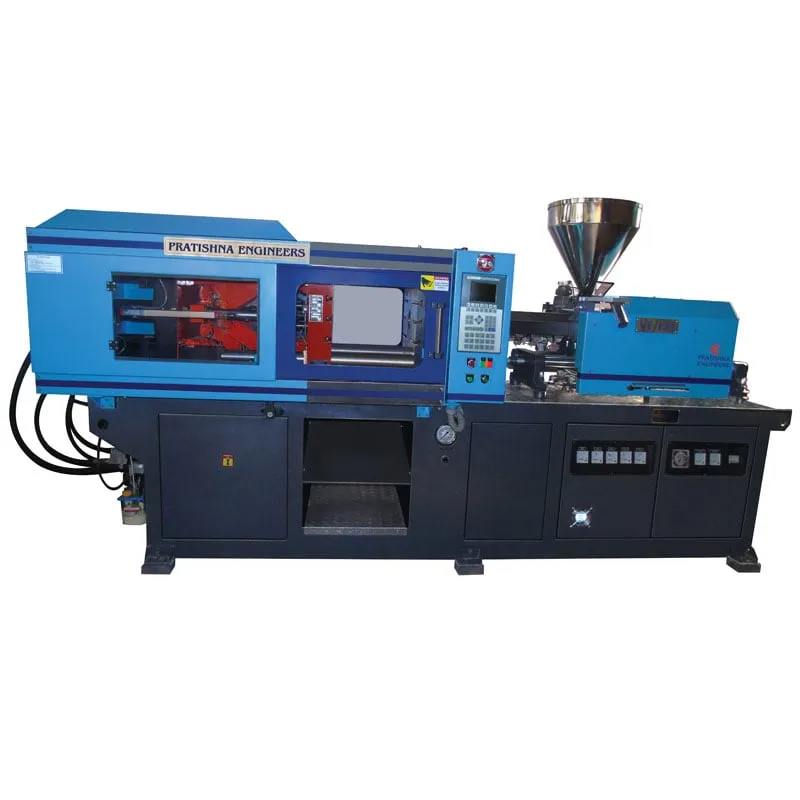

Quick answer: a fully automatic injection moulding machine runs complete cycles without anyone opening the safety gate or lifting parts out. It closes, injects, holds, cools, opens and ejects by itself, and the parts leave by free drop, a picker or a robot onto a conveyor. What you pay for is not the word "automatic" but the layers you specify: auto cycle, part removal, conveying, robot interface and monitoring.
Most of the cost and most of the risk sit in the last four layers, not in the machine's own cycle. This guide explains each layer so your enquiry lists what the job needs and nothing it does not.
Key Takeaways
- Auto cycle is only the first layer. Part removal, conveying, interface signals and monitoring decide whether the cell can run unattended.
- Free drop suits small, sturdy parts that can tumble. Cosmetic parts, inserts, labels and runner separation need a picker or robot.
- Specify the robot interface on day one, even if the robot arrives later. Adding signals to a running machine costs production time.
- An unattended cycle needs proof that the mould is empty and safe to close, every cycle, or one stuck part can damage the tool.
What does a fully automatic injection moulding machine do on its own?
It repeats the full cycle from mould close to ejection with no operator action, and it stops itself when a check fails. The machine handles clamp, injection, hold, screw recovery, cooling and ejection. Everything after the part leaves the cavity depends on the equipment you add around it.
Think of it as five layers. Each one removes a reason for an operator to stand at the machine. If you skip a layer, the cycle may still be automatic on paper, but someone will be standing there to clear parts, separate runners or watch for problems.
The five layers of a fully automatic moulding cell
| Layer | What it does | What to specify |
|---|---|---|
| Auto cycle | Runs the cycle continuously with the safety gate closed | Ejector confirmation, mould protection on close, cycle counters |
| Part removal | Takes parts and runners out of the open mould | Free drop, sprue picker or robot, with the take-out time |
| Conveying | Moves parts away from the machine | Conveyor length, speed, guarding, part separation from runners |
| Robot interface | Lets machine and robot exchange safe signals | Mould open, ejector forward, safe to close, robot clear |
| Monitoring | Detects faults before the next shot | Part-present checks, alarms, reject handling, data export |
Write these five lines into your enquiry, even if the answer for one layer is "not needed". It forces the supplier to say what is included rather than leave it to the commissioning day.
When does free drop work, and when do you need a picker or robot?
Free drop works when parts are small, tough and not cosmetic, and the runner can fall with them or is not there at all. Use a sprue picker when the runner must be separated. Use a robot when parts must be placed, oriented, kept unmarked or loaded with inserts.
A part that falls through the platen area can catch on a tie bar, land on the ejector side or stay on the core. A good free-drop job has a clean ejection stroke and a part that clears the mould every time. Anything else needs handling.
Robots also steady the process. In one industry case study, a four-cavity insert job took about 30 s per cycle to unload, inspect and reload by hand. A robot took over unloading, runner disposal and insert loading, with vision checks before each shot, and steady mould-open times removed mould temperature swings.
Conveying is the layer most often left vague. Decide where good parts go, where runners go and where suspect shots go. A single belt that mixes all three puts a person back at the machine, sorting by hand, which is the job automation was meant to remove.
Take-out time matters as much as the hardware. One costing model assumes robotic removal at about 6 s and manual removal at about 8 s, but treat those as model inputs, not measurements. Ask for the take-out time on your part, with your mould opening stroke.
What should monitoring and interlocks cover in an unattended cycle?
At minimum, the machine must confirm that every part and runner has left the mould before it closes again, and it must stop safely when that check fails. Add alarms that reach someone, a reject path for suspect shots and a record of why the cell stopped.
Mould protection on close is the core check. The clamp closes slowly and at low force through the last part of its stroke, so a stuck part trips an alarm instead of hitting the steel. Ejector-forward confirmation, part-present sensors on the robot gripper and vision checks of the cavity add further layers.
Plan what the machine does when it stops. A machine waiting for help with hot barrels still draws power. Measurements in one study found idling machines drawing 52% to 97.5% of their full moulding energy, and idle periods longer than about 1.5 hours may be cheaper to switch off and restart.
Our flat view: a cell is only fully automatic if it can run a whole night shift with nobody inside the guarding. If the plan relies on someone clearing a chute every hour, budget for that person.
Ask for data export as well. Cycle time, shot count and alarm history tell you whether the cell is running unattended in practice or only in the brochure.
What should you send before asking for a fully automatic set-up?
Send the part drawing, the material grade, the mould drawing with cavities and runner type, your daily output target and how parts must be packed. Say which of the five layers you want and who supplies each one. Then compare machines on the product range page.
Frequently Asked Questions About Fully Automatic Moulding
Is a fully automatic machine the same as an all-electric machine?
No. "Fully automatic" describes how the cycle runs and how parts leave the mould. "All-electric", "hybrid" and "hydraulic" describe how the clamp and injection are driven. A hydraulic machine can run fully automatic, and an all-electric machine can still be operated with the gate opened every shot.
Can a semi-automatic machine be converted to fully automatic?
Often, yes, if the controller can run continuous cycles with the gate closed and accept external signals. Check whether it has a robot interface, mould protection on close and ejector confirmation. If those are missing, the upgrade can need controller changes, wiring and fresh safety checks, which take the machine out of production.
Does fully automatic mean no operator at all?
It means no operator per cycle. Someone still loads material, changes moulds, checks first-off parts, clears alarms and handles packing. A realistic goal is one person looking after several machines, with alarms that reach that person quickly when any machine stops.
Which parts are hard to run fully automatic?
Parts with metal inserts, in-mould labels, thin flash-prone edges, sticky cores or cosmetic faces that scratch when they fall. These need placing, orienting or gentle handling. They can still run unattended, but the handling equipment and its checks cost more design effort than the machine itself.
What happens if a part sticks in the mould during an unattended cycle?
With mould protection set correctly, the clamp meets the part at low force, stops and raises an alarm. Without it, the clamp can close on the part at full force and damage the cavity. Set the protection zone on your mould at commissioning, not on default values.
Related Articles
- Plastic Injection Moulding Machines for Automotive Battery Parts
- Injection Moulding Machine Suppliers in India
- Automatic Injection Moulding for Mass Production
- Automatic Injection Moulding Machines in Mumbai
Sources & References
- Robotic Industries Association via Smart Molding, J. Clark: Automated injection molding operation
- aPriori: Cost Model Guide: Insert Injection Molding Options
- PlasticsToday, R. Kent: Getting to know your real energy use and cost (Jan 2010)
- Reliance Industries: Repol H110MAS technical data sheet (July 2024)
Technical Disclaimer
Disclaimer: The information provided in this document is for general informational and educational purposes only. It is based on technical references and industry information available at the time of preparation and may be subject to change. It does not constitute engineering, technical, commercial or professional advice, nor does it constitute a quotation, specification, warranty or contractual commitment by Pratishna Engineers.
Actual injection moulding machine and process requirements vary according to the component design, material, mould, production volume, machine configuration and operating conditions. The information, examples, calculations and recommendations provided should be independently evaluated and verified for the specific application before making any equipment, process or production decision. Information obtained from third-party sources remains subject to the accuracy and limitations of those sources.
Limitation of Liability: Pratishna Engineers makes no representation or warranty, express or implied, regarding the completeness, accuracy or suitability of the information for any particular application. To the extent permitted by applicable law, Pratishna Engineers shall not be liable for any loss, damage, cost or consequence arising from reliance on or use of the information contained in this document. Final machine selection, configuration and application suitability should be confirmed with Pratishna Engineers based on complete and accurate project requirements.

