






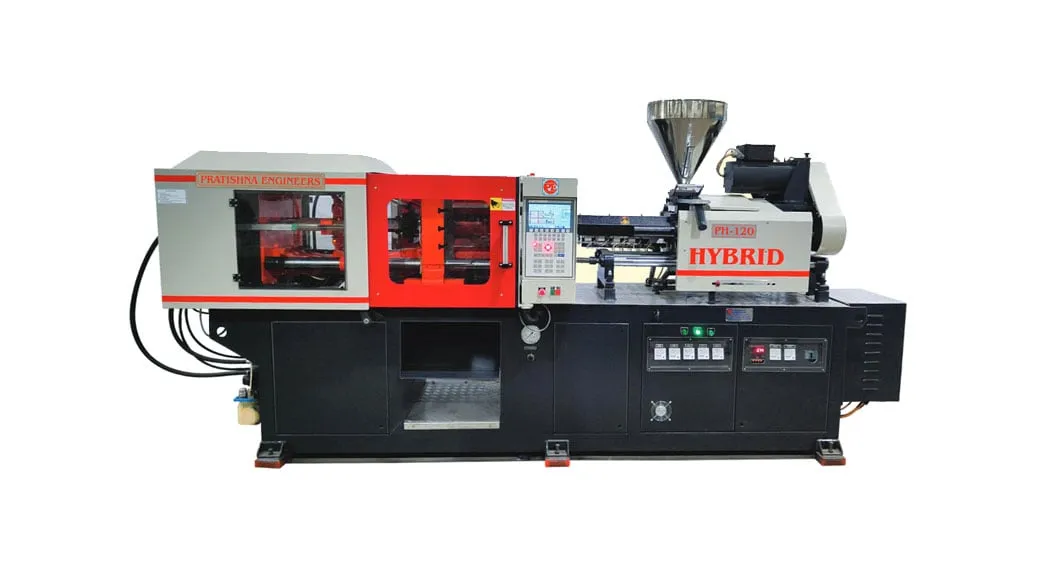

Take a two-cavity mould. On an assumed 32 s semi-automatic cycle at 98% good shots, it gives 3,600 / 32 x 2 x 0.98 = about 220 parts an hour. On an assumed 26 s automatic cycle, it gives about 271. That arithmetic is the case for automatic injection moulding machines in Mumbai plants: more parts per hour and fewer operators per machine.
Automatic does not always mean a robot. A machine can cycle on its own with parts dropping onto a conveyor, with a sprue picker taking the runner, or with a robot placing parts. This page compares those levels and the labour each needs. Pratishna Engineers builds machines and automation in house.
Check the cycle on your own mould before you count on the saving. Time the gate opening, part removal and gate closing separately, because those seconds are what automation removes; the rest of the cycle stays with the mould.
Key Takeaways
- Semi-automatic cycles wait for the operator to open and close the safety gate every shot; automatic cycles repeat without that wait or manual removal.
- Free-drop parts suit simple shapes; a sprue picker removes cold runners; a robot is for parts that must be placed, oriented, inspected or kept unmarked.
- Labour per machine falls when parts leave the mould on their own, because one person can tend several machines instead of one.
- Consistent mould-open time from automatic cycling steadies mould temperature from shot to shot, so it can improve part consistency, not only output.
What changes between semi-automatic and automatic cycles?
In a semi-automatic cycle, the machine completes one shot and waits for the operator to open the gate, remove the part and close the gate. In an automatic cycle, the machine starts the next shot on its own once ejection is confirmed, so operator pace no longer sets it.
The difference is more than seconds. Gate opening times vary from shot to shot and from operator to operator, and so does the time the mould stays open. Mould-open time affects mould temperature, and mould temperature affects shrinkage and part weight. Automatic cycling holds that time steady.
Automation levels compared (qualitative; confirm on your mould)
| Level | Part removal | Operator role | Suits |
|---|---|---|---|
| Semi-automatic | Operator opens gate and removes part | One per machine, every cycle | Insert parts, short runs, trial jobs |
| Automatic, free drop | Parts fall onto a conveyor or into a bin | Checks parts, fills hopper, tends several machines | Simple parts that can drop without damage |
| Automatic with sprue picker | Picker removes the runner, parts drop | Same as free drop | Cold-runner moulds where runners would mix with parts |
| Automatic with robot | Robot picks, places, stacks or loads inserts | Tends cells, handles quality checks | Parts that scratch or need orientation, inserts, labels |
Semi-automatic still has a place. Insert jobs, short runs and parts that must be checked by hand every shot often run better with an operator at the gate. The aim is to choose the level per job, not to switch every machine to automatic.
Cooling usually sets most of the cycle. In one RJG trial on an eight-cavity ABS part 3.3 mm thick, about 85% of the cycle was cooling. Automation removes handling time; it does not shorten cooling. So check what share of your cycle is handling before you expect a large gain.
When is a sprue picker enough and when do you need a robot?
A sprue picker is enough when parts can drop freely and only the cold runner needs separating. You need a robot when parts must not fall, must be placed in a set orientation, stacked, inspected or degated, or when inserts or labels must be loaded into the mould.
A sprue picker is a simple swing or traverse arm that grips the runner and drops it into a chute or granulator. It needs little programming and adds little to the cycle. Hot-runner moulds with no cold runner may need neither picker nor robot if parts drop cleanly.
Robots earn their place on handling, not only speed. In one published costing model, robotic part removal is set at 6 s against 8 s for manual removal; these are model inputs, not measurements, but they show how the comparison is framed. Measure your own removal times before deciding.
A Robotic Industries Association case study shows what a full cell can do: a SCARA robot picks four parts and the runner, places parts on an index table for inspection, loads inserts from a bowl feeder, and uses vision to confirm the cavities are clear before the mould closes.
How many operators does each machine need?
On semi-automatic cycles, plan one operator per machine for every shift, because each shot needs a person at the gate. On automatic cycles with parts leaving the mould on their own, one person can tend several machines, limited by inspection, packing, material loading and walking distance.
How many machines one person can tend depends on the work left after automation. Count what still needs hands: checking parts against a limit sample, packing, labelling cartons, topping up hoppers, clearing small stoppages and logging rejects. Add the minutes per hour for each, then divide the hour by the total.
Layout changes the answer. Machines in a row with conveyors ending at one packing table let one person cover more presses than machines scattered across a shed. Central material feeding and a granulator beside each press also remove trips. Plan the layout with the automation, not after it.
Do not cut operators to zero on a new job. Keep one person per machine for the first runs while you find the stoppages, then reduce staffing as the process proves stable. Flat opinion: a press that stops every hour for a stuck part is not automatic, whatever its controller says.
What should automatic injection moulding machines in Mumbai include?
Automatic injection moulding machines in Mumbai plants should include reliable ejection confirmation, low-pressure mould protection, a robot or picker interface, interlocked guarding for automatic mode, and conveyor or chute outlets. Without these, the machine stops for small faults and someone must stand beside it anyway.
Mould protection matters most. During the last part of mould closing, the clamp should move at low pressure so that a part left in the cavity stops the clamp before it damages the mould. Ask how sensitive this setting is, how the machine signals a fault, and how quickly it restarts once the fault is cleared.
Guarding must suit unattended running. Robots need their own fenced area and interlocks linked to the machine, and openings for conveyors must not let hands reach moving parts. Check guards and interlocks against ISO 20430, the safety standard for injection moulding machines, during factory acceptance.
Power deserves a check too. A robot, conveyor and granulator add to connected load, and in Maharashtra kVAh billing applies to LT consumers above 20 kW, so a poor power factor raises the bill. Add these loads to your site calculation before the order, not after the electrician sees the panel. The calculation is short, and it avoids a late upgrade.
How Pratishna Engineers supports automatic moulding
Pratishna Engineers began with machine rebuilding, indigenisation and technology adaptation, then moved to complete machine design, manufacturing and automation. Import substitution is a stated focus. The group also makes hydraulic systems, special purpose machines and automation, alongside its horizontal, vertical, two-platen, hybrid and PET injection moulding machines.
Design, manufacturing, assembly, testing and service are done in house in Mumbai, so machine controls and the automation interface can be discussed with the people who build them. Every enquiry follows the same order: component, material, mould, production requirement, then machine configuration, which is where the automation level is decided.
- 35+ years of experience, 9,000+ machines and 1,000+ customers in India and international markets, from the works at Andheri (E), Mumbai.
- A design team working on SolidWorks, Creo and AutoCAD, with an independent QA department that follows written SOPs and uses accredited external labs when required.
What data should you collect before you automate?
Time one shift on the current job: cycle, gate-open time, part removal, stoppages and rejects. Note how parts must leave the mould and what still needs hands. With that record, a maker can propose the right automation level and the labour it saves. Explore the injection moulding machines by type.
Frequently Asked Questions About Automatic Injection Moulding
Can a semi-automatic machine be converted to automatic?
Often, if the machine has reliable ejection confirmation, low-pressure mould protection and a free-drop path or space for a picker. The control must repeat cycles without a gate signal while keeping guards interlocked. Ask the maker to confirm which changes your machine needs and how they will be tested.
Do I need a robot for a hot-runner mould?
Not always. If there is no cold runner and parts drop cleanly without scratching or tangling, a conveyor may be enough. A robot becomes useful when parts must be stacked, oriented, inspected or kept from touching, or when inserts or labels are loaded into the mould every cycle.
Does automation shorten cooling time?
No. Cooling is set by wall thickness, mould temperature and the resin, and it often takes most of the cycle. Automation removes handling time and keeps mould-open time steady, which can steady mould temperature. To shorten cooling itself, look at the cooling channels in the mould and the part's wall.
How many machines can one operator run on automatic?
It depends on the work left per machine: inspection, packing, hopper loading and clearing stoppages. Add the minutes each task needs per hour and divide the hour by the total. Layout matters too: machines in a row feeding one packing point let one person cover more of them.
Is automatic moulding safe to leave unattended?
Only if the guarding and interlocks are designed for it, mould protection is set and tested, and faults stop the machine safely. Robots need their own fenced area. Check these during factory acceptance against the safety standard, and keep someone within reach of the machines on every shift.
Does Pratishna Engineers supply automation with its machines?
Pratishna Engineers designs and builds machines in house and lists automation among its group's products, along with hydraulic systems and special purpose machines. The automation level is set during machine selection, after component, material, mould and production requirement. Share your part and cycle data to discuss the right level.
Related Articles
- Buy Injection Moulding Machine in Mumbai
- Best Plastic Injection Moulding Machine in Mumbai
- Servo-Driven Injection Moulding Machine in Mumbai
- High-Speed Plastic Moulding Machines in Mumbai
Sources & References
- RJG Inc.: How to Determine Injection Molding Cooling Time (Mar 2021)
- aPriori: Cost Model Guide: Insert Injection Molding Options
- Robotic Industries Association via Smart Molding, J. Clark: Automated injection molding operation
- ISO: ISO 20430:2020, Plastics and rubber machines: Injection moulding machines: Safety requirements
Technical Disclaimer
Disclaimer: The information provided in this document is for general informational and educational purposes only. It is based on technical references and industry information available at the time of preparation and may be subject to change. It does not constitute engineering, technical, commercial or professional advice, nor does it constitute a quotation, specification, warranty or contractual commitment by Pratishna Engineers.
Actual injection moulding machine and process requirements vary according to the component design, material, mould, production volume, machine configuration and operating conditions. The information, examples, calculations and recommendations provided should be independently evaluated and verified for the specific application before making any equipment, process or production decision. Information obtained from third-party sources remains subject to the accuracy and limitations of those sources.
Limitation of Liability: Pratishna Engineers makes no representation or warranty, express or implied, regarding the completeness, accuracy or suitability of the information for any particular application. To the extent permitted by applicable law, Pratishna Engineers shall not be liable for any loss, damage, cost or consequence arising from reliance on or use of the information contained in this document. Final machine selection, configuration and application suitability should be confirmed with Pratishna Engineers based on complete and accurate project requirements.

