






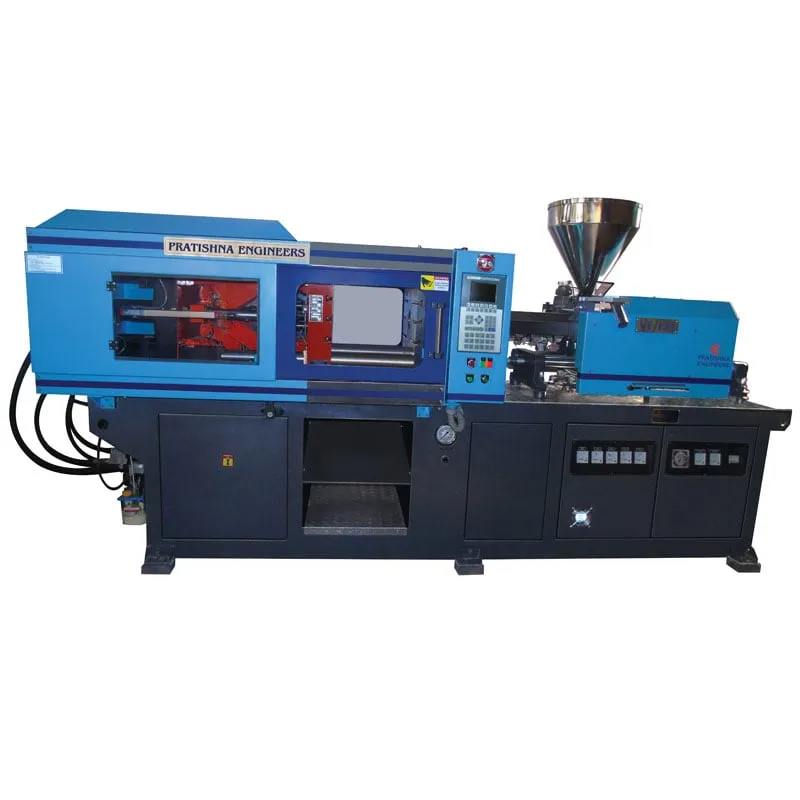

Automatic injection moulding for mass production pays because output becomes a figure you can plan on. Output per hour equals 3,600 divided by the cycle in seconds, times the cavities, times the share of good shots. A fully automatic cell holds that figure shift after shift, because no operator opens a gate between shots, so the cycle does not stretch. The machine alone is not enough, though. Unattended running also needs sure part removal, mould protection, a steady supply of material and cooling, and alarms that stop the cell safely.
Key Takeaways
- Output per hour is 3,600 divided by the cycle in seconds, times cavities, times good-shot share; every term can be measured on your own floor.
- Cooling usually takes most of the cycle, and it scales with wall thickness squared, so wall design moves output more than machine speed.
- Unattended running needs confirmed part removal, low-pressure mould protection, steady material and cooling supply, and alarms that stop the cell.
- Each extra second on a 14 s cycle costs about 6.7% of output, so small cycle gains add up across a year of mass production.
How do you work out output per hour?
Multiply three numbers: shots per hour, cavities and good-shot share. Shots per hour is 3,600 divided by the cycle in seconds. A 12 s cycle gives 300 shots an hour, so an eight-cavity mould at 98% good shots gives 2,352 parts an hour.
Each term deserves its own attention. The cycle is mostly cooling: in one published trial on an eight-cavity ABS part 3.3 mm thick, about 85% of the cycle went on cooling. Cooling time depends on wall thickness squared, so a wall 20% thinner needs about 36% less cooling.
Parts per hour at 98% good shots (calculated)
| Cycle | 4 cavities | 8 cavities | 16 cavities |
|---|---|---|---|
| 10 s | 1,411 | 2,822 | 5,645 |
| 15 s | 941 | 1,882 | 3,763 |
| 20 s | 706 | 1,411 | 2,822 |
Read the table one way: halving the cycle doubles output, and so does doubling the cavities. The difference lies in cost and risk. A shorter cycle needs better cooling and a machine that keeps pace, while more cavities need a larger mould, more clamp and a balanced runner.
Cavities multiply output but also multiply risk. One blocked cavity on a manned press gets noticed within minutes; on an unattended cell it can run for hours. Good-shot share is where automation earns its keep, because a cell that rejects bad shots on its own protects the count you ship.
What does a machine need to run unattended?
It needs four things working together: part removal that never misses, mould protection that stops a close on a stuck part, steady material and cooling supply, and alarms that stop the cell safely and call someone. Miss any one and the night shift becomes a scrap shift.
Part removal comes first. Free-falling parts need a confirmed drop, from a sensor or a light curtain under the mould, before the next close. Parts that hang, scratch or must stay oriented need a picker or robot. Runners need their own path to a granulator or a scrap bin.
Mould protection is the next guard. Low-pressure closing over the last few millimetres lets the clamp sense an obstruction and open again instead of crushing a part between the halves. Set it tight enough to catch a thin runner, but not so tight that it trips on normal mould friction.
Supply runs out quietly. A hopper loader, a dryer sized for the hourly throughput and a chiller with alarms keep the cell fed. A flat view: if you cannot leave the cell for a full shift with only an alarm watch, it is not automatic yet, whatever the brochure says.
Alarms need a person at the other end. Set the cell to stop on a missed drop, a mould protection trip, low material, high oil or water temperature and a reject count above your limit, then send a message to whoever is on watch. A cell that stops and waits costs far less than one that moulds scrap until morning.
How do resin and mould choices support automatic injection moulding for mass production?
Choose a resin that flows easily through long paths and sets fast, and a mould built for steady cooling and clean ejection. Both shorten and stabilise the cycle, which matters more on an unattended line than on a manned one, because no one is there to adjust.
Resin suppliers make grades for this work. Reliance lists Repol H200MA, an Indian PP homopolymer, for thin-walled containers, multicavity moulding and long flow paths, with an MFR of 25 g/10 min, melt temperatures of 210 to 250 °C and food-contact compliance to IS 10910.
On the mould, cooling lines close to every cavity and an equal flow in each line keep cavities at the same temperature. Unequal cooling shows up as one cavity running heavier or warping, which an unattended cell will not notice unless it weighs or checks parts.
Add a safety margin to cooling time. A published method adds about 20% to the calculated cooling timer. On a manned line you might trim it later; on an unattended line, keep it until weeks of data show the part holds size without it.
Ejection must be just as dependable. A part that sticks on the core even once in a few hundred shots will stop an unattended cell or damage the mould. Enough draft, polished cores and ejector pins placed at the deepest areas of the part keep every shot leaving the mould cleanly.
What should you measure before automating a line?
Time a week of cycles on the current job, count rejects by cavity, and note every stop with its cause. Those three records show whether automation adds output or only moves the bottleneck. Then size the machine and auxiliaries around the target. See the injection moulding machine range.
Frequently Asked Questions About Automatic Moulding for Mass Production
What is the difference between semi-automatic and fully automatic moulding?
In semi-automatic mode the operator starts each cycle, usually by closing the safety gate, and often removes parts by hand. In fully automatic mode the machine cycles on its own, and parts drop or are picked out without anyone at the press. Only fully automatic mode gives a fixed, plannable cycle.
How many cavities should a mass production mould have?
Work back from the parts you need per hour, a realistic cycle and your expected good-shot share. Then check that the clamp, shot size and platen can carry that many cavities with a balanced runner. More cavities raise output but also raise mould cost, clamp needs and the risk of one cavity going wrong unnoticed.
Can an automatic cell run through the night without anyone?
It can if part removal is confirmed every shot, mould protection is set tight, material and cooling supply cannot run dry, and alarms stop the cell and call a person. Start with a short unattended run under watch, fix every stop it shows, then extend the hours step by step.
What good-shot share should I plan for?
Use the figure your own line achieves on the job, measured over at least a week, not a target from a brochure. New moulds and new materials often run lower at first. Plan output on the measured share, and treat any later improvement as a gain rather than building it into the plan.
Does an idle automatic machine still use much power?
It can. Measurements on idling machines found them drawing 52% to 97.5% of their full moulding energy, depending on the drive. On idle periods longer than about 1.5 hours it may be cheaper to switch off and restart, so set alarms that stop and park the machine rather than leave it idling.
Related Articles
- Why PVDL Series Vertical Locking Machines Are Ideal for Medical Equipment Parts
- Why Electric Injection Moulding Machines Are Becoming Industry Favorites
- Automatic Injection Moulding Machines in Mumbai: Smart, Fast and Reliable
- Plastic Injection Machine: Revolutionizing Mass Production
Sources & References
- RJG Inc.: How to Determine Injection Molding Cooling Time (Mar 2021)
- PlasticsToday, R. Kent: Getting to know your real energy use and cost (Jan 2010)
- Reliance Industries: Repol H200MA Technical Data Sheet (July 2024)
Technical Disclaimer
Disclaimer: The information provided in this document is for general informational and educational purposes only. It is based on technical references and industry information available at the time of preparation and may be subject to change. It does not constitute engineering, technical, commercial or professional advice, nor does it constitute a quotation, specification, warranty or contractual commitment by Pratishna Engineers.
Actual injection moulding machine and process requirements vary according to the component design, material, mould, production volume, machine configuration and operating conditions. The information, examples, calculations and recommendations provided should be independently evaluated and verified for the specific application before making any equipment, process or production decision. Information obtained from third-party sources remains subject to the accuracy and limitations of those sources.
Limitation of Liability: Pratishna Engineers makes no representation or warranty, express or implied, regarding the completeness, accuracy or suitability of the information for any particular application. To the extent permitted by applicable law, Pratishna Engineers shall not be liable for any loss, damage, cost or consequence arising from reliance on or use of the information contained in this document. Final machine selection, configuration and application suitability should be confirmed with Pratishna Engineers based on complete and accurate project requirements.

