







Say you have an enquiry for two-pin plug tops moulded onto a cord, with metal pins placed in the mould every shot. On a horizontal machine those pins have to be held against gravity in a mould that opens sideways. On a vertical machine they just rest in the lower half.
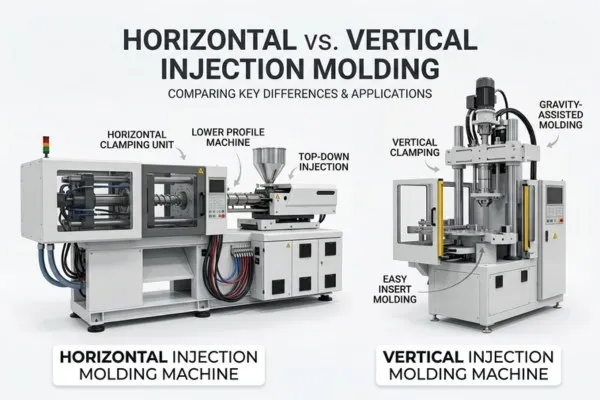
That is the core of horizontal vs vertical injection moulding. A horizontal machine opens the mould side to side and suits fast, automatic production where parts can drop out. A vertical machine opens it up and down and suits parts with inserts, cables or terminals placed before each shot.
Key Takeaways
- The difference is the clamp axis. Horizontal moulds open side to side, vertical moulds open up and down.
- Choose vertical when an insert, terminal or cable end goes into the mould every shot, because gravity holds it in the lower half.
- Choose horizontal for high-volume parts without inserts, where moulded parts can fall onto a conveyor without a robot.
- A shuttle or rotary table on a vertical machine lets loading overlap moulding, but it needs an extra lower mould half for each station.
What Is the Real Difference in Horizontal vs Vertical Injection Moulding?
The difference is the direction in which the clamp moves. On a horizontal machine the mould opens parallel to the floor and the parting line is vertical. On a vertical machine the mould opens upwards and the parting line is horizontal, so the lower half faces up like a table.
Everything else follows from that one choice. A horizontal mould sheds parts sideways, so they can drop under gravity onto a conveyor or into a bin. A vertical mould keeps parts and inserts sitting in the lower half, so something has to lift them out, but nothing falls out of place while the mould closes. One Japanese machine maker lists the horizontal layout's other practical points as low machine height, fewer limits on the building it goes into, and moulds that are installed with an ordinary hoist.
Horizontal vs vertical injection moulding machines compared
| Point | Horizontal machine | Vertical machine |
|---|---|---|
| Mould opening | Side to side, parallel to the floor | Up and down, lower half faces upwards |
| Part removal | Free fall to a chute or conveyor, or a robot | Lifted out by an operator or a robot |
| Inserts and cables | Must be held against gravity by pins, magnets or fixtures | Rest in the lower half, held by gravity |
| Floor space | Longer footprint | About half the footprint, per one maker |
| Height and mould change | Low machine, mould hung from a hoist | Taller machine, mould handled overhead |
| Shuttle or rotary table | Not used | Available, with an extra lower mould half per station |
| Typical work | High-volume parts without inserts | Insert moulding, overmoulding, cable and terminal parts |
When Does a Vertical Machine Make More Sense?
A vertical machine makes sense when something has to be placed in the mould before every shot. Metal pins, threaded bushes, terminals and cable ends sit in the lower half under their own weight while the upper half closes, so they stay in position without extra fixtures.
This is common in Indian electrical accessories. Plugs and socket-outlets sold in India fall under IS 1293, which was notified for mandatory BIS certification through a Quality Control Order in December 2019. A plug top moulded onto a cord, with its pins loaded by hand each cycle, is exactly the kind of job where the cord hangs clear and the pins sit still on a vertical machine.
If a loose metal insert goes into every shot, buy the vertical machine.
The weak point is loading time. On a basic vertical machine the clamp waits while the operator unloads parts and places new inserts. A shuttle table, which slides between two lower mould halves, or a rotary table, which indexes two or more, lets the operator load one half while the other is being moulded. A cost-modelling guide for insert moulding describes this as two lower halves sharing one upper half, and it treats tables as a vertical-only option.
Inserts also need care before they go in. Plastics Today notes that cracking around metal inserts, caused by plastic shrinking onto the metal, is the most common complaint in insert moulding, and that inserts should be preheated. In a humid monsoon month, metal pins stored in open trays beside the machine are another thing worth keeping dry and clean.
When Is a Horizontal Machine the Better Choice?
A horizontal machine is the better choice for parts without inserts, especially at high volume. Because the mould opens sideways, ejected parts fall clear, so a line can run unattended with a chute or conveyor. It also handles large, heavy moulds more easily because the machine stays low.
Sources don't fully agree on output. A vertical machine maker says its machines take about half the floor area of a horizontal one and so give roughly double the productivity per square metre. A moulding company that runs both types says horizontal moulding is faster and more cost-effective for high-volume parts without inserts. We trust the second view for plain parts, because floor area is rarely the limit on a high-volume job, and the first view only where insert loading would leave a horizontal machine waiting.
Automation is the other deciding point. A horizontal machine can line up with others and feed a common conveyor, and a robot is optional rather than essential. On a vertical machine, every part has to be lifted out, so you'll need an operator or a robot at each station.
There are limits. Horizontal machines are poor at holding loose inserts, and a vertical machine maker states plainly that they can't do it reliably.
What Drives the Cost Difference Between the Two Layouts?
Cost depends less on the clamp direction than on what goes around it. A vertical cell with a table needs a second lower mould half for each extra station, while a horizontal cell may need a robot, conveyor or insert fixtures. Compare the whole cell, not the bare machine.
Tooling is easy to miss. With a two-station table, the lower mould half is built twice, so the mould cost rises even though the clamp tonnage stays the same. For short runs, a single-station vertical machine with one mould can cost less overall, even with a slower cycle.
Labour is the other half of the sum. A vertical station with hand loading needs an operator at every machine, while horizontal machines dropping parts into bins may share one operator. Work out the cost per good part with your own wage rates and reject levels before you decide.
Which Layout Should You Ask For?
Start from the part, not the machine. Note whether anything goes into the mould before each shot, how long loading takes, the number of cavities, the part weight and your hourly target. Those figures decide the clamp direction and whether a table is worth its second mould half. You can see how this fits the horizontal layout on our horizontal injection moulding machine page.
Frequently Asked Questions About Horizontal vs Vertical Injection Moulding
Is a vertical injection moulding machine slower than a horizontal one?
Not by design. The injection and cooling stages work the same way on both. A vertical machine is slower only when the clamp waits for an operator to unload parts and load inserts. Adding a shuttle or rotary table lets loading happen while the other mould half is being moulded, which removes most of that waiting time.
Can a horizontal machine be used for insert moulding?
It can for some parts, using pins, magnets or spring fixtures to hold the insert in a mould that opens sideways. The risk is the insert moving or falling before the mould closes, which damages the mould or makes a reject. For loose inserts loaded every shot, a vertical machine holds them by gravity and is the safer choice.
What is the difference between a shuttle table and a rotary table?
Both carry more than one lower mould half. A shuttle table slides two lower halves from side to side, so the operator loads one while the other is moulded. A rotary table turns to index two or more lower halves under the upper half. Rotary tables suit more stations and robot loading, while shuttles suit simple two-station jobs.
Does a vertical machine save floor space?
Usually yes. One machine maker states that a vertical machine often needs about half the floor area of a horizontal machine. Check the height as well, because a vertical clamp stands taller, and allow space around it for the operator, insert trays and any robot, since parts are not dropped onto a conveyor.
Why do inserts need preheating before moulding?
Plastic shrinks as it cools, and a cold metal insert resists that shrinkage, which leaves stress in the plastic around it. That stress can cause cracks, sometimes days after moulding. Preheating the insert reduces the temperature difference and the stress. Your resin supplier can advise on the insert temperature and on grades that resist cracking around inserts.
Related Articles
- What Is a Horizontal Injection Moulding Machine?
- How Does a Horizontal Injection Moulding Machine Work?
- Important Specifications to Consider Before Buying a Horizontal Injection Moulding Machine
- Applications of Horizontal Injection Moulding Machines
Sources & References
- Bureau of Indian Standards: Standards for Plugs, Socket-Outlets and Switches
- TÜV Rheinland: Information to Industry regarding implementation of IS 1293
- aPriori: Insert Injection Molding Options (cost model guide)
- YIZUMI: Vertical vs Horizontal Injection Molding Machine: Features, Pros, Cons, Applications, and How to Choose
- Yamashiro Seiki (via IPROS): Vertical injection molding machine: differences between vertical and horizontal injection molding machines
- Chen Hsong: V Series vertical injection molding machines
- Hansen Plastics: Comparing Horizontal vs. Vertical Molding Processes
- Plastics Today: Design and material advice from the pros, Part 3: Insert molding essentials
Technical Disclaimer
Disclaimer: The information provided in this document is for general informational and educational purposes only. It is based on technical references and industry information available at the time of preparation and may be subject to change. It does not constitute engineering, technical, commercial or professional advice, nor does it constitute a quotation, specification, warranty or contractual commitment by Pratishna Engineers.
Actual injection moulding machine and process requirements vary according to the component design, material, mould, production volume, machine configuration and operating conditions. The information, examples, calculations and recommendations provided should be independently evaluated and verified for the specific application before making any equipment, process or production decision. Information obtained from third-party sources remains subject to the accuracy and limitations of those sources.
Limitation of Liability: Pratishna Engineers makes no representation or warranty, express or implied, regarding the completeness, accuracy or suitability of the information for any particular application. To the extent permitted by applicable law, Pratishna Engineers shall not be liable for any loss, damage, cost or consequence arising from reliance on or use of the information contained in this document. Final machine selection, configuration and application suitability should be confirmed with Pratishna Engineers based on complete and accurate project requirements.

