







A 150 g polypropylene shot with 10 seconds of cooling needs a screw that melts about 18 g of plastic every second. If the machine can't do that, the cycle stretches, however good its clamp and tie bars look.
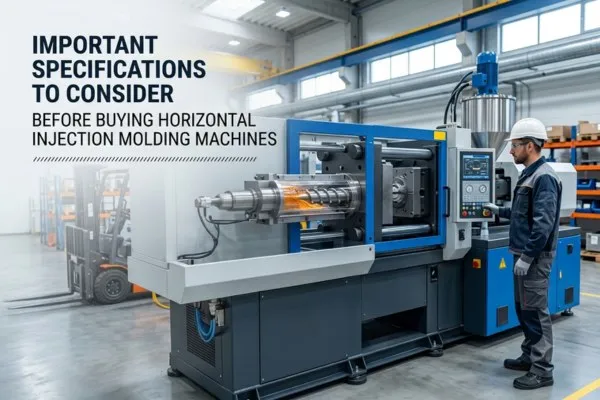
That is why injection moulding machine specifications have to be read as a set. Before buying a horizontal machine, check four groups against your mould and part: mould fit (tie-bar spacing, mould height, opening and ejector stroke), the injection unit (shot capacity, pressure, injection rate and plasticising rate), power and utilities, and the control and robot interfaces.
Key Takeaways
- Read the clamp specifications against the mould drawing. Tonnage alone does not tell you whether the mould fits or opens far enough.
- Shot capacity and plasticising rate are usually quoted for polystyrene, so convert them for your resin before comparing machines.
- Use no more than about 70% of the rated shot capacity, and keep 10 to 15% spare plasticising capacity.
- Connected load and power factor affect your electricity bill and contract demand, so ask for both before you order.
Which Injection Moulding Machine Specifications Decide Mould Fit?
Mould fit depends on the clamp dimensions, not the tonnage. The mould must pass between the tie bars, sit on the platen, lie between the minimum and maximum mould height, and open far enough for the part and runner to come out. The ejector stroke must clear the deepest core.
Check each figure against the mould drawing, not against an older mould that ran on a similar machine. Mould height is a common trap. A mould thinner than the minimum height can't be clamped without a spacer plate, and one thicker than the maximum won't fit at all. Where the daylight is fixed, a thick mould also leaves less room to open, so ask for the opening that remains with your mould mounted.
Clamp-side specifications and what to check them against
| Specification | Check it against | What goes wrong if it is short |
|---|---|---|
| Tie-bar spacing (H × V) | Mould width and height, plus any side cores or hoses | Mould cannot be loaded, or must be tilted in |
| Platen size | Mould plate size and clamp slots | Mould cannot be clamped securely |
| Minimum and maximum mould height | Mould shut height | Spacer plates needed, or the mould will not fit |
| Opening stroke and daylight | Part depth, runner and removal method | Part or robot hand cannot clear the mould |
| Ejector stroke and force | Deepest core and part grip | Parts stick or are pushed out only partly |
Which Injection Unit Specifications Matter Most?
The injection unit specifications that matter most are shot capacity, injection pressure, injection rate and plasticising rate. Each has to be read for your material and screw diameter, because most spec sheets quote shot capacity and plasticising rate for polystyrene (PS), which melts and fills differently from polypropylene or nylon.
MoldMaking Technology recommends using no more than 70% of the rated shot capacity, so a cushion remains and the pellets have time to melt. It also sets a practical lower limit, a screw stroke of at least half the screw diameter or 15 to 20% of the shot capacity. Inside that window, convert the rating with melt densities. Plastics Technology gives about 0.945 g/cm³ for PS and about 0.74 g/cm³ for PP, so a PS shot rating overstates what the same barrel holds in PP by roughly a quarter.
Injection pressure and injection rate matter most for thin walls and long flow paths. Ask for both at the screw diameter you will actually buy, since a larger screw on the same unit gives more shot volume and less pressure. If you run more than one material, check each one, because the PP and nylon figures will differ from the PS rating and from each other.
Never sign off a machine on clamp tonnage and shot weight alone.
Why Should You Check the Plasticising Rate?
Plasticising rate is how fast the screw can melt the next shot, usually given in g/s of PS. The screw has to finish within the cooling time, minus short delays for screw start, decompression and idle time. If it cannot, the cooling time has to be stretched and output falls.
Plastics Technology notes that few moulders specify this figure, and recommends 10 to 15% spare capacity to cover check-valve leakage, screw wear and higher back pressure for colour mixing. The same column notes that converting a PS rating to another resin depends on its heat content, not just density, so the honest step is to ask the supplier for the rate on your resin and screw.
The check matters most on fast cycles. A thin-walled part with a short cooling time leaves the screw very little time to recover, so a machine with plenty of shot capacity can still be too slow to melt. On thick parts with long cooling, the plasticising rate rarely limits the cycle, and shot capacity matters more.
What Power and Utility Specifications Should You Check?
Check the connected load (pump motor plus barrel heaters), the drive type, the power factor the drive presents, the cooling water flow and temperature the machine needs, and the oil tank volume. These decide your electrical connection, your monthly bill and the size of the chiller or cooling tower.
In Maharashtra this has a direct cost. MSEDCL bills HT industrial consumers on kVAh, the apparent energy, so a poor power factor raises the energy bill itself, not only a penalty line. A machine drive with a better power factor, or correction at the panel, shows up on every bill.
Contract demand is the other side. An MSEDCL grievance case quotes the utility's rule that if billing demand exceeds the contract demand in a month, the load factor incentive is not paid for that month. Add up the connected load of every new machine and its auxiliaries before you apply, so the new line doesn't push you over your contract demand.
Which Control and Interface Specifications Are Worth Asking For?
Ask which robot and plant-network interfaces the controller supports, how many injection and pack stages it offers, whether it has low-pressure mould protection, and how process data is stored. These decide how easily the machine joins automation and a monitoring system later.
EUROMAP 67 has long been the standard robot interface. EUROMAP and the OPC Foundation have published OPC 40079, first as a draft, as its software-based successor, and EUROMAP 77, released in May 2018, covers data exchange between machines and plant software such as MES. If you plan robots or production monitoring, put these names in the enquiry. Guarding should meet ISO 20430:2020, the safety standard for injection moulding machines, so check the current edition when you order.
What Should You Send Before Comparing Machines?
Send the mould drawing or its outside size and shut height, part and runner weight, material grade, cooling time if known, and your hourly target. With those, each specification above can be checked before any machine is named. See how this fits the horizontal range on our horizontal injection moulding machine page.
Frequently Asked Questions About Injection Moulding Machine Specifications
What is tie-bar spacing on an injection moulding machine?
Tie-bar spacing is the clear distance between the tie bars, given as horizontal by vertical, for example in mm. It sets the largest mould that can be passed between the bars and mounted on the platen. Check it against the mould width and height, including any side cores, hoses or connectors that stick out beyond the mould plates.
Why is shot capacity quoted in grams of polystyrene?
Many machine makers rate shot capacity as the weight of polystyrene the screw can inject, because it is a common reference material. Other resins have different melt densities, so the same barrel holds a different weight of them. Convert using melt densities, about 0.945 g/cm³ for PS and about 0.74 g/cm³ for PP, before comparing machines.
What happens if the plasticising rate is too low?
The screw does not finish melting the next shot before the cooling time ends. The machine then waits for screw recovery, so the cycle gets longer and output drops. Running the screw faster or with more heat to compensate can affect melt quality. Plan for 10 to 15% spare plasticising capacity on your actual resin.
What is the difference between opening stroke and daylight?
Opening stroke is how far the moving platen travels. Daylight is the maximum distance between the platens when fully open. On many machines the mould height uses up part of that space, so a thicker mould leaves less room to remove the part. Check the opening left after mounting your mould, not just the brochure figure.
Which robot interface should an injection moulding machine have?
EUROMAP 67 has been the common standard interface between injection moulding machines and robots. EUROMAP and the OPC Foundation have published OPC 40079, first as a draft, as a software-based successor. Ask the machine supplier which interface the controller supports and confirm that your robot supplier supports the same one before you order.
Related Articles
- What Is a Horizontal Injection Moulding Machine?
- How Does a Horizontal Injection Moulding Machine Work?
- Horizontal vs Vertical Injection Moulding Machines: Key Differences
- Applications of Horizontal Injection Moulding Machines
Sources & References
- ISO: ISO 20430:2020 Plastics and rubber machines, Injection moulding machines, Safety requirements
- MSEDCL: Power point presentation on kVAh billing (Annexure 7)
- MSEDCL: Case No. 17 of 2019 (contract demand and load factor incentive)
- MoldMaking Technology: Mold design: extruder sizing for shot and plasticizing capacity (September 2025, p. 34)
- Plastics Technology: Plasticating Rates: Your Profits Are at Stake
- Plastics Technology (J. Bozzelli): A Simpler Way to Calculate Shot Size vs. Barrel Capacity
- Plastics Technology: EUROMAP and OPC Foundation Collaborate on Industry 4.0 Compatible Standard
- MacPlas: Data exchange between injection moulding machines and MES (EUROMAP 77)
Technical Disclaimer
Disclaimer: The information provided in this document is for general informational and educational purposes only. It is based on technical references and industry information available at the time of preparation and may be subject to change. It does not constitute engineering, technical, commercial or professional advice, nor does it constitute a quotation, specification, warranty or contractual commitment by Pratishna Engineers.
Actual injection moulding machine and process requirements vary according to the component design, material, mould, production volume, machine configuration and operating conditions. The information, examples, calculations and recommendations provided should be independently evaluated and verified for the specific application before making any equipment, process or production decision. Information obtained from third-party sources remains subject to the accuracy and limitations of those sources.
Limitation of Liability: Pratishna Engineers makes no representation or warranty, express or implied, regarding the completeness, accuracy or suitability of the information for any particular application. To the extent permitted by applicable law, Pratishna Engineers shall not be liable for any loss, damage, cost or consequence arising from reliance on or use of the information contained in this document. Final machine selection, configuration and application suitability should be confirmed with Pratishna Engineers based on complete and accurate project requirements.

