






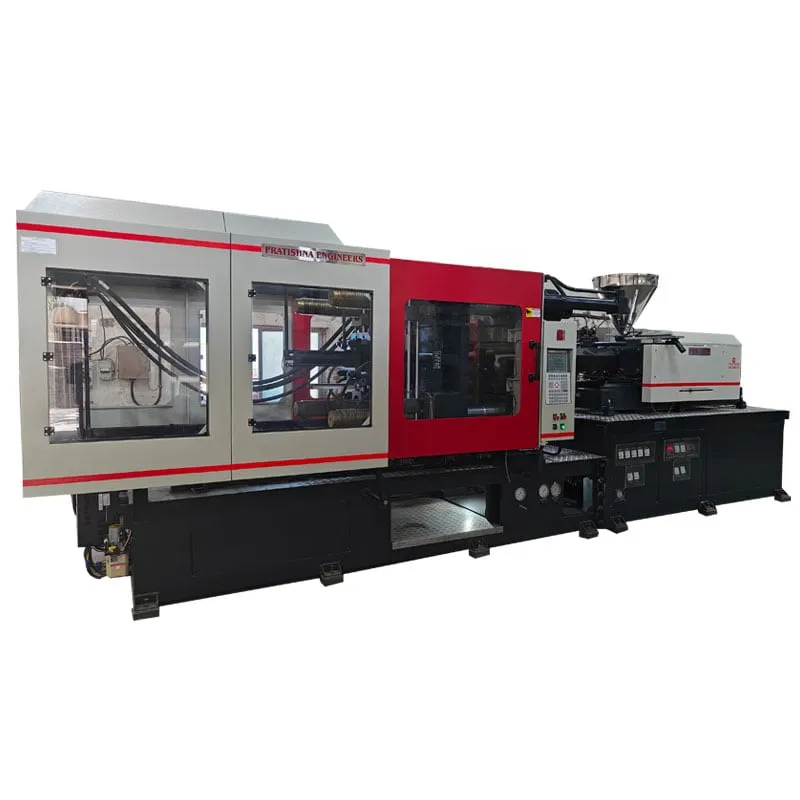

Indian vs imported injection moulding machines: what to check on five factors
| Factor | Indian-built machine | Imported machine |
|---|---|---|
| Lead time | Build schedule plus road transport; ask for dated milestones | Build schedule plus sea freight, customs clearance and port handling |
| Spares | Ask which parts are stocked and which are made to order | Ask which parts are stocked in India and which ship from abroad |
| Service response | Depends on where engineers are based, not on origin | Depends on the local service network and its engineer count |
| Energy use | Set by drive type: fixed pump, servo, hybrid or electric | Set by drive type, not by country of manufacture |
| Adaptation | Confirm 50 Hz rating, voltage and cooling water assumptions | Check whether it was drawn for 60 Hz, and the voltage and ambient used |
Choosing between Indian vs imported injection moulding machines is less about the nameplate and more about five practical factors: how long the machine takes to reach your floor, how fast you can get spares, how close the service engineer is, how much energy the drive uses, and whether the machine was designed for your power supply and plant conditions. The table above sets out what to check on each. An imported machine can make sense for a niche process with no local equivalent. An Indian-built machine can make sense when uptime, spares and local service weigh more. Pratishna Engineers, a Mumbai machine builder since 1991, began in indigenisation and import substitution, so this is a comparison its engineers work through with buyers.
Key Takeaways
- Compare the two on lead time, spares, service response, energy use and adaptation to Indian conditions, not on country of origin alone.
- Energy use depends on the drive type, whether fixed pump, servo, hybrid or all-electric, far more than on where the machine was built.
- A machine drawn for a 60 Hz supply runs its pump motors about 17% slower on India's 50 Hz grid unless it is adapted.
- Under kVAh billing in Maharashtra, a poor power factor raises your billed energy, so ask for the machine's power factor and correction plan.
Which matters more for uptime, spares or the machine's origin?
Spares and service matter more than origin. A machine that waits a week for a seal kit or a control card loses more output than any small difference in build quality. Ask every supplier which wear parts are stocked locally and how quickly an engineer reaches you.
List the parts that wear or fail in normal running: screw, barrel, check ring, heater bands, thermocouples, hydraulic seals, proportional valves, pump, and the controller's I/O cards. For each one, ask whether it is stocked in India, who stocks it, and whether it is a standard catalogue item or a part made only by the machine builder.
Standard components help both sides. A machine built on widely available hydraulic valves, motors and sensors can be repaired from local stock even if the original supplier is far away. A machine with proprietary boards or unique screw designs ties you to one source, whatever its origin.
Service response depends on where engineers are based and how many there are, not on the country of manufacture. Ask for the nearest service location, the number of engineers who cover your area, and whether remote diagnosis is possible through the controller. Ask too whether engineers are employed directly or through an agent.
How do lead time and commissioning differ for Indian vs imported injection moulding machines?
An imported machine adds sea freight, customs clearance and port handling to its build time, and any missing part after arrival repeats that chain. An Indian-built machine moves by road. In both cases, commissioning time depends on how well the mould, utilities and operators are ready on arrival day.
Do not compare quoted lead times as single numbers. Ask each supplier to split the schedule into design approval, manufacture, factory trial, transport and installation, with a date for each. A split schedule shows where delays can happen and who controls them. It also gives you a fair basis for comparison.
A factory trial before dispatch matters more for an imported machine, because fixing a problem after shipment is slower. If you cannot attend an overseas trial, ask for a recorded run with your mould and material, and agree the acceptance checks in writing before the machine is packed. Agree in advance who pays for travel if the trial must be repeated.
Prepare your plant in parallel. Foundation or levelling, power cabling, cooling water lines, compressed air and the mould itself should be ready before the machine arrives. A machine can sit idle after delivery because a cable or chiller was not ordered in time, and that delay has nothing to do with origin.
Is energy use decided by origin or by drive type?
Energy use is decided mainly by the drive and by how well the machine is matched to the job, not by origin. A standard hydraulic machine's base load can be 75% or more of its total energy, while all-electric and hybrid machines have base loads of about 10 to 20%.
Over a machine's life, energy can cost more than the machine itself. An energy saving guide for injection moulders puts the ten-year energy cost above the purchase cost in almost every case. That makes the drive type a bigger decision than the origin of the frame. Ask each supplier for the connected load and the expected power draw on your job.
Size matters as much as drive. A high base load can mean the machine is too large for the job, so a bigger machine bought for future flexibility may waste power every shift. Older fixed-pump hydraulics can be retrofitted with variable-speed motors, variable-volume pumps or servo motors.
In Maharashtra the bill itself matters. MERC moved HT consumers and LT consumers above 20 kW toward kVAh billing from April 2020, so a poor power factor raises billed energy. At a power factor of 0.85, 100 kWh of useful energy is billed as about 117.6 kVAh; at 0.95, about 105.3 kVAh.
What does adaptation to Indian conditions mean in practice?
Adaptation means the machine was designed for the supply, utilities and plant environment it will run in: 50 Hz power at local voltage, your cooling water temperature, ambient heat and dust, and the resin grades you buy. A machine drawn for other conditions may run below its rated performance.
Frequency is the easiest to miss. Motor speed is 120 × frequency ÷ poles, so a 4-pole motor turning 1,800 rpm at 60 Hz turns 1,500 rpm at 50 Hz. A fixed pump then delivers about 17% less oil, which slows clamp and injection movements unless the pump or motor is resized.
Cooling water is the next check. Oil coolers and mould circuits are sized for an assumed water temperature. If your tower water runs warmer than the design figure, oil temperature climbs and the hydraulics drift. Ask what inlet temperature the cooler was sized for.
Finally, ask about ambient heat and dust. Electrical cabinets need ventilation or cooling that suits a hot, dusty shop, and filters your maintenance team can clean. Ask for the cabinet's rated ambient temperature. These details decide whether a machine holds its settings through a Mumbai summer and monsoon.
How Pratishna Engineers approaches import substitution
Pratishna Engineers was founded in Mumbai in 1991 and started with machine rebuilding, indigenisation and technology adaptation before moving to complete machine design, manufacturing and automation. Import substitution remains a stated focus, which is why this page frames the comparison around spares, service and local conditions rather than origin.
Design, manufacturing, assembly, testing and service are done in-house, in manufacturing facilities in Mumbai of about 25,000 sq ft. The company reports 35+ years of experience, 9,000+ machines and 1,000+ customers in India and international markets. Its works is at Saki Vihar Road, Andheri (E), Mumbai 400 072.
- The range covers the E, C and H horizontal series, PV and PVDL vertical series, PET, PHM two-platen, hybrid and special-purpose machines.
- The hybrid machines combine hydraulic locking with electric injection, for buyers weighing energy use against the cost of a fully electric drive.
How should you run the comparison?
Shortlist one Indian and one imported option for the same part and mould. Ask both for a split schedule, a stocked-spares list, the nearest service base, the drive type, the power factor and the frequency the machine was designed for. Then compare the answers line by line. See the full injection moulding machine range.
Frequently Asked Questions About Indian and Imported Injection Moulding Machines
Are imported injection moulding machines more accurate than Indian ones?
Accuracy depends on the design, the controls, the build quality and how the machine is maintained, not on the country of manufacture. Judge it on your own part: run a trial with your mould and measure shot weight consistency and critical dimensions over an agreed run on each machine you shortlist.
What import costs should I plan for besides the machine?
Plan for sea freight, insurance, customs clearance, port handling, inland transport and any local changes needed for power or cooling. Also plan for spares you may need to stock yourself if they are not held in India. Ask your clearing agent for the current duty and charges that apply.
Can a 60 Hz machine run on Indian power?
It can run, but a fixed pump on a 4-pole motor turns at 1,500 rpm instead of 1,800 rpm, so flow drops by about 17%. Movement speeds and cycle time suffer unless the pump, motor or drive is adapted. Ask the supplier how the machine was rated for 50 Hz.
How does power factor affect my electricity bill in Maharashtra?
Under kVAh billing, a poor power factor increases the energy you are billed for the same useful work. At 0.85, about 117.6 kVAh is billed per 100 kWh, against about 101 kVAh at 0.99. Capacitors or an APFC panel can correct it; use your latest bill for actual rates.
Which spares should I keep in my own store?
Keep the parts whose failure stops production and whose supply is slowest: heater bands, thermocouples, hydraulic seal kits, a check ring, key sensors and, for machines with proprietary electronics, a spare control card. Base the list on the supplier's stocked-spares list and your own breakdown history.
Does Pratishna offer Indian-built alternatives to imported machines?
Import substitution is a stated focus at Pratishna Engineers, which began with machine rebuilding and indigenisation in Mumbai in 1991. Its range covers horizontal, vertical, PET, two-platen, hybrid and special-purpose machines, designed, built, tested and serviced in-house. Share your current machine or part details for a comparison.
Related Articles
- Custom Injection Moulding Machine Manufacturer
- How to Choose an Injection Moulding Machine
- Injection Moulding Machine Suppliers in India
- Compare Injection Moulding Machine Suppliers
Sources & References
- ExxonMobil, AMI and Tangram Technology: An Energy Saving Guide for Injection Moulders
- SPE Plastics Engineering, R. Kent (Tangram Technology): Energy-Saving Tip 67: Injection Molding: get the right motor (Sept 2016)
- MSEDCL: kVAh Billing: Frequently Asked Questions
Technical Disclaimer
Disclaimer: The information provided in this document is for general informational and educational purposes only. It is based on technical references and industry information available at the time of preparation and may be subject to change. It does not constitute engineering, technical, commercial or professional advice, nor does it constitute a quotation, specification, warranty or contractual commitment by Pratishna Engineers.
Actual injection moulding machine and process requirements vary according to the component design, material, mould, production volume, machine configuration and operating conditions. The information, examples, calculations and recommendations provided should be independently evaluated and verified for the specific application before making any equipment, process or production decision. Information obtained from third-party sources remains subject to the accuracy and limitations of those sources.
Limitation of Liability: Pratishna Engineers makes no representation or warranty, express or implied, regarding the completeness, accuracy or suitability of the information for any particular application. To the extent permitted by applicable law, Pratishna Engineers shall not be liable for any loss, damage, cost or consequence arising from reliance on or use of the information contained in this document. Final machine selection, configuration and application suitability should be confirmed with Pratishna Engineers based on complete and accurate project requirements.

