






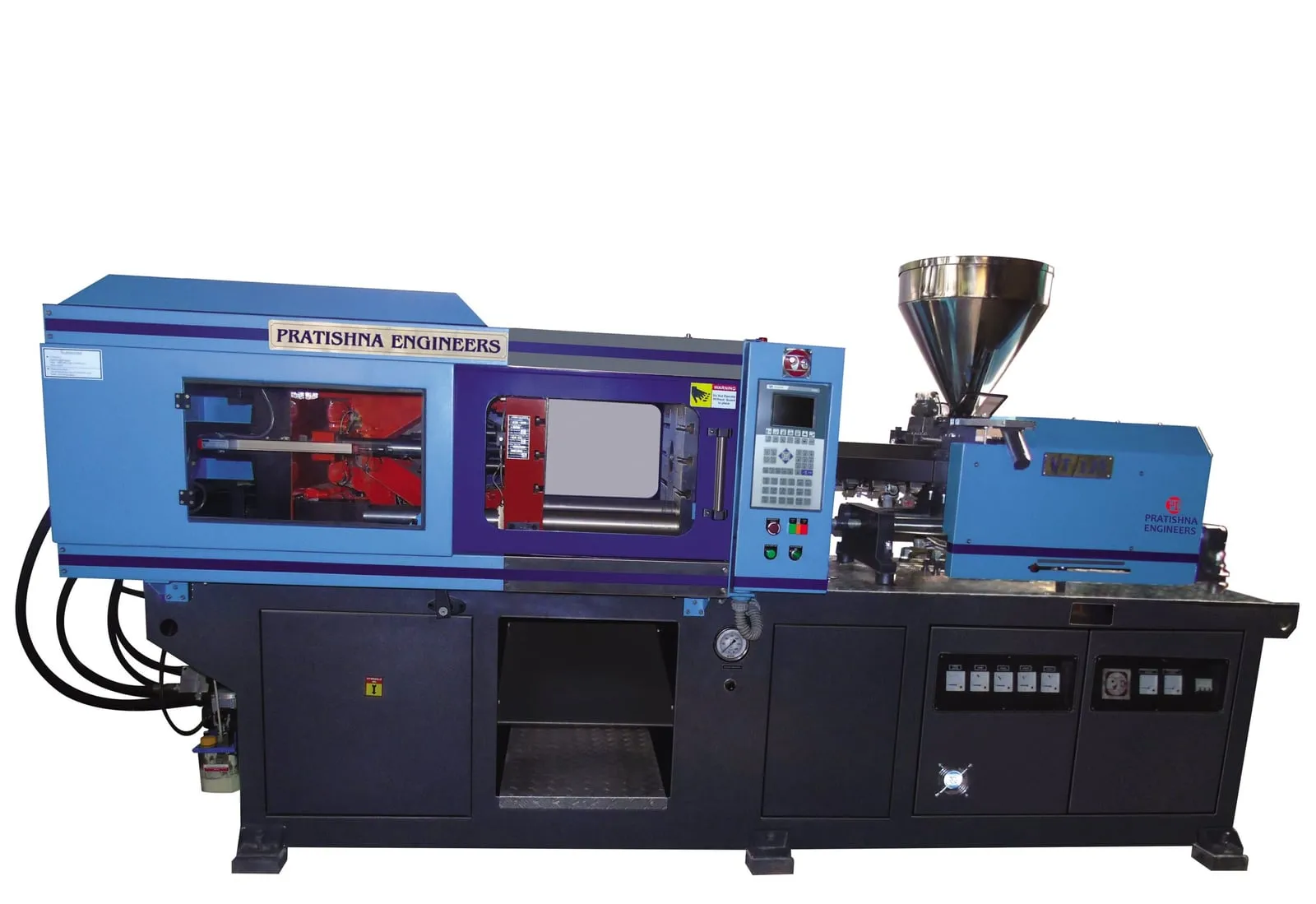

Quick answer: injection moulding machine dealers in Mumbai can help you compare options, handle paperwork and get a machine moving, but the warranty, the deep spares and the engineer who fixes a hard breakdown usually trace back to the maker. Before you order through a dealer, get three names in writing: who honours the warranty, who holds the spares, and who comes when the machine stops. If all three answers point to the maker, buying direct gives you a shorter chain. Pratishna Engineers is a manufacturer in Andheri (E), Mumbai, that designs, builds, tests and services its machines in-house, so this guide also shows what the direct route looks like.
Key Takeaways
- A dealer sells and coordinates; the maker designs the machine, sets the warranty terms and holds the deep spares.
- Ask who answers the service call before you compare offers, because a stopped machine loses output every hour.
- Put the warranty scope, the spares list and the escalation path in the purchase order, not in a conversation.
- A dealer adds value when it brings local stock, trained engineers and quick access to the maker, and adds a link to the chain when it does not.
What do injection moulding machine dealers in Mumbai actually do?
A dealer buys or represents machines from one or more makers and sells them to you. Depending on the agreement, a dealer may also arrange delivery, installation, first-level service and some spares. What a dealer cannot change is the machine's design, the maker's warranty terms or the maker's spares stock.
That split matters more than the label on the visiting card. Some dealers run a workshop, employ service engineers trained on the brands they sell and keep wear parts in stock. Others pass your order to the maker and step back once the invoice is paid. Both call themselves dealers, so you have to ask what this particular dealer does after delivery.
Our view is plain: a dealer who cannot name the engineer who will commission your machine, or the place your spares will come from, is selling you a box rather than a working machine.
Who honours the warranty when you buy through a dealer?
Unless the dealer gives its own written warranty, the maker's terms apply and the dealer acts as the channel for claims. A failed part may travel from your shop floor to the dealer and on to the maker before anyone decides. Ask for the warranty document itself, not a summary.
Read three things in that document. First, what is covered: the frame and clamp, the hydraulics, the electrical cabinet and the controller may each carry different terms. Second, what is excluded: heater bands, thermocouples, check rings and seals may be treated as consumables. Third, who decides whether a failure is a warranty case, and how long that decision is allowed to take.
Dealer route and direct route: who does what
| Item | Buying through a dealer | Buying direct from the maker |
|---|---|---|
| Warranty terms | Set by the maker unless the dealer adds its own; claims pass through the dealer | Set and handled by the maker |
| Commissioning | Dealer engineer or maker engineer; confirm which one | Maker engineer |
| Wear spares | Dealer stock if held, otherwise ordered from the maker | Maker stock |
| Pumps, valves, controller cards | Ordered from the maker unless the dealer stocks them | Maker stock or maker supply chain |
| Process and design questions | Passed on to the maker | Answered by the design team |
| What to get in writing | Warranty holder, spares list, escalation contact | Spares list, service contact, training scope |
How do spares reach your shop floor, and how fast?
Spares come from your own shelf, the dealer's store, the maker's store or an outside supplier, and each route has a different waiting time. Wear parts belong on your shelf. Pumps, proportional valves and controller cards are expensive to stock, so you need to know where the nearest one sits.
Ask the dealer for a recommended spares list for your exact machine, split into parts you should hold and parts the dealer or maker holds in Mumbai. Then ask how a part that is not in Mumbai would reach you, who arranges the courier and who pays for it.
Plan for the screw and barrel as well. A second barrel ordered along with a new machine can be low cost, and a skilled operator can swap one in under 30 minutes, according to Plastics Technology. If your shots range from small to large, raise this before the order, whoever sells you the machine.
Track energy as the machine ages. Rising energy on the same job can indicate screw or barrel wear, so a service team that logs energy at each visit gives you an early warning of wear.
Who answers the service call when the machine stops?
Find out before you buy. Through a dealer, the first call may go to the dealer's service desk, which sends its own engineer or escalates to the maker. On a direct purchase, the call goes to the maker. Either route works if names, numbers and escalation steps are written down.
Ask how a fault that the first engineer cannot fix is escalated, and whether the maker's engineers can connect to the controller remotely, read the alarm history and guide your maintenance team. Ask how many machines of your type the service team already looks after near you. You are not after a promise of speed; you are after a clear path and people who know the machine.
There is an Indian regulatory point too. Under the Machinery and Electrical Equipment Safety (Omnibus Technical Regulation) Order, 2024, the manufacturer registers with BIS and holds the licence or certificate for covered machinery, which includes injection moulding machines. Its enforcement date is awaiting notification, so check the current status and ask the dealer whose name will appear on that certificate.
When does buying through a dealer make sense?
A dealer makes sense when it adds what the maker cannot easily give you: wear parts stocked nearby, engineers trained on the brand, financing paperwork, or one contact for the machine plus auxiliaries such as dryers, chillers and robots. If it adds none of these, ask for a direct offer.
Compare the two routes on the same scope. Ask both for the same machine configuration, the same spares list, the same installation and training scope and the same warranty document. Any difference in the final figure then shows what each route includes, rather than what one offer quietly left out.
Keep the comparison honest on time as well. A route with an extra link is not slower by definition, but every hand-off is a place where a part or a decision can wait, so count the hand-offs in each route before you sign.
How Pratishna Engineers sells and supports machines directly
Pratishna Engineers was founded in Mumbai in 1991 by Nandkumar R. Kushe, a first-generation engineer. It has 35+ years of experience, 9,000+ machines and 1,000+ customers in India and international markets. Design, manufacturing, assembly, testing and service are done in-house, so the company that designs your machine also services it.
Its manufacturing facilities in Mumbai cover about 25,000 sq ft, with CNC turning centres, vertical and horizontal machining centres, jig boring machines, and assembly and testing facilities, at A1-4, Vaibhav Ind. Premises, Saki Vihar Road, Andheri (E). The range covers horizontal (E, C and H series), vertical (PV and PVDL series), PET, two-platen (PHM series), hybrid and special purpose machines.
Machines are selected with customers in a fixed order: component, material, mould, production requirement, then machine configuration. Bring the questions in this guide to that conversation as well, and ask for the spares list, the service contact and the warranty document in writing.
What should you ask a dealer before you sign?
Send each dealer, and the maker if you are comparing routes, the same short brief: part drawing or sample, material, mould size, required output and working shifts. Then ask for the warranty document, the recommended spares list with stock locations, the commissioning engineer's name and the escalation contact. Browse the full injection moulding machine range to match machine types to your parts.
If a dealer and the maker both answer quickly and in writing, either route can serve you well. The paperwork is what protects you once the machine is running and the people who sold it have moved on to the next order.
Frequently Asked Questions About Injection Moulding Machine Dealers
Is buying from a dealer cheaper than buying direct from the maker?
It depends on what each offer includes. A dealer may add its own margin and its own services, while a direct offer may include commissioning and training by the maker. Compare both on the same configuration, spares list, installation scope and warranty document, and the difference will show what you are paying for.
Does a dealer warranty differ from the maker warranty?
It can. A dealer may pass on the maker's warranty unchanged, add its own cover on top for service or response, or both. Ask for both documents, check which parts each covers, and confirm who decides whether a failure is a warranty case. If the dealer's cover is verbal only, treat it as absent.
How do I check that a dealer is authorised by the maker?
Ask the dealer for a current authorisation letter from the maker, then confirm it with the maker directly by phone or email. Check that the letter covers the machine type you are buying and your region, and ask the maker whether spares and warranty claims from that dealer are handled in the normal way.
Which spares should I keep on my own shelf?
Keep the wear parts that stop the machine and are cheap to hold: heater bands, thermocouples, a check ring set, seals and hydraulic filters for your model. Ask for the maker's recommended list and add any part whose waiting time would hold up a delivery. Hold controller cards and pumps only if no stock exists nearby.
Can a dealer arrange installation and operator training?
Some can, but confirm who does the work. Ask whether the commissioning engineer comes from the dealer or the maker, what training covers (start-up, mould setting, process settings, daily checks), how many operators are trained, and whether a second visit is included once production starts. Get the training scope written into the order.
Can I buy direct from Pratishna Engineers in Mumbai?
Yes. Pratishna Engineers is a manufacturer in Andheri (E), Mumbai, with design, manufacturing, assembly, testing and service in-house. Send your component, material, mould details and production requirement, and the team will work through machine configuration with you. You can then compare that offer with any dealer offer on the same scope.
What should a dealer send me before I place the order?
Ask for the machine configuration in writing, the warranty document, a recommended spares list with stock locations, the installation and training scope, the commissioning engineer's name and an escalation contact at the maker. If any of these are missing, the gap is where problems tend to sit after delivery, so close it first.
Related Articles
- Affordable Injection Moulding Machines in Mumbai
- What is the Best Injection Moulding Machine Brand in Mumbai?
- Injection Moulding Machine Cost Breakdown India
- Injection Moulding Machinery Suppliers Mumbai Maharashtra
Sources & References
- Bureau of Indian Standards: Circular on the Machinery and Electrical Equipment Safety (Omnibus Technical Regulation) Order, 2024 (12 Sept 2024)
- Plastics Technology, J. Bozzelli: A Simpler Way to Calculate Shot Size vs. Barrel Capacity
- PlasticsToday, R. Kent: Getting to know your real energy use and cost
Technical Disclaimer
Disclaimer: The information provided in this document is for general informational and educational purposes only. It is based on technical references and industry information available at the time of preparation and may be subject to change. It does not constitute engineering, technical, commercial or professional advice, nor does it constitute a quotation, specification, warranty or contractual commitment by Pratishna Engineers.
Actual injection moulding machine and process requirements vary according to the component design, material, mould, production volume, machine configuration and operating conditions. The information, examples, calculations and recommendations provided should be independently evaluated and verified for the specific application before making any equipment, process or production decision. Information obtained from third-party sources remains subject to the accuracy and limitations of those sources.
Limitation of Liability: Pratishna Engineers makes no representation or warranty, express or implied, regarding the completeness, accuracy or suitability of the information for any particular application. To the extent permitted by applicable law, Pratishna Engineers shall not be liable for any loss, damage, cost or consequence arising from reliance on or use of the information contained in this document. Final machine selection, configuration and application suitability should be confirmed with Pratishna Engineers based on complete and accurate project requirements.

