






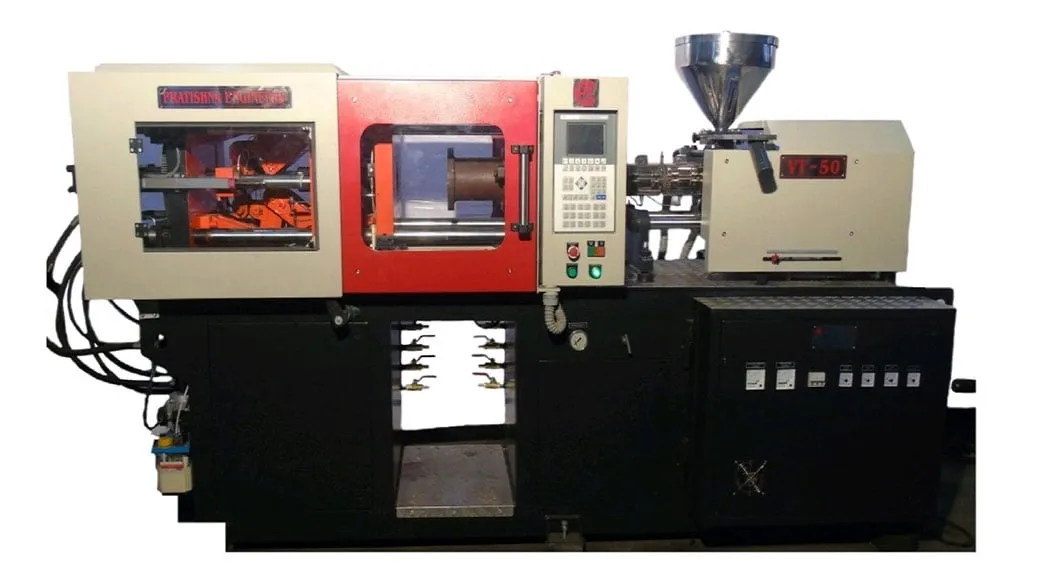

A connector housing in glass-filled PBT passes every check on the first shift. By the third shift, one dimension has drifted out of tolerance and nobody can say which shot it started on. That is the real test of a moulding machine for automotive and aerospace work: not peak speed, but whether it holds engineering resins at tight tolerances shot after shot, and records enough data to prove it. You need four things: correct drying and melt control for the resin, a clamp and screw sized to the part, stable packing and cooling, and a process log your customer can audit.
Key Takeaways
- Engineering resins such as PA66, POM and glass-filled PBT bring narrow drying and melt windows, so the machine must hold barrel and mould temperatures steadily all shift.
- Glass-filled grades can shrink more than twice as much across the flow as along it, which makes gate position and cavity sizing as important as the machine.
- Tolerance comes from repeatable packing, hold time and cooling; a machine that varies these between shots will move dimensions however good the mould steel is.
- Automotive and aerospace customers expect process records per batch, so choose controls that log cushion, pressures, temperatures and cycle time and keep that data retrievable.
Which engineering resins does the machine have to handle?
Most demanding automotive parts use PA66, POM, glass-filled PBT and impact-modified PP, and each brings its own drying target, melt window and mould temperature. The machine has to hold barrel zones, nozzle and mould temperature within those windows for the whole shift, not only during the trial.
Moisture is the first trap. One impact-modified PA66 datasheet asks for processing moisture of 0.2% or less and gives a melt range of 288 to 305 °C with the mould at 60 to 100 °C. Nylon 66 picks up water from the air and degrades if it is moulded wet, so the dryer belongs in the machine specification from day one.
Glass-filled PBT is stricter. A hydrolysis-resistant PBT with 30% glass, sold for under-bonnet connectors and electronic housings, needs moisture below 0.04% before moulding. Its maker reports that a 25 kg bag stored at 5 °C took 48 hours to reach 20 °C, so bags from a cold store should be opened only at shop temperature.
POM brings a different risk. Its recommended melt is about 215 °C, and long residence or excess heat degrades it, so it must never share a barrel with PVC or flame-retardant grades. On the Indian side, impact copolymer PP such as Repol B300MN is listed for automotive and appliance parts, with a melt range of 190 to 240 °C.
Processing windows for common automotive resins (from resin datasheets)
| Resin | Moisture or drying | Melt | Mould |
|---|---|---|---|
| PA66, impact-modified | 0.2% max at processing | 288 to 305 °C | 60 to 100 °C |
| PBT-GF30, hydrolysis resistant | Below 0.04% | 250 to 275 °C | 60 to 100 °C |
| POM homopolymer | Per resin datasheet | About 215 °C | Per resin datasheet |
| PP impact copolymer (Repol B300MN) | Per resin datasheet | 190 to 240 °C | 20 to 50 °C |
How does a moulding machine for automotive and aerospace parts hold tight tolerances?
It holds tolerance by repeating the same melt, the same packing and the same cooling on every shot. Shrinkage, not machining, sets most part dimensions, so any drift in hold pressure, hold time, melt temperature or mould temperature shows up directly as a dimension that moves.
Published shrinkage ranges show why. PA66 runs at roughly 0.7% to 1.8%, acetal at 1.8% to 2.5%, and amorphous grades such as ABS and PC below 1%. Hold pressure reduces shrinkage only while the gate is open, so once the gate freezes, packing stops working. Stable hold time and gate freeze are part of the tolerance budget.
Glass fibres add direction. The PBT-GF30 grade above lists 0.50% shrinkage along the flow and 1.30% across it. A part that shrinks unevenly bends, so gate position and wall thickness decide flatness as much as machine settings do. The worked example below shows what that difference means for a 60 mm dimension.
Packing time matters more than many setters expect. In a published trial on a POM part with an outside diameter near 49.6 mm, 15 s of pack with 2 s of cooling held ±0.02 mm on a 26 s cycle, while 5 s of pack spread to ±0.2 mm. Packing, not a longer cycle, bought the tolerance.
What process records should automotive and aerospace buyers expect?
Expect a shot-by-shot record of the variables that move dimensions: cushion, injection time, peak injection pressure, transfer position, hold pressure, melt and mould temperatures and cycle time. Each record should link to a batch and resin lot, so a rejected part can be traced to the shots that made it.
Automotive supply chains already run on audited quality systems; resin plants making PP for automotive use meet ISO TS 16949, for example. Aerospace buyers usually add their own customer requirements on top. In both cases the question is the same: can you show what the machine did when that part was made?
So look at the controller before the clamp. Ask how many shots it stores, whether data exports without a service visit, and whether alarms can be set on cushion and peak pressure so a drifting shot is separated automatically. Cushion that creeps shot by shot often points to check-ring wear before parts go out of tolerance.
A flat rule: if a moulder cannot pull up last week's shot log for a part, the process is not under control, whatever the first-article capability study says. Records turn a good trial into a part you can deliver for years.
What should you prepare before you choose a machine?
Before you shortlist machines, collect the part drawing with critical dimensions, the resin grade and its datasheet, the mould layout, annual volume and the records your customer will audit. Those inputs decide clamp, screw, dryer and controls. See the automotive solutions page for how parts are matched to machines.
Frequently Asked Questions About Moulding Automotive and Aerospace Parts
Can a standard hydraulic machine mould automotive engineering parts?
Yes, if it holds temperatures and packing pressure steadily and its screw suits the resin. Many automotive parts run on standard horizontal machines. What matters is the dryer, barrel and nozzle temperature control, hold-pressure repeatability and a controller that records each shot. Check those before you look at clamp speed.
Why do glass-filled parts warp more than unfilled parts?
Glass fibres line up with the flow and restrain shrinkage in that direction, so the part shrinks less along the flow than across it. A 30% glass PBT, for example, lists 0.50% and 1.30%. Uneven shrinkage bends the part, so gate position and even wall thickness matter as much as settings.
How dry does nylon need to be before moulding?
Follow the datasheet for the exact grade. One impact-modified PA66 asks for processing moisture of 0.2% or less, and for exposed material to be dried at 66 °C until moisture falls to 0.04% to 0.20%. Wet nylon degrades in the barrel and loses strength that no later inspection can see.
What process data should you be ready to show an aerospace customer?
Be ready to show the validated settings, the shot-by-shot log for each batch, resin lot numbers, drying records and the inspection results tied to those shots. Requirements differ by customer, so read the purchase order and quality clauses first, and confirm that your controller can export the data they specify.
Does a longer cooling time always improve tolerance?
No. In a published trial on a POM part, adding cooling time with the same 15 s of pack widened the spread from ±0.02 mm to ±0.07 mm and stretched the cycle from 26 s to 41 s. Pack time had the bigger effect. Change one variable at a time and measure the result.
Related Articles
- Injection Moulding Machine for Toys & Sports Items
- Injection Moulding Machine for Household Items
- Injection Moulding Machine for Engineering Parts
- Injection Moulding Machine for Automotive Parts
Sources & References
- BASF: Ultradur B 4300 G6 HR Product Information (02/2026)
- BASF via Material Data Center (M-Base): Ultramid A3L HP datasheet
- DuPont: Delrin Acetal Homopolymer Resin Molding Tips
- LyondellBasell: Technical Tip: Mold Shrinkage
Technical Disclaimer
Disclaimer: The information provided in this document is for general informational and educational purposes only. It is based on technical references and industry information available at the time of preparation and may be subject to change. It does not constitute engineering, technical, commercial or professional advice, nor does it constitute a quotation, specification, warranty or contractual commitment by Pratishna Engineers.
Actual injection moulding machine and process requirements vary according to the component design, material, mould, production volume, machine configuration and operating conditions. The information, examples, calculations and recommendations provided should be independently evaluated and verified for the specific application before making any equipment, process or production decision. Information obtained from third-party sources remains subject to the accuracy and limitations of those sources.
Limitation of Liability: Pratishna Engineers makes no representation or warranty, express or implied, regarding the completeness, accuracy or suitability of the information for any particular application. To the extent permitted by applicable law, Pratishna Engineers shall not be liable for any loss, damage, cost or consequence arising from reliance on or use of the information contained in this document. Final machine selection, configuration and application suitability should be confirmed with Pratishna Engineers based on complete and accurate project requirements.

