






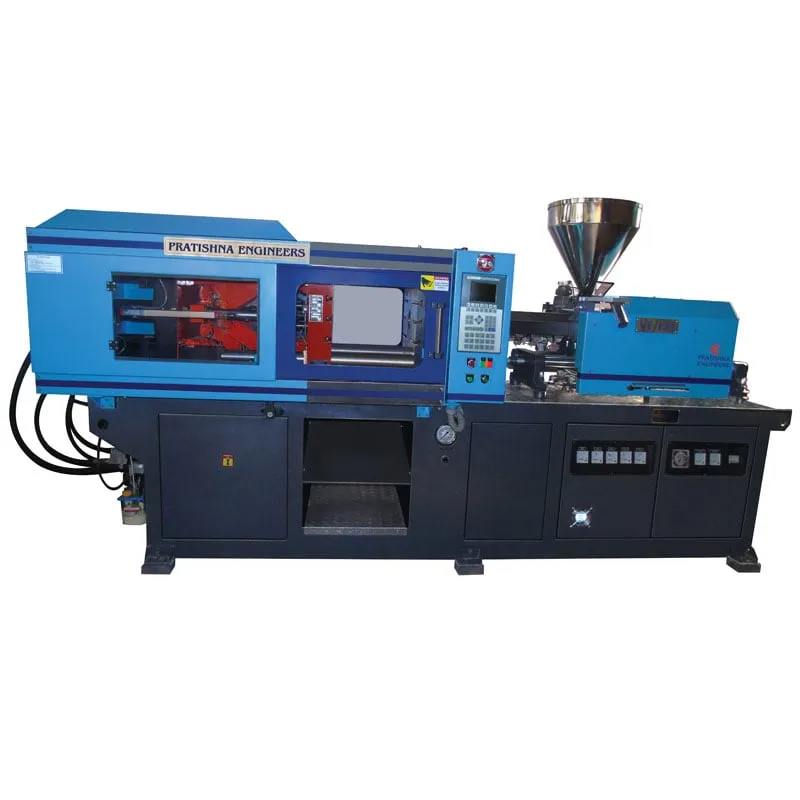

Eight building bricks, each 32 × 16 mm, plus an 8 cm² runner give a projected area of about 49 cm². In ABS at 2 to 4 US tons per square inch, that needs roughly 15 to 30 t of clamp with a 10% reserve, which is a starting margin, not a rule. So the right injection moulding machine for toys is often smaller than buyers expect. What decides the choice is the rest: BIS rules under the Toys Quality Control Order, small parts that must not break off, fast colour changes and edges with no flash.
Key Takeaways
- Under the Toys (Quality Control) Order 2020, toys sold in India must meet the listed Indian Standards and carry the ISI mark, so moulded parts must pass those tests.
- IS 9873 Part 1 covers mechanical hazards, including choking, sharp points and sharp edges, which puts flash, weak joints and small loose parts at the centre of process control.
- Small toy parts need modest clamp force; shot size against barrel capacity and residence time matter more than tonnage when you choose the machine.
- Toy lines change colour often, so measure how many shots each change takes and keep regrind within the resin maker's limit to hold colour and strength.
What do Indian toy rules mean for the moulding process?
Since 1 January 2021, the Toys Quality Control Order has required toys sold in India to meet seven Indian Standards and carry the ISI mark. For a moulder that means every part must survive the IS 9873 mechanical tests, and the process must make passing parts every shift.
Part 1 of IS 9873 covers mechanical and physical properties, including choking hazards, sharp points and sharp edges. Part 2 covers flammability, and Parts 3 and 9 cover toxic elements and phthalates, which you control through resin and masterbatch choice. Electric toys fall under IS 15644. BIS tested about 2,500 toy samples up to January 2023, and about 83% met the standards.
Read the remaining share as a warning. A thin web of flash on a doll's hand or a toy car body can become a sharp edge. A joint that is underpacked can snap off in a drop test and leave a small part behind. Both problems start on the machine, not in the test lab.
So treat the toy standards as process inputs. Write the critical edges, joints and walls onto the setup sheet, and check them at start-up and after every colour or mould change. Trimming flash by hand as a routine is a sign the mould or process needs fixing, not a quality step.
IS 9873 parts and the moulding controls they point to
| Standard | Covers | Moulding control |
|---|---|---|
| IS 9873 Part 1 | Mechanical and physical properties, incl. choking hazards, sharp points and edges | Flash control, packing at joints, wall thickness at snap features |
| IS 9873 Part 2 | Flammability | Resin and additive selection |
| IS 9873 Parts 3 and 9 | Toxic elements and phthalates | Approved resin and masterbatch, lot records |
| IS 15644 | Electric toys | Housings and battery covers moulded to drawing |
How do you size an injection moulding machine for toys?
Start from projected area and shot volume, not from the biggest toy in the catalogue. When parts are small, clamp force comes out low, and the real limits become a barrel small enough for the shot, daylight for the mould and repeatable injection for fine details.
Clamp first. A datasheet for a general-purpose ABS lists toys among its applications and gives a clamp range of 2 to 4 US tons per square inch, about 0.28 to 0.56 t/cm². The eight-brick mould in the opening sits at 15 to 30 t. Add the full runner area to the parts, and use the upper factor for long, thin flows.
Shot second. Use 25% to 65% of barrel capacity for the shot; below that range, melt uniformity suffers and residence time grows. A small toy shot on an oversized barrel sits hot for many cycles, which can discolour light shades. A barrel sized to the shot does more for quality than extra tonnage.
Then the mould. Family moulds that make several different toy parts in one shot fill unevenly unless the runner is balanced, so keep injection speed and pressure in hand. Check that the mould fits between the tie bars and that the stroke clears the tallest part for removal.
How should you handle colour changes and regrind on toy lines?
Measure each colour change instead of guessing it, and plan the schedule around it. Count the shots until the old colour is gone, then multiply by the cycle time. Run light to dark where you can, and keep regrind within the resin maker's limit for the grade.
Residence formulas based on barrel size miss the resin that hangs on in dead spots at the root of the screw flights. One published check found trapped resin almost every time screws were pulled; red resin once clung for over a month while the machine ran only black. Dropping a few coloured granules into the feed throat and counting shots gives the true figure.
Moisture comes next. The same ABS datasheet asks for drying at 71 to 88 °C for 2 to 4 hours to below 0.10% moisture, a melt of 246 to 266 °C and a mould of 43 to 66 °C. Wet ABS splays, and splay on a glossy toy is a reject even when the part is strong.
Regrind needs a rule. The datasheet caps it at 20%. Keep sprues and runners separated by colour, regrind them the same day and blend at a fixed ratio, so colour and impact strength do not wander from one batch to the next.
What should you send before choosing a toy moulding machine?
Send part drawings or samples, the resin and masterbatch grades, the number of colours per month, target output and the IS 9873 parts that apply to the toy. From those inputs, clamp, barrel and auxiliaries can be sized. See the sports and safety solutions page for related parts.
Frequently Asked Questions About Moulding Toys
Is the ISI mark compulsory for plastic toys in India?
Yes. Under the Toys (Quality Control) Order 2020, in force from 1 January 2021, toys must meet the listed Indian Standards and carry the ISI mark. For plastic toys that brings in IS 9873, which covers mechanical safety, flammability and toxic elements. Check the current BIS notification for your product before production.
What clamp force does a small toy part need?
Multiply the projected area of all cavities and the runner by the resin's tonnage factor. For ABS, one datasheet gives 2 to 4 US tons per square inch, about 0.28 to 0.56 t/cm². A mould with 49 cm² of projected area needs about 15 to 30 t with a 10% reserve.
Can one machine run many toy moulds?
Yes, if the moulds share a similar size range. Check every mould against tie-bar spacing, minimum and maximum mould height, stroke and shot size. A barrel that suits the largest shot may be too big for the smallest, so group moulds by shot size and consider a second barrel for the extremes.
How do you stop sharp edges on moulded toys?
Stop flash at the source. Keep clamp force adequate, keep vents clean and at the right depth, avoid injecting too fast at transfer and maintain the parting lines. Add an edge check to the start-up sheet and repeat it after every mould change. Hand trimming hides the problem rather than fixing it.
Which plastics can be used for moulded toys?
ABS, PP, PE and other thermoplastics are all moulded into toys, chosen for stiffness, impact strength, gloss and cost. Whatever you choose, the resin and masterbatch must let the finished toy pass the toxic-element and phthalate parts of IS 9873, so ask suppliers for test reports with each lot.
Related Articles
- Injection Moulding Machine for Household Items
- Injection Moulding Machine for Automotive & Aerospace
- Best Injection Moulding Machines for Plastic Industry in India
- Plastic Injection Machine: Revolutionizing Mass Production
Sources & References
- Bureau of Indian Standards (BIS Blog): Indian Standards on Toys: Ensuring your child's safety
- INEOS ABS via UL IDES: Lustran ABS 248 datasheet
- Plastics Technology, J. Bozzelli: Revisiting Shot Size vs. Barrel Capacity
- Plastics Technology, J. Bozzelli: Injection Molding: A Practical Approach to Calculating Residence Time
Technical Disclaimer
Disclaimer: The information provided in this document is for general informational and educational purposes only. It is based on technical references and industry information available at the time of preparation and may be subject to change. It does not constitute engineering, technical, commercial or professional advice, nor does it constitute a quotation, specification, warranty or contractual commitment by Pratishna Engineers.
Actual injection moulding machine and process requirements vary according to the component design, material, mould, production volume, machine configuration and operating conditions. The information, examples, calculations and recommendations provided should be independently evaluated and verified for the specific application before making any equipment, process or production decision. Information obtained from third-party sources remains subject to the accuracy and limitations of those sources.
Limitation of Liability: Pratishna Engineers makes no representation or warranty, express or implied, regarding the completeness, accuracy or suitability of the information for any particular application. To the extent permitted by applicable law, Pratishna Engineers shall not be liable for any loss, damage, cost or consequence arising from reliance on or use of the information contained in this document. Final machine selection, configuration and application suitability should be confirmed with Pratishna Engineers based on complete and accurate project requirements.

