






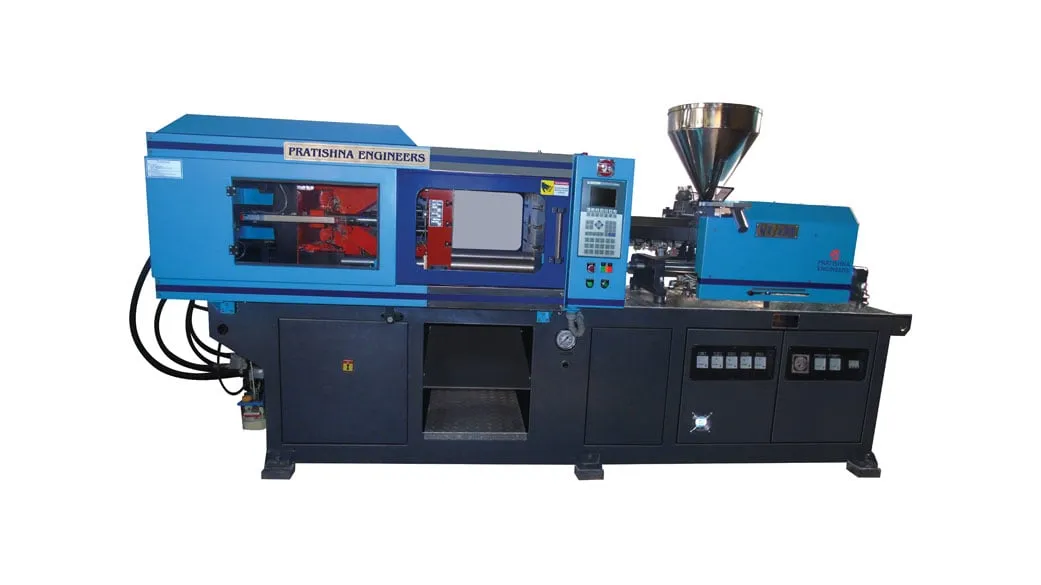

Here is the number that sums up engineering moulding. In a published acetal trial on one part, 15 s of packing with 2 s of cooling held the outer diameter at 49.61 ± 0.02 mm. Cutting packing to 5 s widened the spread to ± 0.2 mm, ten times worse. An injection moulding machine for engineering parts in nylon, POM or PBT must repeat pack pressure and time that closely, feed from properly dried resin and resist wear from glass fibre. The sections below cover drying, tolerances and wear in that order.
Key Takeaways
- Nylon, acetal and PBT each have their own moisture limit and melt window, so drying and barrel control decide part quality before the mould does.
- Tolerance on engineering parts depends on packing time and pressure as much as on the mould; a short pack can widen the spread tenfold.
- Glass-filled grades wear the screw, barrel and check ring, so specify wear-resistant parts and watch cushion and energy for early signs.
- Treat the dryer as part of the machine: size it on throughput, check moisture and keep conveying closed from dryer to feed throat.
How dry must nylon, POM and PBT be before moulding?
Each resin sets its own limit. One PBT-GF30 grade asks for moisture below 0.04% with pre-drying as the rule, while one PA66 grade allows up to 0.2% at processing. Nylon 66 is hygroscopic and degraded by excess moisture, so follow the data sheet, not a habit.
Processing windows from three engineering resin data sheets
| Resin (grade type) | Moisture and drying | Melt | Mould shrinkage |
|---|---|---|---|
| PA66, unreinforced, impact-modified | Up to 0.2% at processing; pre-dry 60 °C for 1 to 2 h from unopened bags | 288 to 305 °C | 0.7 to 1.8% (nylon 66 range) |
| POM homopolymer | Avoid long residence; never run with PVC or FR resins | 215 ± 5 °C | 1.8 to 2.5% (acetal range) |
| PBT-GF30, hydrolysis resistant | Below 0.04%; pre-dry, closed conveying | 250 to 275 °C | 0.50% along flow, 1.30% across |
Moisture causes trouble in two ways. In nylon and PBT, water breaks polymer chains in the barrel, which cuts toughness without always showing on the surface. The PBT grade above notes that a 25 kg bag stored at 5 °C took 48 hours to reach 20 °C, so open cold bags only at processing area temperature.
Closed conveying from dryer to throat matters as much as the drying itself, because resin left in an open hopper picks moisture back up. For exposed nylon, one data sheet suggests drying at 66 °C until moisture is between 0.04 and 0.20%, which shows how wide the safe band can be.
Our view is that the dryer is part of the machine, not an accessory. Drying can use up to 15% of process energy, and in Maharashtra HT and larger LT industrial supply is billed on kVAh, so a dryer left running through idle hours shows on the bill. Size it on real throughput.
What tolerances can an injection moulding machine for engineering parts hold?
Tolerance depends on shrinkage, packing and cooling more than on the machine's rated accuracy. Acetal shrinks about 1.8 to 2.5% and nylon 66 about 0.7 to 1.8%, so a few seconds of pack time or a few degrees of mould temperature can move a dimension beyond the drawing.
Acetal shows the effect clearly. It is almost 60% crystalline, and it loses about 11% of its volume through crystallisation plus 7% thermally, close to 2% linear. Poor packing can cut its mechanical performance by up to 30%. Gate into the thickest section, with a gate diameter of at least half the wall.
Glass fibre adds direction to shrinkage. The PBT-GF30 grade shrinks 0.50% along the flow but 1.30% across it, so a round part can come out oval and a flat part can twist. Gate position and fibre orientation decide which way it moves, which is why flow analysis pays on tight-tolerance parts.
On the machine, look for repeatable hold pressure and time, closed-loop barrel heating and a stable mould temperature controller. Eject acetal parts hot and let them cool outside the mould on a conveyor before bulk packing, as the resin supplier advises, so they shrink evenly rather than in a warm heap.
How does glass fibre wear a moulding machine?
Glass-filled nylon and PBT act like a fine abrasive in the barrel. They wear the screw flights, the barrel liner and the check ring, which lets melt slip back and makes shot size drift. Wear-resistant screw and barrel metallurgy and regular check-ring inspection keep the process stable.
Watch for the signs. Cushion that wanders from shot to shot, longer screw recovery and rising energy use on the same job can all point to screw or barrel wear. A clamp-meter data logger can measure a machine's energy in as little as 30 minutes, so a monthly reading on each glass-filled job is cheap insurance.
Glass fill also weakens weld lines. Heavily filled weld lines may keep only about 60% of the unfilled strength, so place gates to keep weld lines away from loaded areas such as snap fits, clip roots and bolt bosses. Venting matters too, because trapped gas at a weld line weakens it further.
Residence time is the last check. Formulas based on barrel size and cycle miss resin trapped at the base of screw flights. To measure it, drop a few granules of the same resin in a different colour into the throat, count the shots until the colour clears and multiply by the cycle time.
What should you send to size a machine for engineering parts?
Send the drawing with critical tolerances, the exact resin grade and glass content, part and runner weight, cavities, target cycle and annual volume. Note any inserts or post-moulding conditioning. Those figures fix shot, clamp, screw metallurgy and dryer size together, before offers are compared. See the engineering solutions page.
Frequently Asked Questions About Moulding Engineering Parts
Can one machine run nylon, acetal and PBT?
It can, with care. The screw must suit all three melt windows, the dryer must reach each resin's moisture target, and you must purge thoroughly between them. Acetal is the one to isolate: it must never meet PVC or flame-retardant resins at processing temperature, so plan purging and scheduling around it.
Why do nylon parts change size after moulding?
Nylon absorbs moisture from the air after moulding, which changes its dimensions and toughness over the following days. Dry-as-moulded parts are stiffer and slightly smaller than conditioned ones. If your drawing gives dimensions after conditioning, agree the conditioning method and measuring time with your customer before the mould steel is finished.
How long can acetal sit in the barrel?
As short a time as practical. Long residence or a melt well above the recommended 215 ± 5 °C degrades acetal. Size the barrel so the shot uses a healthy share of it, keep nozzles and hot runners near 190 °C, and purge or empty the barrel before long stops rather than letting melt sit.
Does a glass-filled resin need a special screw?
It needs a wear-resistant one. Standard screws and barrels wear quickly with glass fibre, so ask for hardened or bimetallic options and a wear-resistant check ring. Lower screw speed and back pressure also reduce fibre breakage, which helps keep stiffness and strength close to the values on the data sheet.
What gate suits a small acetal part?
Acetal guidance favours a tunnel gate into the thickest section, with a gate diameter of at least half the wall, a gate land under 0.8 mm and a tunnel diameter of at least the wall plus 1 mm. A gate that freezes too early stops packing and leaves voids and dimensional scatter.
Related Articles
- Injection Moulding Machine for Luxuries & Travel
- Injection Moulding Machine for Electric & Electronics
- Injection Moulding Machine for Automotive and Aerospace Parts
- Injection Moulding Machine for Automotive Parts
Sources & References
- BASF via Material Data Center (M-Base): Ultramid A3L HP datasheet
- DuPont: Delrin Acetal Homopolymer Resin Molding Tips
- BASF: Ultradur B 4300 G6 HR Product Information (02/2026)
- LyondellBasell: Technical Tip: Mold Shrinkage
Technical Disclaimer
Disclaimer: The information provided in this document is for general informational and educational purposes only. It is based on technical references and industry information available at the time of preparation and may be subject to change. It does not constitute engineering, technical, commercial or professional advice, nor does it constitute a quotation, specification, warranty or contractual commitment by Pratishna Engineers.
Actual injection moulding machine and process requirements vary according to the component design, material, mould, production volume, machine configuration and operating conditions. The information, examples, calculations and recommendations provided should be independently evaluated and verified for the specific application before making any equipment, process or production decision. Information obtained from third-party sources remains subject to the accuracy and limitations of those sources.
Limitation of Liability: Pratishna Engineers makes no representation or warranty, express or implied, regarding the completeness, accuracy or suitability of the information for any particular application. To the extent permitted by applicable law, Pratishna Engineers shall not be liable for any loss, damage, cost or consequence arising from reliance on or use of the information contained in this document. Final machine selection, configuration and application suitability should be confirmed with Pratishna Engineers based on complete and accurate project requirements.

