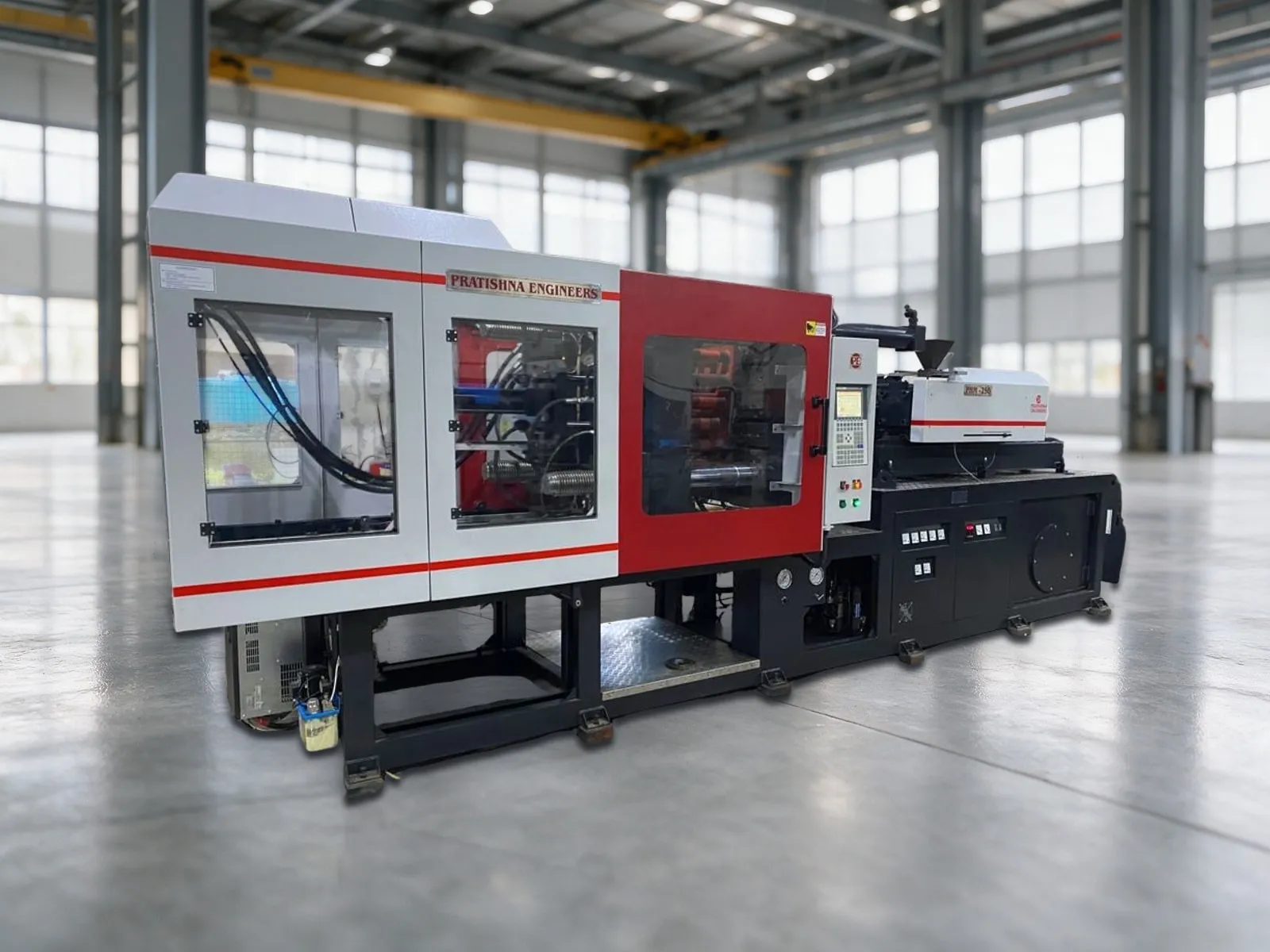
A furniture moulder is asked to quote for a 450 × 450 mm side table on a 350 t machine. The clamp check comes back at about 626 t even at the lowest PP factor. On a 350 t plastic table making machine, the clamp sets a hard ceiling on table tops, while crates with open bases fit far better.
With a 10% reserve (a starting margin, not a rule), 350 t carries about 754 to 1,132 cm² of PP area. That covers small round tops up to about 370 mm, table legs and frames, and crates up to about 500 × 350 mm once base openings are deducted.
Key Takeaways
- A solid table top gets no deduction for openings, so even a 400 × 400 mm top needs about 495 t at the lowest PP factor.
- Crate base openings are deducted from the projected area; openings in the side walls are not.
- A mould should cover at least about 70% of the distance between the tie bars, and the parts' area must sit inside them.
- PP does most of its shrinking in the first 48 hours, so flat tops need an even wall and a flatness check after that.
What Size Does a Plastic Table Making Machine Need?
Far more than 350 t for a full-size top. A table top is a solid, wide outline, and ribs under it add no projected area because they sit inside that outline. The clamp scales with the top's full area, so it climbs fast as the top grows.
Clamp needed for table tops, one per shot (sizes assumed; PP factor 2 to 3 US t/in²; 10% reserve)
| Top size | Projected area | Clamp needed | Fits 350 t? |
|---|---|---|---|
| Round, 370 mm | 1,075 cm² | 332 t to 499 t | Only near factor 2 |
| Square, 400 × 400 mm | 1,600 cm² | 495 t to 743 t | No |
| Square, 450 × 450 mm | 2,025 cm² | 626 t to 940 t | No |
| Rectangular, 900 × 600 mm | 5,400 cm² | 1,669 t to 2,507 t | No |
The clamp method is explained in the applications article in this series. At 350 t, the largest square top is about 336 mm a side at factor 2 and about 275 mm at factor 3.
So a 350 t machine fits the table business through parts: small round stool-tables, legs, frames, brackets and corner joints for knock-down designs. Full-size tops belong on a much larger clamp.
Legs and frames can run in multi-cavity moulds at 350 t, because each leg has a small outline. Their long, thick sections make cooling and shot weight the limits there, not clamp.
How Large a Crate Fits 350 t?
A crate fits if its outline, less the openings through its base, stays within about 754 to 1,132 cm². Openings in the side walls do not reduce the projected area, because the base outline still sits beneath them when viewed from the parting line.
Clamp needed for crates by outline and base open area (sizes and open areas assumed; PP factor 2 to 3 US t/in²; 10% reserve)
| Crate outline and open base | Net area | Clamp needed | Fits 350 t? |
|---|---|---|---|
| 450 × 300 mm, 40% open | 810 cm² | 250 t to 376 t | Up to about factor 2.8 |
| 500 × 350 mm, 40% open | 1,050 cm² | 325 t to 487 t | Up to about factor 2.15 |
| 600 × 400 mm, 50% open | 1,200 cm² | 371 t to 557 t | No |
| 600 × 400 mm, solid base | 2,400 cm² | 742 t to 1,114 t | No |
Crate walls are thin, ribbed and long from gate to rim, which pushes the factor toward the top of the PP range. Gating from the base centre shortens the flow to each corner. Where the crate sits near the limit, a second gate can do more for fill than extra clamp.
Crates are heavy for their size, so check the shot as well. How a barrel rating in PS translates into a usable PP shot is covered in the screw choice article in this series.
Will a Wide Crate Mould Fit Between the Tie Bars?
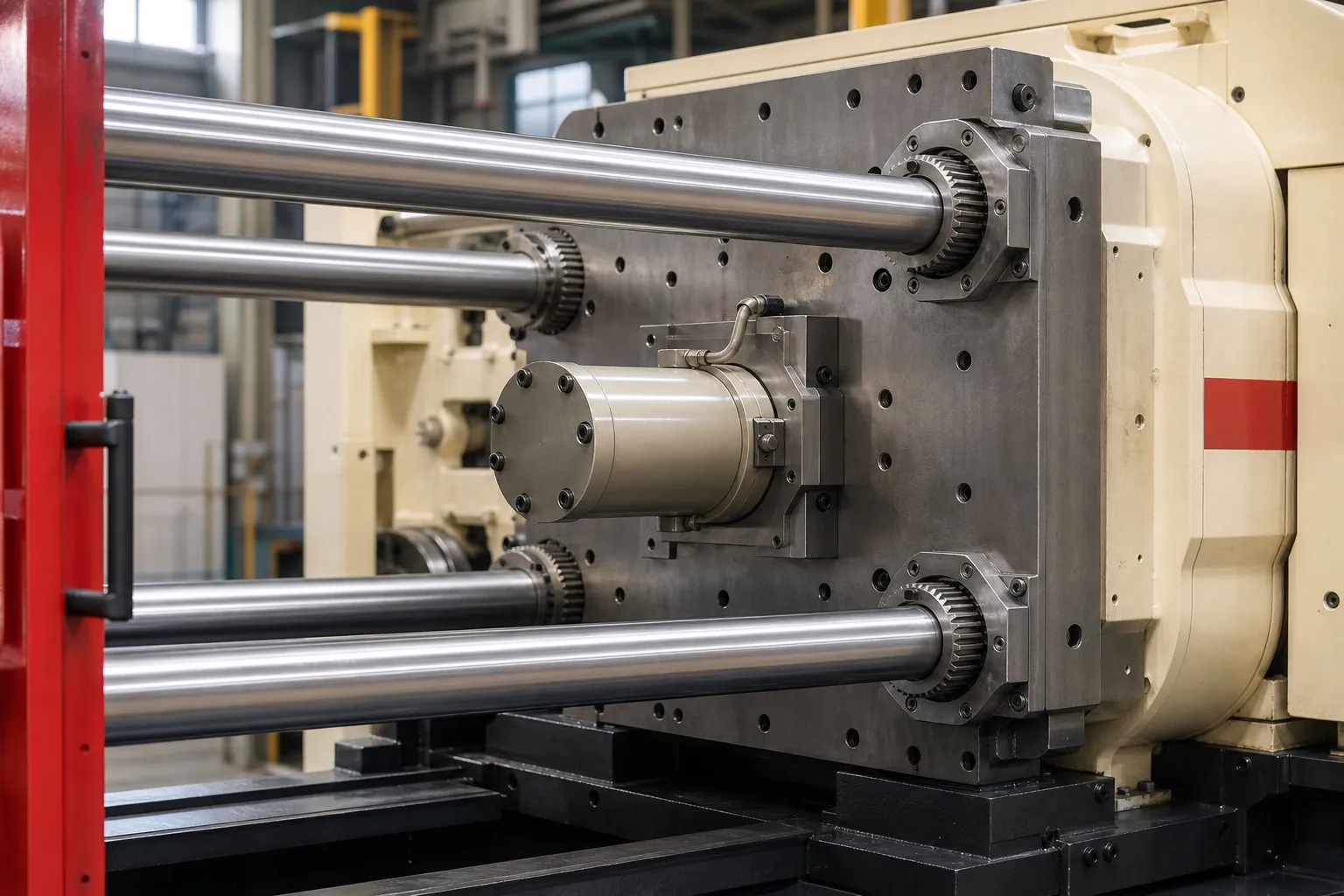
It must, at least where the parts are. Bruce Catoen's MoldMaking Technology guide says the whole mould should ideally fit within the tie bars, and at minimum the parts' projected area must, because the platens can pull in near the tie bars and wear the parting line.
Crate moulds grow wide quickly. Side-wall openings are formed by slides that move outward, so the mould is far wider than the crate. Catoen also asks you to check the maximum mould weight for both platens, and a large crate mould with slides is heavy.
Remember the loading path as well. A mould lifted in from above must pass between the upper tie bars, so its width across the bars, including slide housings and water fittings, matters as much as its fit once clamped.
There is a lower limit too. A Plastics Technology article on mounting moulds, by P. Witaszek and co-authors, gives a rule of thumb that the mould should cover at least 70% of the distance between the tie bars; smaller moulds let the platens bow and flash in the mould centre.
Which PP Grades and Design Rules Suit Crates and Tables?
Impact copolymers for crates and furniture, with walls kept even so the part cools and shrinks uniformly. UL Prospector's listing of Reliance Repol grades shows B030MG and MI3530 for crates and furniture, and C080MA, a high-impact antistatic grade, for furniture, luggage and industrial parts.
Flat tops and crate bases warp when walls vary. EnviroTech Molded Products advises keeping wall thickness constant, because thick sections cool slower and shrink more. It suggests rib base widths of about 75% of the adjacent wall and notes that some pigments, such as green, blue and orange, act as strong nucleators.
The same notes say PP does most of its shrinking within 48 hours of moulding, and that melt temperature, mould temperature, mould-closed time and packing pressure all change how much it shrinks. Our view: for a crate range sold in several colours, prove dimensions in every colour before releasing the mould, not only in natural.
What Should You Send for a Crate or Table Check?
Send the outline, height, base open area, wall, part weight, resin grade and colours, with the mould maker's estimate of the mould's outside size and weight. Clamp, tie-bar fit, opening and shot can then be checked together. See the 350 ton two platen injection moulding machine page.
Frequently Asked Questions About Crates and Tables at 350 t
Can a table top be moulded in two halves on a 350 t machine?
It can, if each half fits the clamp and the design joins the halves strongly enough for the load. The joint line must be designed for strength and appearance from the start. Most of the work then moves into the mould and assembly design rather than the machine choice.
Why does a crate with a 40% open base fit when a solid one does not?
Clamp follows the projected area that melt pressure acts on. Openings that pass right through the base carry no melt, so they are deducted. A 40% open base cuts the area, and the clamp, by 40%, provided the cold runner is added back if one is used.
Do crate moulds need slides?
Usually, for side-wall openings and handles, because those features run across the opening direction. Slides make the mould wider, heavier and more complex, so check tie-bar fit and mould weight early. Shallow handle recesses can sometimes be formed without slides if the design allows straight draw.
How do I keep a large flat top from warping?
Keep the wall even, gate so the melt reaches the far edges with similar pressure, and hold packing until the gates freeze. PP does most of its shrinking in the first 48 hours after moulding, so measure flatness after that period, not straight off the machine.
Can I use recycled PP for crates?
Often, for crates that do not carry food, though recycled PP varies more than virgin resin. Use cold runners and larger gates rather than hot runners, since small metal particles can plug hot tips. Test drop strength on every lot, because crates are judged by how they survive handling.
Related Articles
- What Can You Make on a 350 Ton Two Platen Machine?
- Shot Weights Up to 1.5 kg: Screw Choice on a 350 Ton Machine
- When to Choose a 350 Ton Two Platen Over a Toggle Machine
Sources & References
- MoldMaking Technology, B. Catoen: Machine Sizing and Specification for Optimal Mold Performance, Part 1
- Plastics Technology, P. Witaszek, J. Klees, J. Fattori, E. Di Siro, J. Bozzelli: How to Mount an Injection Mold (June 2017)
- UL Prospector: Polypropylene (PP): REPOL grade listing
- EnviroTech Molded Products: Molded Parts Design
Technical Disclaimer
Disclaimer: The information provided in this document is for general informational and educational purposes only. It is based on technical references and industry information available at the time of preparation and may be subject to change. It does not constitute engineering, technical, commercial or professional advice, nor does it constitute a quotation, specification, warranty or contractual commitment by Pratishna Engineers.
Actual injection moulding machine and process requirements vary according to the component design, material, mould, production volume, machine configuration and operating conditions. The information, examples, calculations and recommendations provided should be independently evaluated and verified for the specific application before making any equipment, process or production decision. Information obtained from third-party sources remains subject to the accuracy and limitations of those sources.
Limitation of Liability: Pratishna Engineers makes no representation or warranty, express or implied, regarding the completeness, accuracy or suitability of the information for any particular application. To the extent permitted by applicable law, Pratishna Engineers shall not be liable for any loss, damage, cost or consequence arising from reliance on or use of the information contained in this document. Final machine selection, configuration and application suitability should be confirmed with Pratishna Engineers based on complete and accurate project requirements.