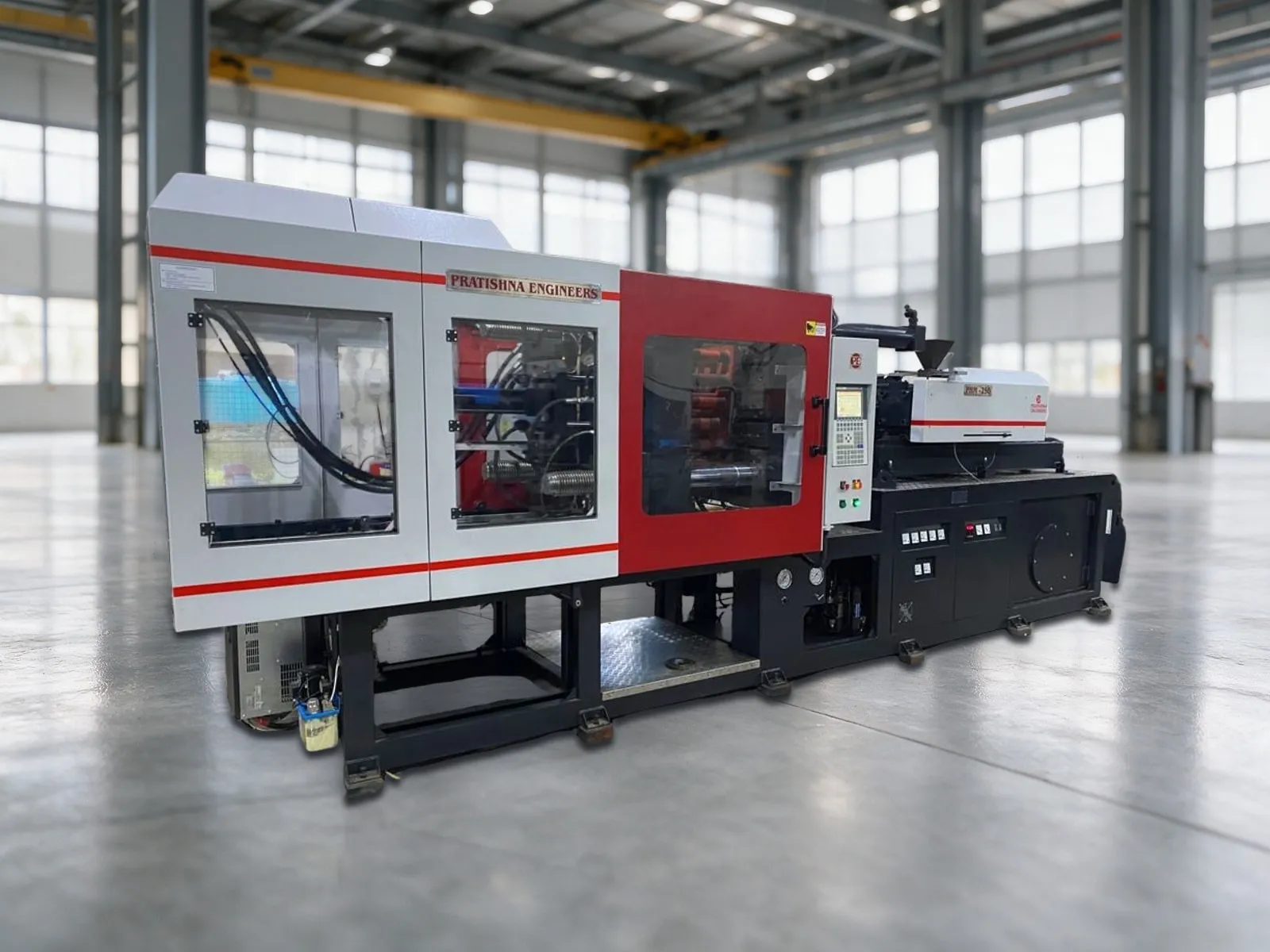
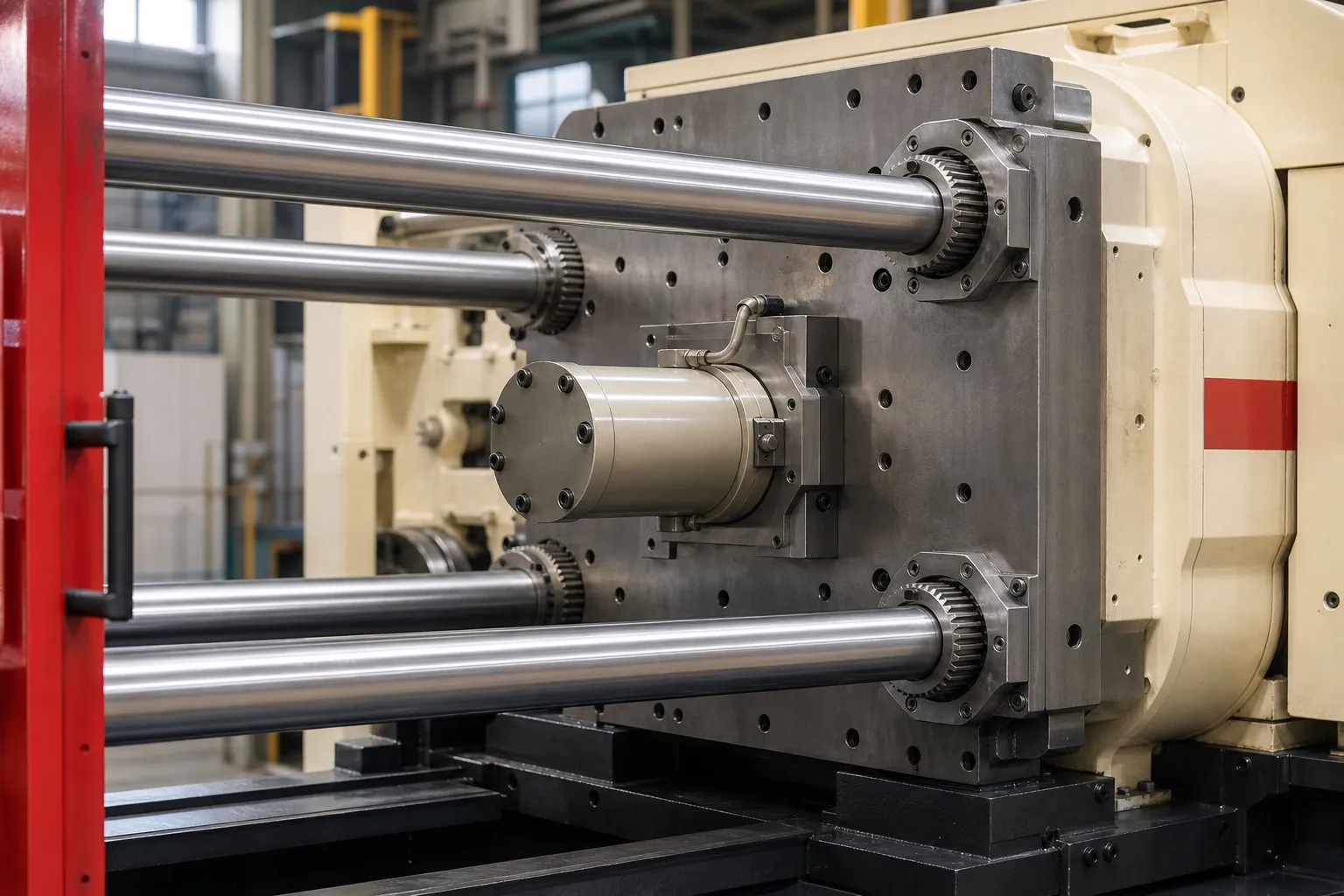
A barrel rated 1,500 g of PS sweeps about 1,587 cm³. Filled with PP melt at about 0.74 g/cm³, that is roughly 1,175 g at full stroke. Within a 20% to 65% window and a 10% allowance, a good PP shot from that barrel is about 213 to 695 g. Large shot weight injection moulding starts with reading the rating in volume, not grams.
Screw choice then decides the balance. A larger screw on the same injection unit holds more melt but delivers less pressure, and a smaller one does the reverse. Pick the screw that puts your shot inside the window and still fills the mould.
Key Takeaways
- Shot ratings are in grams of PS; a 1,500 g PS barrel gives a good PP shot of only about 213 to 695 g.
- A 1.5 kg PP part needs a barrel rated at least about 3,240 g PS to stay within 65% of capacity.
- On the same injection unit, pressure falls with the square of screw diameter while volume rises with it.
- A large barrel running a small shot keeps melt in the barrel for many cycles, which raises the risk of degradation.
What Does a 1.5 kg Shot Rating Mean for PP Parts?
It means about 1,587 cm³ of swept volume, rated with PS. PP melt is lighter than PS melt, so the same volume holds fewer grams of PP, and only part of that volume should be used for a shot if the melt is to stay even and fully melted.
John Bozzelli's Plastics Technology articles give the numbers. Machine shot ratings are usually in grams or ounces of PS; melt density is 0.945 g/cm³ for PS and about 0.74 g/cm³ for PP. He advises working in volume, adding 10% for check-valve leakage and melt uniformity, and keeping the shot at no more than 65% of the barrel.
At the other end, he warns that shots below about 20% of capacity lead to long residence time and degradation. Put together, a barrel rated R grams of PS gives a good PP shot of about 0.142 × R to 0.463 × R. For R = 1,500 g, that is 213 to 695 g.
The reverse also holds. A 1.5 kg PP part needs a barrel rated at least 1,500 ÷ 0.463, or about 3,240 g PS. That is more than double a 1.5 kg PS rating, so check shot weight in the resin you will actually run.
How Does Screw Diameter Trade Pressure for Volume?
On one injection unit, the hydraulic force is fixed, so a bigger screw spreads it over a larger area. Swept volume rises with the square of the diameter and injection pressure falls with it. Moving from 70 to 80 mm gives 31% more volume and about 23% less pressure.
Three screw options on one injection unit (assumed 300 mm stroke and 2,000 kg/cm² on the 70 mm screw; volume = 0.7854 × D² × stroke; pressure scales with (70 ÷ D)²)
| Screw | Swept volume | Rating in PS | Good PP shot | Injection pressure |
|---|---|---|---|---|
| 70 mm | 1,155 cm³ | 1,091 g | 155 to 505 g | 2,000 kg/cm² |
| 80 mm | 1,508 cm³ | 1,425 g | 202 to 660 g | 1,531 kg/cm² |
| 90 mm | 1,909 cm³ | 1,804 g | 256 to 835 g | 1,210 kg/cm² |
Bozzelli's article on intensification ratio explains why: the ratio is the hydraulic ram area divided by the screw area, so it changes with screw size. He describes a mould that needed 1,585 bar and would not fill on a machine giving 1,380 bar, but filled on one giving 2,014 bar.
He also warns against buying the biggest screw by default, because big screws usually mean lower plastic pressure. A second barrel ordered with a new machine can cost little, and a skilled operator can swap one in under 30 minutes, which suits a plant that runs both heavy and light parts.
Why Do Large PP Shots Need Care in Melting?
Because PP takes a lot of energy to melt and most of it must come from the screw. Bozzelli puts melting energy at about 300 BTU/lb for PP against 150 for ABS, with about 80% of it ideally coming from shear rather than the heater bands.
Above about 65% of barrel capacity, he reports unmelt, poor melt uniformity and long recovery, and notes that PP or PE can grind metal off the flights at large shots. Recovery must also finish within the cooling time, or the cycle stretches to wait for the screw.
A larger screw on the same barrel length also has a lower L/D, which leaves fewer flights for melting. Bozzelli notes that a 20:1 L/D screw has about 10 feed flights. Ask for the L/D of each screw option, not only its diameter.
Resin choice helps. Reliance's Repol B300MN is a high-crystalline PP impact copolymer with an MFR of 30 g/10 min, described as suitable for large articles with lower cycle times. Our view: on heavy PP parts, choose the screw for melt quality first and output second, because unmelt costs more in rejects than a slower recovery costs in cycle time.
Large Shot Weight Injection Moulding: How Long Does Melt Stay in the Barrel?
Roughly the barrel's swept volume divided by the shot volume, times the cycle time. A shot that fills half the barrel spends about two cycles inside; one that fills a fifth spends about five. Halving the shot on the same barrel and cycle doubles the residence time.
This matters most when one large machine runs a light part. A 250 g PP shot is about 338 cm³ of melt; on a 1,909 cm³ barrel it stays about 5.6 cycles, or nearly four minutes on a 40 second cycle. Keep heavy and light parts on suitably sized screws where you can.
What Should You Send for a Screw Selection Check?
Send the part weight, resin grade, wall, flow length and expected cycle time, plus any injection pressure figure from a mould-filling study or trial. The shot window, pressure margin and residence time can then be checked for each screw option. See the 350 ton two platen injection moulding machine page.
Frequently Asked Questions About Large Shots and Screw Choice
Why are shot weights quoted in PS?
PS is the common reference resin, so ratings can be compared between machines. Your part's resin will differ in melt density: PP melt is about 0.74 g/cm³ against 0.945 for PS, so a PP shot weighs about 22% less than a PS shot of the same volume. Convert before you compare.
Can I run a shot at 80% or 90% of the barrel?
It may fill, but melt quality suffers. Above about 65% of capacity, unmelt, poor colour mixing and long recovery appear, and the screw may not finish recovery within the cooling time. If a part needs that much of the barrel, a larger screw or barrel is the better route.
Does a bigger screw slow injection?
Not usually in volume terms. On the same unit, a bigger screw moves more melt per millimetre of stroke, so the volumetric injection rate can rise. What it loses is pressure. A thin, long-flow part may need the smaller screw's pressure more than the larger screw's rate.
How do I measure residence time on my machine?
Formulas give a rough figure but miss resin trapped at the base of flights. A practical check is to drop a few granules of a different colour of the same resin into the feed throat during running, count shots until the colour clears and multiply by the cycle time.
Is a second barrel worth ordering with a new machine?
If the machine will run both heavy and light parts, often yes. A second barrel ordered with the machine can be low cost and can be swapped in under 30 minutes by a skilled operator. It keeps light parts out of a long residence time and heavy parts within 65%.
Related Articles
- What Can You Make on a 350 Ton Two Platen Machine?
- Large Crates and Tables on a 350 Ton Two Platen Machine
- When to Choose a 350 Ton Two Platen Over a Toggle Machine
Sources & References
- Plastics Technology, J. Bozzelli: A Simpler Way to Calculate Shot Size vs. Barrel Capacity
- Plastics Technology, J. Bozzelli: Revisiting Shot Size vs. Barrel Capacity
- Plastics Technology, J. Bozzelli: Understanding Intensification Ratio
- Reliance Industries: Repol B300MN technical data sheet (July 2024)
Technical Disclaimer
Disclaimer: The information provided in this document is for general informational and educational purposes only. It is based on technical references and industry information available at the time of preparation and may be subject to change. It does not constitute engineering, technical, commercial or professional advice, nor does it constitute a quotation, specification, warranty or contractual commitment by Pratishna Engineers.
Actual injection moulding machine and process requirements vary according to the component design, material, mould, production volume, machine configuration and operating conditions. The information, examples, calculations and recommendations provided should be independently evaluated and verified for the specific application before making any equipment, process or production decision. Information obtained from third-party sources remains subject to the accuracy and limitations of those sources.
Limitation of Liability: Pratishna Engineers makes no representation or warranty, express or implied, regarding the completeness, accuracy or suitability of the information for any particular application. To the extent permitted by applicable law, Pratishna Engineers shall not be liable for any loss, damage, cost or consequence arising from reliance on or use of the information contained in this document. Final machine selection, configuration and application suitability should be confirmed with Pratishna Engineers based on complete and accurate project requirements.