(35 ÷ 32)² = 1.196, and 1 ÷ 1.196 = 0.836. Fit a 35 mm screw in place of a 32 mm screw on the same electric injection unit and each millimetre of stroke moves about 20% more melt, at about 84% of the pressure. Injection moulding screw size selection on a 120 t hybrid comes down to two checks: does your largest regular shot fit the 32 mm barrel, and does your hardest part fill at 84% of its pressure?
This article works through both checks with POM and PP shots, the two resins most likely to share such a machine.
Key Takeaways
- On one injection unit, swept volume and injection rate rise with the screw diameter squared, while maximum melt pressure falls in the same ratio.
- Electric injection reads plastic pressure directly, so there is no intensification ratio to convert when you compare screws.
- Work in melt volume: 100 cm³ of swept volume holds about 94.5 g of PS melt, 74 g of PP or 117 g of POM.
- Keep each shot, plus 10% for leakage and uniformity, between about 20% and 65% of the screw's swept volume.
Why Does the Larger Screw Give Less Pressure on an Electric Unit?
The servo motor and ball screw push the injection screw with a maximum force that stays the same whichever screw is fitted. Pressure is force divided by screw area, so a 35 mm screw spreads that force over 20% more area and delivers about 84% of the pressure.
On a hydraulic injection unit the same law appears through the intensification ratio, the hydraulic ram area divided by the screw area. John Bozzelli notes in Plastics Technology that machines range from 6:1 to 43:1 and that the ratio changes with every screw size. Electric machines, he adds, read plastic pressure directly, an effective ratio of 1:1.
His example shows how small the margin can be. A mould that needed 1,585 bar of plastic pressure could not fill on a machine giving 1,380 bar, but filled on one giving 2,014 bar. A 16% drop in available pressure is the size of gap that decides cases like this.
If a mould comes from a hydraulic machine, convert its recorded hydraulic pressure to plastic pressure with that machine's ratio before comparing it with either screw. Copying the screen number across can leave the mould short of pressure or packed too hard.
32 mm vs 35 mm screw on the same injection unit (relative values, calculated)
| Property | 32 mm screw | 35 mm screw |
|---|---|---|
| Swept volume per mm of stroke | 1.00 | 1.196 (about 20% more) |
| Maximum melt pressure | 1.00 | 0.836 (about 16% less) |
| Injection rate at the same screw speed | 1.00 | 1.196 |
| Largest shot inside the 65% limit | 1.00 | 1.196 |
| Smallest shot inside the 20% limit | 1.00 | 1.196 (small shots fall out sooner) |
| L/D if barrel length is unchanged (640 mm assumed) | 20:1 | 18.3:1 |
How Do You Size a Shot Against Each Screw?
Turn the shot weight into melt volume using the resin's melt density, add 10% for check-valve leakage and melt uniformity, then divide by each screw's swept volume. The answer should sit between about 20% and 65%. Shot ratings in grams of PS mislead for any other resin.
What 100 cm³ of swept volume holds in melt, by resin
| Resin | Melt density | Melt per 100 cm³ swept |
|---|---|---|
| PS (basis of most shot ratings) | 0.945 g/cm³ | 94.5 g |
| PP | About 0.74 g/cm³ | About 74 g |
| POM (acetal) | 1.17 g/cm³ | 117 g |
The PS and PP figures come from a second Bozzelli column, and the POM figure from DuPont's moulding tips for Delrin. The same barrel therefore holds about 24% more POM by weight than PS, and about 22% less PP.
Bozzelli sets the limits too. Below about 20% of capacity, melt stays in the barrel long enough to degrade; above 65%, melt quality suffers. He also warns against buying the biggest screw by default, since big screws usually mean lower plastic pressure. For acetal the lower limit matters most, because DuPont warns that long residence degrades it.
Barrel length adds a quieter effect. If both screws share one barrel length, the larger screw has a lower L/D ratio and fewer flights to melt and mix each shot. That matters most when a large shot sits near the top of the barrel.
Which Parts Need the 32 mm Screw's Extra Pressure?
Thin walls, long flow paths, fine features and many cavities that must fill and pack together. If a process sheet or filling study shows a part needs over about 80% of the larger screw's maximum pressure, choose the 32 mm screw and confirm the shot fits.
The larger screw does have a speed advantage. At the same linear screw speed, it moves about 20% more melt per second, which helps fill a thin section before it freezes, provided the pressure is there to push it.
Resin choice can ease the pressure question. Reliance lists its Repol H200MA, a PP homopolymer with an MFR of 25 g/10 min, for thin-walled containers, multi-cavity moulding and long flow paths. A higher-flow grade fills at lower pressure, but check that its impact and stiffness still meet the part's needs.
If your shots really do span both screws, Bozzelli notes that a second barrel ordered with a new machine can be low cost, and that a skilled operator can swap one in under 30 minutes, even hot.
Our view: on a hybrid bought for precision work, start from the 32 mm screw and move up only when your regular shots force you to. Pressure reserve protects every thin-wall and multi-cavity job, while spare shot capacity you rarely use mainly adds residence time.
What Should You Send for Injection Moulding Screw Size Selection?
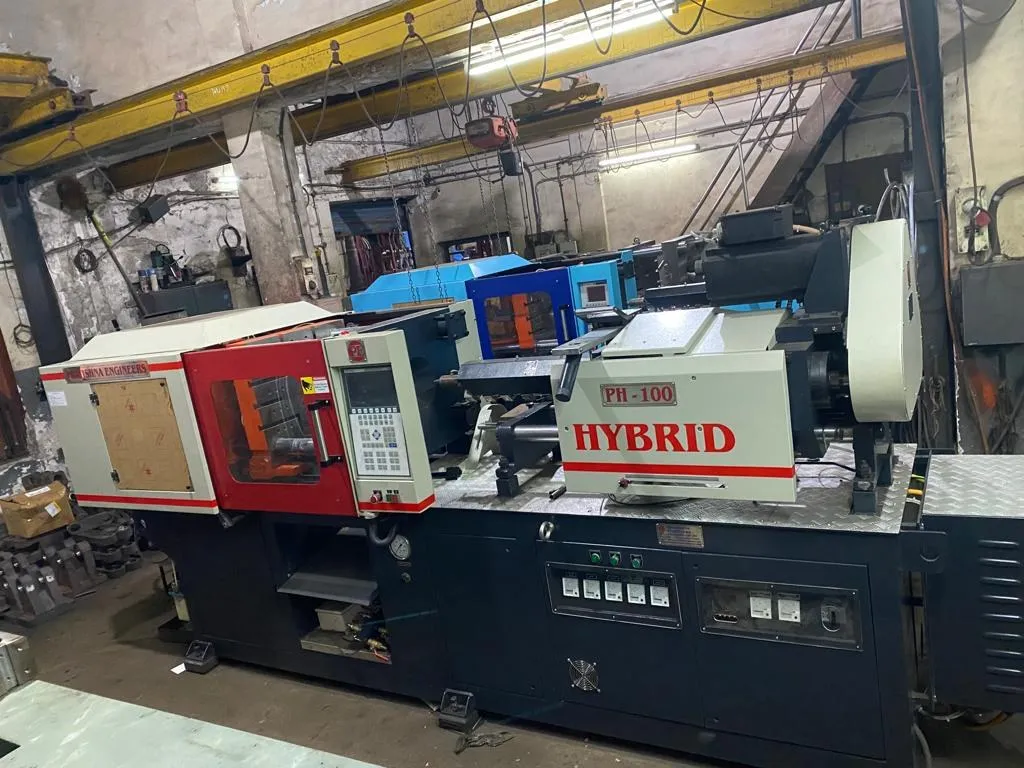
List every mould planned for the machine with part and runner weight, resin grade, cavity count, thinnest wall and longest flow path, and any process sheet showing injection pressure at transfer. With those, each shot can be checked against both screws. See the 120 ton hybrid injection moulding machine page.
Frequently Asked Questions About Injection Moulding Screw Size Selection
Does the 35 mm screw inject faster than the 32 mm screw?
In volume, yes. At the same linear screw speed it moves about 20% more cm³ per second, because its area is about 20% larger. Whether the part fills faster depends on pressure too. If the mould needs more pressure than the larger screw can give, the extra flow rate cannot be used.
Why is there no intensification ratio on an electric injection unit?
Because the controller works with the force on the screw and the screw's own area, so it reads plastic pressure directly. On a hydraulic unit, the screen may show oil pressure, which must be multiplied by a ratio that changes with screw size. Always compare and transfer processes using plastic pressure.
What happens to L/D when only the screw diameter changes?
If the barrel length stays the same, L/D falls as the diameter rises. With a 640 mm barrel, 32 mm gives 20:1 and 35 mm gives about 18.3:1. Fewer flights per diameter means less length to melt and mix, which matters most for large shots near the top of the barrel.
How can I tell if a mould is limited by injection pressure?
Look at the pressure at transfer on the process sheet. If it sits close to the machine's maximum, the mould has little reserve, and short shots or weight swings often appear when the resin lot or melt temperature changes. A filling study before the mould is built gives the same warning earlier.
Should I order both screw and barrel sets with the machine?
Only if your regular shots fall on both sides of one screw's working range. If most jobs sit inside 20% to 65% of one screw, buy that one. If small POM shots and large PP shots both run often, a second set ordered with the machine can cost less than a later purchase.
Related Articles
- What Can You Make on a 120 Ton Hybrid Injection Moulding Machine?
- Moulding Precision Gears and Connectors on a 120 Ton Hybrid Machine
- Power Consumption of a 120 Ton Hybrid vs Hydraulic Machine
Sources & References
- Plastics Technology, J. Bozzelli: Understanding Intensification Ratio
- Plastics Technology, J. Bozzelli: A Simpler Way to Calculate Shot Size vs. Barrel Capacity
- DuPont: Delrin Acetal Homopolymer Resin Molding Tips (DLE-A11169-00-B0615)
- Reliance Industries: Repol H200MA technical data sheet (July 2024)
Technical Disclaimer
Disclaimer: The information provided in this document is for general informational and educational purposes only. It is based on technical references and industry information available at the time of preparation and may be subject to change. It does not constitute engineering, technical, commercial or professional advice, nor does it constitute a quotation, specification, warranty or contractual commitment by Pratishna Engineers.
Actual injection moulding machine and process requirements vary according to the component design, material, mould, production volume, machine configuration and operating conditions. The information, examples, calculations and recommendations provided should be independently evaluated and verified for the specific application before making any equipment, process or production decision. Information obtained from third-party sources remains subject to the accuracy and limitations of those sources.
Limitation of Liability: Pratishna Engineers makes no representation or warranty, express or implied, regarding the completeness, accuracy or suitability of the information for any particular application. To the extent permitted by applicable law, Pratishna Engineers shall not be liable for any loss, damage, cost or consequence arising from reliance on or use of the information contained in this document. Final machine selection, configuration and application suitability should be confirmed with Pratishna Engineers based on complete and accurate project requirements.