
Typical jobs for a 120 ton hybrid moulding machine and what each asks of the injection unit
| Product family | Common resins | Why injection control matters | Check first |
|---|---|---|---|
| Plastic gears and small mechanical parts | POM, PA66 | Gear size follows shrinkage, and shrinkage follows packing | Packing time, gate size, cavity balance |
| Electrical connectors and switch parts | PA66, PBT, FR PC | Thin walls and fine pins must fill the same way every shot | Fill pressure, drying, flame rating at the wall used |
| Closures and dispensing parts | PP, HDPE | Many cavities must fill alike | Cavities by clamp, runner type, cooling |
| Medical and diagnostic consumables | PP, PS, PC | Weight and size are checked part by part | Cavity balance, cleanliness, validation |
| Pen, cosmetic and small precision parts | ABS, PP, PC | Small shots and visible surfaces | Share of barrel used, residence time |
| Thin-walled components | High-flow PP | High fill speed and pressure | Higher tonnage factor, injection rate |
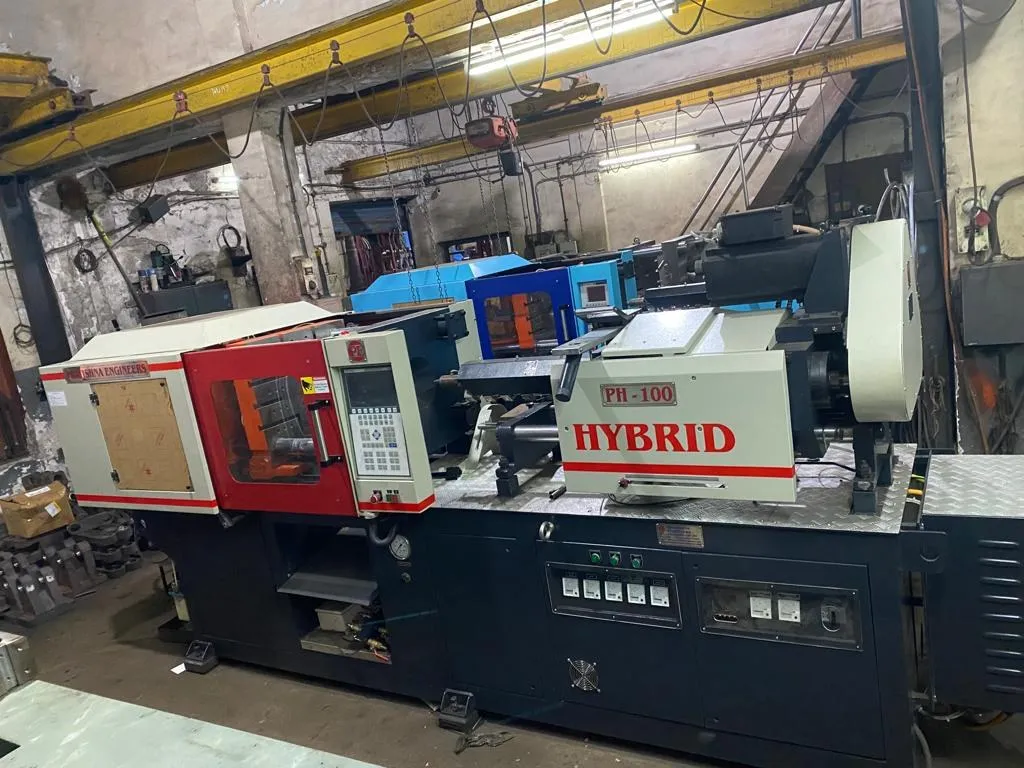
A 120 ton hybrid moulding machine suits small, precise parts in one or many cavities: plastic gears, connectors and switch parts, closures, medical and diagnostic consumables, pen and cosmetic parts, and thin-walled components. The clamp decides how much projected area fits. The electric injection unit is the reason to choose a hybrid, because these jobs are judged on weight and dimensions, shot after shot.
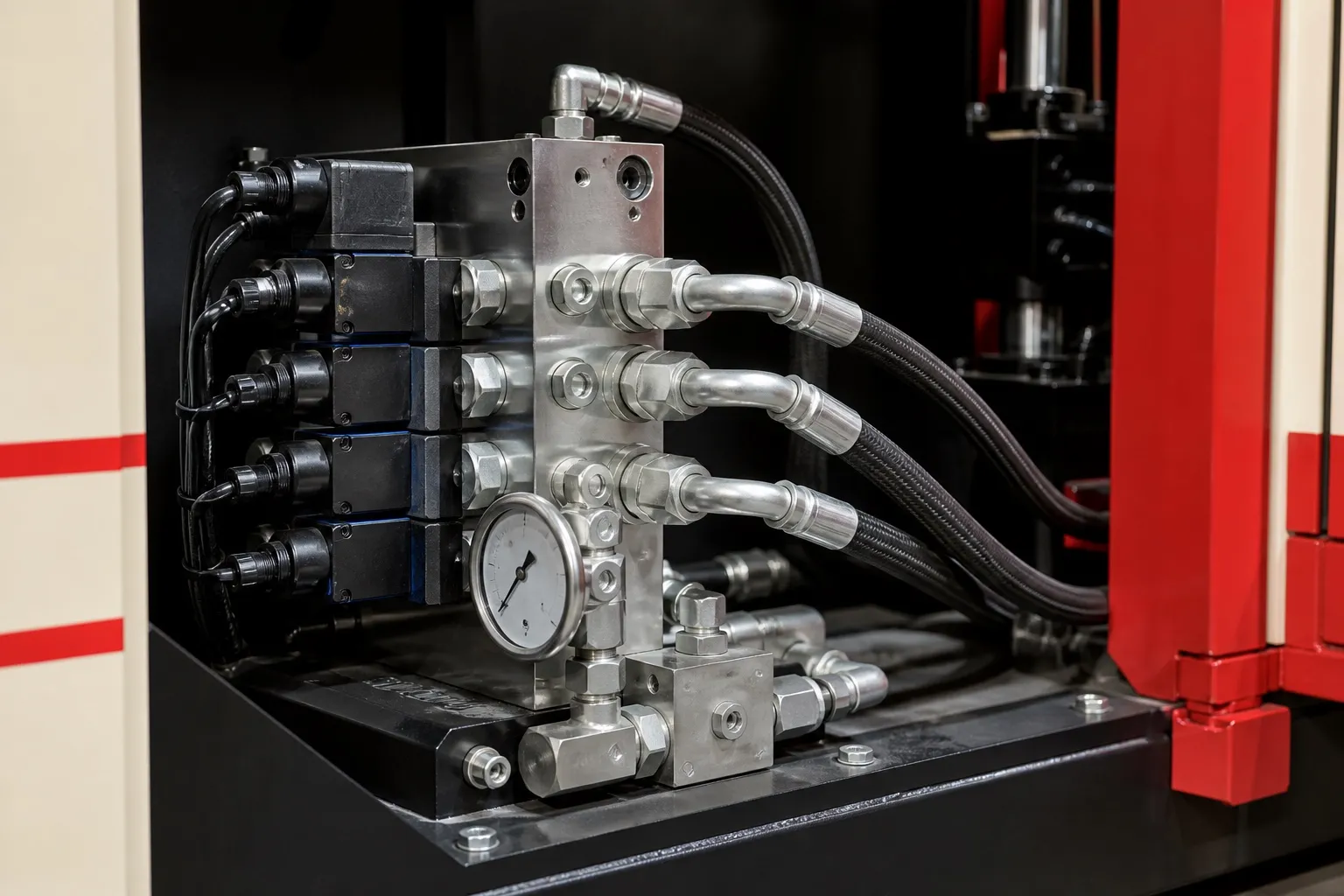
The word hybrid covers several drive combinations. Here it means a servo motor driving the injection screw through a ball screw, with a hydraulic clamp holding the mould shut.
Key Takeaways
- With a 10% reserve, 120 t holds about 388 cm² of projected area at a tonnage factor of 2 US t/in², 194 cm² at 4 and 97 cm² at 8.
- Small multi-cavity precision parts are often limited by cavity balance, shot size and cooling before the clamp runs out.
- A hybrid earns its cost where part weight, size or thin-wall filling must repeat closely; for general parts, a standard machine can do the job.
- Food-contact closures in India need resins that meet the Indian Standards named in the FSSAI packaging regulations.
Which Parts Suit a 120 Ton Hybrid Moulding Machine?
Small parts, often in many cavities, judged on weight or dimensions as much as looks. Gears, connectors, switch parts, closures, diagnostic consumables and thin walls fit that description. If your clamp calculation lands between about 50 and 109 t and tolerance matters, a 120 t hybrid deserves a look.
What these parts share is sensitivity. A gear tooth, a connector latch or a pipette tip can be out of tolerance while looking perfect. The usual causes are a shot that varies in weight, a cavity that fills a fraction later than its neighbour, or packing that changes as the machine warms up.
An electric injection unit moves the screw with a servo motor and ball screw, so screw position and speed follow the set profile from one shot to the next. That is the property you are buying. It helps most where many cavities share one shot and each must come out the same.
Our view is plain: if your part has no tight tolerance, no thin wall and no cavity balance problem, do not pay for a hybrid. A standard hydraulic 120 t machine will make buckets, crates and general housings just as well.
Gears and connectors have their own process demands, from packing time to flame ratings. They are covered in the gears and connectors article in this series.
How Much Projected Area Fits on a 120 t Clamp?
With a 10% reserve, 120 t leaves about 109 t to use. That holds roughly 388 cm² of projected area at a tonnage factor of 2 US t/in², 259 cm² at 3, 194 cm² at 4 and 97 cm² at 8. Stiffer resins and thin walls raise the factor.
Largest total projected area at 120 t with a 10% reserve (calculated)
| Tonnage factor (US t/in²) | Metric factor (t/cm²) | Largest total area | One round part, largest diameter |
|---|---|---|---|
| 2 | 0.281 | 388 cm² | About 222 mm |
| 3 | 0.422 | 259 cm² | About 181 mm |
| 4 | 0.562 | 194 cm² | About 157 mm |
| 5 | 0.703 | 155 cm² | About 141 mm |
| 8 | 1.125 | 97 cm² | About 111 mm |
The method comes from a Plastics Technology column by RJG trainer Jeremy Williams. Take one part's projected area, subtract through-holes, multiply by the cavities and add the full cold-runner area. Multiply by a tonnage factor; he gives 2 to 10 US t/in² as typical and suggests 3 as a starting point.
SPE's Plastics Engineering magazine places polyethylene at the low end of the range, polycarbonate toward the top and PP at 2 to 3. INEOS lists 2 to 4 US t/in² for its Lustran ABS 248, a grade it names for small appliance housings and toys. For POM, PA66 and PBT, ask the resin supplier for a clamp figure on the grade you will use.
The 10% reserve in the table is a starting margin, not a rule. It covers hotter melt, a new resin lot or a partly blocked vent, all of which raise the force pushing the mould open.
When Is a Hybrid Worth It Over a Standard 120 t Machine?
When shot-to-shot consistency, thin-wall filling or balance across many cavities is the hardest part of the job. Electric injection repeats screw speed and position closely, which steadies part weight. When none of those is the difficulty, the extra precision adds cost without improving the parts you sell.
Screw choice matters as much as drive type. A smaller screw gives more melt pressure for thin walls and long flow paths, while a larger one delivers more volume per shot. The trade, with worked figures, is in the screw article in this series.
Power use is the other common reason buyers look at hybrids. Electric injection draws power mainly while the screw moves, but heaters, the hydraulic clamp and auxiliaries still draw their share. The power article in this series compares the two drive types on the same job.
Cycle time follows the part, not the drive. A gear or closure with a thick section still needs its cooling time, so do not expect a hybrid to shorten cycles that cooling controls.
Which Indian Rules Apply to Closures and Consumables?
Food-contact closures and containers must use plastics that meet the Indian Standards listed in the FSSAI Packaging Regulations, 2018, such as IS 10910 for PP and IS 7328 for HDPE. Overall migration is tested to IS 9845, with a limit of 60 mg/kg or 10 mg/dm².
The same regulations require food businesses to hold a certificate of conformity from an NABL lab for packaging in direct food contact. Your customer may therefore ask for the resin supplier's compliance letter before approving a closure mould, so collect it at the quotation stage.
Schedule IV of the regulations suggests PP or HDPE caps for milk, fats and oils and several other food categories, which narrows the resin choice before you size the clamp.
What Should You Send to Check Your Part on 120 t?
Send the part drawing or a sample, the exact resin grade, the cavity count, runner type, mould size and shut height, the tolerance on critical dimensions and your monthly quantity. With those, clamp, shot and mould fit can be checked on paper first. See the 120 ton hybrid injection moulding machine page.
Frequently Asked Questions About a 120 Ton Hybrid Moulding Machine
Can a 120 ton hybrid run PP closures as well as engineering parts?
Yes. The drive type does not limit the resin, so PP and HDPE closures can share the machine with POM gears or PC parts. Plan the changeovers: engineering resins often need drying and hotter moulds, and the barrel must be purged well between resins that should not meet.
Does a hybrid need a different mould from a hydraulic machine?
No. A mould built for a 120 t clamp fits either, provided the platen size, tie-bar space, shut height, locating ring and ejector pattern match. Check those against the machine before ordering a new mould, and against the old machine if you plan to move an existing one.
Is a 120 ton hybrid suitable for medical and diagnostic parts?
It can be, because those parts are usually small, multi-cavity and checked on weight and size. The machine is only one part of it. Cleanliness, mould design, validation and documentation decide whether parts are accepted, so agree those with your customer before choosing the machine.
Why do tonnage factors differ so much between resins?
Stiffer, less free-flowing melts need more pressure to fill, and that pressure pushes the mould open. Flow length, wall thickness, gate size and the number of gates also move the factor. That is why one mould can fit a clamp in PP and need more tonnage in PC.
What if my calculation comes out above 109 t?
Then 120 t has no reserve for your mould. Options include fewer cavities, a hot runner to remove cold-runner area, or a larger clamp. Do not raise the machine to full tonnage and hope; a clamp at its limit turns small process changes into flash and parting-line wear.
Related Articles
- Moulding Precision Gears and Connectors on a 120 Ton Hybrid Machine
- 32 mm or 35 mm Screw on the PH 120: Pressure vs Shot Weight
- Power Consumption of a 120 Ton Hybrid vs Hydraulic Machine
Sources & References
- Plastics Technology, J. Williams (RJG): Clamp Tonnage: More Is Better...Right? (May 2017)
- Plastics Engineering (SPE), A. Urbina: Mastering Clamping Force Calculation (March 2024)
- INEOS ABS via UL IDES: Lustran ABS 248 technical data sheet
- Food Safety and Standards Authority of India: Food Safety and Standards (Packaging) Regulations, 2018, compendium
Technical Disclaimer
Disclaimer: The information provided in this document is for general informational and educational purposes only. It is based on technical references and industry information available at the time of preparation and may be subject to change. It does not constitute engineering, technical, commercial or professional advice, nor does it constitute a quotation, specification, warranty or contractual commitment by Pratishna Engineers.
Actual injection moulding machine and process requirements vary according to the component design, material, mould, production volume, machine configuration and operating conditions. The information, examples, calculations and recommendations provided should be independently evaluated and verified for the specific application before making any equipment, process or production decision. Information obtained from third-party sources remains subject to the accuracy and limitations of those sources.
Limitation of Liability: Pratishna Engineers makes no representation or warranty, express or implied, regarding the completeness, accuracy or suitability of the information for any particular application. To the extent permitted by applicable law, Pratishna Engineers shall not be liable for any loss, damage, cost or consequence arising from reliance on or use of the information contained in this document. Final machine selection, configuration and application suitability should be confirmed with Pratishna Engineers based on complete and accurate project requirements.