






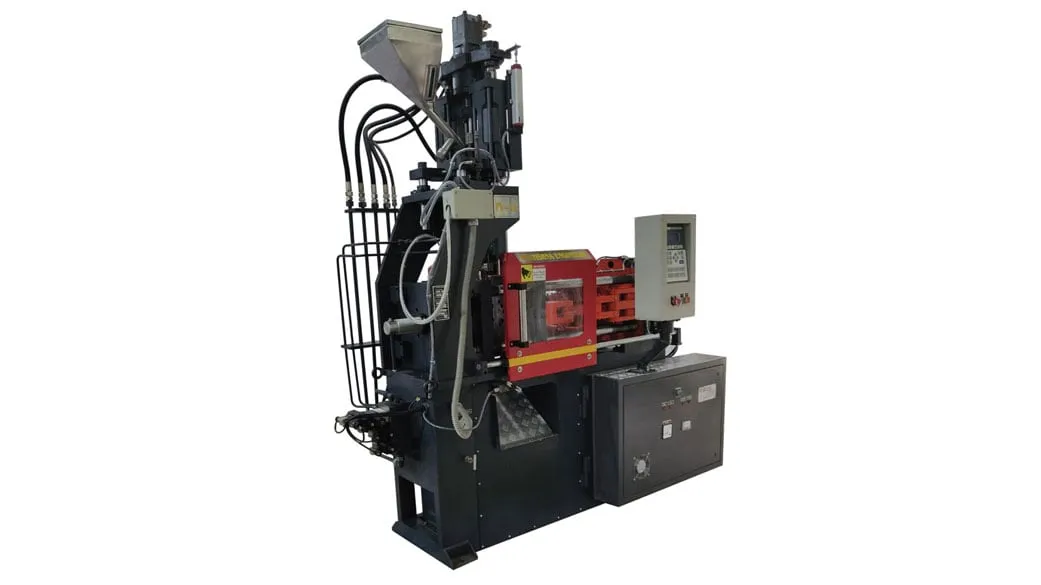

A plant head in Bhiwandi has a new order for 10 litre PP buckets and two machines on the shortlist. Each supplier calls theirs the best plastic moulding machine in Mumbai. Neither claim helps, because the best machine for buckets is the wrong machine for thin-wall cups or insert-moulded terminals.
Best depends on the part: its size, wall, material and volume. This guide gives a decision table by part type, the clamp and barrel checks behind it, and a scorecard you can use with any supplier, including Pratishna Engineers.
Start with your most demanding part, not your average one, because that part sets the clamp, shot and stroke you cannot do without. Every other job on the machine then runs inside those limits. If your hardest part is still on the drawing board, use the largest part you expect to win in the next order cycle and say so in your enquiry.
Key Takeaways
- There is no single best machine; the right one is the smallest that runs your hardest part with clamp, shot and stroke margin.
- Clamp force comes from projected area times a tonnage factor for the material; for PP that factor is about 2 to 3 US tons/in².
- Keep the shot between 25% and 65% of barrel capacity, so the melt stays uniform and recovery stays short.
- Score suppliers on a trial with your mould, service reach and written specifications, not on adjectives in a brochure or a sales call.
Which machine type suits which part?
Match the machine type to the part before you compare suppliers. Thin-wall packaging needs fast injection and a stiff clamp, insert parts suit vertical machines with loading tables, large buckets and crates need long stroke and wide tie bars, and precision electrical parts need stable injection control.
Decision table by part type, size and material (starting point for shortlisting)
| Part type | Typical material | Machine type to shortlist | What decides it |
|---|---|---|---|
| Thin-wall containers and lids | High-flow PP | Horizontal with fast injection and fast clamp | Injection speed, platen stiffness, barrel not oversized |
| Buckets, crates, large housings | PP impact copolymer, HDPE | Horizontal toggle or two-platen | Opening stroke, tie-bar distance, mould weight |
| Insert and overmoulded parts | PA, PBT, PP, TPE | Vertical with shuttle or rotary table | Loading access, insert placement time |
| Electrical switches and housings | PC, FR grades, PA | Horizontal with closed-loop injection | Shot repeatability, mould temperature control |
| Toys and small consumer parts | ABS, PP | Horizontal, general purpose | Clamp per cavity, cycle, colour changes |
| PET preforms | PET bottle grades | Dedicated PET machine | Drying, barrel design, preform handling |
Size narrows the choice further. The mould must fit between the tie bars, its height must sit inside the machine's mould height range, and the opening stroke must let the part drop or be picked clear. Check all three from the mould drawing before you look at clamp force.
Material narrows it again. Glass-filled grades wear screws faster, PVC needs a melt path without dead spots, and PET needs drying and a dedicated barrel design. The table only tells you which machine family to ask suppliers about; the next sections cover clamp and material checks in detail.
Volume decides how much speed is worth building in. A job that runs a few thousand parts a month gains little from a high-speed build, while a round-the-clock packaging line repays every tenth of a second saved. Count your yearly hours on the hardest job first.
How do part size and projected area decide the clamp?
Clamp force must hold the mould shut against cavity pressure across the projected area of all cavities and the runner. Multiply that area by a tonnage factor for your material, add a reserve, and you have the clamp requirement. Undersized machines flash; oversized ones waste floor and power.
Tonnage factors run from 2 to 8 US tons per square inch depending on material. Polyethylene sits at the low end, polycarbonate toward the high end, and PP at 2 to 3. Without better data, a cavity pressure of 400 bar can serve as a guide value.
The factor moves with the part as well as the resin. Melt flow, flow length, wall thickness, gate location and size, the number of gates and the resin volume all push it up or down. A long, thin flow path needs a higher factor than a short, thick one.
Convert units with care. One US ton per square inch equals about 0.141 metric tonnes per square centimetre, so factor 2 is about 0.281 t/cm² and factor 3 about 0.422 t/cm². The worked example at the end of this page applies these figures to a round PP container.
How does the material change the screw and barrel you need?
Material decides the shot window, the screw design, the barrel temperatures and the drying you need. Size the barrel so your shot uses 25% to 65% of its capacity, check the resin's melt and mould temperatures, and confirm whether it needs drying before it reaches the hopper.
Below 25% of barrel capacity, the melt is often poorly mixed because the screw turns too few times per shot. Above 65%, unmelted pellets, poor uniformity and long recovery appear. Machine shot ratings are usually given in grams of polystyrene, so convert your resin to volume before you compare.
Take an Indian PP homopolymer such as Reliance Repol H110MAS, used for rigid packaging, furniture and houseware. Its datasheet gives MFR 11 g/10 min, melt 200 to 250 °C and mould 20 to 50 °C, and states compliance with IS 10910 for food contact. Those figures set the heater and chiller duty.
ABS behaves differently. A grade such as Lustran ABS 248 needs drying at 71 to 88 °C for 2 to 4 hours to below 0.10% moisture, so a hopper dryer belongs in the machine package. Flat opinion: a machine bought without a dryer and chiller sized for the resin is not ready to run.
What makes the best plastic moulding machine in Mumbai for your part?
The best plastic moulding machine in Mumbai for your part is the one that passes a trial on your mould, meets the clamp, shot and stroke requirement with margin, and comes with service close enough to reach your plant quickly. Score each shortlisted supplier on the same criteria.
Supplier scorecard (score each row 1 to 5; the weights are suggestions, edit them for your job)
| Criterion | What to ask for | Suggested weight |
|---|---|---|
| Fit to part | Clamp and shot calculation for your part | 25% |
| Trial result | Trial report on your mould or the nearest match | 25% |
| Service reach | Who attends breakdowns and how they reach you | 20% |
| Specification clarity | Written specification annexed to the order | 15% |
| Documents and spares | Drawings, manuals, spares list | 15% |
Fill the scorecard from documents, not conversation. A supplier who will not show the clamp calculation or a trial report scores low on fit, however good the machine looks on the floor. Missing data is a score in itself. Keep the filled scorecards with the order file, so the reasons for the choice are on record when the next machine is bought.
Visit at least one plant where a similar machine runs a similar part, and ask the plant team about uptime, spares and how fast faults were fixed. Ask to see the size you plan to buy, and talk to the person who maintains it, not only the owner. A reference visit tells you more than a demonstration on a mould the supplier chose.
Do not let a single word in a title, including best, carry the decision. Rank by the scorecard, run the trial with the top two, and decide on the evidence. If two suppliers tie, choose the one whose trial report is more complete.
Pratishna Engineers machines by part type
Pratishna Engineers, founded in Mumbai in 1991, builds horizontal, vertical, vertical-horizontal combination, hydro-mechanical and hybrid injection moulding machines, with product pages for two-platen, PET and special purpose machines. Design, manufacturing, assembly, testing and service are done in house, and every enquiry starts with the component, then material, mould, production requirement and machine configuration.
The clamp ranges below, as given in the series data, show which family to ask about first. Confirm screw diameter, shot weight and platen size for your part from the series data sheet, one model at a time.
- Horizontal machines: E series 75 to 165/180 t, C series 125 to 320 t and H series 120 to 320 t mould clamping force.
- PHM two-platen series 160 to 350 t for large moulds, Hybrid (PH) series 120 to 140 t with hydraulic locking and electric injection, and PV and PVDL vertical series for insert work.
What should you send for a machine recommendation?
Send your hardest part: drawing or sample, resin grade, wall thickness, number of cavities, mould dimensions and monthly volume. A maker can then run the clamp and shot checks and suggest a trial. Use the scorecard above on every reply you receive. Browse the injection moulding machine range by type.
Frequently Asked Questions About Choosing a Plastic Moulding Machine
Is there one best plastic moulding machine for every job?
No. A machine that suits thin-wall cups has fast injection and a stiff clamp, while a crate machine needs long stroke and wide tie bars. Each is poor at the other's job. Pick the machine for your hardest regular part, then check that it runs the rest of your mix.
What tonnage factor should I use for PP?
For PP, a factor of 2 to 3 US tons per square inch of projected area is the usual starting range. Use the higher end for thin walls, long flow paths or small gates, and the lower end for short, thick flows. Confirm the figure with the resin supplier for your grade.
Can one machine run both PP and ABS parts?
Yes, if the clamp, shot and barrel sizes suit both parts and you add the right auxiliaries. ABS needs drying before moulding, while PP generally does not. Check the shot window for each part on the same barrel, and plan purging and colour changes into the schedule.
How do I compare two suppliers fairly?
Give both the same part data and ask for the same outputs: clamp and shot calculation, specification sheet, trial report and service plan. Score each on one scorecard and visit one reference plant for each. Two proposals written for two different briefs cannot be compared in any useful way.
Does a bigger machine give better parts?
Not by itself. An oversized barrel holds resin longer and can degrade it, and a clamp far above the need uses more floor and power without improving the part. Size the machine to the part with a modest reserve, and spend the difference on mould cooling and auxiliaries.
Which Pratishna Engineers series should I look at first?
Start from the part. Horizontal E, C and H series cover 75 to 320 t clamping force, PHM two-platen covers 160 to 350 t for large moulds, and PV and PVDL vertical series suit insert work. Send your part data and the team will check clamp, shot and stroke.
Related Articles
- Buy Injection Moulding Machine in Mumbai
- Automatic Injection Moulding Machines in Mumbai
- High-Speed Plastic Moulding Machines in Mumbai
- Plastic Injection Moulding Machine Supplier in Mumbai
Sources & References
- SPE Plastics Engineering, A. Urbina: Mastering Clamping Force Calculation (Mar 2024)
- Plastics Technology, J. Bozzelli: Revisiting Shot Size vs. Barrel Capacity (Jan 2020)
- Reliance Industries: Repol H110MAS Technical Data Sheet (July 2024)
- INEOS ABS via UL IDES: Lustran ABS 248 datasheet
Technical Disclaimer
Disclaimer: The information provided in this document is for general informational and educational purposes only. It is based on technical references and industry information available at the time of preparation and may be subject to change. It does not constitute engineering, technical, commercial or professional advice, nor does it constitute a quotation, specification, warranty or contractual commitment by Pratishna Engineers.
Actual injection moulding machine and process requirements vary according to the component design, material, mould, production volume, machine configuration and operating conditions. The information, examples, calculations and recommendations provided should be independently evaluated and verified for the specific application before making any equipment, process or production decision. Information obtained from third-party sources remains subject to the accuracy and limitations of those sources.
Limitation of Liability: Pratishna Engineers makes no representation or warranty, express or implied, regarding the completeness, accuracy or suitability of the information for any particular application. To the extent permitted by applicable law, Pratishna Engineers shall not be liable for any loss, damage, cost or consequence arising from reliance on or use of the information contained in this document. Final machine selection, configuration and application suitability should be confirmed with Pratishna Engineers based on complete and accurate project requirements.

