






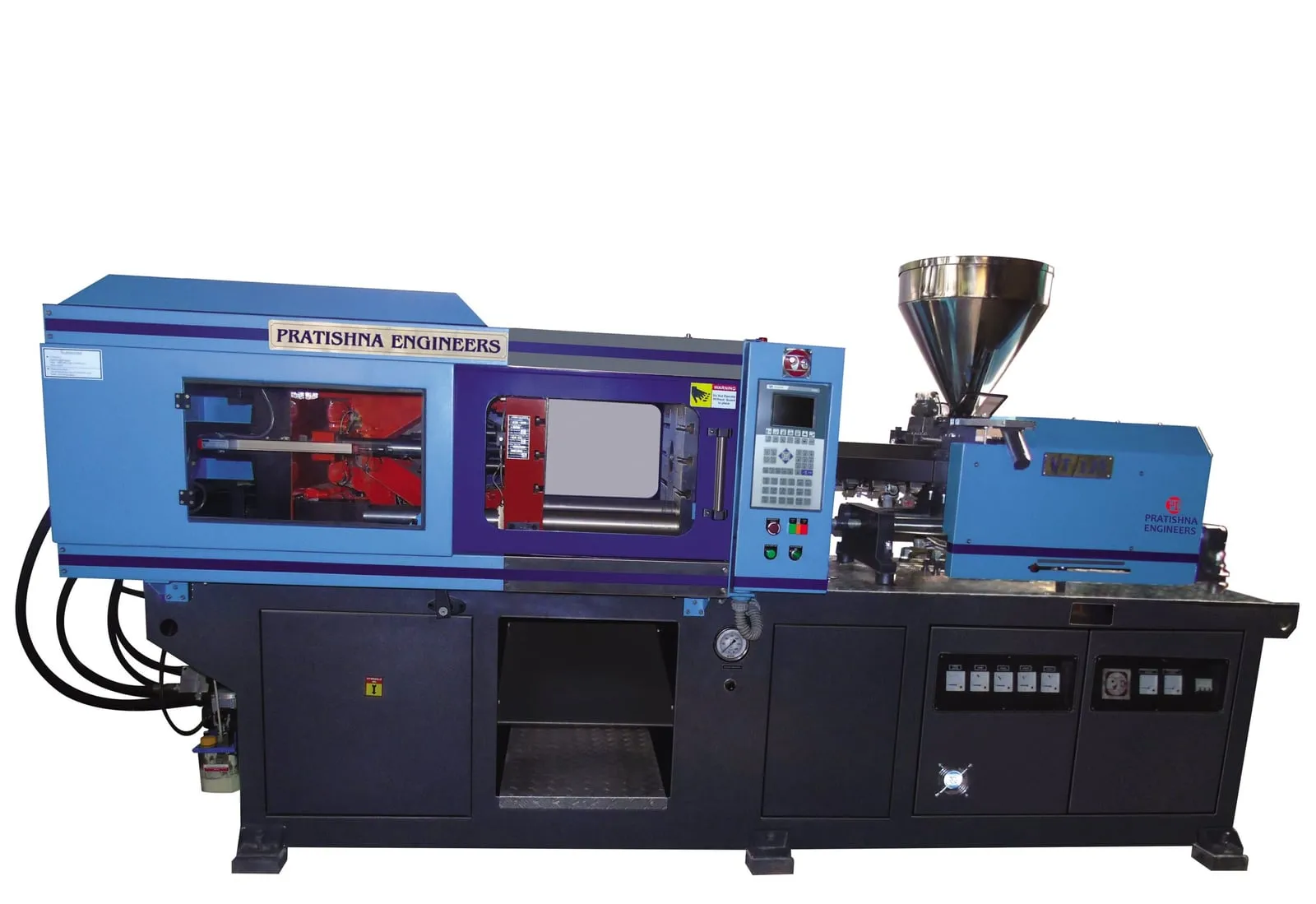

Before you shortlist high speed plastic moulding machines, test each one against your thinnest part on five points.
Injection speed: can the unit fill the cavity in under one second?
Injection pressure: is there margin above what the mould needs at that speed?
Clamp speed: is the dry cycle short, with fast open and close?
Platen stiffness: are the platens thick enough not to bow at high tonnage factors?
Barrel size: will your shot use at least 40% of the barrel?
A machine that fails one point will not hold a fast cycle for long, whatever its rated tonnage. Pratishna Engineers builds horizontal and hybrid machines in Mumbai, and each check is explained below with the figures behind it. If you already run thin-wall parts, use your best current machine as the benchmark for each line.
Key Takeaways
- Thin-wall parts often need fill times under one second and injection velocities above 76 mm/s, so injection speed matters more than tonnage.
- Thin-wall clamps work at 5 to 8 US tons/in² against 3 to 5 for conventional parts, which means stiffer platens and stronger moulds.
- Pick a barrel your shot fills to at least 40%. An oversized barrel lowers the pressure boost and lets the melt degrade.
- Do not convert a general-purpose machine into a thin-wall machine. Specify speed, pressure and platen stiffness from the start.
How fast must the injection unit be for thin-wall parts?
For true thin-wall parts, plan on injection velocities above 3 in/s, about 76 mm/s, with many jobs at 6 in/s, about 152 mm/s, and fill times under one second. The unit must also hold high pressure at that speed, often above 30,000 psi.
The reason is flow length. Thin-wall designs typically run flow length to wall thickness ratios of 100:1 to 200:1. The melt starts freezing against the cold steel as soon as it enters, so a slow fill leaves short shots at the far end of the part.
Pressure follows speed. A pressure above 30,000 psi is about 2,109 kg/cm², well beyond what many general-purpose units deliver at full speed. Ask for the injection rate and the pressure available at that rate, not the two maximums quoted on their own.
Control resolution also matters at these speeds. Better thin-wall controllers resolve speed to 0.04 in/s, pressure to 1 bar and time to 0.01 s. Coarser steps turn a fill window of a few tenths of a second into a guess.
Check the hydraulic side behind the speed figure. Ask whether the rated injection speed is reached with a full shot against a real mould, and whether it holds shot after shot once the oil is at running temperature.
Thin-wall and conventional moulding compared on machine demands
| Demand | Thin-wall | Conventional |
|---|---|---|
| Clamp factor | 5 to 8 US tons/in² (0.703 to 1.125 t/cm²) | 3 to 5 US tons/in² (0.422 to 0.703 t/cm²) |
| Injection pressure | Typically above 30,000 psi (about 2,109 kg/cm²) | Lower, set by part and resin |
| Fill time | Under 1 s | Longer |
| Dry cycle | 1 to 2.5 s | 3 to 5 s |
| Shot share of barrel | At least 40% | 25% to 65% window |
Why do clamp speed and dry cycle matter on high speed plastic moulding machines?
Clamp movement is dead time in every cycle. A thin-wall machine should dry cycle in about 1 to 2.5 s, against 3 to 5 s for general work. When cooling is short, a slow clamp can take a large share of the cycle and cap your output.
Cooling still sets the floor. Cooling time depends most on wall thickness, which is squared in the cooling equation. In an RJG trial on a 3.3 mm ABS part, about 85% of the cycle was cooling. A wall 20% thinner needs about 36% less cooling time, since 0.8² is 0.64.
So as walls get thinner, the non-cooling parts of the cycle start to dominate: clamp close, lock-up, injection, mould open and ejection. That is why thin-wall machines tend to use accumulator-assisted clamps for fast movement.
Clamp type plays a smaller role than many buyers expect. Some suppliers claim a toggle locks up in about 0.2 s against 0.5 s for a hydraulic clamp. Ask for measured dry cycle times at your mould weight and opening stroke instead of comparing claims.
Part removal and mould cooling count too. If a robot or picker needs a second or more to clear the mould area, that time adds to every cycle. Cooling channels and chiller capacity must also remove heat as fast as the machine cycles, or parts warp.
How stiff should the platens be for fast, thin-wall moulding?
Thin-wall machines need extra-thick platens because the clamp works at 5 to 8 US tons/in² instead of 3 to 5. On better machines, the tie-bar distance to platen thickness ratio is 2:1 or less. Thin platens bow, and bowing shows up as flash.
Run the ratio on any quote. With a 560 mm gap between tie bars, the 2:1 guide asks for a platen at least 280 mm thick. Ask the supplier for platen thickness on the general arrangement drawing, since brochures rarely list it.
The mould has to carry the same load. Thin-wall moulds use steels harder than P-20, thicker plates, as many heavy support pillars as will fit and interlocks between halves. A stiff platen cannot rescue a mould plate that flexes in the middle. Ask what mould size the platen is meant to carry at full tonnage, because a small mould on a large platen loads the centre.
Venting and ejection also change at speed. Demanding parts vent core pins and ejector pins as well as the parting line, because air has very little time to escape. A common rule of thumb is to double the number of ejector pins and make each twice as large.
What barrel size suits a fast, thin-wall shot?
Choose the smallest barrel that holds your shot with margin, so the shot uses at least 40% of its capacity. Thin-wall machines often carry a smaller barrel than a general-purpose machine of the same tonnage, because a big barrel gives less pressure boost and holds melt too long.
Barrel ratings are usually quoted in grams of polystyrene, so convert your shot to volume first. PP melt density is about 0.74 g/cm³ against 0.945 for PS, so the same barrel holds less PP by weight. Add about 10% for check-valve leakage and melt uniformity.
The resin must also suit speed. Thin-wall work needs high flow and must handle shear heating of 50,000 s⁻¹ or more. In India, Reliance lists Repol H200MA, a PP homopolymer with an MFR of 25 g/10 min, for thin-walled containers and multicavity moulds.
Avoid the opposite error too. Shots below about 20% of barrel capacity sit in the barrel for long periods and degrade, which adds black specks and brittle parts. Screw design matters as well: ask for the screw L/D and the recovery rate at your shot size, since a short cycle leaves little time for the screw to melt the next shot evenly.
How does Pratishna approach high-speed moulding jobs?
Pratishna Engineers has built injection moulding machines in Mumbai since 1991. Its range covers horizontal E, C and H series machines, PH hybrid machines with hydraulic locking and electric injection, and special purpose builds for specific parts.
A high-speed job starts from the part, not from a catalogue model. Design, manufacturing, assembly, testing and service are all done in-house, so speed, barrel and platen questions are answered by the same team that builds the machine. Share the mould drawing early, since platen size, tie-bar space and mould stiffness have to match.
- Selection order: Component, Material, Mould, Production Requirement, then Machine Configuration.
- Send your thinnest wall, flow length, resin grade and target cycle so injection rate and barrel size can be checked first.
What should you send for a high-speed machine review?
Send the part drawing with wall thickness and flow length, the resin grade, cavity count, shot weight and the cycle you need to hit. Those five inputs decide injection rate, clamp factor and barrel size. If you have a sample part or a current cycle record, include it. Browse the injection moulding machine range to see the series available.
Frequently Asked Questions About High-Speed Moulding Machines
What makes a part thin-wall for machine selection?
The flow length to wall thickness ratio matters more than the wall alone. Thin-wall designs typically sit at 100:1 to 200:1. At those ratios the melt must fill very fast before it freezes, which pushes injection speed, pressure and clamp factor well above conventional work.
Can I make a standard machine faster by adding an accumulator?
An accumulator can speed up injection or clamp movement, but speed is only one demand. Thin-wall work also needs higher pressure, stiffer platens, finer control and a suitably small barrel. Adapting a conventional machine for thin wall is usually not a wise idea, so specify a suitable machine instead.
Does a faster machine always give a shorter cycle?
No. Cooling time usually sets most of the cycle, and it depends on wall thickness squared. A faster clamp helps most when walls are thin and cooling is short. On thick parts, mould cooling design will cut more time than extra machine speed.
Why does barrel size affect injection pressure?
On the same injection unit, plastic pressure scales with the inverse of screw diameter squared. A larger screw gives more shot volume but less pressure. For thin-wall parts that need high pressure at high speed, a smaller barrel that the shot fills to at least 40% is usually the better choice.
Which resins suit high-speed thin-wall moulding?
High-flow grades with low melt viscosity that tolerate high shear heating suit this work. For PP, look at grades the resin maker lists for thin-walled containers and multicavity moulding, and confirm melt temperature and mould temperature ranges on the technical data sheet before trials.
What control resolution should a thin-wall machine offer?
Better thin-wall machines resolve injection speed to 0.04 in/s, pressure to 1 bar, position to 0.004 in and time to 0.01 s. Fine resolution lets you repeat a fill that lasts only a fraction of a second, shot after shot, without drifting into short shots or flash.
Related Articles
- Two-Platen Injection Moulding Machine Manufacturer in India
- Plastic Injection Moulding Machine Supplier in Mumbai
- Servo Driven Injection Moulding Machine
- Automatic Injection Moulding Machines in Mumbai
Sources & References
- PlasticsToday, G. Tremblay: Never too thin
- MoldMaking Technology, B. Catoen: Machine Sizing and Specification for Optimal Mold Performance, Part 1 (Aug 2025)
- RJG Inc.: How to Determine Injection Molding Cooling Time (Mar 2021)
- Reliance Industries: Repol H200MA TDS (July 2024)
Technical Disclaimer
Disclaimer: The information provided in this document is for general informational and educational purposes only. It is based on technical references and industry information available at the time of preparation and may be subject to change. It does not constitute engineering, technical, commercial or professional advice, nor does it constitute a quotation, specification, warranty or contractual commitment by Pratishna Engineers.
Actual injection moulding machine and process requirements vary according to the component design, material, mould, production volume, machine configuration and operating conditions. The information, examples, calculations and recommendations provided should be independently evaluated and verified for the specific application before making any equipment, process or production decision. Information obtained from third-party sources remains subject to the accuracy and limitations of those sources.
Limitation of Liability: Pratishna Engineers makes no representation or warranty, express or implied, regarding the completeness, accuracy or suitability of the information for any particular application. To the extent permitted by applicable law, Pratishna Engineers shall not be liable for any loss, damage, cost or consequence arising from reliance on or use of the information contained in this document. Final machine selection, configuration and application suitability should be confirmed with Pratishna Engineers based on complete and accurate project requirements.

