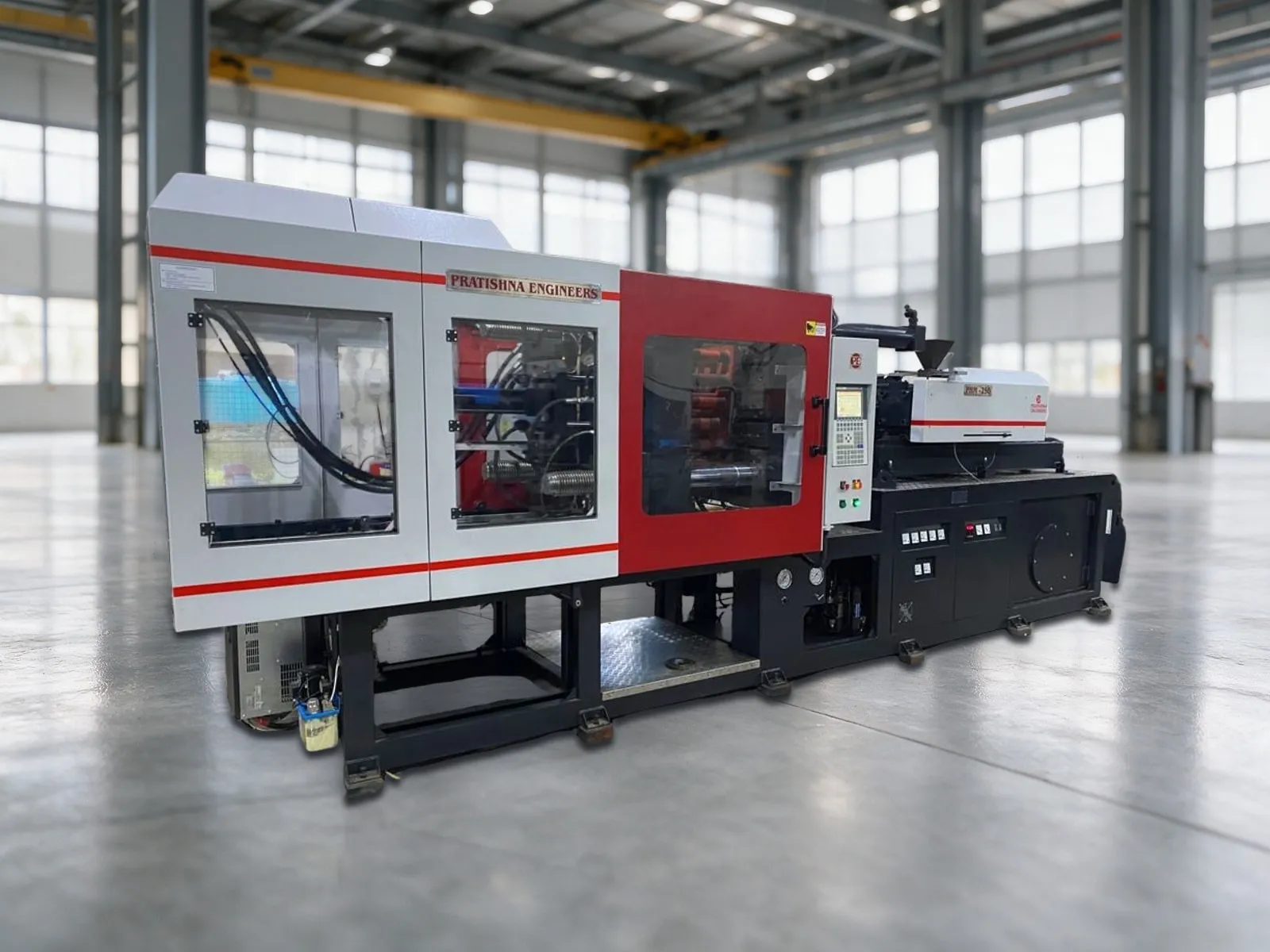
Can a 250 t battery container moulding machine also run appliance housings? Yes, one part per shot in most cases. The table gives the area each part type can use at 250 t, with a 10% reserve (a starting margin, not a rule).
Part types at 250 t with a 10% reserve (sizes are assumed examples; tonnage factors from the sources cited)
| Part | Resin and factor (US t/in²) | Largest area at 250 t | Example |
|---|---|---|---|
| Starter battery container | PP copolymer, 2 to 3 | 539 to 809 cm² | 240 × 175 mm (420 cm²) needs 130 t to 195 t, one cavity |
| Inverter or tubular battery container | PP copolymer, 2 to 3 | 539 to 809 cm² | 500 × 220 mm (1,100 cm²) needs 340 t to 511 t, beyond 250 t |
| Battery lid | PP copolymer, 2 to 3 | 539 to 809 cm² | Same outline as its container, so the same clamp |
| Small appliance housing | ABS, 2 to 4 | 404 to 809 cm² | Factor rises with thin walls and long flow |
| Housing in general-purpose PC | PC, 3 to 5 | 323 to 539 cm² | Needs drying and a hot mould |
Starter battery containers and most small housings fit. Large inverter battery containers, with footprints well over 1,000 cm², point to a bigger clamp.
Key Takeaways
- A starter battery container of about 240 × 175 mm needs about 130 t to 195 t, so one cavity fits 250 t and two do not.
- Battery case PP must give dimensional and heat stability, impact resistance and good weldability for the lid seal.
- ABS housings need drying to below 0.10% moisture and a mould at 43 to 66 °C for the grade cited here.
- Irons, immersion heaters, stoves and room heaters to IS 302 are under compulsory BIS certification in India.
What Clamp Does a Battery Container Moulding Machine Need?
Enough for the container's outline at a PP factor near the top of the 2 to 3 range. A battery box has deep cells divided by thin partitions, so melt travels far through narrow walls, and that raises the pressure the mould must hold shut.
The applications article in this series explains the clamp method step by step. For battery containers, the outline is the whole footprint, because the cells open on one face and the partitions add no projected area of their own. The lid has the same outline but a far shallower draw.
Wall ratio is the warning sign. RJG's John Williams, writing in Plastics Technology, notes that a flow length to wall ratio below 150:1 carries a low risk of short shots, sinks and dimensional problems. Long, thin partitions can approach that ratio, so a battery mould needs gates placed to shorten the flow.
What Does a Battery Case Demand From the Resin and the Mould?
Battery cases need PP that holds its size and shape under heat, survives impact and welds well, because the lid is sealed to the container rim. LyondellBasell lists these properties for starter, traction and stationary battery cases, including AGM types and forklift and emergency batteries.
It adds that grades can be formulated for extended heat stabilisation and better resistance to stress whitening. For the moulder, weldability means a flat, consistent rim from shot to shot. Flash or a warped rim on a container shows up later as a poor lid seal.
Deep cells also make ejection hard. P. Thal's MoldMaking Technology article advises locating ejection at the deepest areas of the part, using as much ejection surface as reasonable and avoiding knockout pins below about 1.2 mm. Blades suit thin partitions but wear faster than pins, so fit them as inserts.
The opening must clear the full cell depth. How much opening a tall part needs, and how mould height reduces it on a two-platen clamp, is covered in the stool article in this series.
What Changes When the Same Machine Runs Appliance Housings?
Drying, mould temperature and surface finish. Battery PP needs little drying, while ABS and PC housings need a dryer, a hotter mould and tighter control of regrind. A housing is judged by its face, so gloss and sink marks matter as much as dimensions.
INEOS's datasheet for Lustran ABS 248, a grade with small appliance housings among its typical applications, gives a clamp range of 2.0 to 4.0 US t/in². It asks for drying at 71 to 88 °C for 2 to 4 hours to below 0.10% moisture, a melt of 246 to 266 °C, a mould of 43 to 66 °C and no more than 20% regrind.
General-purpose PC sits higher still, at 3.0 to 5.0 US t/in² on one Makrolon datasheet, with drying at 121 °C for 4 hours. At factor 5, the area limit at 250 t with a 10% reserve falls to about 323 cm².
The same datasheet suggests a shot of 50% to 75% of barrel capacity for that ABS grade, narrower than the general window. Barrel sizing is explained in the stool article in this series.
Which Indian Rules Apply to Appliance Housings?
The housing itself is not certified, but the appliance often is. BIS lists irons, immersion heaters, stoves and room heaters under IS 302 parts in its compulsory certification scheme, so the finished product needs the ISI mark under a Quality Control Order.
BIS places these under the Electrical Wires, Cables, Appliances and Protection Devices and Accessories (Quality Control) Order, 2003. Switches to IS 3854 sit on the same list. The appliance maker carries the certificate, but the housing resin, wall and moulding quality feed into the tests the product must pass.
Our view: for a battery container, judge the machine and mould by the rim, not by the clamp figure. A container that fills at 195 t but gives a rim that varies shot to shot will fail at the lid seal, and no amount of spare tonnage fixes that.
What Should You Send for a Battery Container or Housing Check?
Send the outline size, cell depth, partition thickness, part weight and resin grade for each part, plus the lid drawing and any cosmetic surface requirements. Clamp, opening, ejection and barrel can then be checked together. See the 250 ton two platen injection moulding machine page.
Frequently Asked Questions About Battery Containers and Housings
Why is PP used for battery containers?
Battery case PP is chosen for dimensional and heat stability, impact resistance and good weldability, as one resin maker's battery case page sets out. Weldability matters because the lid is sealed to the container rim. Grades can also be formulated for longer heat stabilisation and resistance to stress whitening.
Can the container and lid run in the same mould?
They can run as a family mould if the combined projected area fits the clamp and both parts fill evenly. In practice the container is far deeper and heavier than the lid, so fill and cooling differ. Separate moulds give better control of the rim and the lid seal.
Do battery container moulds need a hot runner?
Not necessarily. A hot runner saves the runner weight and can place gates where the deep cells need them, but adds cost and zones to control. If the containers use recycled PP blends, resin suppliers advise cold runners, because small metal particles in recycled pellets can plug hot tips.
Can one 250 t machine switch between battery containers and ABS housings?
Yes, with a purge between resins, a dryer for the ABS and a mould temperature controller able to reach the ABS window. Plan changeovers in blocks rather than daily, because each switch costs purge material, heating time and first-off checks on the housing's cosmetic face.
What causes stress whitening on a battery container?
Stress whitening shows where PP is strained hard, often at ejection on deep cells or where the part sticks to the core. Better draft, more ejection area at the deepest points and a grade formulated for stress whitening resistance all help. Check ejector placement before changing the resin.
Related Articles
- What Can You Make on a 250 Ton Two Platen Machine?
- Moulding Plastic Stools on a 250 Ton Two Platen Machine
- Balanced Clamping and Flash Control on Large Flat Parts
Sources & References
- LyondellBasell: Battery cases (application page)
- INEOS ABS via UL IDES: Lustran ABS 248 datasheet
- MoldMaking Technology, P. Thal (Thal Precision): Three Key Decisions for an Optimal Ejection System
- Bureau of Indian Standards: Scheme I (ISI Mark Scheme): products under compulsory certification
Technical Disclaimer
Disclaimer: The information provided in this document is for general informational and educational purposes only. It is based on technical references and industry information available at the time of preparation and may be subject to change. It does not constitute engineering, technical, commercial or professional advice, nor does it constitute a quotation, specification, warranty or contractual commitment by Pratishna Engineers.
Actual injection moulding machine and process requirements vary according to the component design, material, mould, production volume, machine configuration and operating conditions. The information, examples, calculations and recommendations provided should be independently evaluated and verified for the specific application before making any equipment, process or production decision. Information obtained from third-party sources remains subject to the accuracy and limitations of those sources.
Limitation of Liability: Pratishna Engineers makes no representation or warranty, express or implied, regarding the completeness, accuracy or suitability of the information for any particular application. To the extent permitted by applicable law, Pratishna Engineers shall not be liable for any loss, damage, cost or consequence arising from reliance on or use of the information contained in this document. Final machine selection, configuration and application suitability should be confirmed with Pratishna Engineers based on complete and accurate project requirements.