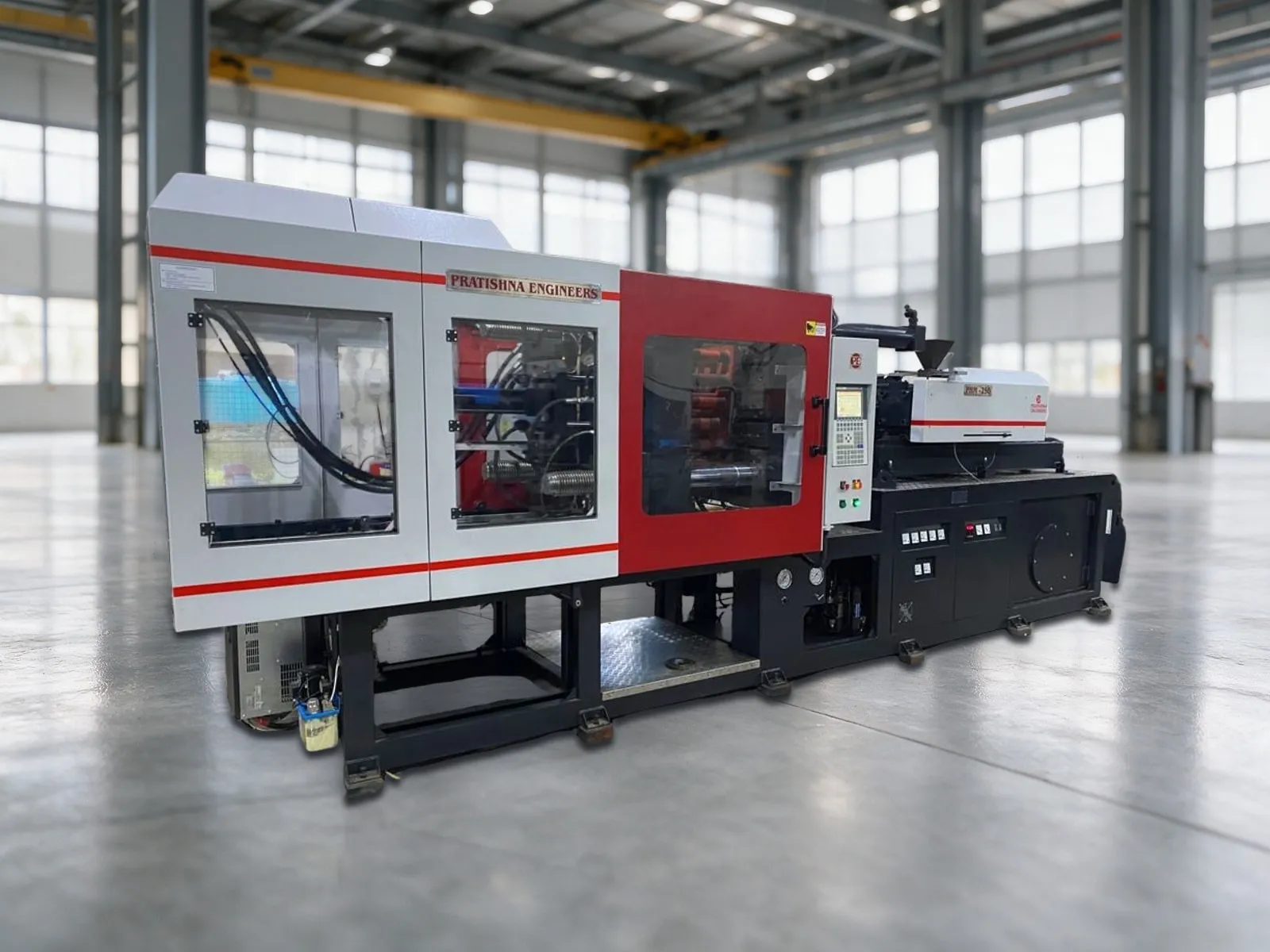
A unit adds a heavier stool to its range. The clamp holds the seat shut with room to spare, but the screw runs almost to the end of its stroke, recovery stretches the cycle and grey streaks of unmelt appear on the legs. On a plastic stool making machine, the barrel can run out before the clamp does.
A 250 t two-platen machine suits one stool per shot: the clamp carries a seat outline of about 539 to 809 cm² in PP, and the long opening lets the legs clear the core. Whether it suits your stool depends on three checks: seat area, shot weight and stool height.
Key Takeaways
- Clamp follows the seat outline, with hand holes deducted and any leg area outside the seat added.
- A 700 g PP stool needs a barrel rated at least about 1,513 g PS to stay within 65% of capacity.
- Cooling time grows with the square of wall thickness, so thick leg junctions set the cycle.
- Indian PP impact copolymers listed for furniture trade stiffness for impact, so match the grade to the load.
What Does a Plastic Stool Making Machine Need at 250 t?
A clamp that covers the seat outline, a barrel big enough for the shot and enough opening for the stool's height. With a 10% reserve, 250 t carries about 539 to 809 cm² of PP area, enough for a round seat of about 280 mm at lower factors.
Clamp needed for one stool per shot by seat outline (sizes assumed; PP factor 2 to 3 US t/in²; 10% reserve; openings not deducted)
| Seat outline | Projected area | Clamp needed | Fits 250 t? |
|---|---|---|---|
| Round, 260 mm | 531 cm² | 164 t to 247 t | Yes, across the PP range |
| Round, 280 mm | 616 cm² | 190 t to 286 t | Up to about factor 2.6 |
| Round, 300 mm | 707 cm² | 219 t to 328 t | Up to about factor 2.3 |
| Square, 300 × 300 mm | 900 cm² | 278 t to 418 t | No, a larger clamp is needed |
The clamp method is set out in the applications article in this series. For a stool, the projected area is the seat outline seen from the parting line, less any hand hole or drain holes through the seat, plus any part of the legs that splays beyond the seat edge.
How Big a Barrel Does a Stool Need?
Big enough that the shot uses no more than 65% of the barrel, and small enough that it uses at least 20 to 25%. Work in volume, because barrels are rated in grams of PS and PP melt is lighter, so the same barrel holds fewer grams of PP.
John Bozzelli's Plastics Technology articles set out the window. Below about 20% of capacity, residence time grows and the melt can degrade; above 65%, unmelt, poor melt uniformity and long recovery appear. He gives melt densities of 0.945 g/cm³ for PS and about 0.74 g/cm³ for PP, and adds 10% for check-valve leakage and melt uniformity.
Put together, a barrel rated R grams of PS gives a good PP shot of about 0.142 × R to 0.463 × R. Bozzelli also warns against buying the biggest screw by default, because big screws usually mean lower plastic pressure, and notes that a second barrel ordered with a new machine can cost little.
That second barrel can make sense where one machine runs heavy stools and lighter parts such as lids. A barrel sized for the stool can leave a light lid well below 20% of capacity.
How Long Does a Stool Cycle Take?
It depends mostly on the thickest section, because cooling usually takes most of the cycle. RJG's guide says wall thickness is squared in the cooling equation; in its trial on an ABS part, about 85% of the cycle was cooling. Thick leg junctions hold heat longest.
So a 4 mm junction on a 3 mm stool needs about 1.78 times the cooling of the wall itself, since (4 ÷ 3)² is 1.78. RJG adds that only about 40% of the heat has to be removed before ejection, and suggests adding about 20% to a calculated cooling time as a safety factor.
Output per hour is 3,600 divided by the cycle in seconds, times the cavities, times the share of good shots. Thinning ribs and coring out thick leg tops often shortens a stool cycle more than any setting on the machine.
Opening is the other time cost. A two-platen machine's maximum daylight is its minimum mould height plus its maximum stroke, so every millimetre of mould height comes off the opening. A stool needs an opening of about 2.5 times its height to clear the core, so a 300 mm stool needs about 750 mm.
Which PP Grades Suit Stools in India?
PP impact copolymers are the usual starting point, because a stool is stood on, dropped and stacked. Reliance lists several Repol grades for furniture, and they differ in the balance between stiffness and impact strength, which decides how much the seat flexes and how it survives a fall.
Reliance's data sheet for Repol B120MA, a medium-impact copolymer listed for furniture, gives a flexural modulus of 1,000 MPa and a notched Izod of 85 J/m at 23 °C. Its BIS designation is IS 10951-3-MBJ-C, and it lists a melt range of 190 to 240 °C and a mould range of 20 to 50 °C.
A nucleated homopolymer such as Repol H110MAS, also listed for furniture, is stiffer at 1,650 MPa but gives 30 J/m notched Izod. Our view: for a stool that people stand on, choose impact first and get stiffness from ribs and section shape, not from a brittle grade.
What Should You Send for a Stool Mould Check?
Send the seat outline, stool height, wall and rib thickness, part weight and resin grade, plus the mould maker's estimate of closed mould height. Clamp, barrel, opening and cycle can then be checked together against the data sheet. See the 250 ton two platen injection moulding machine page.
Frequently Asked Questions About Moulding Plastic Stools
Can a 250 t machine make two stools per shot?
Only small ones. Two seats of about 260 mm need roughly twice the area of one, about 1,062 cm², which is beyond 250 t at PP factors of 2 to 3 with a 10% reserve. Two cavities also double the shot weight, which often limits first.
Why do stool legs show sink marks?
Sinks appear where a section is thicker than the wall around it, such as the top of a leg or a rib junction, because the thick core keeps shrinking after the surface sets. Core out thick areas, keep ribs thinner than the wall and hold packing pressure until the gate freezes.
Can I use recycled PP for stools?
Often, for stools sold empty, since they are not packaging. Recycled PP varies more than virgin resin, so test impact and stiffness on each lot. Use cold runners and larger gates, keep melt temperature lower than for virgin PP, and hold residence time under five minutes.
How does stacking affect the stool mould?
Stools that nest need draft on the legs and a seat shape that lets one sit inside the next without sticking. More draft also helps the stool release from the core. Agree the nesting height with the mould maker early, because it fixes leg angle and core depth.
Is a two-platen machine needed for stools?
Not always. Low stools can run on a toggle machine if the opening and mould height fit. A two-platen machine helps when the stool is tall or the mould is deep, because the long opening lets the legs clear the core without a larger, longer machine.
Related Articles
- What Can You Make on a 250 Ton Two Platen Machine?
- Battery Containers and Appliance Housings on a 250 Ton Machine
- Balanced Clamping and Flash Control on Large Flat Parts
Sources & References
- Plastics Technology, J. Bozzelli: A Simpler Way to Calculate Shot Size vs. Barrel Capacity
- RJG Inc.: How to Determine Injection Molding Cooling Time
- MoldMaking Technology, B. Catoen: Machine Sizing and Specification for Optimal Mold Performance, Part 1
- Reliance Industries: Repol B120MA technical data sheet (July 2024)
Technical Disclaimer
Disclaimer: The information provided in this document is for general informational and educational purposes only. It is based on technical references and industry information available at the time of preparation and may be subject to change. It does not constitute engineering, technical, commercial or professional advice, nor does it constitute a quotation, specification, warranty or contractual commitment by Pratishna Engineers.
Actual injection moulding machine and process requirements vary according to the component design, material, mould, production volume, machine configuration and operating conditions. The information, examples, calculations and recommendations provided should be independently evaluated and verified for the specific application before making any equipment, process or production decision. Information obtained from third-party sources remains subject to the accuracy and limitations of those sources.
Limitation of Liability: Pratishna Engineers makes no representation or warranty, express or implied, regarding the completeness, accuracy or suitability of the information for any particular application. To the extent permitted by applicable law, Pratishna Engineers shall not be liable for any loss, damage, cost or consequence arising from reliance on or use of the information contained in this document. Final machine selection, configuration and application suitability should be confirmed with Pratishna Engineers based on complete and accurate project requirements.