






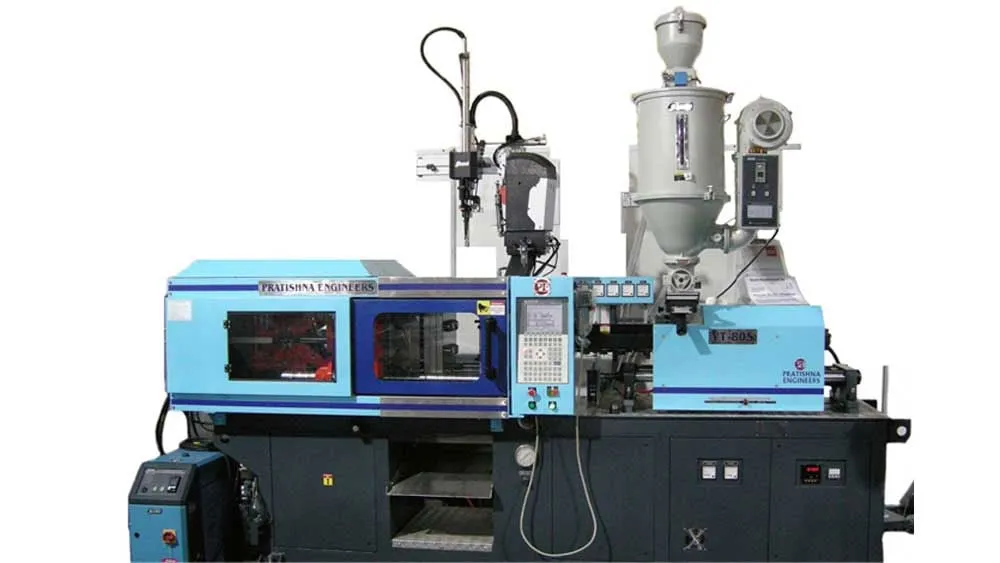

The right plastic moulding machine supplier in Mumbai is the one that delivers five things after the order, in writing: installation and commissioning, a trial on your own mould, operator and maintenance training, a recommended spares list, and a service response time. Tonnage and shot size get the attention while you buy, but these five items decide how soon the machine makes good parts.
Get them into the purchase order, not into a sales conversation. Pratishna Engineers designs, manufactures, assembles, tests and services its machines in-house from Andheri (E), Mumbai, and the sections below set out what to ask any supplier for, item by item. If a supplier hesitates on any of the five, treat that as part of the quote.
Key Takeaways
- Write installation, trial, training, spares and response time into the purchase order, because terms agreed only in a conversation are hard to enforce later.
- Accept the machine on your own mould at an agreed cycle and good-part share, not on a dry run or a supplier test mould.
- Train operators and maintenance staff separately; the first group sets process and safety habits, the second keeps hydraulics, heaters and electrics healthy.
- Keep a small shelf of wear parts before the first breakdown, and agree who answers the phone and how fast a visit follows.
What should installation and commissioning include?
Installation should cover unloading, positioning, levelling, connection of power, water and air, oil filling and a powered check of every function and safety guard. Commissioning ends when the machine runs your mould. Agree in writing what your plant prepares and what the supplier brings.
Prepare the site before dispatch. You usually supply the floor or foundation, the power cable to the panel, cooling water and compressed air. The supplier should give a layout drawing, the total connected load and the water need early enough for your electrician and civil team to finish. Ask how long installation takes for your machine size and how many supplier engineers will attend, and plan the dispatch date so the machine arrives when the site is ready.
Check the power side with your tariff in mind. In Maharashtra, MSEDCL bills many industrial consumers on kVAh, so a poor power factor raises the energy charge. At a power factor of 0.85, 15% of power does no useful work, which is why MSEDCL recommends capacitors or APFC panels.
Safety guards deserve a line of their own. ISO 20430:2020 sets safety requirements for the design and construction of injection moulding machines with hydraulic or electric platen drives. Ask the supplier which safety standard the machine is built to and check every guard interlock during commissioning.
Installation handover checklist: who prepares what
| Item | What to check | Usually prepared by |
|---|---|---|
| Floor and levelling | Machine level, platen parallelism within the agreed limit | Buyer, checked by supplier |
| Power supply | Cable size, earthing, power factor correction | Buyer |
| Cooling water and air | Flow, pressure and return lines to oil cooler and mould | Buyer |
| Safety guards | Every door interlock and emergency stop tested | Supplier |
| Documents | Manuals, electrical and hydraulic diagrams, spares list | Supplier |
How should the trial run on your mould be judged?
Judge the trial on your own mould and resin, against numbers agreed before dispatch: cycle time, cavities running, good-part share, key dimensions and run length. A dry cycle or a supplier test mould proves the machine moves; only your mould proves it does your job.
Write the acceptance terms into the order. State the mould, the resin grade, the cycle the process engineer expects, how long the trial runs and how parts will be measured. If the mould is new, separate mould faults from machine faults before the trial starts.
Agree what happens if the trial falls short. The order can state that the supplier corrects machine faults and repeats the trial at its own cost, while mould faults go back to the toolmaker. Invite your process engineer and quality inspector, so the people who will run the job sign the result.
Record a baseline while the machine is new. A clamp-meter data logger can measure a machine in as little as 30 minutes. Keep that figure, because rising energy on the same job later can point to screw or barrel wear.
Keep the trial parts and the setting sheet. They become your reference when the first process question comes up months later.
What training should operators and maintenance staff get?
Operators need training on safe start-up and shutdown, mould change, process setting and the alarm screens. Maintenance staff need hydraulics, heaters and thermocouples, electrical panels, lubrication and filter changes. Train the two groups separately, on your machine, before the supplier engineer leaves the site.
Ask for the training plan in writing, with the topics, the hours and the names of the people to be trained. Include shift supervisors, because they set the habits that operators follow at night. Where your team prefers Marathi or Hindi, ask whether the sessions can be given in that language.
Safety belongs in the first session. Operators should know every guard, interlock and emergency stop on the machine, and never bypass a door switch to save time during setting. Keep a short sign-off sheet per trainee, so new joiners can be trained to the same list later.
Add energy habits to the operator session. Idling machines draw 52% to 97.5% of their full moulding energy, and idle periods longer than about 1.5 hours may be cheaper to switch off and restart. Small habits like this decide running cost more than the brochure does.
Ask for a refresher visit after the first few months of production. By then your team knows which questions matter.
Which spares and response terms should a plastic moulding machine supplier in Mumbai commit to?
A good supplier gives a recommended spares list with the machine and commits in writing to a response time for phone support, site visits and part dispatch. The list should cover wear items such as heater bands, thermocouples, seals and filters, so a small failure does not stop production.
Split spares into two groups. Keep fast-wearing, low-cost items on your shelf from day one. For heavier parts, such as a screw, check valve or pump, ask how long dispatch takes and whether the part is held in stock.
Ask for part numbers on the list, not only descriptions. When a heater band fails at night, your maintenance team should match the part from the shelf without calling anyone. Review the list after the first year, adding parts that failed and dropping parts that never moved.
Response terms need the same detail. Ask who answers a breakdown call, how quickly an engineer can reach your plant, and how the issue is escalated if the first visit does not fix it. A supplier who will not write response terms into the order is not worth shortlisting. Also agree whether phone or video support is part of the first response.
Spares to discuss at the order stage
| Part | Why it matters | Typical approach |
|---|---|---|
| Heater bands and thermocouples | Common failures that stop the barrel heating | Keep on shelf |
| Seals and filters | Wear with hours and oil condition | Keep on shelf |
| Nozzle tip and check valve | Wear changes shot repeatability | Keep one set |
| Screw, barrel, pump | Long lead items, high impact | Agree dispatch terms |
Where does Pratishna fit as a Mumbai supplier?
Pratishna Engineers was founded in Mumbai in 1991 and works from A1-4, Vaibhav Ind. Premises, Saki Vihar Road, Andheri (E). Design, manufacturing, assembly, testing and service are done in-house, which keeps commissioning and service questions with the team that built the machine.
Its Mumbai facilities cover about 25,000 sq ft with CNC turning, machining and assembly and testing areas, and an independent QA department works to written SOPs, using accredited external labs when required. Ask for the installation, trial, training, spares and response terms in writing with the quote, as you would from any supplier. The Andheri (E) location also lets buyers visit machines under assembly or testing before they order.
- Range: horizontal, vertical, PET, two-platen, hybrid and special purpose injection moulding machines.
- Experience: 35+ years, 9,000+ machines and 1,000+ customers in India and international markets.
What should you ask for before you sign?
Before you sign, ask for the installation scope, the trial acceptance terms, the training plan, the recommended spares list and written response times, all attached to the order. Then compare suppliers on those terms as well as the machine. Keep a signed copy in the machine file. See the injection moulding machine range to start.
Frequently Asked Questions About Buying From a Mumbai Machine Supplier
Who prepares the foundation and utilities for a new moulding machine?
In most orders the buyer prepares the floor, the power cable to the panel, cooling water and compressed air, while the supplier gives the layout, connected load and water need. Agree this split in writing, with dates, so the machine is not waiting on site for a cable or a pipe.
Should the trial be done at the supplier works or at my plant?
A trial at the supplier works helps catch faults before dispatch, but the final acceptance should run at your plant, on your mould, power and cooling water. Conditions differ between sites, and only the installed machine shows how the job will run in daily production.
How do I separate a mould problem from a machine problem during the trial?
Run the mould first on a known machine if possible, and record its settings. During the new machine trial, compare cycle, fill and part weight against that record. Faults that follow the mould, such as flash at one cavity, usually belong to the mould rather than the machine.
What documents should come with the machine?
Ask for the operation manual, maintenance manual, electrical and hydraulic circuit diagrams, a recommended spares list with part numbers, and the test record from the supplier works. Keep them in one place near the machine, because the maintenance team needs them during the first breakdown.
Does power factor matter for a moulding plant in Maharashtra?
Yes. MSEDCL bills many industrial consumers on kVAh, so a low power factor raises the energy charge. Under kWh billing, a power factor below 0.90 brings a penalty and above 0.95 an incentive. Capacitors or an APFC panel are the usual correction, sized by your electrical consultant.
How often should a new machine be serviced in the first year?
Follow the maintenance manual for oil, filter and lubrication intervals, and agree a check visit after the first few months of production. Ask the supplier to include that visit in the order. Use your energy baseline from commissioning to spot early wear between visits.
Related Articles
- Two-Platen Injection Moulding Machine Manufacturer in India
- High-Speed Plastic Moulding Machines in Mumbai
- Buy Injection Moulding Machine in Mumbai
- Custom Injection Moulding Machine Manufacturer
Sources & References
- ISO: ISO 20430:2020 Plastics and rubber machines: Injection moulding machines: Safety requirements
- MSEDCL: kVAh Billing: Frequently Asked Questions
- PlasticsToday, R. Kent: Getting to know your real energy use and cost (Jan 2010)
Technical Disclaimer
Disclaimer: The information provided in this document is for general informational and educational purposes only. It is based on technical references and industry information available at the time of preparation and may be subject to change. It does not constitute engineering, technical, commercial or professional advice, nor does it constitute a quotation, specification, warranty or contractual commitment by Pratishna Engineers.
Actual injection moulding machine and process requirements vary according to the component design, material, mould, production volume, machine configuration and operating conditions. The information, examples, calculations and recommendations provided should be independently evaluated and verified for the specific application before making any equipment, process or production decision. Information obtained from third-party sources remains subject to the accuracy and limitations of those sources.
Limitation of Liability: Pratishna Engineers makes no representation or warranty, express or implied, regarding the completeness, accuracy or suitability of the information for any particular application. To the extent permitted by applicable law, Pratishna Engineers shall not be liable for any loss, damage, cost or consequence arising from reliance on or use of the information contained in this document. Final machine selection, configuration and application suitability should be confirmed with Pratishna Engineers based on complete and accurate project requirements.

