






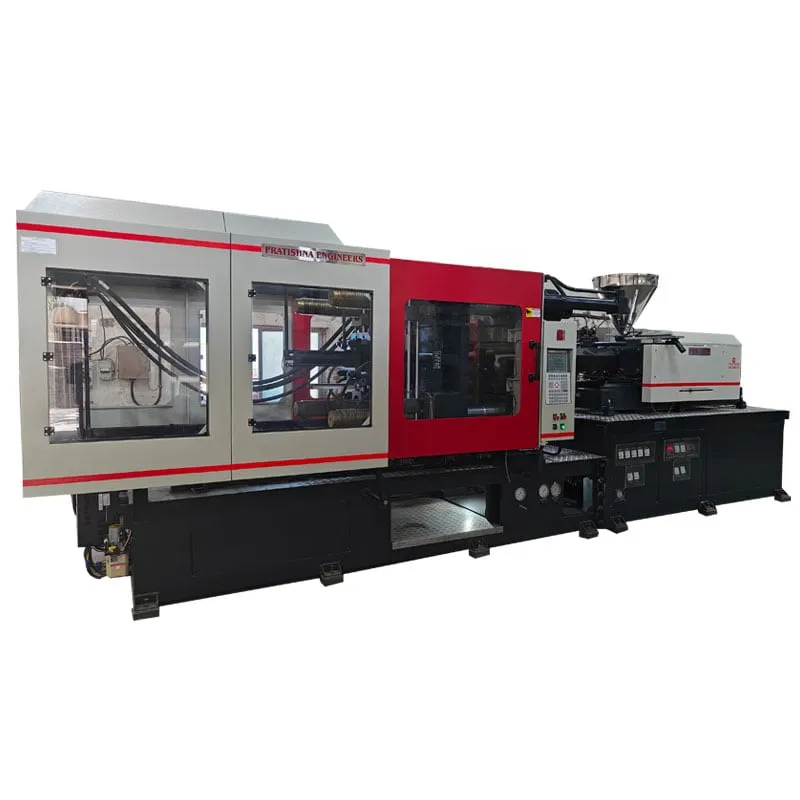

A 300 mm deep paint pail needs about 750 mm of mould opening, because a common sizing rule asks for an opening stroke of at least 2.5 times the part height. If the mould stands about 560 mm tall, the machine needs roughly 1,310 mm of daylight. That single figure tells you whether a toggle can run the job or whether you need a two-platen clamp.
So when you compare any two platen machine manufacturer in India, start with daylight, stroke and tie-bar space, then tonnage. A two-platen machine locks the moving platen and builds tonnage with short-stroke cylinders, and it is usually shorter than a toggle of similar force. Pratishna Engineers builds two-platen machines in Mumbai, and the checks below work for any shortlist you hold.
Key Takeaways
- Size a two-platen machine from daylight first: the mould height plus 2.5 times the part height must fit inside the maximum daylight on the quote.
- On a two-platen clamp, usable stroke falls as mould height rises, while a toggle gives its full stroke at every shut height it accepts.
- Check that the mould covers at least 70% of the tie-bar gap, or the platens can bow under clamp and flash the mould centre.
- Buy a two-platen machine for opening, mould size and floor length. Buying one for tonnage alone means paying for a strength the job may not use.
When does a two-platen clamp beat a toggle?
A two-platen clamp wins when the part is deep, the mould is tall or wide, or floor length is tight. It gives a long opening from a short machine and direct hydraulic control of tonnage. A toggle still suits shallow parts that need fast lock-up and high opening force.
The two designs build force in different ways. In a typical two-platen hydromechanical clamp, split nuts or similar locks hold the moving platen, then one or more short-stroke cylinders apply tonnage. There is no linkage behind the moving platen, which is why these machines are usually shorter overall than toggles or fully hydraulic machines.
Toggle critics point to a narrower stroke-adjustment range, a risk of over-clamping when die height is set with a cold mould that later expands, and possible platen deflection because force arrives at the corners. Worn linkages can also upset parallelism.
Toggle defenders cite simplicity, rigidity and reliability. Some suppliers claim a toggle locks up slightly faster, around 0.2 s against 0.5 s for a hydraulic clamp, and gives greater opening force for deep-draw parts. Treat these as claims to test on your own mould, not as fixed numbers.
For most buyers, part depth settles the question first. If the part and its mould fit the stroke of a toggle you already run, compare cycle, energy and service. If they do not, the two-platen route is the practical one.
Two-platen and toggle clamps compared on the points that decide large-mould jobs
| Point | Two-platen (hydromechanical) | Toggle |
|---|---|---|
| Stroke at tall mould heights | Falls as mould height rises; full stroke only at minimum mould height | Same full stroke at every accepted shut height |
| Machine length | Usually shorter for similar tonnage | Longer, linkage sits behind the moving platen |
| Tonnage control | Direct hydraulic, finer and more uniform (reported) | Set through linkage and die height |
| Lock-up and opening force | Slower lock-up claimed | Faster lock-up and higher opening force claimed |
How much daylight and stroke does your mould need?
Your mould needs an opening of at least 2.5 times the part height, and the machine daylight must cover the mould height plus that opening. On a two-platen clamp, check this at your actual mould height, because the usable opening equals maximum daylight minus mould height.
This is where the two clamp types part ways. On a toggle, maximum daylight equals maximum shut height plus stroke, so the full stroke is available whatever the mould height. On a piston-type clamp, which includes two-platen machines, maximum daylight equals minimum shut height plus maximum stroke. A taller mould eats into the opening.
A simple test follows. A two-platen machine gives more opening than a toggle whenever your mould height is less than the two-platen daylight minus the toggle stroke. Work it out for your tallest mould, not your average one, because the tallest mould sets the limit.
Also check minimum mould height. A mould thinner than the machine minimum cannot be clamped without spacer plates, and a mould thicker than the maximum will not fit at all.
Ejector boxes and adapter plates count as well. If the mould needs either, that extra stack adds to the mould height you subtract from daylight, so include it in the calculation from the start.
Will your mould fit between the tie bars?
Ideally the whole mould fits inside the tie bars. At the very least, the projected area of the parts must sit fully inside them, because platens can pull in near the tie bars and wear the parting line. The mould should also cover at least 70% of the tie-bar gap.
Both limits matter on large work. A mould that is too wide for the tie-bar space cannot be loaded from the top, and a part area that spills past the bars sees uneven pressure. A mould that is too small lets the platens bow under clamp, which shows up as flash in the centre of the mould. Very small moulds can damage a platen badly.
Run the 70% rule of thumb as a quick number. On a 560 mm tie-bar gap, the mould should be at least 392 mm across. If your smallest mould is below that, ask for the minimum mould size from the machine manual or frame placard.
Two more checks finish the fit. Confirm the maximum mould weight for both the fixed and moving platens, and match the locating ring, usually 101.6 mm or 120 mm. Under 500 t, platen level and parallelism of 0.025 to 0.05 mm is generally accepted.
What should you ask a two platen machine manufacturer in India?
Ask for daylight, stroke, mould height range and tie-bar space as one set, then check them against your tallest and smallest moulds. After that, confirm clamp tonnage, shot size and connected load. A quote that leads with tonnage alone has not yet looked at your mould.
Start with opening. Ask what usable opening the machine gives at your mould height, not the brochure maximum. Then ask for the minimum and maximum mould thickness, the space between tie bars and the platen size.
Next, check clamp force with a simple method. Take the projected area of one part, subtract through holes, multiply by cavities, add the cold-runner area, then multiply by a tonnage factor. Plastics Technology suggests 3 tons/in² as a starting point for that factor, which is a starting value, not a rule.
Material changes the answer. For paint pails, resin listings show Indian impact copolymer PP grades such as Reliance Repol C080MA and C120MN, so ask the supplier to size the barrel for the grade you buy. A shot that uses 25% to 65% of barrel capacity gives the steadiest melt.
Finally, ask for the total connected load, the oil cooling water need and the floor plan, so your power and space are ready before dispatch.
What does the Pratishna PHM series offer for large moulds?
Pratishna Engineers, founded in Mumbai in 1991, builds the PHM series as its two-platen hydromechanical range. Design, manufacturing, assembly, testing and service are done in-house, and the company has supplied 9,000+ machines to 1,000+ customers in India and abroad.
The table gives the published PHM figures. In each model, maximum daylight equals the minimum mould thickness plus the clamping stroke, which is the piston-type relationship described above. So check the usable opening at your own mould height.
Total connected load runs from 38.6 kW on the PHM 160 to 81 kW on the PHM 350. Use it to plan cable and panel sizing with your electrician before the machine arrives.
- PHM models run from 160 to 350 t, with clamping strokes from 1,000 to 1,350 mm.
- Selection follows Component, Material, Mould, Production Requirement and Machine Configuration, in that order.
PHM series figures as published (tie-bar space H x V)
| Model | Clamp (t) | Stroke (mm) | Daylight (mm) | Mould thickness (mm) | Tie bars (mm) |
|---|---|---|---|---|---|
| PHM 160 | 160 | 1000 | 1225 | 225 to 645 | 460 x 440 |
| PHM 200 | 200 | 1100 | 1340 | 240 to 655 | 560 x 540 |
| PHM 250 | 250 | 1150 | 1400 | 250 to 700 | 640 x 640 |
| PHM 350 | 350 | 1350 | 1650 | 300 to 800 | 720 x 720 |
What should you send before asking for a two-platen quote?
Send the part drawing with its height, your tallest and smallest mould dimensions, mould weight, resin grade, cavity count and target output. With those, any supplier can check daylight, tie-bar fit and tonnage before quoting. See the two-platen injection moulding machine page for the full range. Add photos if the mould is already built.
Frequently Asked Questions About Two-Platen Injection Moulding Machines
Is a two-platen machine only worth it above a certain tonnage?
Tonnage is not the deciding factor. Part depth, mould height, mould width and floor length decide it. A deep bucket mould can need two-platen daylight even when its clamp requirement is modest, while a flat, shallow part at the same tonnage may run well on a toggle.
Why does usable opening drop when I fit a taller mould?
On a two-platen clamp, maximum daylight equals the minimum mould height plus the maximum stroke. Every extra millimetre of mould height uses up a millimetre of opening. On a toggle, the stroke stays the same across the accepted shut height range, so taller moulds do not reduce it.
Can a two-platen machine save floor space?
Usually, yes. Because there is no toggle linkage behind the moving platen, most two-platen hydromechanical machines are shorter overall than toggles or fully hydraulic machines of similar force. Measure your bay length, including the area needed for mould loading and part removal, before you compare layouts.
What goes wrong if my mould is too small for the platens?
The platens can bow under clamp because the force is not spread across enough of the mould face. The common sign is flash in the centre of the mould. A useful rule of thumb is that the mould should cover at least 70% of the distance between the tie bars.
Which parts typically suit a two-platen machine?
Parts with large depth or a large mould face suit it: paint pails, buckets, crates, dustbins, storage boxes and similar containers. The common thread is that the mould needs a long opening to release the part, or the mould is too big for the tie-bar space of a comparable toggle.
Do I need a different mould for a two-platen machine?
Usually not, if the mould height, width, weight, locating ring and ejector pattern fit the machine. Check the mounting and ejector patterns against the platen drawing. A mismatch may need an adapter plate or ejector box, which adds height and reduces the usable opening.
Related Articles
- High-Speed Plastic Moulding Machines in Mumbai
- Plastic Injection Moulding Machine Supplier in Mumbai
- How to Choose Plastic Injection Moulding Machines in Mumbai
- Indian vs Imported Injection Moulding Machines
Sources & References
- MoldMaking Technology, B. Catoen: Machine Sizing and Specification for Optimal Mold Performance, Part 1 (Aug 2025)
- Plastics Technology, M. Knights: Hybrid Injection Clamps: The Best of Both Worlds? (June 2010)
- Plastics Technology, J. Williams (RJG): Clamp Tonnage: More Is Better...Right? (May 2017)
- Plastics Technology, P. Witaszek et al.: How to Mount an Injection Mold (June 2017)
Technical Disclaimer
Disclaimer: The information provided in this document is for general informational and educational purposes only. It is based on technical references and industry information available at the time of preparation and may be subject to change. It does not constitute engineering, technical, commercial or professional advice, nor does it constitute a quotation, specification, warranty or contractual commitment by Pratishna Engineers.
Actual injection moulding machine and process requirements vary according to the component design, material, mould, production volume, machine configuration and operating conditions. The information, examples, calculations and recommendations provided should be independently evaluated and verified for the specific application before making any equipment, process or production decision. Information obtained from third-party sources remains subject to the accuracy and limitations of those sources.
Limitation of Liability: Pratishna Engineers makes no representation or warranty, express or implied, regarding the completeness, accuracy or suitability of the information for any particular application. To the extent permitted by applicable law, Pratishna Engineers shall not be liable for any loss, damage, cost or consequence arising from reliance on or use of the information contained in this document. Final machine selection, configuration and application suitability should be confirmed with Pratishna Engineers based on complete and accurate project requirements.

