






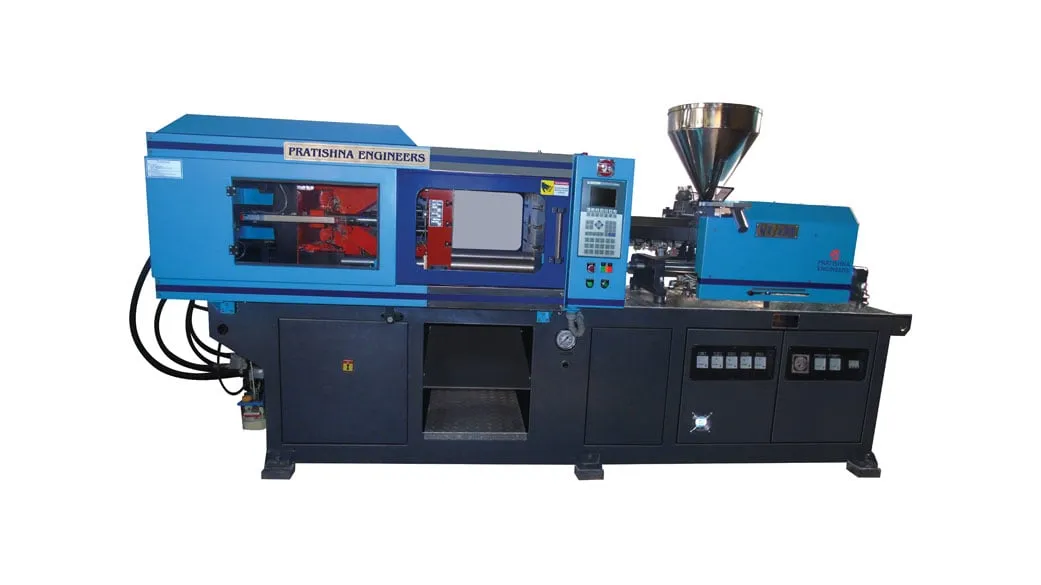

Good hydraulic moulding machine manufacturers can tell you, in writing, which pump drives the machine, how the oil is cooled and filtered, and what the machine draws while moulding and while idle. Those answers decide most of your running cost and your maintenance load over the life of the machine. A spec sheet that lists only clamp force and shot weight leaves the expensive questions open.
Pratishna Engineers has built injection moulding machines in Mumbai since 1991, and this guide sets out the checks we would run on any hydraulic machine, ours included. It covers pump types, oil temperature and cleanliness, energy per kilogram, Maharashtra power billing and the questions to put to a manufacturer before you order.
Key Takeaways
- Ask for the pump type first: a fixed pump at constant speed keeps drawing power when little oil is needed, while servo and variable pumps cut that waste.
- Oil temperature and oil cleanliness decide how long seals, valves and pumps last, so the cooler and filters deserve as much attention as the clamp.
- An energy guide for moulders puts the base load of a standard hydraulic machine at 75% or more of its energy, so idle time is costly.
- In Maharashtra, kVAh billing turns a poor power factor into more billed units, so ask how the drive and panel hold the power factor up.
Which Pump Type Should a Hydraulic Machine Have?
For most new work, choose a servo motor on a fixed pump or a variable displacement pump, not a fixed pump at constant speed. The motor is the largest energy user on a hydraulic machine, and both options reduce power drawn when the cycle needs little oil.
Robin Kent of Tangram Technology, writing for SPE Plastics Engineering, notes that progress over about 20 years has mostly come from slowing the motor when oil is not needed, or from cutting oil demand. Some new hydraulic machines, he says, come close to all-electric energy use.
Hydraulic pump drives compared (qualitative)
| Drive | How it delivers oil | What to ask |
|---|---|---|
| Fixed pump, constant-speed motor | Full flow all the time; surplus oil is relieved and turns into heat | Idle power reading and oil cooler size |
| Variable displacement pump | Pump stroke reduces when the circuit needs less flow | Response time and pressure stability at low flow |
| Servo motor on a fixed pump | Motor speed follows the flow the cycle asks for | Servo drive make, spares and oil temperature at low speed |
The other side of that finding is the installed base. Many older machines with fixed-speed, fixed-volume pumps are still running with very high energy demand. Kent lists the retrofit routes: variable-speed motors, variable-volume pumps and servo motors driving fixed pumps.
Our view is plain: on a new hydraulic machine for a full-time job, a fixed pump at constant speed is false economy. Pay for the drive once, or pay for the waste on every shift for the life of the machine.
Ask the manufacturer to show the pump nameplate and the drive on the trial machine. A brochure line that says energy saving tells you nothing about which of these three you are buying.
How Should Oil Cooling and Filtration Be Specified?
Ask for a heat exchanger sized for your summer cooling water, an oil temperature reading on the controller, and filters with clogging indicators on the pressure and return lines. Hot or dirty oil wears pumps, valves and seals faster, and it makes injection and clamp movements less repeatable.
Oil viscosity changes with temperature, so a machine that runs cool in the morning and hot by the afternoon can shift injection speed and pressure response through the shift. The cooler has to remove the heat the pump, valves and relief losses put into the oil on your worst day, not an average one.
Cooling water is the weak link in many plants. If the tower or chiller water reaching the machine runs warm in May, the oil runs warm too. Give the manufacturer your cooling water temperature and flow, and ask what oil temperature the machine is designed to hold with it.
Filtration needs the same scrutiny. Check where the filters sit, whether each has a visual or electrical clogging indicator, how elements are changed without draining the tank, and which oil grade the manufacturer specifies. Keep a set of elements on the shelf from day one.
How Do You Compare Energy Use Between Hydraulic Machines?
Compare kilowatt hours per kilogram moulded on the same part, plus the power drawn at idle. An energy guide for moulders gives a typical variable load of 0.9 to 1.6 kWh per kg, and idling machines have been measured drawing most of their moulding power.
The guide, produced for ExxonMobil with AMI and Tangram Technology, puts the base load of a standard hydraulic machine at 75% or more of its total energy, against about 10 to 20% for all-electric and hybrid machines, mostly barrel heating. It also warns that a high base load can mean the machine is too large for the job.
Published measurements show idling machines drawing 52 to 97.5% of their full moulding energy, and one hydraulic machine using 22% less energy with its variable-frequency drive switched on. Ask for both readings on your trial: moulding power and idle power.
Billed kVAh for every 100 kWh used, by power factor (calculated)
| Power factor | Billed kVAh per 100 kWh | Extra units billed |
|---|---|---|
| 0.85 | 117.6 | 17.6 |
| 0.90 | 111.1 | 11.1 |
| 0.95 | 105.3 | 5.3 |
| 0.99 | 101.0 | 1.0 |
In Maharashtra the drive also shows up in tariff terms. MSEDCL bills HT industrial consumers on kVAh, so energy charges follow apparent energy and a low power factor raises billed units, as the table shows. Ask what power factor the machine presents and whether correction is fitted.
What Should You Ask Hydraulic Moulding Machine Manufacturers Before Ordering?
Ask for the pump and motor type, the oil cooler rating and design oil temperature, filter positions and element part numbers, tank volume, oil grade and measured moulding and idle power. Then ask who services the hydraulics locally and which spares are stocked.
Put the answers in the purchase order, not only in the sales discussion. A written oil temperature limit and filter specification give your maintenance team something to hold the machine to after commissioning, and give the manufacturer a clear test at handover.
Ask how the hydraulic circuit is documented. A circuit diagram with valve part numbers, settings and a recommended maintenance schedule saves hours when a valve sticks during a night shift. If the manufacturer will not hand it over, plan on depending on their service team.
Finally, ask to see a machine of the same build running in a customer plant, preferably one that has been through a monsoon and a summer. Oil temperature, noise and leaks on a two-year-old machine tell you more than a new machine on a test bay.
Compare manufacturers on the same list of questions, scored the same way, so the decision rests on facts rather than on the last presentation you heard.
How Pratishna Engineers Builds Hydraulic Machines
Pratishna Engineers was founded in Mumbai in 1991 by Nandkumar R. Kushe, a first-generation engineer. The company began with machine rebuilding, indigenisation and technology adaptation before moving to complete machine design, manufacturing and automation. Design, manufacturing, assembly, testing and service are done in-house, from about 25,000 sq ft of facilities in Mumbai.
The range covers horizontal, vertical, vertical-horizontal combination, hydro-mechanical and hybrid machines, which pair hydraulic locking with electric injection. Across 35+ years the company has supplied 9,000+ machines to 1,000+ customers in India and international markets. Total connected loads in the series data run from 17.5 kW on the E - 75 to 81 kW on the PHM - 350.
- Horizontal hydraulic series: E, C and H, with mould clamping forces from 75 to 320 tons in the series data.
- The PHM two-platen series lists a servo driven pump in its spec sheet, with clamping forces from 160 to 350 tons.
What Should You Send to Compare Hydraulic Machines?
Send your part drawing, material, part and runner weight, cycle target, shifts per day, cooling water temperature and your MSEDCL billing basis. With those, pump type, cooler size and connected load can be checked against your job before you compare offers. Browse the injection moulding machine range.
Frequently Asked Questions About Hydraulic Injection Moulding Machines
Is a hydraulic injection moulding machine still worth buying?
Yes, for many jobs. Hydraulic machines handle large clamp forces, long holding times and heavy moulds well, and their parts are easy to service locally. Choose a servo or variable pump drive, check oil cooling and filtration, and compare idle power. Those choices close much of the energy gap with electric machines.
How often should hydraulic oil be changed on a moulding machine?
Follow the manufacturer's schedule, but base the decision on oil condition rather than the calendar alone. Periodic oil analysis for contamination, water and viscosity tells you when the oil is reaching its limit. Change filter elements whenever the clogging indicator trips, and find the cause if it trips sooner than usual.
What oil temperature should a hydraulic moulding machine run at?
Use the band the manufacturer specifies for its oil grade and seals, and ask for it in writing. What matters most is that the temperature stays steady through the shift. A machine whose oil temperature drifts with the weather will drift in injection speed and pressure response as well.
Can an old fixed-pump machine be converted to a servo drive?
Often, yes. Retrofit routes include variable-speed motors, variable-volume pumps and servo motors driving fixed pumps. Check the age and condition of the machine, its valves and its controller first, because a servo retrofit on a worn machine can save energy without fixing its repeatability problems.
Why does a hydraulic machine use so much power when idle?
On a fixed-pump machine the motor and pump keep running while nothing is moulded, and the barrel heaters stay on. Measured idle draw has ranged from about half to almost all of the moulding draw. Use an idle mode with motors off and heaters set back for short stops.
Does power factor matter for a single moulding machine?
Yes, if you are billed on kVAh, as MSEDCL HT industrial consumers are. Every kWh used at a power factor of 0.90 is billed as about 1.11 kVAh. Correction can be fitted at the machine or at the main panel; ask your electrical contractor which suits your plant better.
Related Articles
- Automatic Injection Moulding Machine Manufacturers
- Vertical Injection Moulding Machine Manufacturers: An Overview
- Servo-Driven Injection Moulding Machine in Mumbai: Speed Meets Savings
- Hybrid Injection Moulding Machine: Revolutionizing Production
Sources & References
- ExxonMobil, AMI and Tangram Technology: An Energy Saving Guide for Injection Moulders
- SPE Plastics Engineering, R. Kent (Tangram Technology): Energy-Saving Tip 67: Injection Molding: get the right motor (Sept 2016)
- MSEDCL: Power point presentation on kVAh billing (Annexure 7)
Technical Disclaimer
Disclaimer: The information provided in this document is for general informational and educational purposes only. It is based on technical references and industry information available at the time of preparation and may be subject to change. It does not constitute engineering, technical, commercial or professional advice, nor does it constitute a quotation, specification, warranty or contractual commitment by Pratishna Engineers.
Actual injection moulding machine and process requirements vary according to the component design, material, mould, production volume, machine configuration and operating conditions. The information, examples, calculations and recommendations provided should be independently evaluated and verified for the specific application before making any equipment, process or production decision. Information obtained from third-party sources remains subject to the accuracy and limitations of those sources.
Limitation of Liability: Pratishna Engineers makes no representation or warranty, express or implied, regarding the completeness, accuracy or suitability of the information for any particular application. To the extent permitted by applicable law, Pratishna Engineers shall not be liable for any loss, damage, cost or consequence arising from reliance on or use of the information contained in this document. Final machine selection, configuration and application suitability should be confirmed with Pratishna Engineers based on complete and accurate project requirements.

