






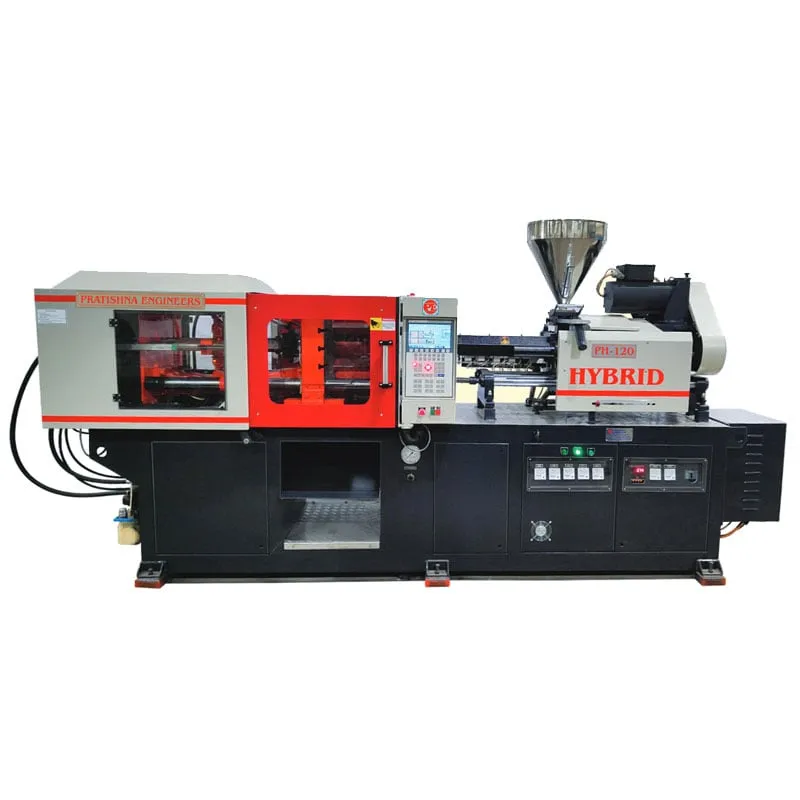

Take one job moulding 20 kg of parts an hour for 6,000 hours a year. If a hydraulic machine uses 1.4 kWh per kg and a hybrid uses 0.9, the gap is 60,000 kWh a year before power factor. Those figures are assumptions for illustration, but the method is how you should settle the hybrid vs hydraulic injection moulding machine choice: measure energy per kg on your own parts, then weigh it against precision, maintenance and the usually higher purchase cost of a hybrid. Here, a hybrid means a hydraulic clamp with electric injection and screw drives.
Key Takeaways
- Most of the energy gap comes from base load: a standard hydraulic machine spends much of its energy keeping pumps running, while a hybrid draws far less at rest.
- Electric injection reads plastic pressure directly, so repeatable shot weight is easier to hold than through a hydraulic intensification ratio that changes with screw size.
- A hybrid still carries hydraulic oil for the clamp, so oil care, filters and cooling do not disappear; they shrink in scale.
- Measure kWh per kg with a clamp-meter logger on your own jobs before you believe any saving figure, including the assumed ones in this article.
Where does a hybrid save energy over a hydraulic machine?
Mostly at rest and during cooling. A standard hydraulic machine's base load can be 75% or more of its total energy, because pumps keep running whether or not the screw moves. Hybrid and all-electric base loads are about 10 to 20%, mostly barrel heating.
Cooling is where this shows. On a long-cooling part the screw has finished recovering and the clamp is holding still, yet a fixed-pump hydraulic machine keeps circulating oil. A hybrid's electric injection and screw drives draw almost nothing in that window, and its clamp pump works mainly when the clamp moves or builds tonnage.
Barrel heating does not change. Heater bands take 10 to 25% of a machine's energy input on any drive type, so insulating the barrel helps a hybrid and a hydraulic machine alike. Do not credit a hybrid with savings that barrel jackets would give you on the machine you already own.
Older hydraulic machines can also be retrofitted with servo motors on fixed pumps or with variable-volume pumps, and one published hydraulic machine used 22% less energy with its drive switched on. Compare a hybrid against a retrofitted machine, not only against an old fixed-pump one.
Hybrid vs hydraulic: side-by-side comparison (general patterns; confirm with your own measurements)
| Factor | Hydraulic (fixed pump) | Hybrid (hydraulic clamp, electric injection) |
|---|---|---|
| Base load share of energy | 75% or more on standard machines | About 10 to 20%, mostly barrel heating |
| Injection pressure control | Through an intensification ratio, 6:1 to 43:1 across machines | Read at the screw, effectively 1:1 |
| Hydraulic oil | Full system: pumps, valves, cylinders, large tank | Mainly the clamp circuit, typically a smaller volume |
| Noise at rest | Pump runs through the whole cycle | Quieter while the clamp is still |
| Purchase cost | Usually lower | Usually higher; recovered only through energy and quality |
| Repair skills | Hydraulics | Hydraulics plus servo drives and electronics |
Is a hybrid more precise than a hydraulic machine?
Often, on injection. An electric screw drive reads plastic pressure directly, so the control acts on what the melt sees. A hydraulic machine controls oil pressure and converts it through an intensification ratio, which adds a layer where temperature and valve response can shift shot weight.
Intensification ratio is the hydraulic ram area divided by the screw area. Across machines it ranges from 6:1 to 43:1, and it changes with screw diameter. Swap a 35 mm screw for a 40 mm one on the same unit and available plastic pressure falls to about 77% of the original.
Oil temperature is the other variable. As hydraulic oil warms over the first hour of a shift, its viscosity drops and valve response changes, so early parts can differ from later ones. Electric injection does not depend on oil temperature, which is the main reason to pick a hybrid for tight parts.
Clamp precision does not change, because the clamp stays hydraulic. Parallelism, platen stiffness and mould protection depend on the clamp design. The flat view: buy a hybrid for repeatable injection on tight-tolerance parts, not for clamp accuracy, because its clamp behaves like any other hydraulic clamp.
How do upkeep and running costs compare in a hybrid vs hydraulic injection moulding machine?
A hybrid trades some hydraulic upkeep for electrical upkeep. It has less oil, fewer valves on the injection side and a lower heat load on the oil cooler, but it adds servo motors, drives and screw transmissions that need a different skill set and different spares.
Ask what fails and who fixes it. A leaking hydraulic seal is a job most maintenance teams handle in-house. A servo drive fault may need the supplier's engineer and a part that is not on your shelf. Before buying, list the drives and boards and ask which are stocked locally.
Power quality matters more with drives. MSEDCL bills HT and larger LT industrial connections in kVAh, so a poor power factor raises the bill directly. At 0.85 power factor, every 100 kWh is billed as about 117.6 kVAh; at 0.95, about 105.3. Plan drives and capacitor panels together.
Idle time counts too. Idling machines can draw 52% to 97.5% of their full moulding energy, and the high end belongs to machines whose pumps never stop. If machines wait for moulds, material or operators, a hybrid narrows that waste, but so does switching off for idle periods over about 1.5 hours.
What should you measure before choosing?
Log one machine on your main job for a full shift with a clamp-meter data logger, note the kg of good parts, and divide. Repeat after any retrofit. Then compare the energy gap, shot weight spread and spares support against the extra purchase cost. See the hybrid injection moulding machine page for drive options.
Frequently Asked Questions About Hybrid and Hydraulic Machines
Is a hybrid the same as an all-electric machine?
No. In the sense used here, a hybrid keeps a hydraulic clamp and uses electric drives for injection and screw rotation. An all-electric machine drives the clamp, injection, screw and ejectors with servo motors and has no main hydraulic system. Builders use the word hybrid for different mixes, so ask which axes are electric.
Can I retrofit my hydraulic machine instead of buying a hybrid?
Often, yes. Servo motors on fixed pumps, variable-volume pumps or variable-speed motors can cut the energy a hydraulic machine wastes at rest. A retrofit does not give you electric injection control, so if shot-weight repeatability is the problem, a retrofit alone will not solve it. List your pump and motor types first.
Does a hybrid need hydraulic oil changes?
Yes, though usually for a smaller volume of oil. The clamp circuit still needs clean oil, working filters and an oil cooler. Because the injection side no longer heats the oil, the cooler often works less hard. Keep the same oil sampling and filter routine you use on hydraulic machines and follow the builder's interval.
Which parts gain most from a hybrid?
Parts where shot weight and dimensions must stay tight over long runs, and jobs with long cooling times where a hydraulic pump would idle for most of the cycle. Thick-walled parts, technical parts in engineering resins and multi-cavity moulds that show cavity-to-cavity weight drift are typical candidates to trial.
How long does it take to measure a machine's energy use?
A clamp-meter data logger can give a useful picture in as little as 30 minutes, and heater load is best averaged over 10 to 15 minutes. For a fair comparison, log a full shift on the same job, include start-up and idle periods, and divide total kWh by kg of good parts.
Related Articles
- Vertical Locking Horizontal Injection Moulding Machine: Maximizing Efficiency
- Horizontal Injection Moulding Machine
- Hybrid Injection Moulding Machine for High-Efficiency Manufacturing
- Hybrid Injection Moulding Machines: Bridging Efficiency and Precision
Sources & References
- ExxonMobil, AMI and Tangram Technology: An Energy Saving Guide for Injection Moulders
- PlasticsToday, R. Kent: Getting to know your real energy use and cost (Jan 2010)
- Plastics Technology, J. Bozzelli: Understanding Intensification Ratio (2016, updated 2022)
- MSEDCL: kVAh Billing: Frequently Asked Questions
Technical Disclaimer
Disclaimer: The information provided in this document is for general informational and educational purposes only. It is based on technical references and industry information available at the time of preparation and may be subject to change. It does not constitute engineering, technical, commercial or professional advice, nor does it constitute a quotation, specification, warranty or contractual commitment by Pratishna Engineers.
Actual injection moulding machine and process requirements vary according to the component design, material, mould, production volume, machine configuration and operating conditions. The information, examples, calculations and recommendations provided should be independently evaluated and verified for the specific application before making any equipment, process or production decision. Information obtained from third-party sources remains subject to the accuracy and limitations of those sources.
Limitation of Liability: Pratishna Engineers makes no representation or warranty, express or implied, regarding the completeness, accuracy or suitability of the information for any particular application. To the extent permitted by applicable law, Pratishna Engineers shall not be liable for any loss, damage, cost or consequence arising from reliance on or use of the information contained in this document. Final machine selection, configuration and application suitability should be confirmed with Pratishna Engineers based on complete and accurate project requirements.

