






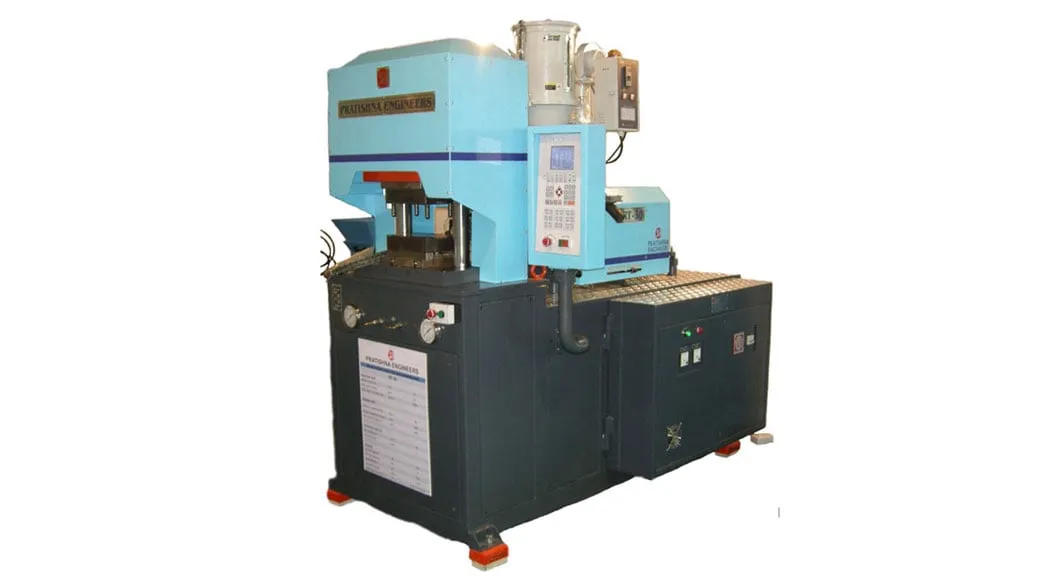

Picture a moulder loading eight brass inserts into a horizontal mould by hand. One slips out of its pocket before the clamp closes, the cavity is damaged, and the job stops for repair. That is often when a buyer starts calling vertical moulding machine manufacturers.
On a vertical machine the mould opens upward, so gravity holds inserts in place, and a sliding or rotary table lets the operator load one mould while the other is being moulded. The right manufacturer will match table type, clamp layout and insert handling to your part, not to a catalogue.
Pratishna Engineers builds vertical machines in Mumbai, and this overview walks through those three choices and what to check on a trial.
Key Takeaways
- Gravity holds inserts in a vertical mould, which is why insert and overmoulding jobs move to vertical machines when loading becomes the bottleneck.
- In one calculated case, a double sliding table lifts output from 252 to 428 parts per hour by loading during the moulding time.
- Clamp layout matters as much as tonnage: vertical injection suits centre gating, while horizontal injection into a vertical clamp fills at the parting line.
- Prove insert loading on a trial with your real inserts, operator and cycle, since loading time often decides output more than the machine does.
Which Table Type Suits Your Insert Loading?
Choose by comparing loading time with mould-closed time. A fixed table suits short loading times; a shuttle or sliding table lets the operator load one lower mould while the other is moulded; a rotary table carries two or more lower moulds when loading takes longer still.
A cost model guide from aPriori describes the trade-off. Shuttle tables move two moulds side to side and rotary tables index two or more; either lets pick and place happen on one mould while the other is injected, cutting cycle and labour time. The default tooling is two lower halves and one upper half, which adds tooling cost.
Output by table type: 4 cavities, 30 s closed, 26 s loading, 3 s table move, 98% good shots (calculated)
| Table type | Cycle | Parts per hour |
|---|---|---|
| Fixed table | 56 s | 252 |
| Single slide (two moves per cycle) | 62 s | 228 |
| Double slide | 33 s | 428 |
The calculation shows why a single sliding table can disappoint. With one lower mould and two table moves a cycle, it adds time instead of saving it. The gain comes only when a second lower mould lets loading run in parallel with moulding.
Our view: when loading takes more than half the mould-closed time (a starting point, not a rule), a double slide or rotary table will usually do more for output than a faster clamp.
Ask each manufacturer for table positioning repeatability and how the table is locked under the clamp.
Which Clamp and Injection Layout Fits Your Part?
Choose from the gate position and the insert layout. Vertical clamp with vertical injection suits centre-gated parts with inserts sitting in the lower mould. Vertical clamp with horizontal injection fills at the parting line, which suits cable and wire overmoulding laid across the mould.
A third layout puts a vertical injection unit on a horizontal clamp. The mould opens sideways as on a conventional machine, but the melt enters at the parting line from above. It suits parts gated on the parting line where gravity loading is not needed.
Clamp mechanism comes next. A vertical machine may use a direct hydraulic clamp, a toggle or a hydro-mechanical design, and each builds and holds force differently. Ask how force is generated, how platen parallelism is checked under load, and how mould height is adjusted for a new tool.
Working height counts too. On a vertical machine the operator works at the lower mould all shift, so table height, reach to the far cavities and space for insert trays decide how fast and how consistently loading is done.
Look at where the injection unit sits for maintenance: a top-mounted unit is out of the loader's way but needs safe access for screw and nozzle work.
How Should Vertical Moulding Machine Manufacturers Support Insert Handling?
They should help you design the whole loading step: insert pockets that hold position, sensors or vision that confirm every insert before the clamp closes, preheating where the resin needs it, and guarding at the open front that protects the loader without slowing the cycle.
Metal inserts are a common case. Brass pins in switch and socket parts sit in pockets in the lower mould, and a pin that lifts by a fraction of a millimetre can be crushed by the closing mould or leave a part that fails inspection.
That inspection carries weight in India. Switches for domestic and similar purposes are under compulsory BIS certification to IS 3854 through a Quality Control Order, so a moulder supplying a brand owner needs parts that pass every time, with inserts in the right place.
Preheating is worth discussing with the resin in mind. A cold metal insert chills the melt around it, which can weaken the bond and leave stress around the insert; some jobs preheat inserts to reduce this. Ask whether the machine can hold a preheater or a loading fixture near the table.
Guarding at the open front is the other half: light curtains or two-hand controls should stop the clamp whenever a hand is in the mould area.
What Should You Check on the Shop Floor During a Trial?
Run your own mould with real inserts and the operator who will load it, and time every step: loading, table move, mould closed and part removal. Then check insert position on sample parts, platen parallelism under clamp and how long a mould change takes.
A trial with a demonstration mould shows that the machine moves. A trial with your mould shows whether your part can be made at your target rate. The second is the only one that should count in the decision.
Watch the operator rather than the machine for the first hour. If the loader reaches across the table, sorts inserts from a loose pile or waits for the table, the cycle you see is the one you will get, whatever the brochure says.
Measure inserts on the first parts and on parts taken after an hour, when the mould has reached temperature. Movement between the two points to pocket wear, insert tolerance or mould temperature, and each has a different fix.
Ask for the settings, cycle breakdown and insert measurements from the trial in writing, so the same results can be demanded at installation in your plant.
Pratishna Engineers' Vertical Machine Range
Pratishna Engineers builds horizontal, vertical and vertical-horizontal combination machines in Mumbai, with design, manufacturing, assembly, testing and service done in-house. The company started in 1991 with machine rebuilding and indigenisation, then moved to complete machine design, manufacturing and automation, and has supplied 9,000+ machines to 1,000+ customers in India and international markets.
The vertical range in the company brochure covers three layouts, each with its own clamp force band. Selection follows the same order as every enquiry: component, material, mould, production requirement and then machine configuration, so the table type and layout are chosen after the insert loading time is known. Each machine is assembled and tested in the company's Mumbai facilities of about 25,000 sq ft.
- PV Series, 40 and 55 tons: horizontal clamp with vertical injection.
- PVDL Series, 40 to 100 tons, vertical clamp with vertical injection; PVDL-S Series, 60 to 140 tons, the same layout with sliding moulds.
What Should You Send Before Choosing a Vertical Machine?
Send the part drawing with insert positions, the insert type and count, the resin, the mould layout and your hourly target. If you know your loading time per insert, include it. With those, table type, clamp layout and tonnage can be checked first. See the vertical injection moulding machine range.
Frequently Asked Questions About Vertical Injection Moulding Machines
What is a vertical injection moulding machine used for?
It is used mainly for insert moulding and overmoulding, where metal pins, bushes, cables or other parts sit in the lower mould and are held there by gravity. Typical work includes electrical parts, cable connectors and small assemblies. Its compact footprint also suits plants that are short of floor space.
What is the difference between a rotary table and a sliding table?
A sliding or shuttle table moves lower moulds side to side under the clamp, usually two of them. A rotary table indexes two or more lower moulds around a centre. Both let loading happen while another mould is in the clamp; the rotary table suits longer loading times or extra stations.
Is a vertical machine slower than a horizontal machine?
Not by nature. On insert work it is often faster overall, because loading on a sliding or rotary table overlaps the moulding time. For parts without inserts that can drop freely from the mould, a horizontal machine with gravity ejection is usually the simpler and quicker choice.
How many tons does a vertical insert moulding machine need?
Work it out from the projected area of all cavities, the resin's clamp factor and a reserve, as on any machine. Inserts do not add clamp force, but runners and any part areas exposed at the parting line do. Then check that the table and mould area fit the mould at that tonnage.
Do metal inserts need to be preheated?
Not always. Preheating helps when a cold insert would chill the melt enough to weaken the bond or leave stress around it, which depends on the insert size, the resin and the wall thickness around it. Run trials with and without preheating and compare pull-out strength or cracking.
Which Pratishna machines are vertical?
The Pratishna Engineers brochure lists the PV Series at 40 and 55 tons with horizontal clamp and vertical injection, the PVDL Series at 40 to 100 tons with vertical clamp and vertical injection, and the PVDL-S Series at 60 to 140 tons with sliding moulds. Final selection depends on your part and loading time.
Related Articles
- Hydraulic Injection Moulding Machine Manufacturers: Meeting Your Plastic Molding Needs
- Automatic Injection Moulding Machine Manufacturers
- The Benefits of Vertical Injection Moulding Machines for Compact Spaces
- Vertical Injection Moulding Machines: Innovating Manufacturing
Sources & References
- aPriori: Cost Model Guide: Insert Injection Molding Options
- Bureau of Indian Standards: Scheme I (ISI Mark Scheme): products under compulsory certification
Technical Disclaimer
Disclaimer: The information provided in this document is for general informational and educational purposes only. It is based on technical references and industry information available at the time of preparation and may be subject to change. It does not constitute engineering, technical, commercial or professional advice, nor does it constitute a quotation, specification, warranty or contractual commitment by Pratishna Engineers.
Actual injection moulding machine and process requirements vary according to the component design, material, mould, production volume, machine configuration and operating conditions. The information, examples, calculations and recommendations provided should be independently evaluated and verified for the specific application before making any equipment, process or production decision. Information obtained from third-party sources remains subject to the accuracy and limitations of those sources.
Limitation of Liability: Pratishna Engineers makes no representation or warranty, express or implied, regarding the completeness, accuracy or suitability of the information for any particular application. To the extent permitted by applicable law, Pratishna Engineers shall not be liable for any loss, damage, cost or consequence arising from reliance on or use of the information contained in this document. Final machine selection, configuration and application suitability should be confirmed with Pratishna Engineers based on complete and accurate project requirements.

